The great conjunction
How often do Jupiter and Saturn meet in the sky?
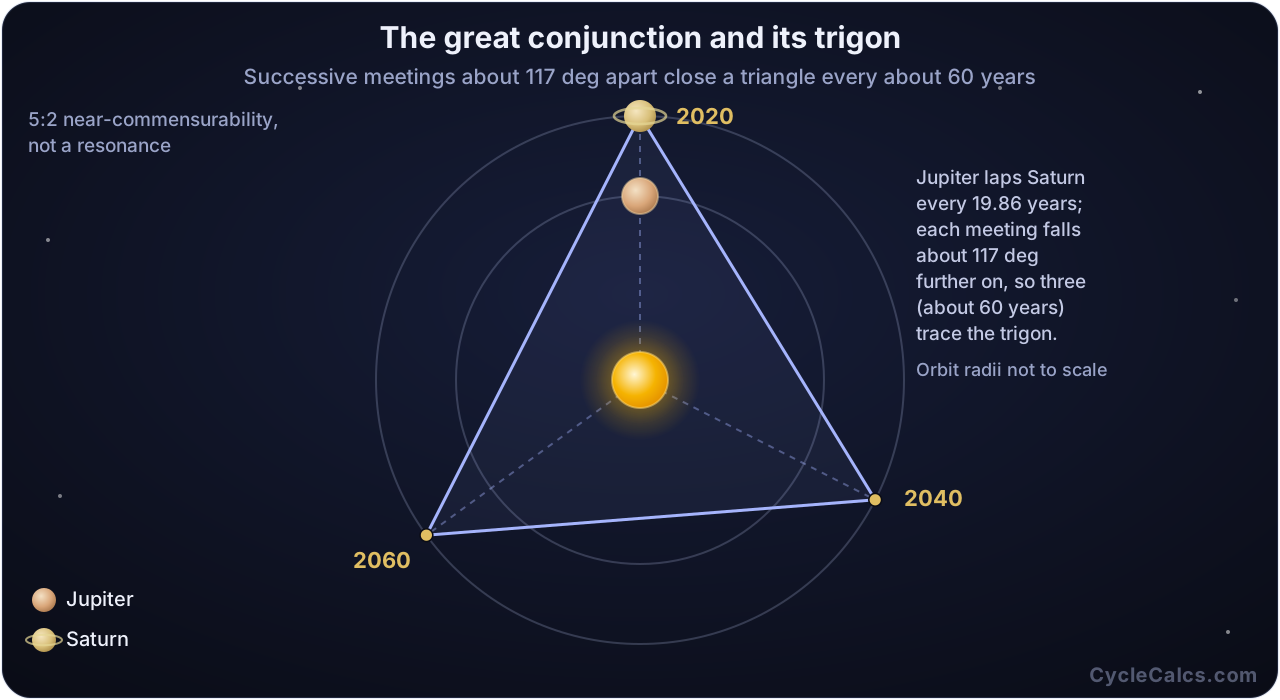
A great conjunction is the meeting of the two slowest naked-eye planets, Jupiter and Saturn, in the same line of sight. It recurs every 7,253.45 days, about 19.86 years, the time Jupiter needs to lap the slower Saturn once around the Sun. The last fell in December 2020, when the two planets closed to about a tenth of a degree; the next comes in 2040.
This page is about the period itself: the 19.86-year beat, why each meeting lands about 243 degrees further east along the ecliptic, and why three of them nearly close a triangle that turns only slowly. For the most recent and next meetings, with how close each pass is, see the Jupiter-Saturn conjunctions page; to place this cycle beside its siblings, see the cycles catalog.
How it works, in plain language: Synodic vs sidereal periods. This page carries the numbers.
On this page
The next Jupiter-Saturn great conjunction is October 31, 2040, in Virgo. They last met in December 2020; great conjunctions recur every 7,253.45 days (19.86 years).
Each meeting lands about 243 degrees further east, 117 short of a full lap, so every third one falls near the first; the triangle of meeting points turns a third of a circle in about 880 years against the stars, about 800 in tropical longitude.
Where we are in the great conjunction right nowcomputed live
The next great conjunction of Jupiter and Saturn falls on October 31, 2040. With JavaScript on, this panel shows how far Jupiter has gained on Saturn since 2020 and counts down to the next meeting.
Computed live in your browser from the open-source Astronomy Engine. See every cycle together on the cosmic clock.
The great conjunction at a glance
| Period | 7,253.45 days (19.86 years) |
|---|---|
| Bodies | Jupiter and Saturn |
| What it is | the synodic period: Jupiter laps the slower Saturn |
| Orbital relationship | 5:2 near-commensurability (not a resonance) |
| Shift each cycle | about 243 degrees east along the ecliptic, 117 short of a full lap |
| Trigon | the triangle of meetings turns about 30 degrees every two centuries in tropical longitude (about 27 against the stars) |
| Trigon turn of 120 degrees | about 880 years against the stars; about 800 in tropical longitude |
| Last conjunction | December 2020 |
| Next conjunction | 2040 |
Sources: U.S. Naval Observatory, Astronomical Applications.
The great conjunction in every unit
Broken into other units and into other cycles, the 7,253.45-day beat reads like this.
| In days | 7,253.45 days |
|---|---|
| In years | 19.859 tropical years (about 19 years 314 days) |
| In hours | about 174,083 hours |
| Jupiter orbits | 1.674 (7,253.45 d / 4,332.6 d) |
| Saturn orbits | 0.674 (7,253.45 d / 10,759.22 d) |
| 5:2 near-commensurability | 5 Jupiter orbits (59.31 yr) about 2 Saturn orbits (58.91 yr) |
| Shift per conjunction | about 243 degrees east, 117 short of a lap; three steps land about 8 degrees past two full laps, against the stars |
| Trigon turn | about 880 years against the stars, about 800 in tropical longitude, for the triangle to turn 120 degrees |
Jupiter's period is 11.862 years and Saturn's is 29.457 years (USNO; Meeus, Astronomical Algorithms). The orbit counts are means. Because both orbits are elliptical and each date is seen from a moving Earth, the real gap between meetings from 1700 to 2200 ranges from about 18.8 to 20.6 years, counting a triple conjunction (three passes within a year) as one meeting.
What the great conjunction is and how it arises
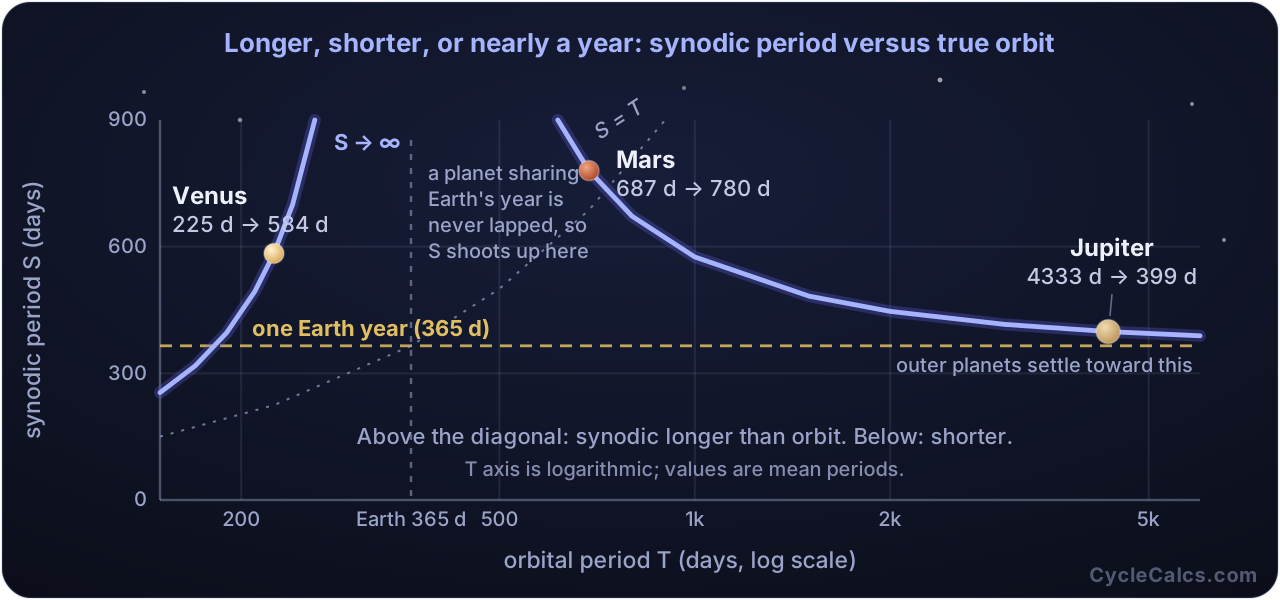
Jupiter orbits the Sun once every 11.862 years and Saturn once every 29.457 years. Because Jupiter is faster, it steadily gains on Saturn, and every so often it draws level, catching Saturn on the same side of the Sun so the two appear close together in our sky. The interval between one catch-up and the next is the synodic period, and for these two planets it works out to 19.86 years.
The meetings do not happen at the same place along the ecliptic. Between one conjunction and the next, Saturn has crept about 243 degrees along its orbit, so the new meeting falls about 243 degrees further east, 117 short of a full lap. Three conjunctions, spread over about 60 years, therefore trace a large triangle across the sky, nearly but not quite closing on themselves. The triangle drifts east a little each time, on average about 8 degrees per three meetings against the stars, a pattern older astronomers called a trigon.
That slow drift turns the triangle. It takes about 880 years measured against the stars, or about 800 in tropical longitude (counted from the moving March equinox), for the triangle to turn a third of a circle, so that the meetings fall back in the same three regions; a single meeting point needs about three times as long to go all the way around the ecliptic. Underlying all of it is a near-commensurability: five Jupiter orbits take almost exactly as long as two Saturn orbits, a 5:2 ratio that is close to whole numbers but is not locked by gravity into a true resonance.
The math
The synodic period follows from the two orbital periods. The rate at which Jupiter gains a full lap on Saturn is the difference of their orbital rates: 1/T = 1/11.862 - 1/29.457 per year. That is 0.084303 minus 0.033948, or 0.050355 laps per year, so T = 19.86 years, which is 7,253.45 days.
The 243-degree step comes from where Saturn sits when the next meeting arrives. In one synodic period Saturn travels 19.86/29.457 of its orbit, about 0.674 of a turn, or roughly 243 degrees eastward. Measured the short way, that puts each conjunction about 117 degrees west of the one before. Three of them add up to about 352 degrees, about eight degrees short of a full circle against the stars (about nine in tropical longitude, which adds precession), which is why the triangle of meeting points slowly rotates rather than standing still.
Those are mean figures. Both orbits are ellipses and each date is seen from a moving Earth, so between 1700 and 2200 the gap between meetings ranges from about 18.8 to 20.6 years, counting a triple conjunction (three passes within a year) as one meeting. To see the most recent and next meetings and how close the planets come each time, open the Jupiter-Saturn conjunctions page.
The next great conjunctions
| Date | Constellation | Ecliptic longitude (of date) |
|---|---|---|
| Oct 31, 2040 | Virgo | 197.9° |
| Apr 7, 2060 | Taurus | 60.7° |
| Mar 15, 2080 | Capricornus | 311.8° |
| Sep 18, 2100 | Virgo | 205.5° |
How the great conjunction relates to other cycles
The great conjunction belongs to a small family of cycles that draw slowly turning figures around the ecliptic. The Venus pentagram is its close cousin: where Jupiter and Saturn sketch a rotating triangle, Venus and Earth sketch a five-pointed star, and both arise from ratios of orbital periods that fall near, but not exactly on, whole numbers. Both are near-commensurabilities, not resonances.
The longitudes in the table are counted from the moving March equinox, the frame of the tropical year; the sidereal year is the matching star-fixed clock, and the gap between the two frames is why the triangle turns in about 800 years in one and about 880 in the other. And the reason Jupiter and Saturn move so slowly in the first place is the subject of Kepler's three laws: the farther a planet orbits, the longer it takes, which is what makes their meetings so rare.
Frequently asked questions
How often do Jupiter and Saturn meet in a great conjunction?
On average every 7,253.45 days, about 19.86 years. That is the synodic period of the two planets, the time it takes faster Jupiter to gain a full lap on slower Saturn and draw level with it again. Because both orbits are elliptical and each date is seen from a moving Earth, the real interval from 1700 to 2200 ranges from about 18.8 to 20.6 years, counting a triple conjunction (three passes within a year) as one meeting. The mean is 19.86 years.
When was the last great conjunction, and when is the next?
The last great conjunction was in December 2020, when Jupiter and Saturn passed about a tenth of a degree apart, close enough to look almost like a single star. The next comes in 2040, one synodic period of about 19.86 years later. For the most recent and next meetings, see the Jupiter-Saturn conjunctions page.
Why do great conjunctions form a triangle in the sky?
Each conjunction falls about 243 degrees east of the one before, 117 short of a full lap, because that is where Saturn has moved to by the time Jupiter catches it again. Three meetings, spread over about 60 years, therefore land near the three corners of a triangle. The triangle drifts east a little each cycle, about 30 degrees every two centuries in tropical longitude (about 27 against the stars).
Is the Jupiter-Saturn 5:2 relationship a resonance?
No. Five Jupiter orbits take almost the same time as two Saturn orbits, a 5:2 ratio, but the match is only approximate and the planets are not held in step by their mutual gravity. That makes it a near-commensurability rather than a true orbital resonance. Real resonances, like Neptune and Pluto's 3:2, are actively maintained and keep the bodies from colliding.
How long until great conjunctions return to the same part of the sky?
About 880 years measured against the stars, or about 800 in the tropical longitude counted from the moving March equinox. Each meeting lands about 243 degrees east of the last, so three of them come about 8 degrees past two full laps against the stars (about 9 in tropical longitude, which adds precession), and the triangle of meeting points slowly turns. Once it has turned a third of a circle, the meetings fall back in the same three regions they started from.
When is the next great conjunction?
The next great conjunction of Jupiter and Saturn is October 31, 2040. They meet every 19.86 years; the previous one was in December 2020 and the one after next is around 2060.
Keep exploring
- Jupiter-Saturn conjunctions: the most recent and next meetings
- All cycles by length: see it beside its siblings
- The Venus pentagram: another figure drawn around the ecliptic
- The sidereal year: the star-fixed clock, against which the trigon turns in about 880 years
- Kepler's three laws: why the outer planets move so slowly