Precession of the Equinoxes
Earth spins like a top, and like a top it slowly wobbles. Its axis traces a full circle against the stars once every 25,920 years, a span known as the Great Year. Scrub the millennia and watch the north pole drift from star to star (left) as the axis sweeps out its cone (right).
On this page
How long is the Great Year? About 25,920 years, the time Earth's axis takes to trace one full circle against the stars (the precession of the equinoxes). The pole drifts about one degree every 72 years, so 72 × 360 = 25,920. The pole star is Polaris now and will be Vega in roughly 11,700 years.
Precession of the equinoxes: the key facts
The precession of the equinoxes is the slow wobble of Earth's spin axis, which traces a full circle against the stars over one Great Year. As the axis turns, the North Star changes and the spring equinox drifts steadily backward through the zodiac.
| Length of the cycle (the Great Year) | About 25,920 years (the traditional round figure; the precise modern measured value is about 25,772 years) |
|---|---|
| Rate of drift | About 1 degree every 72 years |
| One zodiac age | About 2,160 years (30 degrees of drift) |
| North Star now | Polaris (less than 1 degree from the pole) |
| Previous North Star | Thuban, around 3000 BCE |
| Next bright North Star | Vega, around 13,700 CE |
| Also known as | the Great Year, the Platonic Year |
The wobble of a spinning world
A fast-spinning top does not simply stand upright. Its axis leans over and swings slowly around in a wide circle, a motion called precession. Earth does exactly the same thing, only far more slowly.
The reason is that Earth is not a perfect sphere: it bulges a little at the equator, and the gravity of the Sun and the Moon pulls on that bulge, trying to tug the tilted axis upright. Because Earth is spinning, the axis does not topple. Instead it sweeps around in a great cone, just as a leaning top's axis circles rather than falling over.
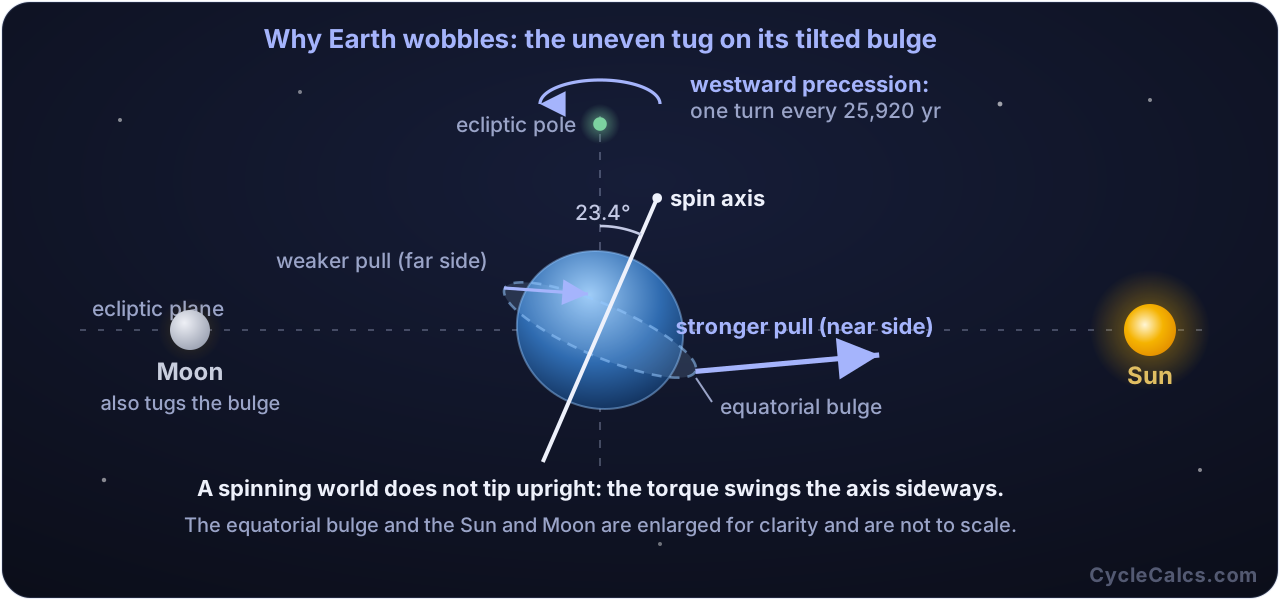
One full sweep takes about 25,920 years and carries the axis around a circle 23.4° in radius, centered on the pole of the ecliptic (the point in the sky directly above Earth's orbit). This grand, slow circling is the precession of the equinoxes, also known as the Great Year or Platonic Year.
A changing North Star
Because the celestial pole slowly moves, no single star stays the North Star forever. Thuban, in the constellation Draco, marked the pole around 3000 BCE, when the Egyptian pyramids were being built. Polaris happens to sit nearest the pole in our own era, less than a degree away, which is why it guides us north so reliably today.
In roughly 11,700 years the brilliant summer star Vega will be the closest bright pole star, though even then it will stand about 5° from the exact pole, a looser marker than Polaris is now. Several fainter stars take their own brief turns in between, and after a full Great Year the pole circles back to Polaris again. The left-hand view traces that entire 25,920-year journey among the stars.
The drifting equinox and the ages
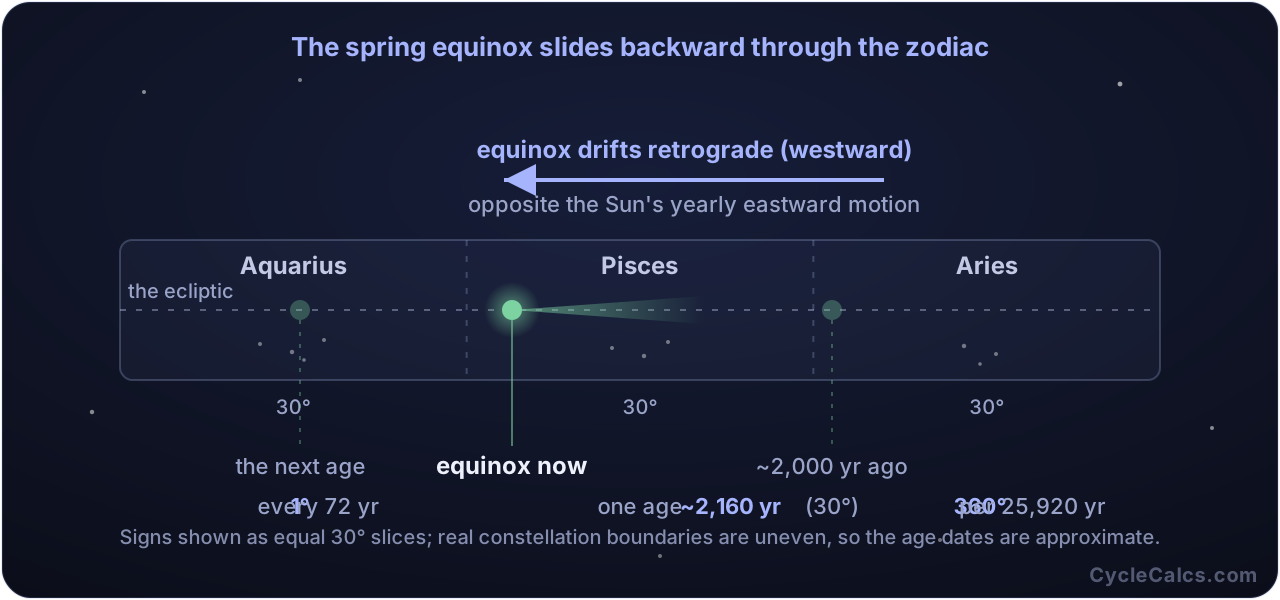
The same wobble slowly drags the equinox point, the spot where the Sun crosses the equator each spring, backward through the constellations of the zodiac, at a rate of about one degree every 72 years. A full zodiac sign, roughly 30° wide, therefore takes about 2,160 years to cross, the span people call an astrological "age."
This backward drift is why the spring equinox, which lay in Aries two thousand years ago, now sits in Pisces and is edging toward Aquarius. (The constellation boundaries are not sharp, so the dates of the ages are only ever approximate.)
You will find the Great Year and the other long Earth cycles on the cycles by length page. And it is this very same 23.4° tilt that, taken one year at a time, gives us the seasons.
Earth’s axis also nods: nutation
Precession is the big, smooth wobble. Riding on top of it is a much smaller and faster nodding of the axis, called nutation (from the Latin nutare, “to nod”). Its main beat has a period of just 18.6 years and an amplitude of only about 9.2 arcseconds, roughly one 390th of a degree.
That is far too small to notice with the unaided eye, yet well within reach of careful instruments. Slide through one cycle below: the pole bobs gently along its precession path (left) and traces a tiny ellipse (right).
Why the axis nods, and why it follows the lunar-node cycle
The Moon’s orbit is tilted about 5.1° to the ecliptic, and its line of nodes swings all the way around once every 18.6 years. As that tilted orbit slowly turns, the Moon’s gravitational tug on Earth’s equatorial bulge strengthens and weakens on the same 18.6-year beat, so the axis nods in step with it.
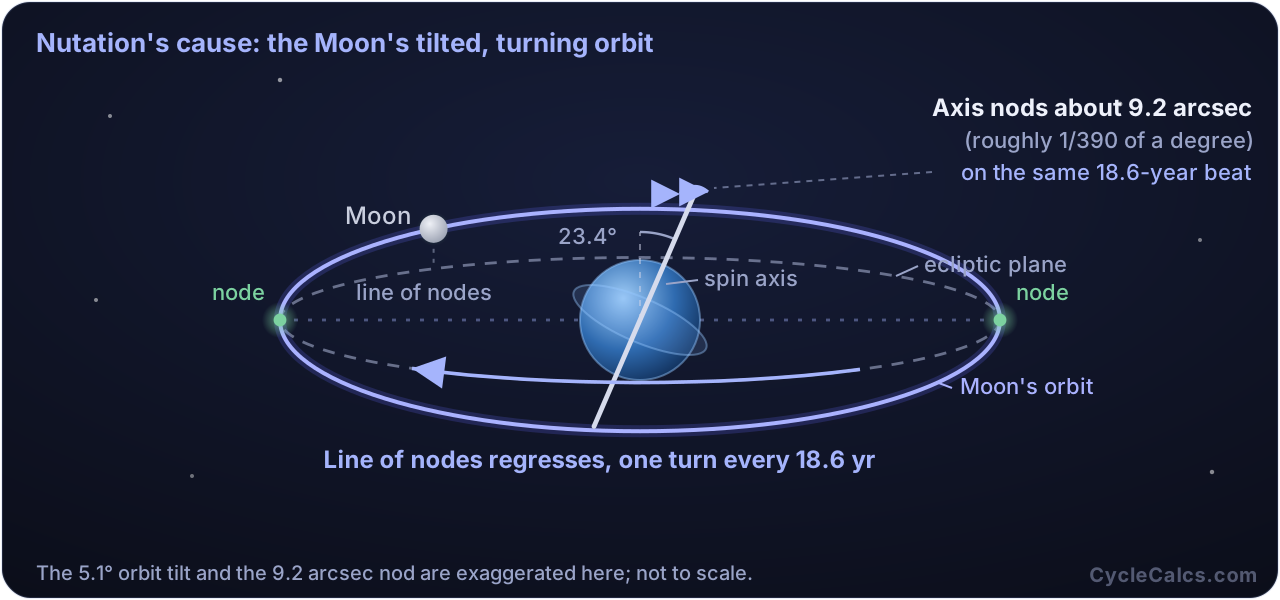
In other words, nutation and the regression of the lunar nodes are the very same cycle: the slow turning of the Moon’s orbital plane is the cause, and the axis’s nod is the effect.
The Sun and the planets add their own smaller contributions, but this 18.6-year lunar nod is by far the largest. The English astronomer James Bradley announced the discovery of nutation in 1748, after more than twenty years of meticulous measurements of the stars.
Frequently asked questions
What is the precession of the equinoxes?
Earth's spin axis slowly wobbles like a spinning top, tracing a full cone against the stars once about every 25,920 years. As it turns, the point where the Sun crosses the equator in spring drifts steadily backward through the zodiac.
Has the North Star always been Polaris?
No. Because of precession the celestial pole moves among the stars. Thuban was the pole star around 3000 BCE, Polaris is closest now, and Vega will take a turn around 13,700 CE.
How long is the precession cycle?
One full circuit takes about 25,920 years, often called the Great Year. That works out to the equinox shifting about one degree every 72 years, or one zodiac age of roughly 2,160 years.
What is the difference between 25,920 and 25,772 years?
Both describe the same Great Year, one full cycle of precession. 25,920 is the traditional round figure, a neat 72 years for each degree of drift, long used for the Great Year and the zodiac ages. The precise value measured by modern astronomy is about 25,772 years, because the rate of precession changes very slightly over time. CycleCalcs uses the round 25,920-year Great Year for its cycle work and notes the 25,772-year modern figure for accuracy.
What is the Platonic Year?
The Platonic Year, also called the Great Year, is another name for one complete cycle of the precession of the equinoxes, about 25,920 years. The term goes back to ancient Greek philosophy and the idea of a grand cycle after which the heavens return to nearly the same arrangement.
What astrological age are we in now?
The spring equinox currently lies in the constellation Pisces and is slowly drifting toward Aquarius, so we are near the end of the Age of Pisces and on the threshold of the Age of Aquarius. Because the constellation boundaries are not sharp, there is no exact date for the change, and estimates for the start of the Age of Aquarius range over several centuries.
Which star will be the next North Star?
After Polaris, the bright star Vega will be the closest naked-eye star to the celestial pole, around the year 13,700 CE, though it will stand about 5 degrees from the exact pole rather than hugging it the way Polaris does now. Thuban in Draco was the pole star around 3000 BCE, and after a full Great Year the pole circles back to Polaris.
Sources & further reading
- NASA Goddard, Precession: how Earth's equatorial bulge and the pull of the Sun and Moon swing the axis over roughly 26,000 years.
- NASA Earth Observatory, Earth's Orbital Precession: how the changing axis direction shifts the timing of the seasons.
- US Naval Observatory, Astronomical Almanac glossary: the formal definition of precession of the equator and the equinox.
- University of Rochester, Precession of the Earth's Rotation Axis: a university astronomy note on the changing pole star and the drifting equinox.
- Jean Meeus, Astronomical Algorithms (Willmann-Bell): the standard reference for computing precession and equinox positions.
See how these figures are computed on the methodology and sources page.
Keep exploring
Sun's Declination & Seasons
The axial tilt that precession turns is the same tilt that makes the seasons.
InteractiveThe Lunar Nodes
Another slow turning of an orbit: the Moon's nodes, every 18.6 years.
InteractiveApsidal Precession
Orbits rotate too: the Moon's perigee and the planets' perihelia creep forward.
SkyThe 88 Constellations
The patterns precession slowly carries around the sky, with a star chart for each one.
ReferenceThe numbers and where we stand: axial precession
The Great Year in numbers: roughly 25,920 years per wobble, where the equinox points now, and the pole stars ahead.