On this page
626 stars have official names. Every other star goes by catalog designations. The International Astronomical Union's Working Group on Star Names has standardized proper names since 2016, drawing on star lore from dozens of cultures, and the list is still growing.
- Brightest named star: Sirius, magnitude -1.46
- Largest tradition: Arabic, 222 names
- Naked-eye: 471 of the 626 shine at magnitude 6.5 or brighter
- Newest: 20 names adopted August 2026
- Who names stars: only the IAU; sold "star names" have no standing
The named-star sky map
Pick a star on the map, or a row in the table below, and its name, meaning and origin appear here.
The complete table of officially named stars
Every proper name the IAU has adopted, in one sortable table: the name, the star's designation, its constellation (linked to the constellation's own guide), its brightness, and the official summaries of the names' meanings and origins, where the Working Group has published them. Click a column heading to sort, filter with the chips, and click any row to fly the map to that star. The source is the IAU Working Group on Star Names' live catalog (IAU data, CC BY 4.0); meanings are the Working Group's own etymological summaries, lightly typeset.
Origin groups follow the language recorded for each name in the IAU catalog, so a NameExoWorlds name proposed in Spanish files under European languages; the table's Origin column keeps the catalog's own wording throughout.
| Name | Designation | Constellation | Mag. | Origin | Meaning | Adopted |
|---|---|---|---|---|---|---|
| Absolutno | XO-5 | Lynx | 11.95 | fictional | Absolutno is a fictional miraculous substance in the sci-fi novel Továrna na absolutno (The Factory for the Absolute) by influential Czech writer Karel Čapek. | 2019 |
| Acamar | θ1 Eri | Eridanus | 3.18 | Arabic | From its name for the Arabic Almagest period akhir al-nahr, "the River's End". Applied in medieval times, and reapplied in recent times | 2016 |
| Achernar | α Eri | Eridanus | 0.46 | Arabic | Arabic name آخر النهر (āḫiru ʾn-nahr) meaning, the End of the River; originally used for θ Eri that was considered the end of the river in the ancient star catalog (Almagest).The name was transferred to α Eri in the Early Modern Era when the constellation was extended south to this new terminus. | 2016 |
| Achird | η Cas | Cassiopeia | 3.44 | Contemporary | The proper name Achird was apparently first applied to Eta Cassiopeiae in the Skalnate Pleso Atlas of the Heavens published in Slovacia in 1950, but is not known prior to that. | 2017 |
| Acrab | β1 Sco | Scorpius | 2.50 | Arabic | Arabic name al-'Aqrab for the constellation Scorpius ("the scorpion") (e.g. Al Sufi). Application of the transliteration "Acrab" specifically to the pair Beta1 and Beta2 Sco was made by Piazzi (1814) in the Palermo Catalog, and its use spread through the 19th century. | 2016 |
| Acrux | α Cru | Crux | 0.76 | Contemporary | A modern creation (1938) that is derived from Bayer's nomenclature by combining the "A" from the "alpha" in α Crucis and the Latin constellation name in the nominative case. | 2016 |
| Acubens | α Cnc | Cancer | 4.25 | Arabic | Applied with various spellings since medieval times, from the Arabic word al-zubana, "the claw", used in Ptolemy's Tetrabiblos in describing the stars α and ι Cnc. Otherwise, the same Arabic word was used for the "claws" of Scorpius. | 2016 |
| Adhafera | ζ Leo | Leo | 3.41 | Arabic | From the name for the Arabic Almagest period al-dafira, "the Lock of Hair," for the Coma Berenices cluster. Wrongly applied to zeta Leonis in recent times. Yet, misapplications of terms for the "hairy" cluster that is called "Coma" to the mane of the lion can be traced back to (at least) the 17th century. | 2016 |
| Adhara | ε CMa | Canis Major | 1.50 | Arabic | Applied in recent times from the Arabic asterism name al-'adhara, "the Virgins", for ε, δ, η and ο2 CMa. The significance of the name is unknown. | 2016 |
| Adhil | ξ And | Andromeda | 4.87 | Arabic | From the Arabic word al-dhail, "the hem of a robe or dress", used in the Arabic Almagest in describing 49 And and χ And, and transliterated in the Medieval Latin Almagest as adhil. This word was wrongly applied as a star name to ξ And in recent times. | 2016 |
| Aerostaticus | ε Mic | Microscopium | 4.71 | Latin | Globus Aerostaticus is one of the obsolete constellations, introduced in early modern time to celebrate new technologies. | 2026 |
| Ain | ε Tau | Taurus | 3.53 | Arabic | From an abbreviation of the name for the Arabic Almagest period ain al-thaur "the Bull's Eye," for a Tau. Applied to ε Tau in recent times (Ptolemy had α Tau the southern eye, and ε Tau on the northern eye). | 2015 |
| Ainalrami | ν1 Sgr | Sagittarius | 4.84 | Arabic | Arabic عين الرامي ʽain al-rāmī (simplified Ainalrami) means The Eye of the Archer. It originates from Arabic Almagest translations. | 2017 |
| Aiolos | HD 95086 | Carina | 7.36 | Greek | Aiolos (Αίολος) was the Greek mythological keeper of the winds. In Homer's Odyssey, Aiolos used an oxhide flask to capture all winds except for the western one, Zephyr. Zephyr then helped the sailboat of Ulysses navigate the seas towards home (Ithaca). | 2023 |
| Aladfar | η Lyr | Lyra | 4.40 | Arabic | Aladfar derives from the Arabic الأظفر al-ʼuẓfur "the talons (of the swooping [eagle])" which designates and asterism consisting of µ and η Lyr. It was made popular by Allen. | 2017 |
| Alasia | HD 168746 | Serpens | 7.95 | NEWC | Alasia is the first historically recorded name of Cyprus, dating back to mid-fifteenth century BCE. | 2019 |
| Alaybasan | β Tri | Triangulum | 3.00 | Arabic | Al-Aybasān (الأيبسان), the Two Joints (of bones), is an Indigenous Arabian asterism. Name variants are Al-Anīsān (الأنيسان) and Al-Baysan. The later spelling variant al-Anīsān that originated from a mistake changed the meaning, as it translates The Two Friends. WGSN adopts a spelling variant without hyphen: "Alaybasan" is the name for β Tri | 2025 |
| Albaldah | π Sgr | Sagittarius | 2.88 | Arabic | The name of the 21st Arabic lunar station, البلدة, Al-Baldah (The empty area), designates a starless region between ζ Sgr and α Cap; the star π Sgr is at its northern edge and was wrongly attributed with this name by Allen (1899, 359). | 2017 |
| Albali | ε Aqr | Aquarius | 3.77 | Arabic | From the Arabic word bali(, "swallower", used in an Arabic discussion pertaining to the Arabic lunar mansion name sa(d bula( (given for ε, μ and ν Aqr; of unknown meaning). In recent times the Arabic article al- was added to bali( and the word was applied as a star name. | 2016 |
| Albireo | β Cyg | Cygnus | 3.08 | Arabic | The formation of this name begins with Ptolemy's name for the constellation Cygnus - ὄρνις, "the Bird". The Arabs transliterated this name as urnis. The Medieval Latin translator of the Arabic Almagest, in turn, did not recognize any Greek word behind urnis (or whatever Arabic corruption he may have read), so he merely transliterated it into a form which appeared int he manuscripts variously as eurisim, eirisun, eirism, etc. In a note appended to this Medieval Latin constellation name for Cygnus, one Latin commentator ventured to derive it from the name of an aromatic herb he knew: ireus. This erroneous commentary read, in brief part: "eirisim...ab ireo", or, "[the constellation name] eirisim...[coming] from [the word] ireus". Apparently in one manuscript of the Latin Almagest, the final word of this commentary, ab ireo, were written on the next line below the constellation title, where the descriptions of the stars begin. Since the first star entered in the Almagest under the constellation Cygnus is β Cyg, the words ab ireo seem to have been confused as a name for this star. "Arabicized" with the insertion of the letter "l", ab ireo, written as "Albireo", was applied as a star name to β Cyg by Early Modern times. | 2016 |
| Alchiba | α Crv | Corvus | 4.01 | Arabic | From the pre-Islamic Arabian asterism name al-khibāʾ, "the Tent," for β, γ, δ and ε Crv. Wrongly applied as a star name to α Crv in recent times. | 2016 |
| Alcor | 80 UMa | Ursa Major | 4.01 | Arabic | Ultimately from the pre-Islamic Arabian name al-jaun, for ε UMa, which was transliterated and eventually corrupted in Latin to "Alcor." The name was wrongly transferred to 80 UMa in Early Modern times. | 2016 |
| Alcyone | η Tau | Taurus | 2.87 | Greek | These names were individually applied in Early Modern times from a family of characters in Greek mythology: Atlas, Pleione and their seven daughters, the Pleiades. | 2016 |
| Aldebaran | α Tau | Taurus | 0.86 | Arabic | Applied in the early Islamic period from its pre-Islamic Arabian name al-dabaran, possibly meaning "the Follower," alternatively used as the lunar mansion name for all the Hyades (or again for α Tau alone). The name is thought to refer to this star's following the Pleiades across the sky, or to the Hyades (or α Tau) coming after the Pleiades as a lunar mansion. "Aldebaran" is one of the oldest Arabic star names applied in the West, from the end of the 10th century A.D. | 2016 |
| Alderamin | α Cep | Cepheus | 2.46 | Arabic | Applied to α Cep since medieval times. The erroneous derivation understood since Early Modern times was from al-dhira (al-)yamin, "the Right Forearm," an assumed Arabic descriptive term for α Cep. Firstly, in the Almagest, α Cep is described on the right "shoulder" (Arabic al-katif or al-mankib) of Cepheus, whereas no right "forearm" (al-dhira<) is described for the figure. Secondly, in Arabic, "right forearm" is spelled correctly as al-dhira al-yumna, which (in contrast to al-yamin) lacks assonance in the last syllable to Alderamin. Therefore, it is more likely that Alderamin is derived from the various medieval Christian abbreviations of muqaddam al-dhira<ain, "the Preceding One of the Two Cubits, or Forearms," which was a name for the Arabic Almagest period (based on pre-Islamic Arabian) for α Gem. This would have been wrongly transferred to α Cep in medieval times. | 2016 |
| Aldhanab | γ Gru | Grus | 3.01 | Arabic | Al Dhanab from Arabic ال ذنب (adh-dhanab), The Tail, became common since its mentioning in Allen (1899). There it is attributed to a Persian astronomer but the whole constellation Grus is a constellation invented in the Early Modern Era. | 2017 |
| Aldhibah | ζ Dra | Draco | 3.17 | Arabic | ζ and η Draconis together had been considered the asterism of الذئب, al-dhiʼb, Two Hyenas or Two Wolfs that are lurking for the Camel's Foal that is protected by its mother (other stars in Draco). | 2017 |
| Áldu | ϵ Per | Perseus | 2.89 | Sami | Áldu, the Reindeer Cow, in Sami language. The Sami constellation of the reindeer is usually called with the male term "Sarvvis", but mythology reports it keeping its antlers during winter, which only females do. | 2025 |
| Aldulfin | ε Del | Delphinus | 4.03 | Arabic | Arabic scholarship adopted the Greek loanword "dulfim" or "dulfin" (with article: ad-dulfin or simplified adulfin) for the marine mammal. The star ε Del at the dorsal fin of the Ptolemaic (smaller than ancient Greek) figure was called Al Dhanab al Dulfim (the Dolphin's Tail) and as there are many stars named with the Arabic root for "tail", WGSN adopted only the last part of the name. | 2017 |
| Alfarasalkamil | ο And | Andromeda | 3.62 | Arabic | Alfarasalkamil (الفرس الكامل) means "The Complete Horse", as opposed to the Greek constellation of a half horse that is now called Pegasus. The Arabian tradition may perhaps root in or connect to the Babylonian one. | 2025 |
| Alfirk | β Cep | Cepheus | 3.23 | Arabic | Applied in recent times from an abbreviation of the pre-Islamic Arabian names kaukaba al-firq (for α and β Cep ), and kawakib al-firq (for α, β , and η Cep). kaukaba and kawakib mean "two stars" and "stars" (more than two), respectively, but the original Arabic script for al-firq can be vocalized in various ways with various meanings. If the vocalization al-firq is accepted, it means "the Flock," and may refer to a flock of sheep here. | 2016 |
| Algedi | α2 Cap | Capricornus | 3.58 | Arabic | Reapplied in recent times (from its older medieval spelling), from the scientific Arabic constellation name al-jady, "the Kid," for Capricornus. | 2016 |
| Algenib | γ Peg | Pegasus | 2.84 | Arabic | From the name for the Arabic Almagest period al-janb, "the Side," for α Per. Wrongly transferred to γ Peg in Early Modern times. | 2016 |
| Algieba | γ1 Leo | Leo | 1.98 | Arabic | Applied in recent times from the pre-Islamic Arabian lunar mansion name al-jabha "the Forehead," for ζ, γ, η, and α Leo, associated with the pre-Islamic Arabian asterism al-asad. | 2016 |
| Algol | β Per | Perseus | 2.12 | Arabic | Applied in medieval times from an abbreviation of its name for the Arabic Almagest period ras al-ghul "the Demon's Head" (for Ptolemy's Gorgon-head). "Algol" is one of the oldest Arabic star names applied in the West, from the end of the 10th century A.D. | 2016 |
| Algorab | δ Crv | Corvus | 2.94 | Arabic | From an abbreviation of the name for the Arabic Almagest period janab al-ghurab, "the Raven's Wing," for γ Crv. Transferred to δ Crv in Early Modern times (both γ and δ were on the Raven's wings in the Almagest). | 2016 |
| Alhena | γ Gem | Gemini | 1.92 | Arabic | Applied in recent times from the pre-Islamic Arabian lunar mansion name al-bana, possibly meaning "the Mark on the Neck of a Camel," for γ and ξ Gem, or alternatively for γ, ξ, η, μ, and v Gem. | 2016 |
| Alioth | ε UMa | Ursa Major | 1.77 | Arabic | Ultimately from its pre-Islamic Arabian name al-jaun, "the Black Horse, or Bull," which became corrupted even in Arabic sources (where some of the corruptions carried other meanings). For example, in the Arabic manuscript of the Almagest that was translated into Latin in 1175 A.D., this name of ε UMa had apparently been miswritten as al-jauza or al-jauza (the latter being identical to the name for the Arabic Almagest period for Orion and Gemini). Whatever was read in this Arabic manuscript was transliterated into Latin as alioze. In subsequent Latin copies, this name was further corrupted to aliore, Alcor, Alioth, etc. Since late medieval times, "Alioth" became the preferred name for ε UMa. | 2016 |
| Aljanah | ε Cyg | Cygnus | 2.48 | Arabic | The star used to be commonly named Gienah (cf. Kunitzsch and Smart 2006, Allen 1899) which derives from Arabic al-Janāḥ, The Wing, based on Almagest translations. WGSN adopted the original Arabic word instead of the corrupted one. | 2016 |
| Alkaid | η UMa | Ursa Major | 1.86 | Arabic | Applied with various spellings since medieval times, from its pre-Islamic Arabian name al-qa'id, "the Leader" (probably as leader of the Daughters of the Bier). | 2016 |
| Alkalurops | μ Boo | Bootes | 4.31 | Latin | The formation of this name begins with one of the words used by Ptolemy to describe this star in the Almagest: κολλόροβον, "club", rarely used as "sphepherd's staff". This word was transliterated into Arabic as qulurubus, and hence into Latin as calurus. Then in Early Modern times, the derivation of calurus was mistakenly attributed to another Greek word: καλαῦροψ, "shepherd's staff". This erroneous word, in its turn, was transliterated into Latin, then Arabicized with the article al-, then its spelling corrupted, to become "Alkalurops", which was thereafter applied as a star name to μ Boo. | 2016 |
| Alkaphrah | κ UMa | Ursa Major | 3.55 | Arabic | corrupted spelling of Arabic القفزة al-qafzah "the leap" of the Indigenous Arabic group of gazelle asterisms preserved in Ibn Qutaybah. | 2017 |
| Alkarab | υ Peg | Pegasus | 4.40 | Arabic | traditional Arabic name Al Karab, The Bucket-rope, was an asterism consisting of τ and υ Peg | 2017 |
| Alkes | α Crt | Crater | 4.07 | Arabic | Applied with various spellings since medieval times, from the Arabic constellation name al-ka's, "the (Wine) Cup," for Crater. | 2016 |
| Almaaz | ε Aur | Auriga | 2.99 | Arabic | The Arabic term المعز (al-maʽaz) can refer to the plural "goats" but has also been interpreted as a He-Goat (contrasting Capella, the She-Goat). Allen (1899, 90) cites Hyde's 1665 translation of Ulugh Beg with this term for a group of stars (asterism or sub-constellation) in Auriga. | 2017 |
| Almach | γ And | Andromeda | 2.10 | Arabic | The formation of this name begins with the Arabic name for this star: ʿanaq al-ard, "the Caracal" (a black-eared feline predator found in the Middle East). The Arabs also gave the name in short form as al-ʿanaq, which became transliterated into Medieval Latin as alamac. Later, the derivatin of alamac was erroneously attributed to the assumed Arabic word al-maq (properly al-muq) for "the boot" or "buskin", rather than to al-ʿanaq. Subsequently the erroneous word, as "Almaak" and later "Almach" was applied as a star name to γ And, mostly in astronomical works in English. Other, non-English works use the spelling "Alamak" derived directly from the Medieval Latin transliteration. | 2016 |
| Almighzal | η Cyg | Cygnus | 3.88 | Arabic | Wool Spindle - central Saudi Arabia. The constellation is used in a contemporary oral tradition by the ordinary people. | 2026 |
| Alnair | α Gru | Grus | 1.71 | Arabic | Applied in recent times from an abbreviation of its late Arabic name al-nayyir min dhanab al-but, "the Bright One from the Fish's Tail" (where a l6th century Arabic astronomer had extended Ptolemy's Southern Fish [Piscis Austrinus] into what is today Grus). The form Al Na'ir was taken from a wrong transliteration (Al Na'ir) of the Arabic adjective al-nayyir, "the Bright One." | 2016 |
| Alnasl | γ2 Sgr | Sagittarius | 2.99 | Arabic | Applied in recent times from its late Arabic name al-nasl, "the Point," in turn an abbreviation of the Arabic Almagest's nasl al-sahm, "the Point of the Arrow." | 2016 |
| Alnilam | ε Ori | Orion | 1.69 | Arabic | Applied in recent times from the pre-Islamic Arabian asterism name al-nizam, "the String of Pearls," for δ, ε, and ζ Ori. | 2016 |
| Alnitak | ζ Ori | Orion | 1.77 | Arabic | Applied in recent times from an abbreviation of the pre-Islamic Arabian asterism name nitaq al-jauza, "the Belt (or Girdle) of al-jauza," for δ, ε, and ζ Ori. | 2016 |
| Alniyat | σ Sco | Scorpius | 2.89 | Arabic | Applied in recent times from the pre-Islamic Arabian name al-niyat, "the Arteries", for σ and τ Sco. α Sco, between the arteries, was the pre-Islamic Arabian qalb al'aqrab, "the Scorpion's Heart" (all were part of the pre-Islamic Arabian Scorpion). | 2017 |
| Alphard | α Hya | Hydra | 1.97 | Arabic | Applied in medieval times from its pre-Islamic Arabian name al-fard, "the Solitary One," descriptive of this star's standing out among the surrounding dim stars. (See the same word in the plural, with ζ CMa.) | 2016 |
| Alphecca | α CrB | Corona Borealis | 2.24 | Arabic | Applied in medieval times from the pre-Islamic Arabian asterism name al-fakka, for Corona Borealis. The Arabic name, from the root f-k-k, "to separate, break up, etc.," apparently refers to this asterism's shape: an incomplete circle. | 2016 |
| Alpheratz | α And | Andromeda | 2.06 | Arabic | The specific origin of this name is unclear. It may represent a transfer from β Peg, where alferaz and other variants were applied in medieval times as abbreviations for β Peg's Arabic name mankib al-faras, "the Horse's Shoulder". Or, it may be from an abbreviation of the name alpheraz id est equus, "alpheraz, that is, the Horse", which was applied directly to α And also in medieval times. In any case, Medieval Latin authors confused these two names, their spellings, and their identifications, and the modern application of "Alpheratz" to α And comes down to us from late medieval times. | 2016 |
| Alpherg | η Psc | Pisces | 3.62 | Arabic | Officially adopted; the WGSN has not published an etymology summary. | 2018 |
| Alqiladah | ο Sgr | Sagittarius | 3.77 | Arabic | al-Qilāda (القِلادَة), "the necklace", is an Indigenous Arabian six‑star asterism recorded by al‑Ṣūfī, Ibn Qutayba, and al‑Marzūqī. | 2026 |
| Alqubba | β CrA | Corona Australis | 4.09 | Arabic | al-Qubba (القُبَّة), "the dome or domed tent", is an Arab asterism that correspond to the stars of Corona Australis. | 2026 |
| Alrakis | μ Dra | Draco | 4.91 | Arabic | Applied in recent times from its pre-Islamic Arabian name al-raqis, "the Trotting Camel." | 2017 |
| Alrescha | α Psc | Pisces | 3.82 | Arabic | From the pre-Islamic Arabian lunar mansion name al-risha', "the Cord," for β And. Wrongly transferred to α Psc in recent times. According to a Arabic source, the pre-Islamic Arabian al-risha' included, in a larger sense, two curving lines of mostly dim stars in Andromeda and Pisces, meant to attach to the pre-Islamic Arabian al-dalw "the Well Bucket" (marked by today's Square of Pegasus). It is also possible that this "cord" was a remnant of the cord joining the two fish of the older Babylonian zodiac. Indeed, these stars of the cord were alternatively known by the pre-Islamic Arabians as al-hut, "the Fish" (a single fish), corresponding to what in other cultures was Pisces among the zodiacal signs (and according to this tradition, the Fish's brightest star, β And, was batn al-hut, "the Fish's Belly"). | 2016 |
| Alruba | HR 6618 | Draco | 5.76 | Arabic | Arabic الربع Al Rubaʽ translates "the foal" and specifically refers to a young camel born in the spring. The name was considered traditional by WGSN in 2018 as it is listed in Allen (1899). | 2018 |
| Alrumh | 34 Bootis | Bootes | 4.79 | Arabic | Al-Rumḥ (الرُّمْح), the Lance/ Spear, is an Arabic asterism from pre-Islamic times that covers the area between Epsilon, Upsilon, Eta and Sigma Bootis. The named star is close to the dominant Epsilon Bootis, which also forms part of the Chinese constellation of The Lance (Genghe). | 2026 |
| Alsafi | σ Dra | Draco | 4.68 | Arabic | Alsafi is corrupted from Athāfi, erroneously transcribed from the Arabic plural Athāfiyy, by which the nomads designated the tripods of their open-air kitchens; one of these being imagined in σ, τ and υ [Dra]. | 2017 |
| Alsamaka | β Lac | Lacerta | 4.44 | Arabic | Al-Samaka al-Ṣuġrā (Arabic: السمكة الصغرى, The Smaller Fish) is an Arabic asterism in Lacerta and Andromeda, attested since Ibn Qutayba. | 2026 |
| Alsciaukat | 31 Lyn | Lynx | 4.25 | Arabic | misspelled Arabic الشوكة aš-šawkat (al-shaukat), The Thorn. The name obviously has nothing to do with the figure of the lynx (or historically sometimes called "Tiger" or "Tigris") that was invented in Early Modern Times. | 2017 |
| Alsephina | δ Vel | Vela | 1.93 | Arabic | The term is Arabic for "The Ship". It originates from the translation of Greek knowledge to Arabic when Argo Navis (The Ship Argo) was translated to Arabic and, thus, originally referred to the whole constellation rather than any specific star. | 2017 |
| Alshain | β Aql | Aquila | 3.71 | Persian | Applied in recent times (with a misreading in the second word) from abbreviating the Persian asterism name shahin-i tarazu, "the Scale Beam," for α, β and γ Aql. The Persian name, in turn, was a medieval translation of these stars' pre-Islamic Arabian name al-mizan, "the Balance" (said to be a popular name for the pre-Islamic Arabians al-nasr al-ti'ir listed under α Aql). | 2016 |
| Alshat | ν Cap | Capricornus | 4.76 | Arabic | The Arabic term سعد الذابح, Saʿd al-Dhābiḥ, The Lucky Asterism of the Slaughterer (22 lunar station), consists of the 3 stars: α1, β and ν Cap. As α and β already have proper names, the corrupted form "shat" (for sad) was used to name ν Cap. | 2017 |
| Altair | α Aql | Aquila | 0.76 | Arabic | Applied with various spellings since medieval times, from an abbreviation of its Arabic name al-nars al-ta)ir, "the Flying Eagle (or Vulture)", alternatively used as an asterism name for α, β and γ Aql. The name has probable origins among the Babylonians and Sumerians, for whom α Aql was "the Eagle Star". | 2016 |
| Altais | δ Dra | Draco | 3.07 | Arabic | Applied in recent times from a misreading of the script for the Arabic constellation name al-tinnin, "the Serpent," as it appeared incorrectly in a late Arabic star catalog, as part of the name for δ Dra. (The incorrect word, al-tais, is a real word in Arabic meaning "the He-goat," however it was never used by the pre-Islamic Arabians in stellar nomenclature. Furthermore, in the same Arabic source, in the name of ε Dra [formed parallel to that of δ Dra], the word was correctly written al-tinnin.) | 2016 |
| Alterf | λ Leo | Leo | 4.31 | Arabic | Applied in recent times from the pre-Islamic Arabian lunar mansion name al-tarf, "the Glance," for κ Cnc and λ Leo, associated with the pre-Islamic Arabian asterism al-asad, as if being located on that lion's eyes. | 2017 |
| Aludra | η CMa | Canis Major | 2.45 | Arabic | Applied in recent times from the alternative Arabic asterism name al-(udhra, "the Virginity", and (udhrat aljauza), "the Virginity [?] of al-jauza)", for ε, δ, η and ο2 CMa. The name (udhrat al-jauza), by tying it with the nearly Arabic asterism al-jauza) (today's Orion), may have been an attempt to apply significance to the enigmatic and perhaps older name al-(udhra. | 2016 |
| Alula Australis | ξ UMa | Ursa Major | 3.79 | Arabic | Applied in recent times from their pre-Islamic Arabian name al-qafza al-ula, "the First Leap", and the Latin distinctions of "northern" and "southern," respectively. | 2016 |
| Alula Borealis | ν UMa | Ursa Major | 3.49 | Arabic | Applied in recent times from their pre-Islamic Arabian name al-qafza al-ula, "the First Leap", and the Latin distinctions of "northern" and "southern," respectively. | 2016 |
| Alwasl | HIP 91014 | Sagittarius | 5.28 | Arabic | al-Waṣl (الوَصْل), "the Joint or Connection" is an Arabic name for the sky region between al-Naʿām al-Wārid", the incoming ostriches and al-Naʿām alṢādir", the outgoing ostriches. | 2026 |
| Alya | θ1 Ser | Serpens | 4.57 | Arabic | From the Arabic word alya, naming the fatty tail of a breed of Eastern sheep. In Early Modern times this word was erroneously proposed as the origin of Alioth, a Medieval Latin name for ε UMa. The erroneous "Alya" was applied as a star name to θ Ser in recent times. | 2016 |
| Alzirr | ξ Gem | Gemini | 3.36 | Arabic | Arabic الزِرّ , al-zirr, "the button". Allen (1899) attributes the name to Al Birūnī and it certainly does not have Greek roots as it is located at the foot of the eastern Twin. | 2017 |
| Amadioha | HD 43197 | Canis Major | 8.98 | Igbo | Amadioha is the god of thunder in Igbo mythology. As well as representing justice, Amadioha is also a god of love, peace and unity. | 2019 |
| Amansinaya | WASP-34 | Crater | 10.30 | Filipino | Aman Sinaya is one of the two trinity deities of the Philippine's Tagalog mythology, and is the primordial deity of the ocean and protector of fisherman. | 2019 |
| Anadolu | WASP-52 | Pegasus | 11.95 | Turkish | Anadolu is the primary homeland of Turkey and refers to the motherland in Turkish culture. | 2019 |
| Añañuca | GJ 367 | Vela | 10.22 | Spanish | Añañuca (Phycella cyrtanthoides) is the name of a red wildflower that grows from the Coquimbo region to the Maule region, whose colour alludes to that of the star GJ 367. | 2023 |
| Ancha | θ Aqr | Aquarius | 4.16 | Latin | A Latin word meaning "hip", used in the Medieval Latin Almagest in describing σ and ι/38 Aqr in the right and left hips, respectively (following an error, for Ptolemy had these stars in "the buttocks"). The word was applied as a star name to θ Aqr (correctly in Ptolemy's "right socket of the hip") in recent times. | 2016 |
| Angetenar | τ2 Eri | Eridanus | 4.77 | Arabic | derived from the Arabic Al Ḥināyat an-Nahr, 'the Bend in the River', based on Arabic Almagest translations | 2017 |
| Aniara | HD 102956 | Ursa Major | 7.86 | fictional | Aniara is the name of a spaceship in the epic poem Aniara by Swedish author Harry Martinson. | 2019 |
| Ankaa | α Phe | Phoenix | 2.38 | Arabic | Applied in recent times from the modern Arabic constellation name al-'anqa' (a fabulous bird) for Phoenix. | 2016 |
| Anser | α Vul | Vulpecula | 4.45 | Latin | Johannes & Elisabetha Hevelius created "Vulpecula cum Ansere" (the Little Fox with the Goose) out of unformed stars in the space between Cygnus and Aquila. The constellation first appeared in Firmamentum Sobiescianum sive Uranographia (1687) and the accompanying introductory text, Prodromus astronomiae (1690). To emphasize that it was his own creation, Hevelius dedicated Figure L to the pair, shown as a detail in Fig. 3.1. In atlases published before Hevelius, its stars are shown simply marking the flow of the Milky Way through the area. Ian Ridpath (1989) noted that "Hevelius placed the fox near two other hunting animals, the eagle (the constellation Aquila) and the vulture (which was an alternative identification for Lyra). He explained that the fox was taking the goose to neighbouring Cerberus, another of his inventions."unnamed before. | 2017 |
| Antares | α Sco | Scorpius | 0.91 | Greek | From its ancient Greek name ἀντάρης, "like Ares", likening the red colour of this star to its planetary namesake (the Roman Mars), name occurs in the Almagest. Possibly the Greek name goes back to a Sumerian precursor AN.TA.GUB (as suggested by Horowitz). | 2016 |
| Antinous | θ Aql | Aquila | 3.22 | Greco-Roman | A "sub"-constellation (or asterism) Antinous was created by Ptolemy of Alexandria and published in the Almagest star catalogue 137 CE. It is placed in the constellation of Aquila, The Eagle. | 2024 |
| Apamvatsa | 74 Vir | Virgo | 4.69 | Sanskrit | Apāṃvatsa (अपऻऺवत्स), "calf of the waters" (or: "the smaller one"), is an Indian star name attested throughout the last millennium. The only indication of the position is Apamvatsa is 5° to the north of Citrā (चित्रा) (Spica) in Virgo, attested in several historical documents. | 2025 |
| Apdu | γ Tri | Triangulum | 4.00 | Egyptian | Apd(w), ȝpd, The Bird, is an ancient Egyptian constellation from the second millennium BCE; the language is moribunt. There are at least 21 spelling variants throughout the millennia in hierglyphs, and it is probably not any specific bird; might be a goose or falcon or something else. Four star names within the constellation are attested in Ramesside Star Clocks and identified with the area between α, β Per and all of Triangulum. WGSN adopts the name of the constellation for any unspecific spot within its area to preserve an old Egyptian cultural name. | 2025 |
| Arcalís | HD 131496 | Bootes | 7.80 | Catalan | Arcalis is a famous peak in the north of Andorra, where the Sun passes through a hole in the mountain twice a year at fixed dates. It was used as a primitive solar calendar and reference point for shepherds and early inhabitants of Andorra. | 2019 |
| Arcturus | α Boo | Bootes | -0.05 | Greek | From its ancient Greek name Ἀρκτοῦρος, "the Guard, or Guardian". Reapplied in Early Modern times. As the Greek word Άρκτος, "bear," also came to mean "north," the meaning can ambiguously be "Guardian of the North" and "Guardian of the Bear", referring to the nearby constellation Ursa Major. | 2016 |
| Arin-majlep | ε Aql | Aquila | 4.02 | Marshallese | Arin-majlep, the "replica of the Big Eye", with the Big Eye referring to Altair, is the name of a small asterism of three stars in a row: ε, ζ, and ω Aql. WGSN named ε Aql after it. | 2026 |
| Arkab Posterior | β2 Sgr | Sagittarius | 4.27 | Arabic | Applied in recent times from an abbreviation of its name for the Arabic Almagest period 'urqub al-rami, "the Archer's Achilles Tendon." | 2016 |
| Arkab Prior | β1 Sgr | Sagittarius | 4.01 | Arabic | Applied in recent times from an abbreviation of its name for the Arabic Almagest period 'urqub al-rami, "the Archer's Achilles Tendon." | 2016 |
| Arneb | α Lep | Lepus | 2.57 | Arabic | Applied in recent times from the Arabic constellation name al-arnab "the Hare", for Lepus. | 2016 |
| Ascella | ζ Sgr | Sagittarius | 2.59 | Latin | ascella ("armpit"). Although it appeared in the 1515 Almagest, the name does not appear to have come into common usage until the 20th century after appearing as Ascella in Richard Hinckley Allen's "Star Names Their Lore and Meaning" (1899). | 2016 |
| Asellus Australis | δ Cnc | Cancer | 3.94 | Latin | From their joint Roman name the Aselli (and also Asini), "the Asses" of "Donkeys", being a translation of these stars' Greek name. Reapplied in Early Modern times, along with the Latin distinctions of "northern" and "southern". | 2016 |
| Asellus Borealis | γ Cnc | Cancer | 4.65 | Latin | From their joint Roman name the Aselli (and also Asini), "the Asses" of "Donkeys", being a translation of these stars' Greek name. Reapplied in Early Modern times, along with the Latin distinctions of "northern" and "southern". | 2016 |
| Ashlesha | ε Hya | Hydra | 3.38 | Sanskrit | Āśleṣā (आश्लेषा) is the Sanskrit name for an asterism in Hydra. It is considered one of the traditional Nakṣatras (lunar stations). | 2018 |
| Aspidiske | ι Car | Carina | 2.26 | Greek | Applied in recent times from the Greek word ἀσπιδίσκη, "little shield", used by Ptolemy in the Almagest in describing several stars in his constellation Argo, that were fixed to the ship for protection and decoration. Ptolemy's shields were in today's Puppis and Vela, but their identification was confused when Argo was divided into the modern Carina, Puppis, and Vela. | 2016 |
| Asterope | 21 Tau | Taurus | 5.76 | Greek | These names were individually applied in Early Modern times from a family of characters in Greek mythology: Atlas, Pleione and their seven daughters, the Pleiades. | 2016 |
| Asuusiha | τ Her | Hercules | 3.87 | Manchu | Asu Usiha (Manchu: ᠠᠰᡠ ᡠᠰᡳᡥᠠ, Net Stars), a Manchu shamanic constellation. It represents a hunting net to capture sables. | 2026 |
| Atakoraka | WASP-64 | Canis Major | 12.53 | Ewe | Atakoraka means the chain of the Atacora: the largest mountain range in Togo. | 2019 |
| Athebyne | η Dra | Draco | 2.74 | Arabic | The transliteration Athebyne is one of several renderings of the Arabic asterism name الذئبين al-dhiʼbayn, "the (two) wolves" (ζ and η Draconis) aiming at the Camel's Foal (group of northern asterisms). | 2017 |
| Atik | ο Per | Perseus | 3.91 | Arabic | Applied in recent times (also to ζ Per), from an abbreviation of the pre-Islamic Arabian name 'atiq al-thurayya, "the Collarbone of the Pleiades," for ο and ζ Per, after their location in the pre-Islamic Arabian asterism here | 2016 |
| Atlas | 27 Tau | Taurus | 3.63 | Greek | These names were individually applied in Early Modern times from a family of characters in Greek mythology: Atlas, Pleione and their seven daughters, the Pleiades. | 2016 |
| Atria | α TrA | Triangulum Australe | 1.88 | Latin | Contraction of Bayer designation A(lpha) Tri(anguli) A(ustralis). The name is listed as "Alpha Tri. Aust." in 1951 American Nautical Almanac, but listed as "Atria" in 1952 version and subsequent versions. | 2016 |
| Aurwandilsta | ι CrB | Corona Borealis | 4.97 | Norse | Aurvandils tá, Aurvandill's Toe, is a Norse constellation from Iceland, documented in Snorri's Edda from the 13th century CE. | 2026 |
| Avior | ε Car | Carina | 1.86 | English | Invented for The Air Almanac of the HM Nautical Almanac Office | 2016 |
| Axólotl | HD 224693 | Cetus | 8.23 | Nahuatl | Axólotl means water animal in the native Nahuatl language, which is a unique and culturally significant endemic amphibious species from the basin of Mexico. | 2019 |
| Ayeyarwady | HD 18742 | Eridanus | 7.81 | Burmese | Ayeyarwady is the largest and most important river in Myanmar. | 2019 |
| Azelfafage | π1 Cyg | Cygnus | 4.66 | Arabic | From the Arabic constellation name al-sulahfat, "the Tortoise," for Lyra ( corresponding to the Greek image of a tortoise shell for the Lyre's soundboard). Transliterated as Azelfage, a Medieval Latin translator erroneously attributed this constellation name to Cygnus. Then in Early Modern times, the corruption "Azelfafage" was applied as a star name to π1 Cyg. | 2016 |
| Azha | η Eri | Eridanus | 3.87 | Arabic | Applied in recent times from an abbreviation of the pre-Islamic Arabian asterism name udhi al-na'am, "the Ostrich's Nest," for ζ, ρ2,3, η and τ1 Eri, and ε and π Cet. | 2016 |
| Azmidi | ξ Pup | Puppis | 3.30 | Greek | The name is an abbreviated misspelling of a Greek term. In the Almagest, the third star in Argo is called "The northernmost of the 2 stars close together over the little shield in the poop." The 'little shield' in Greek is ἀσπιδίσκῃ (Aspidiske), sometimes misspelled Azmidi(ske), and the asterism may or may not consist of stars, while the Almagest lists ξ and ο Pup "above" it. According to Allen (1899) The Century Atlas (1897) by Benjamin E. Smith registers ι Arg (now Car) with the name "Aspidiske". | 2018 |
| Bade | μ Lep | Lepus | 3.29 | Balinese | Bade, the Funeral Tower, is an Oceanic constellation name from Bali (Indonesia). | 2026 |
| Baekdu | 8 UMi | Ursa Minor | 6.83 | Korean | Baekdu is the highest mountain on the Korean peninsula, situated in North Korea, and symbolises the national spirit of Korea. | 2019 |
| Bagu | δ Aur | Auriga | 3.72 | Chinese | Bā Gǔ (Eight Kinds of Crops, 八穀) is a Chinese constellation consisting of eight stars located within the constellations Lynx, Auriga, and Camelopardalis. It refers to land management officials in charge of rice, millet, barley, wheat, soybean, bean, chestnut, and hemp. It belongs to the asterisms introduced by Gan De and originated during the Han dynasty (roughly 2000 years ago). | 2025 |
| Bajamar Star | 2MASS J20555125+4352246 | Cygnus | 13.09 | Spanish | a star close to the North America Nebula named after an original term for the Bahamas islands (name has been in SIMBAD already). | 2026 |
| Bake-eo | γ Oph | Ophiuchus | 3.75 | Marshallese | A Marshallese star name for γ Oph. Pronounced "bakey-yew". Both spellings, "Bake-eo" and "Bake Eo" are accepted. The particle "Eo" simply means "here it is, take it", Bake is the spondylus mussel. | 2024 |
| Baltesha | γ CrB A | Corona Borealis | 4.05 | Sumerian | (MUL.)BAL.TEŠ2.A (𒀯𒁄𒌨𒀀), the Asterism of Dignity, is an ancient Sumerian constellation in CrB. | 2026 |
| Barnard's Star | V2500 Oph | Ophiuchus | 9.54 | Contemporary | Named after American astronomer E. E. Barnard who first measured the record high proper motion for this star in 1916, the name started appearing in the astronomical literature in the follow-up studies of the star and came into common use starting in the 1920s. | 2017 |
| Baten Kaitos | ζ Cet | Cetus | 3.72 | Arabic | Applied in recent times from its name for the Arabic Almagest period batn qaitus, "the Sea Monster's Belly." | 2016 |
| Batsũ̀ | LHS 3844 | Indus | Bribri | Batsũ̀ means "hummingbird" in the Bribri language. Batsũ̀ are the messengers of the creator Sibö̀, a culture hero and creator of Earth and Humanity. | 2023 | |
| Beehive Proplyd | HH 540 | Orion | English | Infrared photographs of the outlayers of the Great Orion Nebula M42 show a structure around this Herbig Haro Object that resembles a beehive. | 2026 | |
| Beemim | υ3 Eri | Eridanus | 3.96 | corrupted | Spelling variations of this name appeared in medieval sources for star 29 in Eridanus in the Almagest (Upsilon3 Eri), with the Alfonsine Tables (1492, Tabule Astronomice Alfonsi Regis) spelling it as "Beemim". | 2017 |
| Beid | ο1 Eri | Eridanus | 4.03 | Arabic | Applied in recent times from the pre-Islamic Arabian name al-baid, "the Eggs" for unspecified dim stars around the pre-Islamic Arabian ostrich's nest. | 2016 |
| Belel | HD 181342 | Sagittarius | 7.55 | Wolof | Belel is a rare source of water in the north of Senegal. | 2019 |
| Bélénos | HD 8574 | Pisces | 7.12 | French | Bélénos was the god of light, of the Sun, and of health in Gaulish mythology. | 2019 |
| Bellatrix | γ Ori | Orion | 1.64 | Latin | A Latin name meaning "the Female Warrior", given to α Aur in a medieval astrological text (the reason behind this initial application is not fully understood and awaits further findings in corresponding Arabic texts). In late medieval times, bellatrix was transferred to γ Ori, perhaps by association with the name Bellator, "the Male Warrior", which was used for Orion in other astrological texts. | 2016 |
| Berehynia | HAT-P-15 | Perseus | 11.72 | Ukrainian | Berehynia was a Slavic deity of waters and riverbanks but in more recent times her status has been promoted to that of a national goddess - "hearth mother, protectress of the earth". | 2019 |
| Betelgeuse | α Ori | Orion | 0.42 | Arabic | Applied with varied spellings since medieval times, from its pre-Islamic Arabian name yad al-jauza', "the Hand of al-jauza'" (The first medieval transliteration into Latin was bedalgeuze, mistaking the initial Arabic letter as "b" instead of "y." In Early Modern times this corruption was erroneously attributed to the assumed Arabic word "bat" [properly ibt], for "the Armpit" of al-jauza', giving rise to the corruption Betelgeuse" seen today. Thus by Early Modern times both the "y" and "d" of the first part of the pre-Islamic Arabian name had become corrupted.) The pre-Islamic Arabian asterism al-jauza' was a feminine figure represented in the stars of what is today Orion. The origin of its name is unclear (as with nearly all of the ancient group of pre-Islamic Arabian names). The root jwz can mean "middle," and the word al-jauza' is structured as a feminine adjective, thus al-jauza' may mean "the female one, having something about her related to the middle." There have been different speculations as to what the "middle" reference, if that is what it is, could be (for one example). The pre-Islamic Arabians' al-jauza' corresponded to what in other cultures was Gemini among the zodiacal signs. The Arabics subsequently used the indigenous name for both the Greek Orion and Twins, leading to some confusion in star names between the two constellations. An alternative name for the Arabic Almagest period for Orion was al-jabbar, "the Giant" and for Gemini, al-taw'aman, "the Twins." | 2016 |
| Bharani | 41 Ari | Aries | 3.59 | Sanskrit | the Indian term (Sanscrit: भरणी), The Bearer, designates the 2nd of the 27 nakshatras consisting of the three stars 35, 39 and 41 Ari, among which 41 Ari is the brightest. The modern star name was given to the brightest star of the historical constellation. | 2017 |
| Bibhā | HD 86081 | Sextans | 8.73 | Bengali | Bibhā [/bɪbɦa/] is the Bengali pronunciation of the Sanskrit word Vibha, which means a bright beam of light. | 2019 |
| Bibing | λ Tau | Taurus | 3.41 | Chinese | Bibing (畢柄), The handle of the Net (Lunar Mansion) in the super-constellation of the White Tiger of the West, attested in ancient China for more than 2000 years. | 2026 |
| Bie | θ CrA | Corona Australis | 4.61 | Chinese | Biē (鳖, River Turtle) is a traditional Chinese asterism. The huge cultural significance of turtles in China can be traced archaeologically to Late Hongshan culture (3300-3000 BCE). | 2026 |
| Biham | θ Peg | Pegasus | 3.55 | Arabic | Applied in recent times from an abbreviation of the pre-Islamic Arabian name sa'd al-biham, for θ and ν Peg. A possible meaning for the name is "the Lucky (Stars) of the Young Beasts [lambs, kids, and the like]," but the exact historical connections are unknown. | 2016 |
| Blaze Star | T CrB | Corona Borealis | 10.25 | English | "Blaze Star" as a nickname for the recurrent nova T CrB has occurred in magazines since 1866. At that time, the physics of novae and supernovae was yet unknown, and the eruption of T CrB in 1866 was actually the first time of a naked-eye transient with spectroscopic evidence for hydrogen in the emission nebula. Recurrent Novae are a rare type of stars; only ten Galactic objects are known. T CrB is the prototype of T CrB-type recurrent novae which are contact binaries composed of a white dwarf orbiting a red giant. | 2025 |
| Bodu | 95 Her | Hercules | 4.26 | Chinese | Bó Dù (帛度, "Textile Ruler") is a Chinese asterism consisting of two stars, established by the Wuxian (巫咸) tradition during the Han dynasty. WGSN chose to adopt the name according to the Yi Shitong catalog because earlier identifications are highly uncertain. | 2025 |
| Bosona | HD 206610 | Aquarius | 8.34 | NEWC | Bosona is the name given to the territory of Bosnia in the 10th century. Later, the name was transformed to Bosnia originating from the name of the Bosna river. | 2019 |
| Botein | δ Ari | Aries | 4.37 | Arabic | Applied in recent times from the pre-Islamic Arabian lunar mansion name al-butain, "the Little Belly", for δ, ϵ and ρ Ari. | 2016 |
| Brachium | σ Lib | Libra | 3.21 | Graeco-Latin | For Bayer (1603), this star is γ Scorpii with no proper name but in the register for the Scorpius-star chart, he lists "Virgilius brachium" among other (Greek and Arabic) designations for this star. Allen (1899, 368/9) that Vergil had not meant it as a star name but only as a marker for the "claws", so it was never meant as a proper name. | 2017 |
| Bubup | HD 38283 | Mensa | 6.69 | Boonwurrung | Bubup is the Boonwurrung word for child. | 2019 |
| Buna | HD 16175 | Andromeda | 7.28 | Ethiopian | Buna is the commonly used word for coffee in Ethiopia. | 2019 |
| Bunda | ξ Aqr | Aquarius | 4.69 | Persian | Bunda is a Persian lunar mansion. | 2018 |
| Butterfly Star | IRAS 04302+2247 | Taurus | English | The YSO was nicknamed "Butterfly" in 1997 because of the shape of its infrared image in Lucas and Roche (1997), who announced it as "a butterfly in Taurus". | 2026 | |
| Calvera | PSR J1412+7922 | Ursa Minor | fictional | This neutron star is named after the villain in the 1960 film The Magnificent Seven, as it was found in 2001 as eighth object of the category of isolated neutron stars that had formerly been called The Magnificant Seven (name has been in SIMBAD already). | 2026 | |
| Canopus | α Car | Carina | -0.74 | Greek | From its ancient Greek name Κάνωβος (Ptolemy's spelling), an untranslated proper name that was introduced rather late into Greek astronomy (perhaps in the 2nd century BCE). There seem to be Egyptian influences in the name's development. Reapplied in Early Modern times. | 2016 |
| Capella | α Aur | Auriga | 0.08 | Latin | Its ancient Roman name meaning "the She-goat" (but more commonly given, in antiquity, as Capra), after the star's Greek name αίξ, "the Goat". Reapplied in recent times. The Roman names Capella, Aselli (for γ/ δ Cnc), and others in the diminutive form (also in Greek), are likely meant to indicate an atypical use of words, as an animal's name given to a star instead of to the animal (rather than meaning "small" animals or personages). | 2016 |
| Caph | β Cas | Cassiopeia | 2.27 | Arabic | Applied in recent times from an abbreviation of its pre-Islamic Arabian name al-kaff al-khadib "the Stained Hand," alternatively and more correctly used for all the brighter stars of today's Cassiopeia (probably α, β, γ, δ, and ε). The pre-Islamic Arabian figure here represented a hand with its finger-tips stained reddish-brown in the traditional Eastern way using henna leaves. al-kaff al-khatdib, in turn, was part of the larger pre-Islamic Arabian asterism kaff althurayya al-yumna al-mabsuta, "the Outstretched Right Hand of the Pleiades." The latter extended from today's Taurus through Perseus into Cassiopeia. A second hand (the Pleiades were a "head" from which two arms or hands radiated) was al-kaff al-jadhma', "the Amputated Hand," in today's Cetus. | 2016 |
| Castor | α Gem | Gemini | 1.58 | Greek | From its ancient Greek name Κάστωρ, a character in Greek mythology, the twin of Pollux (β Gem). Reapplied in Early Modern times. | 2016 |
| Castula | υ2 Cas | Cassiopeia | 4.62 | Latin | Castula is Latin for a type of woman's tunic. Bayer (1603, Uranometria) attributes the name "castulum" to Nonius (Portugese scholar Pedro Nunez, 1502-1578), with the Greek alias ταινίαν for a ribbon. | 2017 |
| Cebalrai | β Oph | Ophiuchus | 2.75 | Arabic | Applied in recent times from its pre-Islamic Arabian name kalb al-ra'i, "the Shepherd's Dog" (in other traditions α Her and 28/29 Cep are given the same name). This dog, together with the shepherd (marked by α Oph), and the two lines of stars enclosing the Pasture, and all the dim stellar sheep in that portion of the sky (al-ghanam or al-aghnam for the sheep), seem to form a complete group of pre-Islamic Arabian figures. | 2016 |
| Ceibo | HD 63454 | Chamaeleon | 9.37 | Spanish | Ceibo is the name of the native tree of Uruguay that gives rise to the national flower. | 2019 |
| Celaeno | 16 Tau | Taurus | 5.46 | Greek | These names were individually applied in Early Modern times from a family of characters in Greek mythology: Atlas, Pleione and their seven daughters, the Pleiades. | 2016 |
| Cervantes | μ Ara | Ara | 5.15 | Spanish | Miguel de Cervantes Saavedra (1547-1616) was a famous Spanish writer and author of "El Ingenioso Hidalgo Don Quixote de la Mancha". | 2015 |
| Cexing | κ Cas | Cassiopeia | 4.16 | Chinese | Cè (Whip, 策) is an ancient Chinese star name representing the horsewhip, located beside the asterism Wangliang (王良) and closely associated with both Wangliang (王良) and Tiansi (天駟). It belongs to the Gān school. "Xing" means star. The ancients sometimes also call it Cexing (whip star) or Tiance (celestial whip). In modern and postmodern literature in English, the name is occasionally used for γ Cas but this is a late shift, only attested from the 18th century onwards when the Chinese uranography was reworked under Jesuit influence. WGSN corrects the adoption to the Indigenous version. | 2025 |
| Chalawan | 47 UMa | Ursa Major | 5.05 | Thai | Chalawan is a mythological crocodile king from a Thai folktale. | 2015 |
| Chamukuy | θ2 Tau | Taurus | 3.41 | Yucatec | The Yucatec Maya identify Theta Tauri as chamukuy, the name of a small bird. | 2017 |
| Chaophraya | WASP-50 | Eridanus | 11.55 | Thai | Chao Phraya is the great river of Thailand. | 2019 |
| Chara | β CVn | Canes Venatici | 4.25 | Greek | Applied in Early Modern times from the Greek word χαρά, "joy", that was used by Hevelius in 1690 to name the southern dog (marked by α and β CVn) in his new constellation Canes Vanatici. | 2016 |
| Chasoň | HAT-P-5 | Lyra | 11.82 | Slovakian | Chasoň is an ancient Slovak term for Sun. | 2019 |
| Chechia | HD 192699 | Aquila | 6.45 | Tunisian Arabic | Chechia is a flat-surfaced, traditional red wool hat worn by men and women, symbolising the country's rich traditions and is considered as the national headdress for in Tunisia. | 2019 |
| Chertan | θ Leo | Leo | 3.35 | Arabic | Applied in recent times from one spelling of the pre-Islamic Arabian lunar mansion name al-khurtan, "the Two Small Ribs (at or near the breast)," for δ and θ Leo. The more common and apparently correct spelling of the lunar mansion name is al-kharatan, of unknown meaning. | 2016 |
| Citadelle | HD 1502 | Pisces | 8.36 | French | The Citadelle is a large mountaintop fortress in Nord, Haiti built after Haiti's independence, and was designated a UNESCO World Heritage site along with the nearby Sans-Souci Palace. | 2019 |
| Citalá | HD 52265 | Monoceros | 6.28 | Nawat language | Citalá means River of stars in the native Nahuat language. | 2019 |
| Cocibolca | HD 4208 | Sculptor | 7.78 | Spanish | Cocibolca is the Nahualt name for the largest lake in Central America in Nicaragua. | 2019 |
| Copernicus | 55 Cnc | Cancer | 5.96 | Latin | Nicolaus Copernicus or Mikolaj Kopernik (1473-1543) was a Polish astronomer who proposed the heliocentric model of the solar system in his book "De revolutionibus orbium coelestium". | 2016 |
| Cor Caroli | α2 CVn | Canes Venatici | 2.88 | Latin | The name first appeared in 1673 on the northern half of a pair of celestial hemispheres that accompanied a book called Astroscopium by the English cartographer Francis Lamb. He labelled the star Cor Caroli Regis Martyris, a reference to the fact that King Charles I was beheaded, or 'martyred', as Lamb loyally put it (Charles had declared himself 'martyr of the people' at his execution). | 2016 |
| Cujam | ω Her | Hercules | 4.58 | Latin | From the Latin word caiam, "club" (in the accusative case, nominative case "caia"), supposedly used in a classical poem alluding to the mythological figure Hercules, not the constellation. The word was applied as a star name in Early Modern times. | 2017 |
| Cursa | β Eri | Eridanus | 2.79 | Arabic | Applied in recent times from an abbreviation of the pre-Islamic Arabian asterism name kursiy al-jauza' al-muqaddam, "the Foremost footstool of aljauza' [today's Orion]," for λ, β and ψ Eri, and τ Ori. | 2016 |
| Custos | BE Cam | Camelopardalis | 4.48 | Latin | Custos Messium, the Harvest Keeper, was a constellation invented in Early Modern Time by the French astronomer Joseph Jérôme de Lalande (1732-1807) who might have punned with the name of his compatriot Charles Messier. Some European astronomers copied and translated it, though. The constellation became obsolete in the depolitisation of the IAU-sky and WGSN only resembles the Keeper, Custos. | 2025 |
| Dabih | β1 Cap | Capricornus | 3.08 | Arabic | Applied in recent times from the pre-Islamic Arabian lunar mansion name sa'd aldhabih, for α and β Cap. Possible meanings for the name are "the Lucky (Stars) of the Slaughterer," or, "Sa'd, the Slaughtering One" (this last using Sa'd as an unspecified proper name). However the exact historical connections are unknown. | 2016 |
| Dajiangjunbei | φ Per | Perseus | 4.06 | Chinese | 天大将军, "Celestial Grand General" is an important constellation in ancient China. As the determinative star was already named, WGSN named the northernmost star "The Northern one of The Great General" (Dajiangjunbei). | 2025 |
| Dalim | α For | Fornax | 3.98 | Arabic | The name was introduced for the star by Piazzi (1814) originating from the Indigenous Arabian asterism ظَلِيم al-ẓalīm, The Ostrich, seen in various stars (e.g. Fomalhaut, theta Eridani) | 2017 |
| Danfeng | L 168-9 | Tucana | 11.03 | Chinese (Simplified) | Danfeng (丹凤) refers to the red phoenix, a sacred bird symbolising good fortune in ancient Chinese legend. | 2023 |
| Darlugal | ζ Lep | Lepus | 3.52 | Sumerian | Derived from Sumerian DAR.LUGAL, The Rooster, an animal first domesticated in China and India, and archaeologically attested in West Asia only since the 2nd millennium BCE for cockfights. | 2026 |
| Deltoton | δ Tri | Triangulum | 4.83 | Greek | Deltoton (Δελτωτόν; the letter Delta: Δ) is an ancient Greek name variant for the constellation triangulum, probably the original one as "Delta" is the first letter in the ancient Greek term for "dios", the highest god who possesses and rules the stars. In early uranographies, this triangle was considered a sign of the divinity of the starry sky, a divine inscription "written in the stars". | 2025 |
| Deneb | α Cyg | Cygnus | 1.25 | Arabic | "Tail" in Arabic | 2016 |
| Deneb Algedi | δ Cap | Capricornus | 2.83 | Arabic | "Tail of the Goat" in Arabic | 2017 |
| Denebola | β Leo | Leo | 2.13 | Arabic | Applied with various spellings since medieval times, from its name for the Arabic Almagest period dhanab al-asad, "the Lion's Tail." | 2016 |
| Dhanishta | γ1 Del | Delphinus | 4.96 | Sanskrit | one of the Nakshatras, a constellation, depicted as an (unnumbered) multitude of stars | 2026 |
| Dhanuśarāgra | γ1 Sgr | Sagittarius | 4.69 | Sanskrit | Dhanuśarāgra (धनुशराग्र), The Arrow, is an Indian star name found on astrolabes since the 14th century CE for a star in (Greek) Sagittarius. | 2026 |
| Diadem | α Com | Coma Berenices | 4.32 | Contemporary | Officially adopted; the WGSN has not published an etymology summary. | 2017 |
| Dilmun | WASP-121 | Puppis | Sumerian and Greek | Dilmun was the Sumerian name of an ancient civilisation of the Bahrain archipelago and the eastern Arabian Peninsula. | 2023 | |
| Dingolay | HD 96063 | Leo | 8.21 | English | Dingolay means to dance, twist and turn in elaborate movements, symbolising the culture and language of the ancestors of the people of Trinidad and Tobago. | 2019 |
| Diphda | β Cet | Cetus | 2.01 | Arabic | Applied in recent times from an abbreviation of its pre-Islamic Arabian name al-difdi' al-thani, "the Second Frog" (a PsA was the pre-Islamic Arabians' "First Frog," al-difdi' al-awwal). | 2016 |
| Dìwö | WASP-17 | Scorpius | 11.38 | Bribri | Dìwö in Bribri language means the sun (bigger than the sun we know) and that never turns off. | 2019 |
| Diya | WASP-72 | Fornax | 10.84 | Hindi | Diya is an oil lamp that is brought by Indian ancestors to Mauritius in the 1820's, and is used for lighting during special occasions, including the light festival of Diwali. | 2019 |
| Dofida | HD 117618 | Centaurus | 7.17 | Nias language | Dofida means our star in Nias language. | 2019 |
| Dombay | HAT-P-3 | Ursa Major | 11.28 | Russian | Dombay is a resort region in the North Caucasus mountains that is enclosed by mountain forests and rich wildlife, including bears (as this star lies in the constellation Ursa Major, the great bear). | 2019 |
| Dschubba | δ Sco | Scorpius | 2.32 | Arabic | Applied in recent times from an abbreviation of the name for the Arabic Almagest period jabhat al-'aqrab, "the Scorpion's Forehead," for β, δ, and π Sco. | 2016 |
| Dubhe | α UMa | Ursa Major | 1.79 | Arabic | Applied in medieval times from the Arabic constellation name al-dubb, "the Bear," for Ursa Major. The spelling in the oldest sources was edubh (corresponding to the Arabic noun with the article al prefixed as e). Afterwards, by corruption, the initial e was transferred to the end of the word: dubhe. | 2016 |
| Dust-Ball | V* V927 Per | Perseus | 11.22 | English | In infrared, the star V927 Per looks embedded into a dusty nebula with bow shocks; the unresolved fuzziness caused the nickname. | 2026 |
| Dziban | ψ1 Dra | Draco | 4.55 | Arabic | Dsiban, from Al Dhibain (the Arabs' title for ζ and η), has been given by some to this pair [ψ1, ψ2 Dra]. | 2017 |
| Ebla | HD 218566 | Pisces | 8.59 | NEWC | Ebla was one of the earliest kingdoms in Syria, and served as a prominent region in the 2nd and 3rd millenia B.C. | 2019 |
| Edasich | ι Dra | Draco | 3.29 | Arabic | Applied in recent times from its pre-Islamic Arabian name al-dhikh, "the Male Hyena." | 2015 |
| Electra | 17 Tau | Taurus | 3.70 | Greek | These names were individually applied in Early Modern times from a family of characters in Greek mythology: Atlas, Pleione and their seven daughters, the Pleiades. | 2016 |
| Elgafar | ϕ Vir | Virgo | 4.84 | Arabic | This name is a rare transliteration of Arabic الغفر al-ghafr (or "El-ġafr"), The Cover. This transliteration was used by Ideler (1809) but is uncommon today except in the Arabic Maghreb (northwest Africa). It is the name of the 15th lunar station (5 Oct). | 2018 |
| Elkurud | θ Col | Columba | 4.99 | Arabic | Early Arab poets referred to a number of anonymous stars as الفرود al-furūd, "the solitary ones". Besides this known name, Allen (1899) suggested that al-furūd might have been an old transcriber's error for القرود al-qurūd "the apes", which he rendered "Al Ḳurūd". Although this idea did not receive scholarly support, WGSN used the rare transliteration Elkurud for this star, as "Furud" was already chosen for ζ CMa. | 2018 |
| Elnath | β Tau | Taurus | 1.65 | Arabic | From the pre-Islamic Arabian name al-naṭh, "the Butting (with the horns)," an alternative name for the 1st lunar mansion al-sharaṭān consisting of β and γ Ari (see β Ari). Some late Arabic authors also applied al-naṭh as a star name to α Ari. In recent times the name, as "Nath," was wrongly transferred to β Tau, and subsequently it was completed to "Elnath" (adding the Arabic definite article). | 2016 |
| Eltanin | γ Dra | Draco | 2.23 | Arabic | Applied in Early Modern times from the Arabic constellation name al-tinnīn, "the serpent", for Draco. | 2016 |
| Emiw | HD 7199 | Tucana | 8.06 | Makhuwa | Emiw represents love in the local Makhuwa language of the northern region of Mozambique. | 2019 |
| Enduri Senggu | τ Cyg | Cygnus | 3.73 | Manchu | Name of the Hedgehog Goddess. She is the guardian of human dwellings and in the sky points head northwards, tail southwards in winter. | 2026 |
| Enif | ε Peg | Pegasus | 2.39 | Arabic | Applied in medieval times, evidently from the Arabic word anf, "nose" (Ptolemy had described this star on the horse's "muzzle"). However, Arabic sources do not mention anf for ε Peg, only other terms, hence the ultimate origin of "Enif" remains uncertain. | 2016 |
| Errai | γ Cep | Cepheus | 3.21 | Arabic | Applied in recent times from its pre-Islamic Arabian name al-ra'i, "the Shepherd". This shepherd, with the sheep he attended (al-aghnam, marked by the various dim stars nearby), and the shepherd's dog (kalb al-ra'i,marked by 28/29 [ρ] Cep), seem to form a complete group of pre-Islamic Arabian figures. | 2015 |
| Fafnir | 42 Dra | Draco | 4.82 | Old Norse | Fafnir was a Norse mythological dwarf who turned into a dragon. | 2015 |
| Fang | π Sco | Scorpius | 2.91 | Chinese | determinitive star of lunar mansion Fang (The Room) whose naming constellation constists of 4 stars according to sources back to the 3rd millennium BCE. | 2017 |
| Fawaris | δ Cyg | Cygnus | 2.87 | Arabic | al-Fawāris (الفوارس), "the Riders" is an in indigenous Arabic asterism consisting of at least four stars. WGSN applied the name of the group to one of its members that now preserves (pars pro toto) the Indigenous heritage. | 2018 |
| Felis | HR 3923 | Hydra | 4.94 | Latin | Felis (The Cat) is the name of a constellation invented by Lalande. The name is applied to one star in the area that the constellation covered. | 2018 |
| Felixvarela | BD-17 63 | Cetus | 9.62 | NEWC | Felix Varela (1788-1853) was the first to teach science in Cuba at the San Carlos and San Ambrosio Seminary. He opened the way to education for all, and began the experimental teaching of physics in Cuba. | 2019 |
| Filetdor | WASP-166 | Hydra | Catalan | "Filet d'Or" refers to a golden sea serpent, the protagonist in the Mallorcan folktale (rondalla) "Na Filet d'Or". | 2023 | |
| Flegetonte | HD 102195 | Virgo | 8.07 | Italian | Flegetonte is the underworld river of fire from Greek Mythology in the Italian narrative poem on the afterlife "Divina Commedia" (Divine Commedy) by Dante Alighieri, chosen as an allusion to the star's fiery nature. | 2019 |
| Flying Saucer | 2MASS J16281370-2431391 | Ophiuchus | English | The star 2MASS J16281370-2431391 is invisible and got the name in 2008 becaus of its edge-on disk of large grains (dust or debris). | 2026 | |
| Fomalhaut | α PsA | Piscis Austrinus | 1.16 | Arabic | Applied with various spellings since medieval times, from an abbreviation of its name for the Arabic Almagest period fam al-but al-janubi, "the Mouth of the Southern Fish." | 2015 |
| Formosa | HD 100655 | Leo | 6.44 | Portuguese | Formosa is the historical name of Taiwan used in the 17th century, meaning beautiful in Latin. | 2019 |
| Franz | HAT-P-14 | Hercules | 9.86 | German | Franz is a character in the movie "Sissi" embodying an emperor of Austria in the XIXth century. The role is played by the actor Karlheinz Böhm. The male name "Franz" is a German derivative from Italian "Francesco" (Latinized Franciscus), meaning "litte Frenchman" with the Latin root "franc" for "free" also interpretable as "Little Free Man". The name goes back to "Franz von Assisi" (Francis of Assisi, 13th century) whose mother was French which caused his father to call him Francesco. | 2019 |
| Frosty Leo | IRAS 09371+1212 | Leo | 10.97 | English | Frosty Leo is the name of the post-AGB star IRAS 09371+1212 in constellation Leo. It is "an icy evolved, mass-losing star with a unique IR spectrum" (1987). | 2026 |
| Fulu | ζ Cas | Cassiopeia | 3.66 | Chinese | traditional Chinese single star asterism: an auxiliary road to Gedao; also represents the chief assistant to maintain roads. Gedao (the flying corridor) is a long chain of stars next to the Purple Palace enclosure constellation. Paradoxically, the auxiliary road is considered a single star asterism as attested in several historical star charts (e.g. the famous Suzhou map). Sun and Kistemaker (1997) who studied sources from the Han dynasty (around the year "0" plusminus 200 years) identify ζ Cas with this single star. Another researcher, Sun Shuwei, who dealt with the Xinyixiangfayao Star Map from Su Song (苏颂, 1020-1101 CE) identifies δ Cas. Both is plausible. | 2017 |
| Fumalsamakah | β Psc | Pisces | 4.52 | Arabic | Arabic فم السمكة fum al-samakah means "mouth of the fish". The name was considered traditional by the IAU in 2016, although it does not appear in Kunitzsch and Smart (2006) and not in Allen (1899). | 2018 |
| Funi | HD 109246 | Draco | 8.75 | Icelandic | Funi is an old Icelandic word meaning fire or blaze. | 2019 |
| Furud | ζ CMa | Canis Major | 2.99 | Arabic | Ultimately from the Arabic word al-furud, "the solitary ones", used in an Arabic poet's allusion to anonymous "solitary stars" around some star hadari. The word was not intended as a name for specific stars as some later Arabic authors supposed. The attempted identity of the "al-furud" stars, like their companion hadari, was variously attributed to stars in today's Centaurus and Columba. The latter stars were included under Canis Maior in the Almagest, leading, in recent times, to the confused assignment of the erroneous "Furud". | 2016 |
| Fuyue | G Sco | Scorpius | 3.21 | Chinese | traditional Chinese single star asterism: a legendary wise minister of the Yin or Shang dynasty, 18th century BCE. According to Rufus and Tien (1945), sometimes called the invocator (regarding faults). Sun and Kistemaker (1997) quote Sima Qian that Fu Yue was a chancellor of Emperor Wu Ding of the Yin dynasty but they admit that the could also represent a shaman in the royal harem helping to produce sons. The ancient star name is typically identified with the bright star G Sco. | 2017 |
| Gacrux | γ Cru | Crux | 1.64 | Contemporary | Contraction of Gamma and Crux, appearing in the 1940s. | 2016 |
| Gaja | τ Tau | Taurus | 4.26 | Sanskrit | The term "gaja" (गज) in Sanskrit means "elephant". Yet, the constellation "Gaja(h)" is not known in India but only in Indonesia. There it is attested in the cultural calendar called Palelintangan where it is found in the intersection between Sunday and the second day of a five-day cycle. | 2026 |
| Gakyid | HD 73534 | Cancer | 8.23 | Dzongkha | Gakyid means happiness. Gross National Happiness is the development philosophy conceived and followed in Bhutan and is one of Bhutan's contributions to the world. | 2019 |
| Gang | 50 Cas | Cassiopeia | 3.94 | Chinese | Gàng ("Shaft") forms part of the ancient Chinese asterism of Huá Gài (Canopy of the Emperor, 華蓋). Allen (1899) mentions the term as a star name in Cam but WGSN places it in a correcter position. | 2025 |
| Gar | GJ 486 | Virgo | 11.39 | Basque | "Gar" means flame in the Basque language. | 2023 |
| Garnet Star | µ Cep | Cepheus | 4.08 | English | Piazzi (1803) named the star Garnet Sidus due to a description by W. Herschel (1773) as "deep garnet red"; the English name is well-established in recent literature and textbooks. | 2024 |
| Geminga | PSR B0633+17 | Gemini | Contemporary | The star name is an Italian pun, suggested in a paper by Bignami et al. (1983): This source is in the constellation of Gemini and it is a gamma-ray source. Pronounced with both G's as in "get," the word means "does not exist" or "it's not there" in Milanese dialect. | 2022 | |
| Genghe | σ Bootis | Bootes | 4.47 | Chinese | Gěnghé (Celestial Lance, 梗河) is a Chinese constellation of 3 stars. WGSN named the second star in the line. | 2026 |
| Giausar | λ Dra | Draco | 3.85 | Persian | From the Persian word jauzahr, a technical term designating the nodes of the moon's or any planet's orbit. Erroneously applied as a star name to λ Dra in recent times. | 2017 |
| Gienah | γ Crv | Corvus | 2.58 | Arabic | A name transferred from γ Crv in recent times, where the Arabic word janab means "wing" (in the Almagest, both ε Cyg and γ Crv lie on the wings of their respective constellations) | 2016 |
| Ginan | ε Cru | Crux | 3.57 | Aboriginal/ Wardaman | Ginan is the Wardaman name of ε Cru, from the Northern Territory, Australia. Ginan was found by Mulugurnden (the crayfish), who brought the red flying foxes from the underworld to the sky. The bats flew up the track of the Milky Way and traded the spiritual song with Guyaru, the Night Owl (Sirius). The bats fly through the constellation Scorpius on their way to the Southern Cross, trading songs as they go. The song informs the people about initiation, which is managed by the stars in Scorpius and related to Larawag (who ensures the appropriate personnel are present for the final stages of the ceremony). The colour of the star is reflected as the brownish-red colour of the dilly bag and its association with ceremonial fire. | 2017 |
| Gloas | WASP-13 | Lynx | 10.38 | Manx Gaelic | In Manx Gaelic, Gloas means to shine (like a star). | 2019 |
| Gnomon | WASP-43 | Sextans | Greek | The gnomon (γνώμων) is a basic astronomical instrument, like a sundial, whose shadow length and direction can indicate time or determine latitude. | 2023 | |
| Gomeisa | β CMi | Canis Minor | 2.89 | Arabic | From the pre-Islamic Arabian surname al-ghumaisa', "the Little Bleary-eyed One ('with a filthy fluid in the corner of the eye')," for α CMi. Wrongly transferred to β CMi in recent times. The original significance of the surname is unknown. Perhaps as an attempt to explain the significance of al-ghumaisa', as well as that of the surname al-<abur, "the One Having Crossed Over [a river, etc.]," for α CMa, an Arabic fable developed associating these and other equally enigmatic star names. According to one version of the fable, al-ghumaisa and ai-'abur were sisters, and their brother was suhail (α Car). Suhail, in turn, was the suitor of al-jauza' (the feminine pre-Islamic Arabian figure in place of Orion). In coitus, suhail broke the spine of al-jauza', thus killing her, after which suhail fled south. He was followed by his sister al-'abur who "crossed over" the Milky Way (where the two stars now lie in the southern sky). Meanwhile suhail's second sister, al-ghumaisa, was left alone north of the Milky Way, weeping, until her "eyes became bleary." (The pre-Islamic Arabian name for α CMa was al-shi'ra, of unknown meaning. Apparently it was developed into a dualis form, al-shi'rayan, to accomodate both α CMa and α CMi, with the aforementioned "surnames" distinguishing the two.) | 2016 |
| Gouguo | c Sgr | Sagittarius | 4.58 | Chinese | Gŏu Guó (狗国, Territory of Dog), is a traditional Chinese asterism that corresponds to the non-Han peoples of northern and northeastern China. | 2026 |
| Grumium | ξ Dra | Draco | 3.75 | Latin | A Late Latin word (its correct spelling should be grunnum) meaning "snout" or "muzzle (especially of a pig)", used in the Medieval Latin Almagest in describing this star. The word was applied as a star name in recent times. | 2016 |
| Guahayona | HAT-P-26 | Virgo | Taino | Guahayona was a Taíno mythological hero who was "the one who shone with his own light" and is identified with the morning and evening "star" Venus. | 2023 | |
| Guansuo | θ CrB A | Corona Borealis | 4.30 | Chinese | Guàn Suǒ (Coiled Thong, 贯索), a Chinese constellation of 9 stars in CrB. It resembles a string threaded through a series of copper coins, attested since ancient times. | 2026 |
| Gudja | κ Ser | Serpens | 4.09 | Aboriginal/ Wardaman | Gudja is the Wardaman name of κ Ser, from the Northern Territory, Australia. Gudja is a Water Goanna, related to birth and rebirth. It is part of the bright trio of stars in Serpens Caput, which also include Munin the Rock Cod (γ Ser) and the Mungamungga birthing place (β Ser), likened to a little hospital. Gudja is involved with the birthing process, which includes sacred ritual practices. The Spiritual Women at the birthing and blessing site in Serpens Caput are connected to the sacred areas of Crux and enacted at Munin Rock and Yinggalarri. | 2018 |
| Gumala | V5652 Sgr | Sagittarius | 6.24 | Malay | Gumala is a Malay word, which means a magic bezoar stone found in snakes, dragons, etc. | 2019 |
| Guniibuu | 36 Oph | Ophiuchus | 5.08 | Aboriginal/ Kamilaroi/ Euahlayi | Guniibuu is the Kamilaroi/Euahlayi name for the robin red-breast bird (Petroica boodang). A traditional story links Guniibuu with Gidjirrigaa (Budgerigar) the star κ Sco. | 2018 |
| Guqi | δ Aql | Aquila | 3.36 | Chinese | Gŭ Qí (Drum Flag, 鼓旗) is a Chinese asterism consisting of nine stars that originated no later than about 100 BCE. It forms a super-constellation with Hé Gŭ (River-Drum) and Zuŏ Qí (Left Flag), as drums and flags were used to transmit signals. | 2026 |
| Hadar | β Cen | Centaurus | 0.58 | Arabic | From some pre-Islamic Arabian name hadari (an untranslated proper name), for one of a pair of stars, the other one being al-wazn. Sci-A authors ventured to identify these stars as α/β Cen or α/β Col, but exactly what two stars were originally intended, and the significance of their names, is unknown. "Hadar" was arbitrarily applied to β Cen in recent times. | 2016 |
| Haedus | η Aur | Auriga | 3.18 | Latin | The Almagest star catalogue gives for n Aur: τῶν ἑπι τοῦ ἀριστεροῦ καρπού β καλοvμένων Ἐρίϕωv ὁ ἑπόμενος (The rearmost of the two stars on the left wrist, which are called 'Haedi'). The Latin term "Haedi" is a translation of Greek Ἐρίϕωv and plural of "Haedus" meaning "young goat(s)". | 2017 |
| Hamal | α Ari | Aries | 2.01 | Arabic | Applied in recent times from the Arabic constellation name, al-hamal, "the Lamb", for Aries. al-hamal seems to belong to those zodiacal constellation names already known in Arabic times. | 2016 |
| Hassaleh | ι Aur | Auriga | 2.69 | Arabic | hasa means in Arabic - handsome or good or benefactor, hassa (with doubled s) is from the same Arabic root, has long vowel (second a) and its meaning is "doer of good" or "benefactor", the end of name "-eh" (or "-ah") could mean femininum. Name from the "Atlas Coeli Skalnaté Pleso" of Czech astronomer Antonín Bečvář (1901-1965). | 2017 |
| Hatysa | ι Ori | Orion | 2.77 | unknown | Name of unknown etymology from the "Atlas Coeli Skalnaté Pleso" of Czech astronomer Antonín Bečvář (1901-1965). | 2017 |
| Helvetios | 51 Peg | Pegasus | 5.46 | Latin | Helvetios is the Latin for "the Helvetian" and refers to the Celtic tribe that lived in Switzerland during the Middle Ages. | 2015 |
| Heng | ν Cen | Centaurus | 3.39 | Chinese | Heng is an old Chinese name of a constellation within the super-constellation of Kulou, The Arsenal. The translation is not certain; probably a measuring device. | 2025 |
| Heryibwia | η Sgr | Sagittarius | 3.11 | Egyptian | Wia, The Boat, is a large ancient Egyptian constellation in Sco & Sgr; "Heryib Wia", The Middle of the Boat, is a star mentioned in the diagonal star clocks, c. 2300 BCE. | 2026 |
| Heze | ζ Vir | Virgo | 3.38 | Greco-Hebrew | Name of unknown etymology from the "Atlas Coeli Skalnaté Pleso" of Czech astronomer Antonín Bečvář (1901-1965). It could refer to God, possibly derived from Ezechiel (one of four prophets from Old Testament). Transcription to the Greek language adds "H" to EZE. | 2018 |
| Hoerikwaggo | α Men | Mensa | 5.01 | San / Khoekhoe | the name of the constellation originally was Mons Mensae (Table Mountain) and not only "table"; this mountain had been called Sea-Mountain by Indigenous ethnics, in the Saan/ Khoe language spelled Huriǂoaxa, simplified in Africaans Hoerikwaggo. | 2024 |
| Hoggar | HD 28678 | Taurus | 8.38 | Arabic | Hoggar is the name of the main mountain range in the Sahara Desert in southern Algeria. | 2019 |
| Holoea | IRAS 05327+3404 | Auriga | 18.62 | Hawaiian | The name is Hawaiian for "flowing gas", given to this Young Stellar Object because it was discovered with the James Clerk Maxwell Telescope at Mauna Kea, Hawaii (name has been in SIMBAD already). | 2026 |
| Homam | ζ Peg | Pegasus | 3.41 | Arabic | Applied in recent times from an abbreviation of the pre-Islamic Arabian name sa'd al-humam, for ζ and ξ Peg. A possible meaning for the name is "the Lucky (Stars) of the Hero," but the exact historical connections are unknown. | 2016 |
| Honores | 7 And | Andromeda | 4.52 | Latin | The Latin term "Honores" means honour. A constellation introduced by Bode (1801). He had given a paper in 1790 that this was a joined decision by many European astronomers as a memorial to an extraordinarily generous patron of scientific research and benevolent, peaceful ruler. WGSN considers this message worth to convay even without the dedication to a specific person; we named a star in the feather "Honores" as there is a German proverb "Die Feder ist mächtiger als das Schwert" (the feather is mightier than the sword). | 2025 |
| Horna | HAT-P-38 | Triangulum | 12.30 | Finnish | Horna is hell or the underworld from Finnic mythology. | 2019 |
| Hru | σ Aql | Aquila | 5.17 | Sanskrit | Hru or Ru means Arrow. The term derives from Sanskrit, but is used as a constellation on the Island of Bali for at least 1300 years. | 2026 |
| Huagai | ι Cas | Cassiopeia | 4.61 | Chinese | Huá Gài (Canopy of the Emperor, 華蓋) is a Chinese asterism consisting of sixteen stars, divided into two parts: seven stars forming the Huá Gài ("Canopy") proper and nine forming the Gàng ("Shaft"). The asterism originated within the Gan school during the Han dynasty, around the first century BCE. | 2025 |
| Hunahpú | HD 98219 | Crater | 8.05 | Kʼicheʼ language | Hunahpú was one of the twin gods who became the Sun in K'iche' (Quiché) Mayan mythology as recounted in the Popol Vuh. | 2019 |
| Hunor | HAT-P-2 | Hercules | 8.72 | Hungarian | Hunor was a legendary ancestor of the Huns and the Hungarian nation, and brother of Magor. | 2019 |
| Hydor | 2 Cet | Cetus | 4.54 | Greek | The IAU-name "Hydor" resembles the original application of this name as a constellation in a vast area of faint stars in antiquity. It fits nicely the Indigenous Arabian constellation of "Safina", Ship. Note that the name "Hydor" was misapplied to a star in Aqr in the recent time. WGSN corrects this mistake. The Greek term "Hydor" (Ὕδωρ), Water, originally referred to a huge constellation, depicted around Cetus on ancient globes and described south of Aquarius in Aratus's poem of the 4th century BCE. | 2025 |
| Iklil | ρ Sco | Scorpius | 3.86 | Arabic | the name derives from the Arabic lunar mansion "Iklil" (Arabic: الإكليل), "The ornamented headband" (or: diadem) composed of the 3 stars β1, δ and π Sco; here misapplied to ρ Sco. | 2017 |
| Illyrian | HD 82886 | Leo Minor | 7.62 | English | Historians largely believe that the Albanians are descendants of the Illyrians, a term Albanians proudly call themselves. | 2019 |
| Imai | δ Cru | Crux | 2.75 | African/ Mursi | The Mursi name a line of four stars imai (δ Cru), thaadoi (β Cru), waar (β Cen) and sholbi (α Cen). Their successive disappearance (heliacal setting) are used to determine when the River Omo will flood (it does this several times) and hence to determine when to plant the annual crop of cowpeas beside it (after the last flood but before the ground dries out). Imai is the Mursi name for the grass that grows along the banks of the river (Rhynchelytrum repens). It is said that when the imai star disappears, the Omo rises high enough to flatten the imai grass. | 2018 |
| Inquill | HD 156411 | Ara | 6.67 | fictional | Inquill was one half of the couple involved in the tragic love story Way to the Sun by famous Peruvian writer Abraham Valdelomar. | 2019 |
| Intan | HD 20868 | Fornax | 9.92 | Bahasa Melyu | Intan means diamond in the Malay language (Bahasa Melayu), alluding to the shining of a star. | 2019 |
| Intercrus | HR 3743 | Ursa Major | 5.39 | Latin | Intercrus means "between the legs" in Latin style, referring to the star's position in the constellation Ursa Major. | 2015 |
| Irena | WASP-38 | Hercules | 9.41 | NEWC | Irena is a leading character in the novel Under the Free Sun: a Story of the Ancient Grandfathers by Slovene writer Fran Saleški Finžgar. Irena is a woman of the court. | 2019 |
| Itonda | HD 208487 | Grus | 7.47 | Myene | Itonda, in the Myene tongue, corresponds to all that is beautiful. | 2019 |
| Izar | ε Boo | Bootes | 2.45 | Arabic | Applied in recent times from the Arabic word izwar, "girdle" or "loin cloth", being a later version of the original term al-mi)zar used in the Arabic Almagest in describing this star. | 2016 |
| Jabbah | ν Sco | Scorpius | 4.35 | Arabic | the name was considered popular by WGSN as mentioned in Allen (1899): "in the Century Cyclopaedia, perhaps from its being one of the mansil Iklil al Jabbah." | 2017 |
| Jian | ξ2 Sgr | Sagittarius | 3.51 | Chinese | Jiàn (Erect, 建) means "to set up" or "to erect," as in raising a wooden pole or a flagstaff. It is an ancient Chinese constellation, attested since the 4th century BCE. | 2026 |
| Jiantai | δ2 Lyr | Lyra | 4.30 | Chinese | Jiàn Tái (Clepsydra Terrace, 渐台) is a Chinese constellation of 4 stars, a symbol of astronomical timekeeping and musical pitch calibration. | 2026 |
| Jishui | ο Gem | Gemini | 4.90 | Chinese | traditional Chinese single star asterism: translations of the term are "Bilgewater", "a store of water to make wine", or "accumulated water (held in by dikes for future use)". It refers to a faint star in Gemini or Perseus that is idenfied differently by modern authors. Sun and Kistemaker (1997) from Han sources and Sun Shuwei (Stellarium) from a medieval source both suggest o Gem while Xu et al. (2000) identify lambda Persei. | 2019 |
| Jiu | iota Peg | Pegasus | 3.77 | Chinese | Jiù (Mortar, 臼) and Nèichǔ (Inner Pestle, 內杵) are a Chinese super-constellation attested since Han Dynasty. | 2026 |
| Junnanmen | φ And | Andromeda | 4.26 | Chinese | Jūn Nán Mén (军南门, "Southern Millitary Gate") is a Chinese constellation, simplified: Junnanmen. It is the name of a Chinese single-star asterism that WGSN preserves in its earliest version (before Tang Dynasty), identified with φ And."Junnanmen" is assigned to the primary of the phi And (HR 335, HIP 5434, HD 6811) binary system, i.e. phi And A (HD 6811A). | 2025 |
| Kaewkosin | GJ 3470 | Cancer | Thai | Kaewkosin (แก้วโกสินทร์) refers to the crystals of the Hindu deity Indra in the Thai language, alluding to the ancient belief that the stars were gemstones. | 2023 | |
| Kaffaljidhma | γ Cet | Cetus | 3.47 | Arabic | Arabic الكف الجذماء, al-kaf al-jaðmāʾ ('the cut-short hand') is given as a star name in Allen (1899) with reference to an Arabic name for the asterism of Cetus's Head. | 2017 |
| Kaffalmusalsala | κ And | Andromeda | 4.14 | Arabic | Arabic desciption of a Greek star name. The Arabic term (كفّ المسلسة) means "Hand of the Chained Woman"; originating from the Almagest "Hand of Andromeda", originally designating a group of three stars. | 2025 |
| Kalasungsang | ρ Bootis | Bootes | 3.59 | Sanskrit, Javanese | On Bali (Indonesia) "Kala" means "demon" and "sungsang" means "upside down". Originally, the term is from Sanskrit काल, dark/ death or time. The daemon reminds us not to waste time. | 2026 |
| Kalausi | HD 83443 | Vela | 8.23 | Dholuo | The word Kalausi means a very strong whirling column of wind in the Dholuo language of Kenya. | 2019 |
| Kamelos | HR 2363 | Camelopardalis | 5.72 | Greek | "Kamelos" is Greek for camel, a pun with the name of the constellation "Camelopardalis" whose Latin term is a Greek loanword, literally meaning "checkered camel" = giraffe. On this base, Jacob Bartsch proposed 1624 "Camelus Rebeccae" as an alternative name for the constellation Camelopardalis, a reference to the story of Abraham's daughter-in-law, Rebecca. | 2025 |
| Kamuy | HD 145457 | Corona Borealis | 6.57 | Ainu | Kamuy is a word in the Ainu language denoting a supernatural entity possessing spiritual energy. | 2019 |
| Kang | κ Vir | Virgo | 4.21 | Chinese | determinitive star of lunar mansion Kang (The Neck) whose naming constellation constists of 4 stars according to sources back to the 3rd millennium BCE | 2017 |
| Karaka | HD 137388 | Apus | 8.71 | Māori | Karaka is the word in the Māori language for a plant endemic to New Zealand that produces a bright orange, fleshy fruit. | 2019 |
| Kaus Australis | ε Sgr | Sagittarius | 1.81 | Arabic | Arbitrarily applied in recent times, together with the Latin distinctions of "middle," "southern," and "northern" (for λ Sgr), from the pre-Islamic Arabian (and later Arabic) constellation name al-qaus, "the Bow." For the pre-Islamic Arabians, al-qaus was marked by the curved line of stars ξ2, o, π, d, ρ and u Sgr (corresponding to what in other cultures was Sagittarius among the zodiacal signs). The Arabics used the indigenous name for the Greeks' Archer, alternatively translated as al-rami. | 2016 |
| Kaus Borealis | λ Sgr | Sagittarius | 2.81 | Arabic | Arbitrarily applied in recent times, together with the Latin distinctions of "middle," "southern," and "northern" (for λ Sgr), from the pre-Islamic Arabian (and later Arabic) constellation name al-qaus, "the Bow." For the pre-Islamic Arabians, al-qaus was marked by the curved line of stars ξ2, o, π, d, ρ and u Sgr (corresponding to what in other cultures was Sagittarius among the zodiacal signs). The Arabics used the indigenous name for the Greeks' Archer, alternatively translated as al-rami. | 2016 |
| Kaus Media | δ Sgr | Sagittarius | 2.67 | Arabic | Arbitrarily applied in recent times, together with the Latin distinctions of "middle," "southern," and "northern" (for λ Sgr), from the pre-Islamic Arabian (and later Arabic) constellation name al-qaus, "the Bow." For the pre-Islamic Arabians, al-qaus was marked by the curved line of stars ξ2, o, π, d, ρ and u Sgr (corresponding to what in other cultures was Sagittarius among the zodiacal signs). The Arabics used the indigenous name for the Greeks' Archer, alternatively translated as al-rami. | 2016 |
| Kautoki | ζ1 Lyr | Lyra | 4.36 | Kapingamarangi | The name means "handle (kau) of the adze (toki)" and describes an asterism from the Polynesian island of Kapingamarangi. | 2026 |
| Kaveh | HD 175541 | Serpens | 8.02 | Persian | Kaveh is one of the heroes of Shahnameh, the epic poem composed by Persian poet Ferdowsi between 977 and 1010 CE. Kaveh is a blacksmith who symbolises justice. | 2019 |
| Keid | ο2 Eri | Eridanus | 4.43 | Arabic | Applied in recent times from the pre-Islamic Arabian name al-qaid, "the Egg Shells," for unspecified stars around the pre-Islamic Arabian ostrich's nest. | 2016 |
| Kenemu | rho1 Sgr | Sagittarius | 3.93 | Egyptian | (Stars of) Kenmu, 17th decan in ancient Egyptian astral science, heliacal rise in month Peret, represented by a small group of stars around rho1 Sgr. | 2026 |
| Khambalia | λ Vir | Virgo | 4.52 | Coptic | The Coptic (Egyptian) term Khambalia means "Crooked-clawed" (perhaps designating an agricultural device or symbol of secret knowledge); it was used in mantic texts for the star in the foot of Virgo. | 2017 |
| Khepdenreret | ϵ Her | Hercules | 3.92 | Egyptian | Khepdenreret, the Buttocks of the Hippopotamus (goddess) Reret, is a star name from ancient Egypt documented in the Ramesside Star Clocks from around 1200 BCE | 2026 |
| Kitalpha | α Equ | Equuleus | 3.93 | Arabic | Applied in recent times from the Arabic constellation name qit'at al-faras, "the Section of the Horse," for Equuleus. Ptolemy had Ἵππου Προτομή, "the First Half of the Horse," for the constellation, because it shows only half the figure (as with the constellations Taurus, Pegasus, and the Greek ship Argo). | 2016 |
| Kochab | β UMi | Ursa Minor | 2.08 | Arabic | Applied to β UMi in Early Modern times and of uncertam derivation. It is probably from one of the names Alrucaba, Rucaba, etc., that were first applied to θ UMa, then to α UMi, in medieval times. However, the name may also be from the Arabic word kaukab, or the Hebrew word kokhabh, both meaning "star." | 2016 |
| Koeia | HIP 12961 | Eridanus | 10.25 | Taíno | Koeia was the word for star in the language of the Taíno Indigenous People of the Caribbean. | 2019 |
| Koit | XO-4 | Lynx | 10.78 | Estonian | Koit is Estonian for the time when the Sun rises in the morning (dawn). | 2019 |
| Komondor | HAT-P-12 | Canes Venatici | Hungarian | The Komondor is a large white Hungarian breed of livestock guardian dog. | 2023 | |
| Kornephoros | β Her | Hercules | 2.77 | Greek | From the Greek word κορυνηφόρος, "club-bearer", mentioned in one Early Modern study as a name for the constellation Hercules. Properly it is of mythological rather than astronomical significance, for Ptolemy's constellation here was "the Kneeler", described without a club. "Kornephoros" was applied as a star name in recent times. | 2016 |
| Kosjenka | WASP-63 | Columba | Croatian | Kosjenka is the protagonist of the Croatian fairy tale Regoč. | 2023 | |
| Kraz | β Crv | Corvus | 2.64 | unknown | Name of unknown etymology from the "Atlas Coeli Skalnaté Pleso" of Czech astronomer Antonín Bečvář (1901-1965). | 2018 |
| Krios | HD 240429 | Cassiopeia | 9.70 | Greek | Krios is one of the twelve Titans from Greek mythology. The name was given to a component of a co-moving pair in a 2018 spectroscopy paper and appears culturally well reflected (name has been in SIMBAD already). | 2026 |
| Kronos | HD 240430 | Cassiopeia | 9.56 | Greek | Kronos is a Greek god. The name was given to a component of a co-moving pair in a 2018 spectroscopy paper and appears culturally well reflected (name has been in SIMBAD already). | 2026 |
| Kui | η And | Andromeda | 4.42 | Chinese | Kui奎, The Legs, is an ancient Chinese constellation with 16 stars, belonging to the 28 Lunar Mansions in China, with a very long history. Its determinative star used to be zeta And for many centuries but it was changed to eta And in Qing Dynasty. | 2025 |
| Kulou | ι Cen | Centaurus | 2.73 | Chinese | "Kulou" (库楼) means arsenal and storied building. It is a super-constellation in the area of modern Cen/Lup created in ancient China, dating back to the 2nd century BCE. | 2025 |
| Kurhah | ξ Cep | Cepheus | 4.29 | Arabic | Applied in recent times from one vocalization of its pre-Islamic Arabian name: al-qurha, "the White Spot on the Forehead of a Horse." However, the original Arabic script for the name can be read and vocalized in other ways with various meanings. | 2016 |
| La Superba | Y CVn | Canes Venatici | 4.87 | Latin | In 1868 Secchi used "superba" as an adjective to describe the star Y CVn, not as a proper name of the star. However, in 1876 Birmingham seems to have borrowed from Secchi this term and used it as a proper name of the star. As a consequence, in 1877 Secchi himself adopted the same name. Agnes Clerke attributed the term to Secchi, without distinguishing between the adjective and the name. In principle, it should be attributed to both Secchi and Birmingham, in my opinion. | 2018 |
| Lang-Exster | α Tuc | Tucana | 2.82 | Malay-Dutch | "Lang" is an Malayan/ Indonesian term meaning "hornbill", "Exster" is a Dutch word meaning "magpie" and both terms were used as name for the newly defined constellation in Early Modern Age by the Dutch sailors (de Houtman 1603) who artificially created the constellation as "Indian Magpie" referring to a species of bird with a strong cultural significance for the indigenous people they met (e.g. Dayak). The star is a spectroscopic binary which is why it makes sense to give it a double-name for the visible dot; the name may be split for the components later. | 2024 |
| Larawag | ε Sco | Scorpius | 2.29 | Aboriginal/ Wardaman | Larawag is the Wardaman name of ε Sco, from the Northern Territory, Australia. Larawag is part of a procession of beings along the curve of stars in Scorpius, acting as the signal watcher, noting when only legitimate participants are present and in view of the ceremony. He gives the "All clear" signal, allowing the secret part of the ceremony to continue. This procession is related to the bats that carry Ginan. | 2017 |
| Leepwal | ζ Cen | Centaurus | 2.55 | Marshallese | Ļeepwal is the name for ζ Cen in Marshallese. Original spelling Ļeepwal. Pronounced leyepwal, the first "l" being pronounced with the back of the tongue raised (velarized) and the root of the tongue retracted (pharyngealized) so as to elongate the oral cavity, thereby giving the consonant a "heavier" or "darker" sound. | 2024 |
| Leidian | ρ Peg | Pegasus | 4.90 | Chinese | Léi Diàn (Thunder and Lightning, 雷電) is a Chinese constellation that is so called because it vanishes as soon as it appears; it has no correlation with meteorology. | 2026 |
| Lembu | 97 Tau | Taurus | 5.08 | Proto-Mon-Khmer | "Lintang Lěmbu" means Ox/Bull/Cow Constellation, representing an animal to pull carts & chariots. It is found in the calendar series Palelintangan used for at least 1300 years on the islands of Java and Bali, Indonesia. | 2026 |
| Lerna | HAT-P-42 | Hydra | 12.00 | Greek | Lerna was the name of a lake in the eastern Peloponnese, where the Lernaean Hydra, an immortal mythical nine-headed beast lived. The star lies in the constellation of Hydra. | 2019 |
| Lesath | υ Sco | Scorpius | 2.65 | Arabic | The formation of this name begins with the Greek term "(foggy) conglomeration," used by Ptolemy in the Tetrabiblos in describing several nebulous sky objects (in the present case, probably the open cluster M7). Ptolemy's term was translated by the Arabs as al-latkha, "the Spot." This word in turn became transliterated and corrupted in Medieval Latin to alascha, which was used in astrological texts in connection with Scorpius' tail. In Early Modern times, the derivation of alascha was erroneously attributed to the Arabic word las'a, "sting, or bite (of a poisonous animal)," rather than to al-latkha. Subsequently the erroneous word, written as "Lesath," was applied as a star name to u Sco (and in recent times, also to λ Sco). | 2016 |
| Libertas | ξ Aql | Aquila | 4.71 | Latin | Libertas is Latin for "liberty". Liberty refers to social and political freedoms, and a reminder that there are people derived of liberty in the world even today. The constellation Aquila represents an eagle - a popular symbol of liberty. | 2015 |
| Lich | PSR B1257+12 | Virgo | fictional | Lich is a fictional undead creature known for controlling other undead creatures with magic. | 2015 | |
| Liesma | HD 118203 | Ursa Major | 8.05 | Lavtian | Liesma means flame, and it is the name of a character from the Latvian poem Staburags un Liesma. | 2019 |
| Ligong | λ Peg | Pegasus | 3.93 | Chinese | Ligong (離宮) denoted a secondary or temporary palace situated apart from the principal palace and used for the ruler's temporary residence, repose, and private life. | 2026 |
| Lilii Borea | 39 Ari | Aries | 4.51 | Latin | Lacaille used the now obsolete constellation Lilium (The Lily) and named this star "in the north of Lily", in Latin: Lilii Borea | 2017 |
| Lionrock | HD 212771 | Aquarius | 7.60 | English | Lion Rock is a lion-shaped peak overlooking Hong Kong and is a cultural symbol with deep respect from the local community. | 2019 |
| Lucilinburhuc | HD 45350 | Auriga | 7.89 | Luxembourgish | The Lucilinburhuc fortress was built in 963 by the founder of Luxembourg, Count Siegfried. | 2019 |
| Lumbung | 39 Cru | Crux | 4.94 | Malay | The term "Lumbung" is inherited from Malay, Proto-Malayo-Polynesian, designating a quickly set up rice barn or granary. The constellation of Lumbung is attested for ~1300 years in the cultural calendar and associated with Wednesday and the third day of an Oceanic market cycle. | 2026 |
| Lusitânia | HD 45652 | Monoceros | 8.10 | NEWC | Lusitânia is the ancient name of the western region of the Iberic Peninsula where the Lusitanian people lived and where most of modern-day Portugal is situated. | 2019 |
| Maasym | λ Her | Hercules | 4.41 | Arabic | From the Arabic word al-mi'sam, "the wrist," used in the Arabic Almagest in describing o Her. Wrongly transferred to λ Her in Early Modern times. | 2016 |
| Macondo | HD 93083 | Antlia | 8.30 | Spanish | Macondo is the mythical village of the novel One Hundred Years of Solitude (Cien años de soledad) the classic novel by Gabriel García Marquez. Macondo is a fictional place where magic and reality are mixed. | 2019 |
| Maenalus | 109 Virginis | Virgo | 3.73 | Latin | Mons Maenalus is an early modern European constellation or asterism introduced by Hevelius (1690), setting a celestial memorial for a mountain in the central Peloponnese, Greece. | 2026 |
| Mago | HD 32518 | Camelopardalis | 6.42 | Ethiopian | Mago is a National Park in Ethiopia noted for its giraffes. The star also happens to be in the constellation of Camelopardis (the giraffe). | 2019 |
| Magur | HIP 90037 | Corona Australis | 5.07 | Sumerian | MA2.GUR8, The Boat/Ship, is a constellation south of Sgr. It's identification is given between Cap, Mic, CrA and southern Sgr. As certainty can only be achieved for Late Babylonian sources, WGSN picked a faint star close to the one which represents the Egyptian Boat-constellation. | 2026 |
| Mahasim | θ Aur | Auriga | 2.62 | Arabic | Arabic المِعْصَم al-miʽşam "the wrist", was used for λ Her by Bayer by misreading the Almagest (and its 1515 Latin translation) where the wrist is designated o Her. Allen 1899, 245 mentions that the 16th century Latin Almagest translation used the (misspelled) variant "Mahasim" for θ and η Aurigae. | 2017 |
| Mahsati | HD 152581 | Ophiuchus | 8.38 | Persian | Mahsati Ganjavi (1089-1159) is one of the brightest shining stars of Azerbaijani poetry. She was said to have associated with both Omar Khayyam and Nizami and was well educated and talented and played numerous musical instruments. | 2019 |
| Maia | 20 Tau | Taurus | 3.87 | Greek | These names were individually applied in Early Modern times from a family of characters in Greek mythology: Atlas, Pleione and their seven daughters, the Pleiades. | 2016 |
| Malmok | V732 Vir | Virgo | 11.89 | Papiamento | Malmok is an indigenous name given to a beach in Aruba with a narrow sandy stretch that interrupts the limestone and rocky terrace along the coast. Its shallow clear Caribbean waters make it a popular snorkelling spot. | 2019 |
| Marfik | λ Oph | Ophiuchus | 3.90 | Arabic | Applied since medieval times from the Arabic word al-marfiq, "the elbow," used in the Arabic Almagest in describing this star. While the medieval transliteration was marsic (with a confusion of f and the long-shaped s), Marfik is an improved spelling of recent times. | 2016 |
| Markab | α Peg | Pegasus | 2.48 | Arabic | From an abbreviation of the name for the Arabic Almagest period mankib al-faras, "the Horse's Shoulder," for β Peg. Wrongly transferred to α Peg in late medieval times. | 2017 |
| Markeb | κ Vel | Vela | 2.47 | Arabic | Evidently from the Arabic word markab, "a ship or any vehicle," presumably standing for the Greek constellation name Argo. However, Arabic sources do not mention markab for Argo, only al-safina ("the Ship"), hence the ultimate origin of the name remains a mystery. "Markeb" was applied as a star name to ρ Pup in medieval times, to κ Pup in Early Modern rimes, and finally to κ Vel in recent times when Argo was divided into its four modern constellations | 2017 |
| Márohu | WASP-6 | Aquarius | 11.98 | Taíno | Márohu the god of drought is the protector of the Sun and is engraved at a higher position on the stalagmite than Boinayel in the El Puente cave, where the Sun makes its way down every 21 December. | 2019 |
| Marsic | κ Her | Hercules | 4.99 | Arabic | Applied in medieval times from the Arabic word al-marfiq, "the elbow," used in the Arabic Almagest in describing this star. | 2017 |
| Maru | WD 0806-661 | Volans | Korean | 'Maru' (마루) is a Korean word reminiscent of the sky. | 2023 | |
| Matar | η Peg | Pegasus | 2.95 | Arabic | Applied in recent times from an abbreviation of the pre-Islamic Arabian name sa'd matar for η and o Peg. Its meaning is unknown. matar has been translated as "rain," and as a common noun in Arabic, al-matar does mean "the rain." However, lack of the definitive article al- for the star points to a use of the word in a sense different from the common noun. | 2016 |
| Matrichakra | δ CrB | Corona Borealis | 4.63 | Sanskrit | Mātrīcakra, The Circle (मातृचक्र), is an Indian name for CrB; the Sanskrit term occurs on historical globes and astrolabes. | 2026 |
| Matza | HIP 65426 | Centaurus | 7.01 | Zoque | Matza refers to "a star in the sky" or "somebody that shines within" in the language of the Zoque people. | 2023 |
| Mazaalai | HAT-P-21 | Ursa Major | 11.56 | Mongolian | Mazaalai is the Mongolian name for the endangered Gobi bear subspecies (Ursus arctos gobiensis) of the Gobi Desert region of Mongolia, and the name of the first Mongolian satellite. | 2020 |
| Mebsuta | ε Gem | Gemini | 2.98 | Arabic | From an abbreviation of the pre-Islamic Arabian asterism name dhira' al-asad almabsuta, "the Lion's Outstretched Paw," for one of the two pairs α/β Gem or α/β CMi. These pairs were assigned to the larger pre-Islamic Arabian asterism al-asad, but there is no unanimity in the Arabic sources as to which pair was the "outstretched" or "folded" paw. "Mebsuta" was arbitrarily applied as a star name to ε Gem in recent times. In its indigenous location stretching from parts of Gemini all the way into Virgo, the pre-Islamic Arabian al-asad, "the Lion," corresponded to what in other cultures was Leo among the zodiacal signs. Subsequently the Arabs used the indigenous name for the smaller Greek Lion (Leo). | 2016 |
| Megrez | δ UMa | Ursa Major | 3.32 | Arabic | Applied in recent times from an abbreviation of its name for the Arabic Almagest period maghriz al-dubb al-akbar, "the Root (of the tail) of the Greater Bear." | 2016 |
| Meissa | λ Ori | Orion | 3.47 | Arabic | From the pre-Islamic Arabian name al-maisan, for either γ or ξ Gem. The meaning of the name is uncertain. It may mean "the Sparkling One," referring to a star, or "the Proudly Marching One," referring to a person. Together, γ and ξ Gem composed the pre-Islamic Arabian 6th lunar mansion alhan'a. The nearby stars λ, ϕ1, and ϕ2 Ori composed the adjacent 5th lunar mansion al-haq'a. Due to confusion between these two parent lunar mansions in a late Arabic source, "Meissa" was wrongly applied to λ Ori (rather than to γ or ξ Gem) in recent times. "Meissa" (without n at the end) corresponds to pre-Islamic Arabian almaisa', a variant form of al-maisan. | 2016 |
| Mekbuda | ζ Gem | Gemini | 3.79 | Arabic | From an abbreviation of the pre-Islamic Arabian asterism name dhira' al-asad al-maqbuqa, "the Lion's Folded Paw". Arbitrarily applied as a star name to ζ Gem in recent times. | 2016 |
| Meleph | ε Cnc | Cancer | 6.29 | Arabic | Bayer (1603) quotes Arabic designations Melleff and Meeleph for this star (among others) which was adopted by other astronomers (e.g. Riccioli) and goes back to the Arabic term Al Ma'laf, The Stall (a variant of the Greek Manger). | 2017 |
| Menkalinan | β Aur | Auriga | 1.90 | Arabic | Applied in recent times from its Arabic name mankib dhi l-(inan, "the Shoulder of the Reinholder". | 2016 |
| Menkar | α Cet | Cetus | 2.53 | Arabic | From the Arabic word al-minkhar, "the nostrils," used in the Arabic Almagest in describing λ Cet. Wrongly applied as a star name to α Cet (properly on the "jaw") in a Medieval Latin star table. | 2016 |
| Menkent | θ Cen | Centaurus | 2.05 | Arabic | Applied in recent times and possibly coined from the Arabic word mankib, "shoulder" (in some recent transliterations: menkib; Ptolemy described this star on the right "shoulder" of the Centaur), plus the Latinized "Kentaurus" for the Arabic constellation name qanturis. Hence this name could be of similar construction to the abbreviation for α Cen: "Rigil Kent." | 2016 |
| Menkib | ξ Per | Perseus | 4.06 | Arabic | Applied in recent times from an abbreviation of its pre-Islamic Arabian name mankib al-thurayya, "the Shoulder of the Pleiades," for its location in the pre-Islamic Arabian asterism here. | 2016 |
| Merak | β UMa | Ursa Major | 2.37 | Arabic | Applied in recent times from an abbreviation of its name for the Arabic Almagest period maraqq al-dubb al-akbar, "the Flank (or Groin) of the Greater Bear." | 2016 |
| Merga | 38 Boo | Bootes | 5.76 | Latin | A Latin word meaning "reaping hook," used in a Early Modern discussion of the constellation Bootes. According to this discussion, some classical sources mentioned a reaping hook held in Bootes' hand opposite the staff. Subsequently the word was applied as a star name to hBoo. | 2016 |
| Meridiana | α CrA | Corona Australis | 4.09 | Latin | The Latin-Arabic name "Alfecca meridiana" is mentioned in Allen (1899, 173). There, it is attributed to "Reduan" (sic!) = Ali bin Radwan's commentary to his Tetrabiblos translation (10th century). Arabic نير الفكّة nayyir al-fakka "the bright (star) of the broken (dish)" in analogy to the Arabic term for CrB. WGSN chose only the second (Latin) term: "Meridiana", the southern (one of the two Alfeccas). | 2017 |
| Merope | 23 Tau | Taurus | 4.18 | Greek | These names were individually applied in Early Modern times from a family of characters in Greek mythology: Atlas, Pleione and their seven daughters, the Pleiades. | 2016 |
| Mesarthim | γ2 Ari | Aries | 4.75 | Arabic | The formation of this name begins with the Arabic lunar mansion name al-sharatan, for β and γ Ari. From the numerous medieval lists of the Arabic lunar mansions (all in Latin transliteration), the Early Modern scholar Johannes Bayer grasped the form Sartai, and used it for the three brighter stars α, β and γ Ari. Bayer also erroneously explained Sartai as from the Hebrew word mesharethim, "servants", rather than from al-sharatan. Subsequently, Bayer's erroneous word, written as "Mesarthim", was applied as a star name. | 2016 |
| Miaplacidus | β Car | Carina | 1.69 | Latin | Applied in recent times, and of unknown astronomical significance. The first element, Mia-, is unexplained. The second element is the Latin adjective placidus, meaning "calm, gentle" (here in the masculine form). | 2016 |
| Mimosa | β Cru | Crux | 1.25 | Latin | Applied in recent times, and of unknown astronomical significance. It is from the Latin word mimus, "an actor", and is otherwise known as the genus name for certain tropical plants. | 2016 |
| Minchir | σ Hya | Hydra | 4.43 | Arabic | Minchir appeared in Bode's 1801 Uranographia rooting in the Arabic term منخر الشجاع minkhar ash-shujāʽ "the nostril brave one" in Hydra. | 2017 |
| Minelauva | δ Vir | Virgo | 3.38 | Arabic | The 13th Arabic lunar station bears the name العوا) Al-ʿAwwā, The bend. It consists of 5 stars: β, η, γ, δ and ε Vir. "Auva" or "Minelauva" are mediaeval transliterations of this name that now names one of its stars. | 2017 |
| Mintaka | δ Ori | Orion | 2.41 | Arabic | Applied in recent times from an abbreviation of the pre-Islamic Arabian (and Arabic) asterism name mintaqat al-jauza', "the Belt (or Girdle) of al-jauza'", for δ, ε, and ζ Ori. | 2016 |
| Mira | ο Cet | Cetus | 6.47 | Latin | Its Latin name since Early Modern times meaning "the Amazing One", as taken from Historiola Mirae Stellae - the title of a work describing the amazing variability of this star (written by Hevelius in 1662). | 2016 |
| Mirach | β And | Andromeda | 2.05 | Arabic | Ultimately from the Arabic word al-mi)zar, "the girdle" or "loin cloth", used in the Arabic Almagest in describing this star. The correct transliteration of the word in the Medieval Latin Almagest was mizar, which was occasionally misspelled as mirac, mirat, etc. These corruptions, taken as proper names for β And, were correctly attributed to al-mi)zar by Early Modern scholars. Subsequently one of the misspellings, "Mirach", gained more popularity over the correct "Mizar", to beome the preferred modern name. | 2016 |
| Miram | η Per | Perseus | 3.79 | Arabic | perhaps a misspelling of the Arabic term مِعْصَم miʽṣam, The Wrist, which was used for naming κ Per "Misam" in the CSN. | 2017 |
| Mirfak | α Per | Perseus | 1.79 | Arabic | Applied in recent times from an abbreviation of its pre-Islamic Arabian name mirfaq al-thurayya, "the Elbow of the Pleiades," for its location in the pre-Islamic Arabian asterism here. | 2016 |
| Mirzam | β CMa | Canis Major | 1.97 | Arabic | Applied in recent times from its Arabic name al-mirzam, of unknown meaning. The Arabs also gave the name to β CMi, and sometimes to γ Ori. Each al-mirzam star preceded the rising of a brighter star (our Sirius, Procyon, and Betelgeuse, respectively), which probably connects to the unknown meaning. | 2016 |
| Misam | κ Per | Perseus | 3.81 | Arabic | the Arabic term مِعْصَم miʽṣam, The Wrist, was originally a name of χ Per (Almagest: "the right hand" of the Hero) and considered the Wrist of Thurayya (the Pleiades) for the Arabs. | 2017 |
| Mizar | ζ UMa | Ursa Major | 2.22 | Arabic | Ultimately from the Arabic word al-maraqq, "the Groin," used in the Arabic Almagest in describing β UMa. Correct transliterations of almaraqq in the Medieval Latin Almagest were mirac and mirach. However, Early Modern scholars confused these words with the Arabic word mi'zar, which had equally been transliterated and corrupted in Latin as mirac, mirach, etc. Subsequently the mistaken mi'zar, written as "Mizar," was applied as a star name to β UMa, and it became transferred to ζ UMa in late Early Modern times. | 2016 |
| Moldoveanu | XO-1 | Corona Borealis | 11.28 | Romanian | Moldoveanu is the highest peak in Romania of the Făgăraș mountain range with an altitude of 2544 metres. | 2019 |
| Mönch | HD 130322 | Virgo | 8.04 | German | Mönch is one of the prominent peaks of the Bernese Alps in Switzerland. | 2019 |
| Montuno | WASP-79 | Eridanus | 10.06 | Spanish | Montuno is the traditional costume the man wears in the "El Punto", a Panamanian dance in which a man and woman dance to the sound of drums. | 2019 |
| Morava | WASP-60 | Pegasus | 12.18 | Serbian | Morava is the longest river system in Serbia. | 2019 |
| Moriah | HAT-P-23 | Delphinus | 12.17 | NEWC | Moriah is an ancient name for the mountain within the Old City of Jerusalem. | 2019 |
| Moth | HD 61005 | Puppis | 8.22 | English | The star has a surrounding nebula and circumstellar disk, creating the appearance of a moth. | 2026 |
| Mothallah | α Tri | Triangulum | 3.42 | Arabic | Applied in recent times from the Arabic constellation name al-muthallath, "the Triangle," for Triangulum. | 2016 |
| Mouhoun | HD 30856 | Eridanus | 7.91 | NEWC | Mouhoun, also called Volta Noire, is the largest river in Burkina Faso and plays an important role in the lives of the people in the areas it passes through. | 2019 |
| Mpingo | WASP-71 | Cetus | 10.57 | NEWC | Mpingo is a famous tree that grows in southern Tanzania and produces ebony wood used for musical instruments and curios. | 2019 |
| Muliphein | γ CMa | Canis Major | 4.12 | Arabic | The formation of this name begins with the Arabic names hadari and al-wazn. In Arabic discussions of these names it came to be said that they were muhlifan, meaning "two [things] causing dispute [in this case as to these stars' identification] and the swearing of an oath". From this usage, al-muhlifan was wrongly taken as a name for hadari and al-wazn together. Transliterated and further mutilated as "Muliphein", the name was arbitrarily applied to the single star γ CMa in recent times. | 2016 |
| Muning | γ Ser | Serpens | 3.84 | Wardaman | Muning, "the Small Rock Cod," is a name for two stars (γ and β Ser) in Serpens from the Australian Wardaman people whose Elders approved the name for γ Ser. | 2026 |
| Muphrid | η Boo | Bootes | 2.68 | Arabic | The formation of this name begins with the ancient Arabic name for α Boo: al-simak al-ramih, "the Lance-bearing simak" (the meaning of simak is uncertain). It seems that later Arabic poets expanded upon this name by making mention of some separate "lance" (al-rumh) that accompanied the star α Boo. Subsequent Arabs attempted to identify this fictitious lance with actual stars, sometimes saying it was η Boo with nearby stars, sometimes saying it was "η Boo alone" (where "alone", in arabic, is written mufradan). From these discussions came, with a slight copying mistake in the Arabic, the erroneous Arabic name mufrad al-ramih, roughly translating as "the Isolated Single One of the Lance-Bearer". With a wrong vocalization and with abbreviation, this erroneous name, as "Muphrid", was applied in recent times. | 2016 |
| Muscida | ο UMa | Ursa Major | 3.42 | Latin | Almagestum 1515: "illa quae est supra extremitatem Musciae" - Bayer (1603) "in naso, barbaris muscida." - attributed to "Barbarians" | 2016 |
| Musica | 18 Del | Delphinus | 5.51 | Latin | Musica is Latin for "music". | 2015 |
| Muspelheim | HAT-P-29 | Perseus | 11.73 | Old Norse | Muspelheim is the Norse mythological realm of fire. The first gods used the sparks of Muspelheim to form the sun, moon, planets, and stars. | 2019 |
| Naga | γ Hya | Hydra | 3.00 | Sanskrit | Sanskrit नाग, nāgá, means "large snake" or "serpent". Languages like Iban, Indonesian, Italian, Javanese, Malay, Marano, Portuguese, Tagalog and Yakan borrow the term; Japanese "naga" means "long"; German "Nagel" (nail) and English "naked" are derived from homophonous Sanskrit "nāga" for gold/ iron/ metal. | 2026 |
| Nahn | ξ Cnc | Cancer | 5.15 | Persian | "Nahn", the Persian term for "Nose", given to ξ Cnc in the NASA Memorandum by Rhoads (1971). | 2018 |
| Naledi | WASP-62 | Dorado | 10.12 | Sesotho, Se Tswana and SePedi | Naledi means star in the Sesotho, SeTswana and SePedi languages and is typically given as a name to girls in the hope that they will bring light, joy and peace to their communities. | 2019 |
| Nandou | phi Sgr | Sagittarius | 3.14 | Chinese | Nándŏu (Southern Dipper 南斗) is a Chinese Lunar Mansion, attested for at least 2500 years: one of the oldest asterisms in China. | 2026 |
| Naos | ζ Pup | Puppis | 2.25 | Greek | Applied in recent times from the word ναῦς, Greek for the "ship", used in one Early Modern discussion as a name for the ancient constellation Argo (since divided into Puppis, Carina, and Vela). | 2016 |
| Nashira | γ Cap | Capricornus | 3.67 | Arabic | Applied in recent times from the pre-Islamic Arabian name sa<d nashira, for γ and δ Cap. Its meaning is unknown. As originally applied, γ was "Nashira Prima" and δ was "Nashira Posterior." | 2016 |
| Násti | HD 68988 | Ursa Major | 8.20 | Northern Sami | Násti means star in the Northern Sami language of Norway. | 2019 |
| Natasha | HD 85390 | Vela | 8.54 | Zambian | Natasha means "thank you" in many languages of Zambia. | 2019 |
| Necklace | IRAS 19417+1701 | Sagitta | English | The star is the central star of a planetary nebula, nicknamed The Necklace Nebula (Sabin 2010). the binary shows eqautorial and polar outflow causing a knotted ring structure which led to the name. | 2026 | |
| Neichu | π2 Peg | Pegasus | 4.29 | Chinese | Nèichŭ (Inner Pestle, 內杵) is a three-star Chinese asterism that forms a super-constellation with Jiù (Mortar, 臼); they are attested for more than 2000 years. | 2026 |
| Nekkar | β Boo | Bootes | 3.52 | corrupted | Applied in recent times from a misreading of the Arabic constellation name al-baqqar, "the Ox-driver", for Boötes. | 2016 |
| Nembus | 51 And | Andromeda | 3.57 | Latin? | Name appears in Bayer's (1603) Uranometria for Upsilon Per (later designated 51 And), which he states is of Arab origin, however the name appears to be Latin not Arabic. From the description it appears that the name appears to be connected with the adamntine harpe sword Perseus used to decapitate Medusa. | 2017 |
| Nenque | HD 6434 | Phoenix | 7.72 | Waorani | Nenque means the Sun in the language spoken by the Indigenous Waorani tribes of the Amazon regions of Ecuador. | 2019 |
| Nervia | HD 49674 | Auriga | 8.10 | Latin | Nervia, adapted from Nervii, was a prominent Belgian Celtic tribe. | 2019 |
| Nganurganity | σ CMa | Canis Major | 3.47 | Aboriginal/ Boorong | Nganurganity [ˈŋanuɾˌɡ̊aniɟ̊] is the "Jacky lizard" in the culture of the Boorong, a clan of the indigenous Maligundidj people of northwestern Victoria in Australia, who saw it as an ancestral figure who fights the moon, flanked by two wives, represented by stars on either side of him (δ CMa and ε CMa). The Moon is Mityan, the quoll. Mityan fell in love with one of the wives of Unurgunite and tried to lure her away. Unurgunite discovered Mityan's trickery and attacked him, leading to a great fight in which Mityan was defeated. The Moon has been wandering the heavens ever since, the scars of the battle still visible on his face as maria. One of the wives (δ CMa) lies further away from Unurgunite and is closer to the Moon than the other wife (ε CMa). This is the wife Mityan tried to lure away. The name was listed as Unurgunite in Stanbridge(1857/61), for initial ng-, which does not occur in English, was typically ignored in transcription of that era. WGSN corrects the spelling. | 2017 |
| Niandao | 13 Lyr | Lyra | 4.00 | Chinese | Niăn Dào (Imperial Passageway, 辇道) is a private way for the emporer for harmonious journeys. WGSN represents it by its determinative star. | 2026 |
| Nihal | β Lep | Lepus | 2.84 | Arabic | Applied in recent times from the pre-Islamic Arabian asterism name al-nihal "the Camels Beginning to Quench Their Thirst" for α, β, γ and δ Lep. | 2016 |
| Nikawiy | HD 136418 | Bootes | 7.88 | Cree language | Nikawiy is the word for mother in the Indigenous Cree language of Canada. | 2019 |
| Ninnisig | θ Lyr | Lyra | 4.38 | Sumerian | Ninnisig and Erragal are two Sumerian gods associated with the pair of stars, Ninnisig is the goddess who is butcher of the highest temple (name honours a profession). | 2026 |
| Noquisi | GJ 436 | Leo | 10.67 | Cherokee | "Noquisi" (ᏃᏈᏏ, No-Kwee-See) is the Cherokee word for "star". | 2023 |
| Nosaxa | HD 48265 | Puppis | 8.05 | Moqoit | Nosaxa means spring in the Moqoit language. The word comes from a combination of nosahuec, which means renew, and ñaaxa, which means year. | 2019 |
| Nüchuang | π Her | Hercules | 3.18 | Chinese | Nǚ Chuáng (Women's Bed, 女床) is a small asterism consisting of only three stars that dates back to around 100 BCE and belongs to the Shi school. | 2026 |
| Nunki | σ Sgr | Sagittarius | 2.07 | Sumerian | ᵐᵘˡNUN.KI or ᵐᵘˡNUNᴷᴵ = the star or constellation of Eridu where Eridu is one of the first big cities known. Archealogical proofs date back to the 3rd millennium (Sumer). It is located at the southern coast of Mesopotamia. The identification of the star or asterism is highly uncertain: it is often identified with Canopus and adjacent areas or "somewhere in Argo". ᵐᵘˡNUN.KI is listed in MUL.APIN and there, it seems to refer to the area of Aquarius with unknown identification (Canopus not excluded) but the identification with other Babylonian texts seems to propose only in the northern part of modern Argo, i.e. Vela. The Euphratean name "Nunki" was mentioned and associated with Sigma Sgr in Robert Brown, Jr. (1892, Proceedings of the Society of Biblical Archaeology, Volume 14, p. 298; "Nun-ki", "Prince-of-the-Earth"), and its use diffused through the 20th century after being mentioned in Richard Hinckley Allen's (Star Names, their lore and meaning, p. 359). The modern Nunki is, thus, not identical with the Sumerian one; it is one of the many misapplications. | 2016 |
| Nusakan | β CrB | Corona Borealis | 3.68 | Arabic | Applied in recent times from the collective pre-Islamic Arabian name al-nasaqan, "the Two Lines [of stars]" for two asterisms in today's Hercules, Serpens, Ophiuchus, and Lyra. al-nasaqan originally marked the boundaries of the pre-Islamic Arabian 'al-rauda, "the Pasture". These boundaries were "the Northern Line" al-nasaq al-sha'ami, and "the Southern Line" al-nasaq al-yamani. | 2016 |
| Nushagak | HD 17156 | Cassiopeia | 8.17 | NEWC | Nushagak is a regional river near Dilingham, Alaska, which is famous for its wild salmon that sustain local Indigenous communities. | 2019 |
| Nyamien | WASP-15 | Centaurus | 10.80 | NEWC | Nyamien refers to the supreme creator deity of Akan mythology. | 2019 |
| Ogma | HD 149026 | Hercules | 8.16 | NEWC | Ogma was a deity of eloquence, writing, and great physical strength in the Celtic mythologies of Ireland and Scotland, and may be related to the Gallo-Roman deity "Ogmios". | 2015 |
| Okab | ζ Aql | Aquila | 2.99 | Arabic | Zeta and Epsilon Aquilae together bore the traditional name Deneb el Okab, from an Arabic term ذنب العقاب Dhanab al-ʽuqāb "the tail of the eagle". | 2018 |
| Orkaria | GJ 1214 | Ophiuchus | Maa | Orkaria refers to the red ochre commonly donned by young Maa warriors during cultural ceremonies and alludes to the colour of GJ 1214. | 2023 | |
| Pabilsang | ν2 Sgr | Sagittarius | 4.98 | Sumerian | Pabilsaĝ is the oldest name of this constellation; a Sumerian god, depicted as a mixed creature (centaur-like with additional scorpion-tail and bird features) with bow and arrow; this constellation was taken over and "simplified" by the Greeks. | 2026 |
| Pagru | η Aql | Aquila | 3.80 | Akkadian | Akkadian Pagru, "body" or "corpse," is commonly translated "The Dead Man", attested as a constellation in MUL.APIN which dates between 1350 and 1150 BCE, and has been used through the entire 1st millennium BCE. | 2026 |
| Paikauhale | τ Sco | Scorpius | 2.81 | Hawaii'ian | Au-haele, Hōkū-'ula and Paikauhale are documented as three stars in a line, running from north to south. Two of the most reliable sources-Mary Puku'i and Rubellite Johnson-both identify Hōkū-'ula as Antares (α Sco), which makes Au-haele Alniyat (σ Sco) and Paikauhale τ Sco. | 2018 |
| Paloma | 2MASS J05243042+4244506 | Auriga | 17.11 | Spanish | Paloma, The Dove/ Pigeon, was introduced by a research team in 2007 for this peculiar cataclysmic variable due to its proximity to an SNR that looks like a bird (name has been in SIMBAD already). | 2026 |
| Paradys | α Aps | Apus | 3.80 | Dutch | In Dutch around 1600, two spelling versions of the Apus-bird existed. WGSN decided to take the first part of the earliest written witness, Paradys-vogel (Plancius 1598), to name the main star of the constellation. | 2025 |
| Parumleo | WASP-32 | Pisces | 11.41 | Latin | Parumleo is a modern Pseudo-Latin term with the intended meaning "little lion", symbolising Singapore's struggle for independence. The name is a modern invention. | 2019 |
| Peacock | α Pav | Pavo | 1.92 | English | Invented for The Air Almanac of the HM Nautical Almanac Office | 2016 |
| Peony Star | WR 102ka | Sagittarius | English | The nebula of this WN star seems to look like a peony flower. | 2026 | |
| Petra | WASP-80 | Aquila | 11.27 | Greek | Petra is a historical and archaeological city in southern Jordan and a UNESCO World Heritage site. | 2019 |
| Phact | α Col | Columba | 2.65 | Arabic | Applied in recent times from the Arabic word fakhita, "ring dove," used in connection with the constellation Cygnus in a Early Modern discussion of Arabic bird names. | 2016 |
| Phecda | γ UMa | Ursa Major | 2.44 | Arabic | Applied in recent times from an abbreviation of its name for the Arabic Almagest period fakhidh al-dubb al-akbar, "the Thigh of the Greater Bear." | 2016 |
| Pherkad | γ UMi | Ursa Minor | 3.00 | Arabic | Applied in recent times from the singular form of the pre-Islamic Arabian asterism name al-farqadan, "the Two Calves," for β and γ UMi. | 2016 |
| Pherkad Minor | 11 UMi | Ursa Minor | 5.01 | Arabic, Latin | One of Piazzi's star names following the schema of naming a faint visual neighbour in reference to the visually more striking star in a constellation. | 2026 |
| Phoenicia | V1703 Aql | Aquila | 7.79 | Latin | Phoenicia was an ancient thalassocratic civilisation of the Mediterranean that originated from the area of modern-day Lebanon. | 2019 |
| Phyllon Kissinou | 23 Com | Coma Berenices | 4.77 | Ancient Greek | Contemporary modern astronomers have used the nickname "Kissin"; therefore, the real name was made official. The term originates from the phrase "φύλλοv κισσίνου (phyllon kissinou, an ivy leaf)" in Ptolemy's Almagest. The star might be "multiple or double" according to SIMBAD, so long double name for the visible dot in the sky might be split up to the components later. | 2024 |
| Piautos | λ Cnc | Cancer | 5.93 | Coptic | piautos (πιαυτος) is a composition from Greek autos ("self") and Coptic pi- ("that") meaning "the same one". It occurred in a Coptic manuscript on lunar stations. Coptic is the ancient Egyptian language written in Greek letters, but lunar stations were uncommon for both the Greek and Egyptian culture. Hence, the origin of this term remains unknown. | 2018 |
| Pincoya | HD 164604 | Sagittarius | 9.66 | NEWC | Pincoya is a female water spirit from southern Chilean mythology who is said to bring drowned sailors to the Caleuche so that they can live in the afterlife. | 2019 |
| Ping | ε Lep | Lepus | 3.18 | Chinese | Píng (屏), the Screen in front of a toilet, is a Chinese constellation | 2026 |
| Pipirima | μ2 Sco | Scorpius | 3.54 | Tahitian | There are many versions of a widespread Polynesian story of two children fleeing their uncaring parents to become two shining stars, the stars themselves being variously recorded as Castor and Pollux (α and β Gem), Shaula and Lesath (λ and υ Sco), ζ and θ Sco, and µ¹ and µ² Sco as well as [possibly] ω¹ and ω² Sco. In Tahiti, Pipiri was the twin brother of Rehua: Pipiri ma refers to the two together, ma "with, and" being used after names to mean "et al.". Calderon identifies the two children as µ¹ and µ² Sco, their mother being Shaula (λ Sco) and their father Lesath (υ Sco). | 2017 |
| Pipit | ν Pup | Puppis | 3.17 | Dayak | Among the Kendayan (Dayak Kenayatn) people of West Kalimantan province, Borneo, Indonesia, the star ν Pup is identified as "Pipit". | 2024 |
| Pipoltr | V1434 Her | Hercules | 12.20 | German | In the local Triesenberg dialect of German, Pipoltr is a bright and visible butterfly, alluding to the properties of a star. | 2019 |
| Pistol Star | V*4647 Sgr | Sagittarius | English | A blue supergiant surrounded by a nebula which is the reason for the name (name has been in SIMBAD already). | 2026 | |
| Pleione | 28 Tau | Taurus | 5.09 | Greek | These names were individually applied in Early Modern times from a family of characters in Greek mythology: Atlas, Pleione and their seven daughters, the Pleiades. | 2016 |
| Poerava | HD 221287 | Tucana | 7.82 | Cook Islands Maori | Poerava is the word in the Cook Islands Maori language for a large mystical black pearl of utter beauty and perfection. | 2019 |
| Polaris | α UMi | Ursa Minor | 2.02 | Latin | A Latin adjective meaning "of the pole" (related to the noun polus, "the pole"). Applied as a star name to α UMi in Early Modern times, it reflects the star's temporary proximity to the north celestial pole. | 2016 |
| Polaris Australis | σ Oct | Octans | 5.42 | Latin | the term literally means "South Pole" and was first used for the star in the 18th century. | 2017 |
| Polis | μ Sgr | Sagittarius | 3.85 | Coptic | the term in Coptic means "a foal." It was originally used for stars in the bow of the Archer but was moved over time. | 2017 |
| Pollux | β Gem | Gemini | 1.14 | Greek | This is the classical Latin form of its ancient Greek name Πολυδεύκης, a character in Greek mythology, the twin of Castor (α Gem). Reapplied in Early Modern times. | 2015 |
| Pongaponga | ε1 Lyr A | Lyra | 4.99 | Cook Is. Maori | Pongaponga ("nostrils") is a star name from the island of Pukapuka (South Pacific) for the visual double star ε1 (4) Lyr and ε2 (5) Lyr. WGSN applies the name to ε1 Lyr A. | 2026 |
| Porrima | γ Vir | Virgo | 2.74 | Latin | The name of a Roman goddess, one of several mythological names mentioned in connection with the constellation Virgo. Applied as a star name in recent times. | 2016 |
| Praecipua | 46 LMi | Leo Minor | 3.83 | Latin | Piazzi (1814) in his star catalogue introduced this proper name for the star because Hevelius (1690) had added the adjective "praecipua" (Chief) as a description of this star. | 2017 |
| Prima Hyadum | γ Tau | Taurus | 3.65 | Latin | the Latin term occurs first in Flamsteed (1729) but is based on the Arabic idea to enumerate the stars in the cluster; in Arabic it was Awwal ad-Dabarān, The First of Dabarān (the group from which the star name "Aldebaran" derives). | 2017 |
| Procyon | α CMi | Canis Minor | 0.37 | Greek | From its ancient Greek name Προκύων, "the One Preceding the Dog", referring to its rising shortly before the "Dog Star", Sirius. Reapplied in Early Modern times. | 2016 |
| Propus | η Gem | Gemini | 3.28 | Greek | Applied in Early Modern times from the Greek word πρόπους, "forward foot", used by Ptolemy in the Almagest in describing this star. | 2016 |
| Protome | 6 Equ | Equuleus | 6.06 | Ancient Greek | Protome, the Bust, is the original name of this constellation from Roman time when Greek was still the language of science. The reasons for this invention are not preserved, but mythology later added. | 2026 |
| Proxima Centauri | α Cen | Centaurus | 11.01 | Latin | Its recent Latin name meaning "the Nearest", as this component of the system is currently the nearest star to our solar system. | 2016 |
| Pulcherrima | ε Boo B | Bootes | 2.35 | Latin | The Latin name translates to "most beautiful" or "loveliest," referring to its striking, contrasting colors; it was introduced by F. Struve in 1837. | 2026 |
| Qedty | δ CrA | Corona Australis | 4.57 | Egyptian | Qedty (ḳdty), The Two Nets, is an Egyptian constellation, used in decan star clocks. | 2026 |
| Qigong | δ Bootis A | Bootes | 3.49 | Chinese | Qī Gōng (Seven Excellencies, 七公) is a Chinese asterism composed of seven stars; WGSN named the determinative star after the constellation. | 2026 |
| Quadrans | 44 Boo A | Bootes | 5.14 | Latin | Quadrans Muralis is an obsolete constellation invented in 1795 by the French astronomer Jérôme Lalande. WGSN decided to commemorate this constellation as it is the root of the name of the Quadrantide meteor shower that peaks in the first days of January. | 2025 |
| Ramus | 102 Her | Hercules | 4.35 | Latin | Ramus, The Branch (of golden apples), is an addition to the early modern asterism Cerberus in Hercules. The name occurs in Bayer (1603) as a term but in depiction only later. | 2025 |
| Ran | ε Eri | Eridanus | 3.73 | Old Norse | Ran is the Norse goddess of the sea, who stirs up the waves and captures sailors with her net. | 2015 |
| Rana | δ Eri | Eridanus | 3.54 | Latin | Rana is Latin "The Frog". There are several stars named "frog" in the Arabic culture but at different places. WGSN placed the name at that constellation of the river. | 2022 |
| Rangifer | 49 Cas | Cassiopeia | 5.22 | Latin | Rangifer, the Reindeer, is an extinct constellation first introduced by Pierre-Charles Le Monnier in 1743 in the book La Théorie des Comètes. He aimed to resemble an Indigenous constellation of the Sami people in Northern Scandinavia, where he had travelled to on a geodetic expedition. | 2025 |
| Rapeto | HD 153950 | Scorpius | 7.39 | Malagasy | Rapeto is a giant creature from Malagasy tales. | 2019 |
| Rasalas | μ Leo | Leo | 3.88 | Arabic | Applied in recent times from an abbreviation of its name for the Arabic Almagest period ra's alasad (al-shamali), "(the Northern [Part] of) the Lion's Head." As originally applied, μ Leo was "Rasalasad Borealis" abbreviated in the first Western astronomical source as "Rasalas. Bor.," for lack of space in the line), and ε Leo was "Rasalasad Australis" (after the Arabic). | 2016 |
| Rasalgethi | α1 Her | Hercules | 2.78 | Arabic | Applied with various spellings since medieval times, from its name for the Arabic Almagest period ra's al-jathi, "the Kneeler's Head." | 2016 |
| Rasalhague | α Oph | Ophiuchus | 2.07 | Arabic | Applied with various spellings since medieval times, from its name for the Arabic Almagest period ra's al-ḥawwa', "the Head of the Serpent Collector." | 2016 |
| Rasalnaqa | ι And | Andromeda | 4.29 | Arabic | The group of stars that Ptolemy called "The Hand of Andromeda" is also called "The Head of the She-Camel" in an Indigenous Arabian tradition. as-Sufi (11th c. CE) combines these two traditions, and so does IAU by naming one of the star after "the hand" and the other one "the camel's head" | 2025 |
| Rastaban | β Dra | Draco | 2.81 | Arabic | Applied with various spellings since medieval times, from the name for the Arabic Almagest period ra's al-tinnin, "the Serpent's Head," for γ Dra. Transferred to β Dra in recent times (originally Ptolemy had γ Dra on the "head," and β more specifically on the "eye"). | 2016 |
| Red Rectangle | HD 44179 | Monoceros | 9.33 | English | The binary system V777 Mon is embedded in a bipolar nebula that made the star look like a rectangle in the first infrared images in 1973. The object was considered peculiar and nicknamed "red rectangle" in a 1975 paper. | 2026 |
| Regulus | α Leo | Leo | 1.40 | Latin | The name is a Latin translation of the ancient Greek name for this star: βασιλίσκος, "the (little) King" or "the Kingly One", which is a translation of the Sumerian name of the star: LUGAL (The King). The Romans, following the Greeks, called the star stella regia, "the Royal Star". Later, the Medieval Latin Almagest, translating from the Arabic (where in one version the original Greek diminutive had been lost), had rex, "the King". The form "Regulus" (again, the [little] King") first appears in 1522, obviously formed by some Early Modern scholar after the Greek diminutive name. | 2016 |
| Revati | ζ Psc | Pisces | 5.19 | Sanskrit | Revatī is a Hindu mother goddess, in Sanskrit written रेवती. It is also the name of the 27th nakshatra and specifically the star ζ Psc. The Sun passing this star designates the beginning of a new (solar) year. | 2017 |
| Rhombus | α Ret | Reticulum | 3.36 | Latin | Lacaille named the constellation ''Réticule Rhomboïde'' which may refer to the earlier constellation "Rhombus" that Habrecht (1621) defined in the area. | 2024 |
| Rigel | β Ori | Orion | 0.13 | Arabic | From an abbrevation of its pre-Islamic Arabian (and Arabic) name rijl al-jauza', the Foot of al-jauza'." "Rigel" is one of the oldest Arabic star names applied in the West, from the end of the 10th century A.D. | 2016 |
| Rigil Kentaurus | α Cen | Centaurus | -0.10 | Arabic | Applied in recent times from its name for the Arabic Almagest period rijl qanturis, "the Centaur's Foot". Today the name is occasionally seen abbreviated as "Rigil Kent." | 2016 |
| Rosalíadecastro | HD 149143 | Ophiuchus | 7.89 | NEWC | Rosalia de Castro was a significant figure of Galician culture and prominent Spanish writer, whose pioneeting work often referenced the night and celestial objects. | 2019 |
| Rosette Eye | RAFGL 961 | Monoceros | English | To the discoverers, the nebula around this star looked like a cat eye in the Rosette Nebula, so they nicknamed it the "rosette eye". | 2026 | |
| Rotanev | β Del | Delphinus | 3.63 | Latin | Nicolaus Venator, responsible for 1814 star catalogue) | 2016 |
| Ruchbah | δ Cas | Cassiopeia | 2.68 | Arabic | Applied in recent times from an abbreviation of its name for the Arabic Almagest period rukbat dhat al-kursiy, "the Knee of the Lady of the Chair." | 2016 |
| Rukbat | α Sgr | Sagittarius | 3.94 | Arabic | Applied in recent times from an abbreviation of its name for the Arabic Almagest period rukbat al-rami, "the Archer's Knee". | 2016 |
| Sabik | η Oph | Ophiuchus | 2.42 | Arabic | Applied in recent times from its pre-Islamic Arabian name al-sabiq, of uncertain meaning or connection. The name might mean literally "the Preceding One" or "the One Arriving First in a Race". Other sources give the name in the dualis form (for the two stars ζ and η Oph), and in the plural form (for more than two stars). | 2016 |
| Saclateni | ζ Aur | Auriga | 3.75 | Latin | Eta and Zeta Aurigae, the 8th and 9th stars of Auriga in the Almagest, were referred to as "the kids" - Eriphoi (Greek), Haedi (Latin), al-Jadayain (Arabic; al-Sufi). Hyginus (Poetica Astronomica, 2. 13) mentions the Greek astronomer Cleostratus of Tenedos (5th cen. BC) pointed out "the kids" among the stars. "Saclateni" appeared in the Alfonsine Tables ("Tabule astronomice Alfonsi Regis", 1492 print) and may be a corrupted Latinization of the Arabic Gadi-thani, "second kid" (Mesnard 1949, "Les noms arabes d'étoiles", Ciel et Terre, Vol. 65, p. 70) | 2017 |
| Sadachbia | γ Aqr | Aquarius | 3.83 | Arabic | Applied in recent times from the Arabic lunar mansion name sa(d al-akhbiya, for γ, π, ζ and η Aqr. A possible meaning for the name is "the Lucky (Stars) of the Tents", but the exact historical connections are unknown. | 2016 |
| Sadalbari | μ Peg | Pegasus | 3.48 | Arabic | Applied in recent times from the pre-Islamic Arabian name sa'd al-bari', for λ and μ Peg. A possible meaning for the name is "the Lucky (Stars) of the Excelling One," but the exact historical connections are unknown. | 2016 |
| Sadalmelik | α Aqr | Aquarius | 2.94 | Arabic | Applied in recent times from the Arabic name sa(d al-malik, for α and ο Aqr. A possible meaning for the name is "the Lucky (Stars) of the King", but the exact historical connections are unknown. | 2016 |
| Sadalsuud | β Aqr | Aquarius | 2.89 | Arabic | Applied in recent times from the Arabic lunar mansion name sa(d al-su(ud, for β and ξ Aqr, and 46 Cap. A possible meaning for the name is "the Luckiest of the Lucky (Stars)", but the exact historical connections are unknown. | 2016 |
| Sadr | γ Cyg | Cygnus | 2.23 | Arabic | "Breast" in Arabic | 2016 |
| Safina | 88 Aqr | Aquarius | 3.64 | Arabic | an Indigenous Arabic constellation of the Ship was between Diphda and Fomalhaut (see al Qutayba); WGSN picked one of the possible stars in the area. considering the close vicinity of the Greek star name "Hydor" (The Water) north of it, it becomes a sunken treasure ship. | 2024 |
| Sagarmatha | HD 100777 | Leo | 8.42 | Nepali | Sagarmatha is the Nepali name for the highest peak in the world (also known as Mount Everest) and symbol of national pride of Nepal. | 2019 |
| Saiph | κ Ori | Orion | 2.06 | Arabic | From an abbreviation of the Arabic asterism name saif al-jabbar, the Giant's Sword," for η, c, θ, and ι Ori. Wrongly applied as a star name to κ Ori in recent times. | 2016 |
| Salm | τ Peg | Pegasus | 4.58 | Arabic | Bayer (1603) mentions three names: Markab, Sagma and its corruption Salma. Allen (1899, 329) considers the correct form "Salm", a Leathern Bucket. | 2017 |
| Sāmaya | HD 205739 | Piscis Austrinus | 8.56 | Sinhalese | Sāmaya means peace in the Sinhalese language. | 2019 |
| Sansuna | HAT-P-34 | Sagitta | 10.31 | Maltese | Sansuna is the name of the mythological giant from traditional Maltese folk tales that carried the stones of the Gozo megalithic temples on her head. | 2019 |
| Sapaki | WR 67-1 | Circinus | 16.25 | Quechua | The word translates into "solitary" which refers to the research find that this Wolf-Rayet star was born in isolation (name has been in SIMBAD already). | 2026 |
| Sargas | θ Sco | Scorpius | 1.85 | Sumerian | MUL.SHAR.GAZ, "mul" is the Sumerian designator for stars and constellations, "Shargaz" and "Sharur" are two weapons of Marduk (the city god of Babylon and highest god of the Babylonian pantheon after 1250 BCE). The line I ii 31-32 in MUL.APIN read: "Two stars which stand in the sting of the Scorpion: Sharur and Shargaz", so these star names have originally been given to the stars lambda and upsilon Sco. The Mesopotamian name "Sargas" was linked to the star Theta Sco by Robert Brown Jr. (1893; "Euphratean Stellar Researches Part II.") and its subsequent mention in R. H. Allen's (1899) "Star-names and Their Meanings" popularized its subsequent use. | 2016 |
| Sarin | δ Her | Hercules | 3.13 | unknown | Name of unknown etymology from the "Atlas Coeli Skalnaté Pleso" of Czech astronomer Antonín Bečvář (1901-1965). It is probably a part of the body. The word probably is not of Semit's origin, | 2016 |
| Sarvvis | δ Per | Perseus | 3.01 | Sami | Sarvvis, the reindeer or moose (bull), is an Indigenous constellation, used by the Sami people of northern Scandinavia. | 2025 |
| Sceptrum | 53 Eri | Eridanus | 3.87 | Latin | from the obsolete constellation of Sceptrum Brandenburgicum | 2017 |
| Scheat | β Peg | Pegasus | 2.42 | Arabic | From the Arabic word al-saq, "the shin," used in the Arabic Almagest in describing δ Aqr. Wrongly transferred as a star name to β Peg in late medieval times. | 2016 |
| Schedar | α Cas | Cassiopeia | 2.23 | Arabic | Applied with various spellings since medieval times, from the Arabic word al-sadr, "the breast," used in the Arabic Almagest in describing this star. | 2016 |
| Secunda Hyadum | δ1 Tau | Taurus | 3.76 | Latin | The Latin term Hyadum II goes back to Flamsteed (1729) in analogy to Hyadum I or Prima Hyadum | 2017 |
| Segin | ε Cas | Cassiopeia | 3.37 | unknown | Name of unknown etymology from the "Atlas Coeli Skalnaté Pleso" of Czech astronomer Antonín Bečvář (1901-1965). | 2017 |
| Seginus | γ Boo | Bootes | 3.02 | Latin | The formation of this name begins with the Greek constellation name βοώτης (Boötes), which was transliterated and then corrupted in the manuscripts of the Arabic Almagest. One of these corruptions, in turn, was transliterated into Latin as theguius, which became further corrupted into cheguius, ceginus, etc. One form, Ceginus, was applied as a star name by late medieval times, and "Seginus" is its recent spelling. | 2016 |
| Shakata | 75 Tau | Taurus | 4.97 | Sanskrit | Rohiṇīśakaṭa (रोहिणीशकट) is the Cart of Rohini, a deity represented in the star Aldebaran, and one of the nakshatras. Her cart is traditionally seen in the Hyades star cluster; WGSN represents it by a star within their central area to honour the area's cultural importance. | 2026 |
| Shakh | β Sge | Sagitta | 4.38 | Sumerian | ŠAḪ, Pig, is a Sumerian constellation attested in MUL.APIN (dating between 1350 and 1150 BCE). The two stars Alpha and Beta Sagittae look like the nose of the Mesopotamian constellation The Pig. WGSN applies the name to Beta. | 2026 |
| Sham | α Sge | Sagitta | 4.38 | Arabic | Applied in recent times from the Arabic constellation name al-sahm, "the Arrow," for Sagitta. | 2016 |
| Shama | HD 99109 | Leo | 9.10 | Urdu | Shama is an Urdu literary term meaning a small lamp or flame, symbolic of the light of the star. | 2019 |
| Shangcheng | HR 932 | Cassiopeia | 4.83 | Chinese | Shàng Chéng (The Great Imperial Minister, 上丞) and Shào Chéng (The Second Imperial Minister, 少丞) are the two stars located to the left and right of the northern gate of the Zǐ Gōng (Purple Palace) / Zǐwēi Yuán (Purple Enclosure). | 2025 |
| Shangwei | HR 2209 | Camelopardalis | 4.76 | Chinese | Shàng Wèi (The Great Imperial Guard, 上衛) is the name of the fifth star on the right wall and the sixth star on the left wall of the Zǐ Gōng (Purple Palace, 紫宮) / Zǐwēi Yuán (Purple Forbidden Enclosure, 紫微垣), counting northward from the southern gate. Its corresponding star has changed many times throughout history. | 2025 |
| Shaomin | ρ Leo | Leo | 3.87 | Chinese | Taimin太民 (or Damin大民) for o Leo and Shaomin少民 (ρ Leo) are the two southernmost stars of the Xuanyuan轩辕 constellation. They were used to star names in ancient China. | 2024 |
| Shaowei | γ Cam | Camelopardalis | 4.60 | Chinese | Shào Wèi (The Second Imperial Guard, 少衛) is the sixth star on the right wall of the Zǐ Gōng (Purple Palace, 紫宮) or Zǐwēi Yuán (Purple Forbidden Enclosure), counting northward from the southern gate. Although its identification has varied across historical sources, all recorded versions consistently place it within the modern constellation Camelopardalis. | 2025 |
| Sharjah | HIP 79431 | Scorpius | 11.34 | Arabic | Sharjah is the cultural capital of United Arab Emirates, and considered the city of knowledge due to its many educational centers, institutes, museums, libraries and heritage centers. | 2019 |
| Shatabhisha | λ Aqr | Aquarius | 3.79 | Sanskrit | Śatabhiṣa (शतभिष), literally "hundred physicians", is the name of the 24th nakshatra of Vedic astronomy. Its earliest attestation is in a Vedic religious text (Atharvaveda) from the first millennium BCE, and an astronomy text (Vedanga Jyotisha) that dates around 300 BCE. As the yogatara (main star) of this nakshatra, λ Aquarii stands "pars pro toto" for the entire constellation. | 2025 |
| Shaula | λ Sco | Scorpius | 1.63 | Sumerian | The Arabic lunar mansion "Al Shaula" ("the sting") refers to the pair Lambda and Upsilon Sco (Al Sufi), the two stars that have been called "the sting of the Scorpion" even in MUL.APIN (I ii 31-32) but with different proper names there. "Shaula" appeared more in early modern literature for the pair of stinger stars after Hyde's (1665) translation of Ulugh Beg, and specifically for Lambda Sco after Piazzi's (1814) Palermo Catalog. | 2016 |
| Sheliak | β Lyr | Lyra | 3.42 | Arabic | Applied in recent times from the Arabic constellation name al-salbaq, "the Harp," for Lyra. salbaq was a Greek loanword in Arabia, and was one of three names of musical instruments used by the Arabics for Lyra. Still other names were alsulalfat, and al-lura. | 2016 |
| Shengong | HR 6298 | Scorpius | 6.05 | Chinese | Shengong (神宫, Divine Palace) is a subsidiary asterism attached to the lodge Wěi (尾), Tail [of the Azure Dragon], located to the left of its determinative star and consisting of only one star (single star-asterism). | 2025 |
| Sheratan | β Ari | Aries | 2.65 | Arabic | Applied in recent times from the Arabic lunar mansion name al-shara-tan, for β and γ Ari. The name means "two" of something, but the complete meaning is uncertain. Some Arabic authors suggested that it meant "the Two Signs", implying these stars as some kind of celestial indicator; others assumed it meant "the Two Horns", referring to the Arabic figure of al-hamals here. | 2016 |
| Shimu | ζ And | Andromeda | 4.06 | Chinese | "Tian Shi Mu", The Eye of the Celestial Pig, is the oldest preserved name for this star in China. Later, this region was named Kui, the Legs, and zeta And was (in historical times before Qing Dynasty) used as the determinative star of this constellation and lunar mansion. | 2025 |
| Sika | HD 181720 | Sagittarius | 7.84 | Ewe | Sika means gold in the Ewe language and gold is one of Ghana's principal exports. | 2019 |
| Sirius | α CMa | Canis Major | -1.46 | Greek | From its ancient Greek name Σείριος, "the Scorching one", or "Brilliant One", appropriate for this brightest of the fixed stars. Reapplied in Early Modern times. | 2016 |
| Situla | κ Aqr | Aquarius | 5.03 | Latin | A Latin word meaning "pot" or "bucket", used in Early Modern philological studies as the translation of the Arabic constellation name al-dalw, for Aquarius. Subsequently the word was applied as a star name to k Aqr. The Arabs located al-dalw ("the Well Bucket") in today's Square of Pegasus. In that location it corresponded to what in other cultures was Aquarius among the zodiacal signs. The Arabs subsequently used the indigenous name al-dalw for the Greek Water Pourer (Aquarius). | 2016 |
| Siwarha | α Ori B | Orion | 8.20 | Arabic | The name Betelgeuse means "Hand of al-Jawzā'," with "al-jawzā'" being the name of an old Arabian female figure whose stars were largely consistent with Greek Orion. Given that alpha Ori A orbits the hand of al-Jawzā', the discovery team suggested that the companion star be named سوارها (Siwarha), or "Her Bracelet." | 2025 |
| Skat | δ Aqr | Aquarius | 3.28 | Arabic | Applied with various spellings since medieval times, from the Arabic word al-saq, "the shin", used in the Arabic Almagest in describing this star. | 2016 |
| Solaris | BD+14 4559 | Pegasus | 9.78 | fictional | Solaris is the title of a 1961 science fiction novel about an ocean-covered exoplanet by Polish writer Stanislaw Lem. | 2019 |
| Solitaire | E Hya | Hydra | 4.41 | French | extinct constellations invented by Le Monnier (1776), Latinized "Turdus Solitarius", was originally meant to remember the extinct bird "Rodrigues Solitaire", but always depicted as a Blue Rock Thrush. | 2024 |
| Southern Crab | WRAY 16-147 | Centaurus | 14.20 | English | The "southern crab" is easily visible in the structure of this PN around this star and therefore nicknamed in the popular French magazin "Ciel et Espace" in 2008. | 2026 |
| Speedy Mic | HD 197890 | Microscopium | 9.34 | English | The variable star V* BO Mic is a red (K-type) flare star with outbursts of high energy (X-ray, UV) and an extraordinarily rapid rotation: its radius equaling that of our Sun, it completes a rotation in 0.38 days (instead of 25). | 2026 |
| Spica | α Vir | Virgo | 0.97 | Latin | Its ancient Roman name meaning "the Ear of Grain", after the star's Greek name στάχυς of identical meaning (in turn having obvious origins among the Babylonians and Sumerians). Reapplied in Early Modern times. | 2016 |
| Stella Ludoviciana | HD 116798 | Ursa Major | 7.58 | Latin | The modern Latin name was given to the star in 1722 due to a misinterpreted observation, mistaking it for a planet (name has been in SIMBAD already). | 2026 |
| Stellio | α Lac | Lacerta | 3.77 | Latin | Hevelius, who invented the constellation Lacerta sive Stellio (modern Lacerta), gave it the alternative name Stellio in his star catalogue and atlas. | 2024 |
| Stephanos | π CrB | Corona Borealis | 5.58 | Ancient Greek | Στέφανος, The Wreath, is the ancient Greek name of CrB. It can represent either the laurel wreath of an emperor or victorious athlete, or a bridal wreath. | 2026 |
| Sterrennacht | HAT-P-6 | Andromeda | 10.54 | Dutch | The Sterrennacht (Starry Night) is a world-famous painting by Dutch grand master Van Gogh that was painted in France in 1889 and now belongs to the permanent collection of New York's Museum of Modern Art. | 2019 |
| Stribor | HD 75898 | Lynx | 8.03 | Slavic languages | Stribor is God of winds in Slavic mythology, as well as a literature character in the book Priče iz davnine (Croatian Tales of Long Ago) by the Croatian author Ivana Brlić-Mažuranić. | 2019 |
| Sualocin | α Del | Delphinus | 3.80 | Latin | reversed Latin Nicolaus Venator, responsible for 1814 star catalogue) | 2016 |
| Subra | ο Leo | Leo | 3.52 | Arabic | From the pre-Islamic Arabian lunar mansion name al-zubra, "the Mane, or Shoulder," for δ and θ Leo, associated with the pre-Islamic Arabian asterism al-asad (see ε Gem; al-zubra was an alternative name for al-kharatan given under θ Leo). "Subra" was wrongly applied as a star name too Leo in recent times. | 2016 |
| Suhail | λ Vel | Vela | 2.21 | Arabic | Applied in recent times and representing an abbreviation of any of several composite pre-Islamic Arabian names (for example suhail al-wazn, suhail al-muhlif) that Arabic authors variously attributed to brighter stars in the region of suhail. A Vel was among these brighter stars. Some of the composite names may have been authentic pre-Islamic Arabian names for far-southern stars, with their true identities unknown to the more northern Arabs, while others of them were surely the creations of pre-Islamic Arabian poets. | 2016 |
| Sukhurmashu | α1 Cap | Capricornus | 4.27 | Akkadian | Sukhurmashu is the Akkadian original name for this goat-fish; it was considered a benevolent and philanthropic daemon that helps humans to stay healthy and vivid. | 2026 |
| Sulafat | γ Lyr | Lyra | 3.25 | Arabic | Applied in recent times from the Arabic constellation name al-sulabfat, "the Tortoise," for Lyra, corresponding to the Greek image of a tortoise shell for the Lyre's soundboard. | 2016 |
| Syrma | ι Vir | Virgo | 4.08 | Greek | From the Greek word σύρμα, "train of a dress", used by Ptolemy in the Almagest in describing this star. The word was applied as a star name in recent times. | 2016 |
| Tabit | π3 Ori | Orion | 3.19 | Arabic | Arabic الثابت al-thābit 'the endurer (the fixed/constant one)' | 2017 |
| Taika | HAT-P-40 | Lacerta | 11.35 | Lithuanian | Taika means peace in the Lithuanian language. | 2019 |
| Taiyangshou | χ UMa | Ursa Major | 3.72 | Chinese | traditional Chinese single star asterism: Taiyangshou means "The Guardian of the Great Yang" and is the general in charge of the yang valve, symbolising Chief Minister. Xu, Pankenier and Jiang (2000) and Sun Shuwei (Stellarium) evaluating the medieval Song map, both identify chi UMa but Sun and Kistemaker (1997) studying the Han dynasty identify psi UMa. | 2017 |
| Taiyi | 8 Dra | Draco | 5.22 | Chinese | single star asterism: August Unity, Supreme One | 2017 |
| Talitha | ι UMa | Ursa Major | 3.13 | Arabic | Applied in recent times from an abbreviation of the pre-Islamic Arabian name alqafza al-thalitha, "the Third Leap," for ι and κ UMa. This pair, with the pairs λ/μ and v/ξ UMa, composed the pre-Islamic Arabian asterism qafazat al-ziba', "the Leaps of the Gazelles," imagined as the tracks left by those animals. In some later tradition, qafazat al-ziba' and adjacent asterisms were associated in a fable, where several gazelles leaped away from the Lion into a pond, leaving their tracks behind. | 2016 |
| Tangra | WASP-21 | Pegasus | 11.40 | Bulgarian | Tangra is the supreme celestial god that early Bulgars worshiped. | 2019 |
| Tania Australis | μ UMa | Ursa Major | 3.05 | Arabic | Applied in recent times from their pre-Islamic Arabian name al-qafza al-thaniya, "the Second Leap", and the Latin distinctions of "northern" and "southern," respectively. | 2016 |
| Tania Borealis | λ UMa | Ursa Major | 3.45 | Arabic | Applied in recent times from their pre-Islamic Arabian name al-qafza al-thaniya, "the Second Leap", and the Latin distinctions of "northern" and "southern," respectively. | 2016 |
| Tapecue | HD 63765 | Carina | 8.10 | Guarani | Tapecue means eternal path in Guarani and represents the Milky Way through which the first inhabitants of the Earth arrived and could return. | 2019 |
| Tarandus | 2 UMi | Cepheus | 4.22 | Latin | Tarandus is an alternative name for the Early Modern European constellation "Rangifer", the Reindeer, from Greek τάρανδος (reindeer), Latinised by Carl Linnaeus 1758 "Cervus Tarandus" for a species, Jamieson 1822 used "Rangifer tarandus" for the reindeer in the sky. | 2025 |
| Tarazed | γ Aql | Aquila | 2.72 | Persian | Applied in recent times (with a misreading) from abbreviating the Persian asterism name shanin-i tarazu, "the Scale Beam", for α, β and γ Aql. The Persian name, in turn, was a medieval translation of these stars' Arabic name al-mizan, "the Balance". | 2016 |
| Tarf | β Cnc | Cancer | 3.52 | Arabic | Arabic: الطرف, Al-Ṭarf (The eyes of the lion) is one of the traditional "Lunar Stations". It is composed of the 2 stars: ε Leo and ο Leo. However, the name has been in common use for β Cnc as it was published in the Yale Bright Star Catalogue. | 2018 |
| Taygeta | 19 Tau | Taurus | 4.30 | Greek | These names were individually applied in Early Modern times from a family of characters in Greek mythology: Atlas, Pleione and their seven daughters, the Pleiades. | 2016 |
| Tegmine | ζ Cnc | Cancer | 4.67 | Latin | A Latin word in the ablative case meaning "covering" or "shell" (nominative case would be "tegmen"), used in a Early Modern discussion of the constellation Cancer. The word was subsequently applied as a star name to ζ Cnc. | 2016 |
| Tejat | μ Gem | Gemini | 2.87 | Arabic | From the Arabic word tihyat, said to be the singular form of al-tahayi, an pre-Islamic Arabian name of unknown meaning and disputed identification. In some sources, the plural al-tahayi is assigned to η, μ, and v Gem. As originally applied in recent times, η was "Tejat Prior," and μ was Tejat Posterior." | 2017 |
| Telum | γ Sge | Sagitta | 3.47 | Latin | Telum, the Dart, has been used as an alternative name for Sagitta in European literature of the past millennium (e.g. Dürer 1515, Uranometria 1603, Kepler 1627). WGSN applies the name to the brightest star of the asterism. | 2026 |
| Tengshe | HR 8726 | Lacerta | 4.94 | Chinese | Tengshe螣蛇 or 腾蛇 (Téng Shé, Flying Serpent) is a constellation created by ancient Chinese astrologers, dating back to the 2nd century BCE. | 2024 |
| Tepennekhet | δ Equ | Equuleus | 4.49 | Egyptian | Head of the Giant, the Giant (Nekhet) being an important Egyptian constellation, is a star name from the Ramesside Star Clocks (1400 and 1200 BCE). | 2026 |
| Tepiamenit | τ Bootis | Bootes | 4.49 | Egyptian | Menit, The Mooring Post, is an Egyptian constellation, preserved in Ramesside Star Clocks of the 2nd millennium BCE. Tepiamenit is the "Predecessor of the Pole" inside Menit. | 2026 |
| Terebellum | ω Sgr | Sagittarius | 4.70 | Latin | Ptolemy's Almagest lists four stars in a quadrilateral with ω Sgr the first in the list (the others being A, b, c Sgr). Bayer (1603) concludes this list with the note after "c": Has quatuor multi Terebellum seu τετράπλευρον vocant. A "terebellum" is an auger, so it designates the asterism at the tip of the tail and originally not a specific star. | 2017 |
| Tevel | HAT-P-9 | Auriga | 12.15 | Hebrew | Tevel means Universe or everything and begins with the letter Taf, the last letter in the Hebrew alphabet. | 2019 |
| Theemin | υ2 Eri | Eridanus | 3.82 | Arabic | The formation of this name begins with one of the words used by Ptolemy to describe this star in the Almagest: καμπή, "the bend [of the river]". This was misread by the Arabs, who transliterated the word as bhmn. This, in turn, was transliterated as beemun in the Medieval Latin Almagest, which was corrupted to beemin, beemim, etc. Then in Early Modern times, the derivation of the form beemim was erroneously attributed to the Hebrew word te'omim, "twins." Subsequently this erroneous word, written as Theemim, then "Theemin," was applied as a star name to any of the various dim stars running from u1 to h Eri. | 2017 |
| Thuban | α Dra | Draco | 3.68 | Arabic | The formation of this name begins with the name for the Arabic Almagest period for γ Dra: ra's al-tinnin, "the Serpent's Head." In medieval times this was transliterated into Latin as raztaben, rahtaben, razcaben, and several other corruptions (eventually leading to the name for β Dra). By Early Modern times the form Rastaben had appeared, and this name was erroneously attributed, in its last part, to the Arabic word thu'ban, "serpent", rather than to al-tinnin (subsequently thu<ban was wrongly regarded as a name for the Arabic Almagest period for the constellation Draco). Finally in recent times, the erroneous word, written as "Thuban," was applied as a star name to α Dra. | 2016 |
| Tiaki | β Gru | Grus | 2.11 | Polynesian/Tuamotu | Makemson (1941: 261 #659) lists Tiaki as the Tuamotuan name for β Gru, sourcing this to unpublished field data supplied by Kenneth P. Emory (ibid.: 197). However, Emory's star information does not appear in his later publications and has not been located to date in archives of his unpublished material. Stimson's Tuamotuan dictionary (1964: 526) gives the meaning of Tīaki as "guardian", "keeper" or "watchman", but does not list it as a star. He does, however, list Tīakitau as the name of an unidentified star on Anaa, which Makemson (1941: 261 #660) lists separately. | 2017 |
| Tianbang | ι Her | Hercules | 3.80 | Chinese | Tiān Bàng (Celestial Flail, 天棓) is a defensive weapon, attested as constellation since 100 BCE. WGSN represents it by its determinative star. | 2026 |
| Tianbian | α Sct | Scutum | 3.83 | Chinese | Tiān Biàn (Market Officer, 天弁) is a traditional Chinese asterism close to the Celestial Market super-constellation. It literally means "Celestial Cap" and describes a ceremonial headgear. The name is attested since around 100 BCE. WGSN represents it by its determinative star. | 2026 |
| Tianfu | τ Aql | Aquila | 5.28 | Chinese | Tianfu (天桴) was an ancient Chinese constellation consisting of four stars. Their counting order has changed over time but we decided to take the name for the 1st star of the early (before Tang dynasty) version. | 2024 |
| Tianguan | ζ Tau | Taurus | 3.03 | Chinese | Chinese single star asterism, a celestial pass along the ecliptic which opens and closes | 2017 |
| Tianji | ζ Her | Hercules | 2.80 | Chinese | Celestial Discipline, 天紀, is an ancient Chinese asterism of nine stars first recorded in the Western Han Shishi xingjing (Master Shi's Star Canon, 石氏星經). | 2026 |
| Tianjinnan | ζ Cyg | Cygnus | 3.21 | Chinese | "Southern star of Tianjin", the Celestial Ferry, is in the Chinese constellation that allows is celebrated to allow the celestial couple of The Girl and The Cowherd to meet once a year. | 2026 |
| Tiansi | γ Cas | Cassiopeia | 2.39 | Chinese | Tiān Sì (Heavenly Quadriga, 天駟) is an old Chinese asterism, attested for at least 2000 years. It comprises four of the five stars forming the constellation Wangliang (王良) and represents the four horses pulling the chariot. It may thus be regarded as a constituent sub-constellation/asterism of Wangliang (王良). In the literature in English, the name "Ce" (old spelling: Tsih) can be found; WGSN corrects this misapplication of an old star name. | 2025 |
| Tianyi | 7 Dra | Draco | 5.42 | Chinese | Chinese single star asterism: heavenly unity | 2017 |
| Tianyue | 4 Sgr | Sagittarius | 4.72 | Chinese | Tiān Yuè (天籥, Celestial Keyhole) is a Chinese constellation believed to govern the functions of opening and closing. | 2026 |
| Timir | HD 148427 | Ophiuchus | 6.89 | Bengali | Timir means darkness in Bengali language, alluding to the star being far away in the darkness of space. | 2019 |
| Tislit | WASP-161 | Puppis | 10.77 | Amazigh | Tislit is the name of a lake in the Atlas mountains of Morocco. It means the bride in the Amazigh language and it is associated with a heartbroken beautiful girl in an ancient local legend. | 2019 |
| Titawin | υ And | Andromeda | 4.10 | Amazigh | Titawin (also known as Medina of Tetouan) is a settlement in northern Morocco and UNESCO World Heritage Site. Historically it was an important point of contact between two civilizations (Spanish and Arab) and two continents (Europe and Africa) after the 8th century. | 2015 |
| Tojil | WASP-22 | Eridanus | 11.58 | Mayan | Tojil is the name of one of the Mayan deities related to rain, storms, and fire. | 2019 |
| Toliman | α Cen | Centaurus | 1.33 | Arabic | Applied in recent times from some pre-Islamic Arabian name al-zulman, "the Ostriches." Stars in today's Centaurus were variously identified with one or more ostriches by the pre-Islamic Arabians, but what star or stars were originally designated is unknown. | 2018 |
| Tonatiuh | HR 4609 | Camelopardalis | 5.80 | Aztec | Tonatiuh was the Aztec god of the Sun. | 2016 |
| Tonglingxing | HR 2527 | Camelopardalis | 4.54 | Chinese | Tóng Líng (Phoenix Tree Mound, 桐陵) is a traditional Chinese star name at the right wall of the Purple Palace constellation, rarely used, but ~2000 years old. WGSN uses "Tonglingxing" to avoid confusion with an asteroid name. | 2026 |
| Torcular | ο Psc | Pisces | 4.26 | Latin | The traditional name Torcularis septentrionalis (northern wine press) was taken from the 1515 Almagest (Latin translation) and abbreviated. | 2017 |
| Triminus | 6 Tri | Triangulum | 4.95 | Latin | The star ι Tri (iota or 6 Trianguli) is the brightest one in the early modern variant of a lesser triangle next to the recognisable classical asterism within the constellation Triangulum. The name is composed of the IAU-abbreviation "Tri" and Hevelius's name "Minus" for the lesser triangle. The name applies to the visible dot in the sky, so that "iot Tri A" is "Triminus A". The other component is not visible to the naked eye. | 2025 |
| Tugongli | ξ Peg | Pegasus | 4.20 | Chinese | Tŭ Gōng Lì (Clerks of the Earth Official, 土公吏) is an ancient Chinese two-star asterism. | 2026 |
| Tuiren | HAT-P-36 | Canes Venatici | 12.09 | Old Irish | Tuiren was the aunt of the hunterwarrior Fionn mac Cumhaill of Irish legend, who was turned into a hound by the jealous fairy Uchtdealbh. | 2019 |
| Tupã | HD 108147 | Crux | 6.99 | Guarani | Tupã is one of four principle gods of the Guarani Cosmogony in popular Paraguayan folklore that helped the supreme god Ñamandu to create the Universe. | 2019 |
| Tupi | HD 23079 | Reticulum | 7.12 | Tupi languages | Tupi is the name of the most populous Indigenous People living on the eastern coast of South America, before the Portuguese arrived in the 16th century. | 2019 |
| Tureis | ρ Pup | Puppis | 2.81 | Arabic | From the Arabic word al-turais, "the Little Shield," used in the Arabic Almagest in describing several stars (ρ Pup not among them) in the constellation Argo. Wrongly applied as a star name to ρ Pup in recent times. | 2016 |
| Tusizuo | 109 Her | Hercules | 3.84 | Chinese | Tú Sì (屠肆, "Butcher's Shop") is a Chinese asterism consisting of two stars, established by the Wuxian (巫咸) school during the Han dynasty. As "Tusi" could be confused with other celestial bodies named Tusi after two Persian astronomers (asteroid (10269) Tusi and asteroid (7058) Al-Tusi), WGSN chose to add a determinative here. The chosen star 95 Her is "the left one in Tusi", in Chinese "Tusizuo", so WGSN adopts this name. | 2025 |
| Udang | θ Cap | Capricornus | 4.07 | Balinese | Udang, "the Shrimp", is an Oceanic name from Bali (Indonesia). It is anchored in the cultural calendar called "Palelintangan" which is attested for ~1300 years. Particularly whiteleg and tiger shrimp are leading fishery commodity in Bali with significant economic potential. | 2026 |
| Udkadua | λ And | Andromeda | 3.82 | Sumerian | The Sumerian term UD.KA.DU8.A is a compound, literally meaning "the storm demon with the gaping mouth". This Babylonian constellation is at least 3000 years old; the star named after it is its heel. It was highly important, as it was used for time-measurement for at least a millennium (if not longer). | 2025 |
| Ukdah | ι Hya | Hydra | 3.91 | Arabic | Kazwini knew the stars tau1, tau2 Hya as عقدة ʽuqdah (or ʽuḳdah), Arabic "knot". Rhoads (1971) considers this asterism consisting of four stars: tau1, tau2, 33 and ι Hya. | 2018 |
| Uklun | HD 102117 | Centaurus | 7.47 | Pitkern | Uklun means us or we in the Pitkern language of the people of Pitcairn Islands. | 2019 |
| Uñallamacha | HD 155985 | Scorpius | 6.49 | Quechua | Uñallamacha, The Baby Llama, is an Inka dark constellation. It forms a super-constellation with its mother, Yaqana. WGSN picked the faintest star above the visibility threshold and inside the dark cloud area to keep its heritage. | 2026 |
| Unukalhai | α Ser | Serpens | 2.63 | Arabic | Applied in recent times from its name for the Arabic Almagest period 'unuq al-hayya, "the Serpent's Neck." | 2016 |
| Uridim | α Lup | Lupus | 2.29 | Sumerian | The constellation of Lupus is one of the few ancient "Greek" constellation outside the zodiac that was directly taken over from a Babylonian constellation. The Sumerian term for this creature was UR.IDIM, later alternatively written "Uridimmu" in the Akkadian language (the literal Akkadian translation of UR.IDIM would be "kalbu šegû", according to lexical lists). | 2024 |
| Urquchillay | ζ2 Lyr | Lyra | 5.58 | Quechua | Urquchillay, the Llama of Many Colors, is the name of the Inka god of livestock and wildlife; it was the protector of animal. Its constellation covers large areas of Lyra; WGSN adopts the name for a star close the the god's heart. | 2026 |
| Uruk | HD 231701 | Sagitta | 8.97 | Akkadian | Uruk was an ancient city of the Sumer and Babylonian civilizations in Mesopotamia situated along an ancient channel of the Euphrates river in modern-day Iraq. | 2019 |
| Uúba | LTT 9779 | Sculptor | 9.79 | Lenguistica U'wa language, also known as Tunebo. | Uúba is the word for "stars", "seeds", and "eyes" in the Lenguistica U'wa language (Tunebo) of the U'wa Indigenous community of Colombia. | 2023 |
| Vega | α Lyr | Lyra | 0.03 | Arabic | Applied in medieval times from an abbreviation of its pre-Islamic Arabian name alnasr al-waqi', "the Swooping Eagle (or Vulture)," alternatively used as an asterism name for α, ε, and ζ Lyr. "Vega" is one of the oldest Arabic star names applied in the West, from the end of the 10th century A.D. | 2016 |
| Veritate | 14 And | Andromeda | 5.22 | Latin | From the latin "Veritas", truth. The ablative form means "where there is truth". | 2015 |
| Vindemiatrix | ε Vir | Virgo | 2.79 | Latin | The formation of this name begins with the classical Greek name for this star: Protrygeter ("the Grape Gatherer") as it is given in the Almagest: ὁ βόρειος αὐτῶv καὶ καλούμενος Προτρυγητήρ. The Romans translated this name as vindemiator and other similiar masculine forms. Similarly, after a somewhat erroneous translation of the Greek name by the Arabs, the Medieval Latin translation in the Almagest was precedens vindemiatorem, "the One preceding the Grape Gatherer", modified in some editions of the Alphonsine Tables into precedens vindemitorem. The exact origin of the current, feminine "Vindemiatrix" from any of these forms is uncertain, but it first appeared in Early Modern times. | 2016 |
| Wasat | δ Gem | Gemini | 3.53 | Arabic | From the Arabic word wasat, "middle," used by a Arabic commentator who was speculating on the meaning of the pre-Islamic Arabian constellation name al-jauza'. Reference was made to al-jauza's being in the "middle" (wasat) of the sky (perhaps meaning the celestial equator). The reference was intended to apply to the pre-Islamic Arabian figure located in today's Orion, however it was under the constellation which is today Gemini that the reference appeared (note the confusion between Orion and Gemini mentioned under α Ori). Therefore, after transliteration into Latin, it was in Gemini (to δ) that the word "Wasat" was arbitrarily applied as a star name in recent times. | 2016 |
| Wattle | WASP-19 | Vela | English | Wattle is a genus of approximately 1000 species of shrubs and trees. The Golden Wattle (Acacia pycnantha), whose colour alludes to the G-type star WASP-19, is native to Australia and is the official floral emblem of Australia. | 2023 | |
| Wazn | β Col | Columba | 3.12 | Arabic | Applied in recent times from some pre-Islamic Arabian name al-wazn, of unknown significance. | 2016 |
| Wezen | δ CMa | Canis Major | 1.84 | Arabic | From the Arabic name al-wazn, for one of a pair of stars, the other one being hadari. Arabic authors ventured to identify these stars as α/β Cen or α/β Col, but exactly what two stars were originally intended, and the significance of their names, is unknown. As a common noun in Arabic, al-wazn means "the weight". "Wezen" was arbitrarily applied to δ CMa in recent times. | 2016 |
| Wouri | WASP-69 | Aquarius | Duala | The Wouri is an important river in Cameroon. The 15th-century Portuguese navigator Fernão do Pó noted the large number of shrimps in the river and called it "Rio dos Camerões" [river of shrimps], which was the source of the nation's name Cameroon. | 2023 | |
| Wurren | ζ Phe | Phoenix | 4.01 | Aboriginal/ Wardaman | Wurren is the Wardaman name of ζ Phe, from the Northern Territory, Australia. Wurren means "child" and refers to the "Little Fish", a child of Dungdung - the life-creating Frog Lady. Wurren gives water to Gawalyan, the echidna (Achernar), which they direct Earthly initiates to carry in small bowls. The water came from a great waterfall used to cool the people during the ceremony. Just as the water at the base of the waterfall keeps people cool and rises to the sky as mist, the water in the initiates' bowls keeps them cool and symbolically transforms into clouds that bring the wet rains of the monsoon season. These ceremonies occur in late December when the weather is hot and these stars are high in the evening sky, signalling the start of the monsoon. | 2017 |
| Xami | α Cir | Circinus | 3.19 | \Xam-dialect of Khoe | The South African asterism "Eyes of the Lion" refers to alpha and beta Centauri. Assuming these bright stars are the eyes, the face of this creature "Xami" covers alf Cir, and the constellation Circinus does not have any mythology or alternative name. Therefore, WGSN decided for an Indigenous name for this main star of a constellation. | 2024 |
| Xamidimura | μ1 Sco | Scorpius | 2.98 | Khoekhoe | Originally spelled as three word "xami di mura" means "eyes of the beast" in the Khoekhoe language (South Africa). The term designates two stars which is why it was suggested (Hahn 1881) to refer to μ Sco as this star appears as a visual pair of two dots of light. Yet, today's identification popularized by the SAAO differs. | 2017 |
| Xihe | HD 173416 | Lyra | 6.04 | Chinese | Xihe (羲和) is the goddess of the sun in the Chinese mythology and also represents the earliest astronomers and developers of calendars in ancient China. | 2019 |
| Xuange | λ Boo | Bootes | 4.18 | Chinese | single star asterism: a halberd, the celestial lance or north lance. | 2017 |
| Yaqana | ε Nor | Norma | 4.52 | Quechua | Yaqana is a mother llama and forms a super-constellation with Uñallamacha, the baby llama. They rise in the sky when baby llamas are born on Earth. | 2026 |
| Yed Posterior | ε Oph | Ophiuchus | 3.23 | Arabic | Originally from the Arabic word al-yad, "the hand," used in the Arabic Almagest in describing these stars. yed was applied as a star name to δ Oph in medieval times. Then in recent times, this application was extended to include both δ and ε, with the addition of the Latin distinctions for "foremost" and "hindmost," respectively. | 2016 |
| Yed Prior | δ Oph | Ophiuchus | 2.75 | Arabic | Originally from the Arabic word al-yad, "the hand," used in the Arabic Almagest in describing these stars. yed was applied as a star name to δ Oph in medieval times. Then in recent times, this application was extended to include both δ and ε, with the addition of the Latin distinctions for "foremost" and "hindmost," respectively. | 2016 |
| Yildun | δ UMi | Ursa Minor | 4.34 | Arabic | From the Turkish word yildiz, "star." In Early Modern times this common noun was erroneously said to be a Turkish name for the Pole Star (α UMi). Misspelled as "Yildun," the word was arbitrarily applied as a star name to δ UMi in recent times. | 2016 |
| Yunü | 31 Leo | Leo | 4.38 | Chinese | Yunü御女 is the star in the middle of the southernmost stars of the Xuanyuan轩辕 constellation. The correct transliteration is "Yunü". | 2024 |
| Yuyu | ι Cnc | Cancer | 4.02 | Javanese | Yuyu is a word from Javanese, inherited from Old Javanese "hayuyu", spoken on the island of Java, Indonesia. It means "freshwater crab". The animal can be found in rice fields in Indonesia and the constellation is attested for at least 1300 years. | 2026 |
| Zaniah | η Vir | Virgo | 3.90 | Arabic | From an abbreviation of the pre-Islamic Arabian name zawiyat al-'awwa', "the Angle of al-'awwa'," for γ Vir. Wrongly transferred to η Vir in recent times. | 2016 |
| Zaurak | γ Eri | Eridanus | 2.94 | Arabic | From the Arabic word zauraq, "boat," used in an unaginat1ve, nonclassical description of several stars near Eridanus (evidently the stars of today's Phoenix). Arbitrarily applied as a star name toy Eri in recent times. | 2016 |
| Zavijava | β Vir | Virgo | 3.60 | Arabic | From a contraction of the pre-Islamic Arabian name zawiyat al-'awwa', "the Angle of al-'awwa'," for γ Vir. Wrongly transferred to β Vir in recent times. The stars β, η, γ, and ε Vir marked the pre-Islamic Arabian lunar mansion al-'awwa' (with γ in its "angle"), but the meaning of al-'awwa' is unknown. | 2016 |
| Zembra | HATS-72 | Aquarius | Arabic | Zembra (زمبرة) is an island in the Gulf of Tunis, known for its wildlife and seabirds. It is part of the UNESCO Iles Zembra et Zembretta Biosphere Reserve, Tunisia. | 2023 | |
| Zhang | υ1 Hya | Hydra | 4.11 | Chinese | determinitive star of lunar mansion Zhang (The Stomach [of the Red Fire Bird] or a Bow or Bird Catcher, an Extended Net, Spread or "to open") whose naming constellation constists of 6 stars according to sources back to the 3rd millennium BCE | 2017 |
| Zhou | β Ser | Serpens | 3.67 | Chinese | This is a traditional Chinese star name of one of the stars in the historical Chinese constellation of Tianshi (Celestial Marketplace). | 2024 |
| Zibal | ζ Eri | Eridanus | 4.80 | Arabic | Applied in recent times from a misreading of the pre-Islamic Arabian name al-ri'al, "the Young of the Ostriches," for the numerous dim stars running between α Eri and α PsA (or, according to another tradition, those within the triangle formed by α Phe/α PsA/β Cet). | 2016 |
| Zosma | δ Leo | Leo | 2.53 | Greek | From the Greek word ζῶσμα, "girdle" or "loin cloth". In Early Modern times this word was erroneously said to have been used to describe δ Leo in a medieval Greek text. Correctly, the text has ὀσφῦς, "hip" or "lower back" (after Ptolemy). The name "Zosma" (transliterated from the erroneous Greek word) was applied in recent times. | 2016 |
| Zubenelgenubi | α2 Lib | Libra | 2.75 | Arabic | Applied in Early Modern times from its name for the Arabic Almagest period al-zubana al-janubi, the Southern Claw ( of the Scorpion)." The stars of Libra were interpreted by the Baby!onians as "the Claws of Scorpius" (thus forming a much larger Scorpion), and alternatively (perhaps in a more recent stage) they were made an independent constellation, "the Balance." Both these conceptions lived on until the Greeks and, partly, the pre-Islamic Arabians. Previous to Greek influences, the pre-Islamic Arabians used the name al-zubanayan, "the Two Claws ( of the Scorpion}," for the lunar mansion marked by α and β Lib. (Ind-A al-zubanayan is obviously related etymologically to Babylonian zibanutu, but the latter, also marked by α and β Lib, meant "the Balance"). Our modern name is occasionally seen abbreviated as Zuben'ubi". | 2016 |
| Zubenelhakrabi | γ Lib | Libra | 3.91 | Arabic | Allen (1899) claims that this term was used for η Lib while "properly belonging to γ Scorpii". He gives the name "Zubān alʿAkrab, the Scropion's Claw," with the spelling variants Zuban al Kravi, Zuben Acrabi, Zuben Hakrabi where the last one goes back to Bayer's Uranometria (1603). Yet, Bayer's γ Scorpii is now σ Lib (Brachium) and Bayer's γ Lib was named "in media lance Boreali prima et superior". | 2017 |
| Zubeneschamali | β Lib | Libra | 2.62 | Arabic | Applied in Early Modern times from its name for the Arabic Almagest period al-zubana alshamali, "the Northern Claw (of the Scorpion)". | 2016 |
| Zuoqi | δ Sge | Sagitta | 3.81 | Chinese | Zuŏ Qí (Left Flag, 左旗) is a Chinese asterism consisting of nine stars and attested for more than 2000 years. It belongs to the super-constellation of flags and drums as signal transmitter. WGSN represents it by its determinative star. | 2026 |
Tip: click a row to fly the map to that star. Names are shown in their official spellings, diacritics and all; the search also matches plain-ASCII forms. A few faint planet-hosting stars have no published coordinates in the catalog and stay table-only.
Where star names come from
Read down the Origin column and a history of astronomy falls out. About a third of all official names descend from Arabic. Between the ninth and thirteenth centuries, astronomers of the Islamic world absorbed Ptolemy's Greek catalog, corrected it, extended it, and folded in older Bedouin sky lore; when their works reached medieval Europe in Latin translation, and Renaissance atlases spread them onward, the names came along, worn smooth by centuries of copying. Aldebaran is honest Arabic ("the follower", trailing the Pleiades across the sky). Betelgeuse is Arabic that scribes mangled so badly its first letter changed and its original sense, "the hand of al-jauza'", the old Arabic name for the Orion figure, nearly vanished.
The Greek and Latin layer is older but thinner: Sirius ("the scorching one"), Arcturus ("the bear keeper"), Regulus ("the little king"), Polaris (Latin, "of the pole", applied as a star name in early modern times). Chinese names arrived in strength when the IAU began recognizing names in use across the world's great astronomical traditions; most translate a position in the old imperial sky maps, bureaucratic and lovely at once. And since 2016 the list has grown deliberately global: Quechua, Wardaman, Hawaiian, K'iche', Wolof, Ainu and dozens more traditions now have official stars, many proposed through the IAU's NameExoWorlds campaigns, public contests that name a planet-hosting star and its planet together.
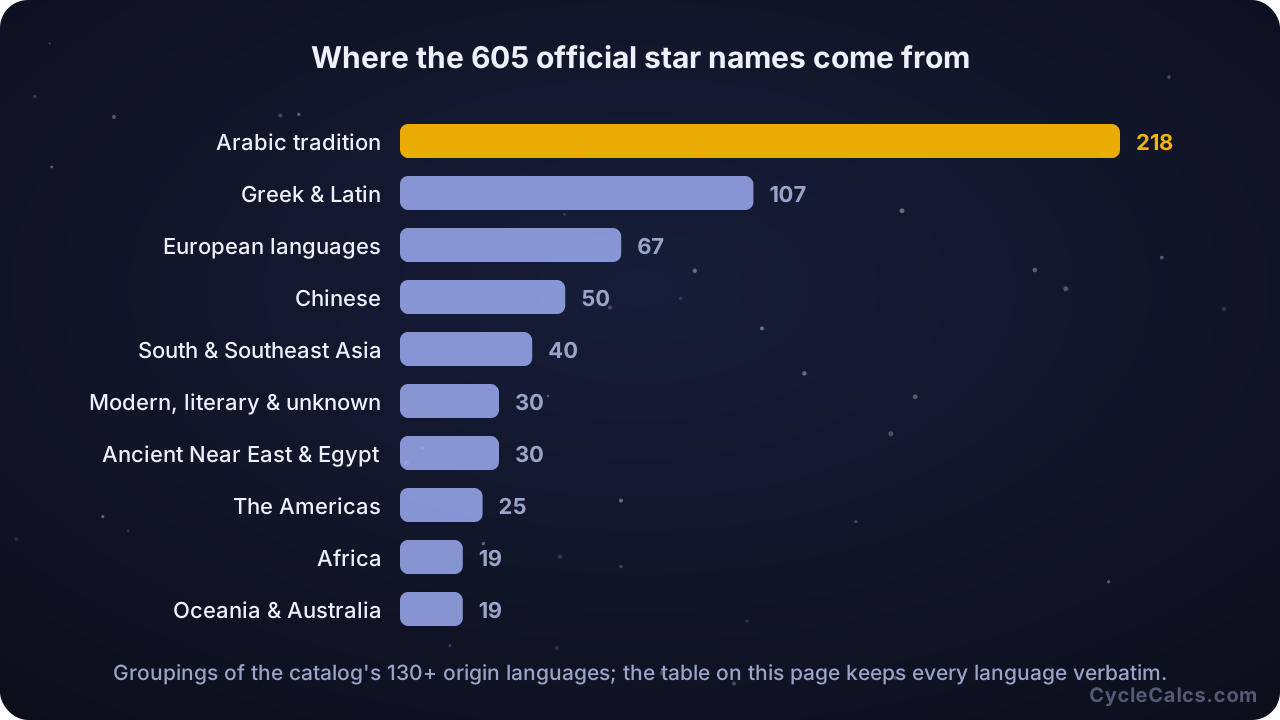
- Arabic tradition (222): brightest are Rigil Kentaurus, Vega, Rigel, Betelgeuse, Achernar, Hadar, Altair, Aldebaran, Fomalhaut, Deneb and 212 more.
- Greek & Latin (107): brightest are Sirius, Canopus, Arcturus, Capella, Procyon, Antares, Spica, Pollux, Mimosa, Regulus and 97 more.
- Chinese (60): brightest are Tiansi, Kulou, Tianji, Fang, Tianguan, Nandou, Nüchuang, Ping, Fuyue, Tianjinnan and 50 more.
- Ancient Near East & Egypt (35): brightest are Shaula, Sargas, Nunki, Uridim, Tarazed, Heryibwia, Darlugal, Alshain, Pagru, Udkadua and 25 more.
- South & Southeast Asia (41): brightest are Lang-Exster, Naga, Pipit, Bade, Ashlesha, Kalasungsang, Bharani, Enduri Senggu, Shatabhisha, Asuusiha and 31 more.
- Oceania & Australia (20): brightest are Tiaki, Larawag, Leepwal, Paikauhale, Nganurganity, Pipirima, Ginan, Bake-eo, Muning, Wurren and 10 more.
- The Americas (25): brightest are Chamukuy, Yaqana, Urquchillay, Tonatiuh, Citalá, Uñallamacha, Tupã, Matza, Tupi, Nenque and 15 more.
- Africa (19): brightest are Imai, Xamidimura, Xami, Hoerikwaggo, Mago, Buna, Rapeto, Itonda, Belel, Sika and 9 more.
- European languages (67): brightest are Avior, Peacock, Áldu, Sarvvis, Ran, Paradys, Garnet Star, Solitaire, Fafnir, Aurwandilsta and 57 more.
- Modern, literary & unknown (30): brightest are Acrux, Gacrux, Kraz, Hatysa, Sarin, Segin, Achird, Diadem, Inquill, Aniara and 20 more.
How stars really get named
Astronomy runs on designations, not names. Johann Bayer's 1603 atlas lettered each constellation's stars with the Greek alphabet, roughly by brightness, attached to the constellation's Latin genitive: Alpha Centauri, Beta Orionis. John Flamsteed's catalog a century later numbered them by position instead: 61 Cygni. Modern catalogs go further, adding HR numbers from the Bright Star Catalog and HIP numbers from the Hipparcos space mission, and one star wears all of its labels at once. Sirius is also Alpha Canis Majoris, also HR 2491, also HIP 32349. The proper name is the oldest layer and, for working astronomers, the least used.
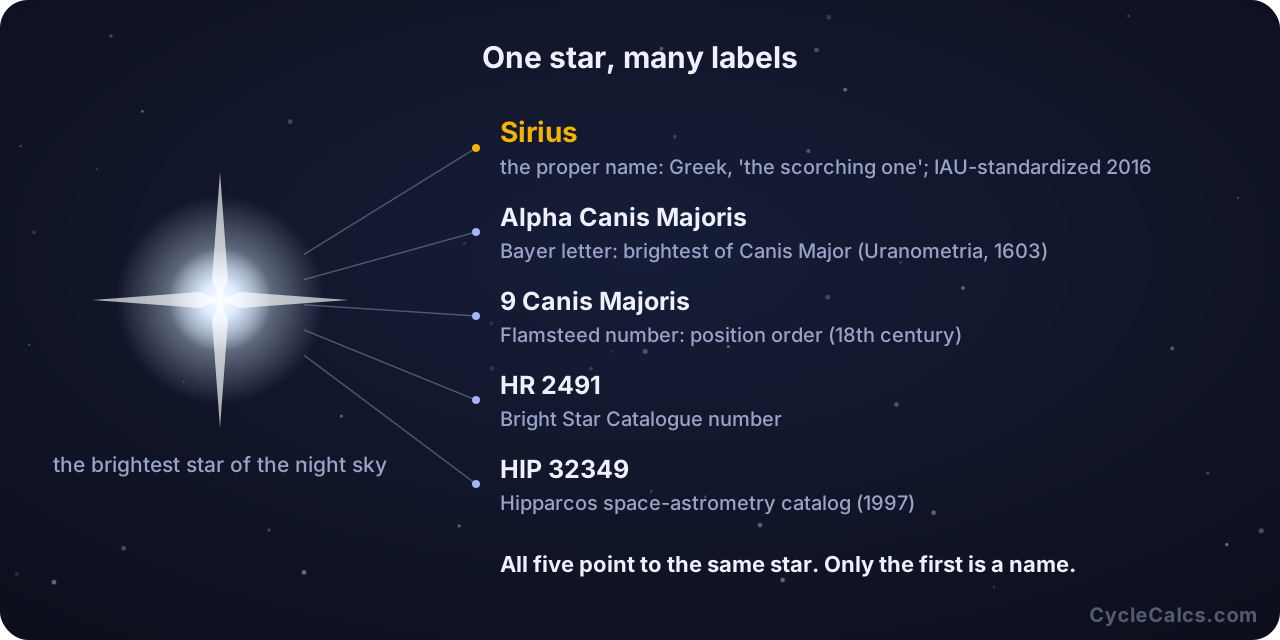
Nobody owned an official list of those proper names until surprisingly recently. Spellings drifted from atlas to atlas; Vega appeared as Wega, and worse. In 2016 the IAU convened its Working Group on Star Names to settle one spelling and one star per name, exactly as it fixed the 88 constellations in the 1920s. The Working Group started with the classical canon, then broadened it: researching and adopting names still in use in cultural traditions from every continent, and running the public NameExoWorlds campaigns through which communities around the world have proposed names for planet-hosting stars. That is why the table above lists a growing catalog of names rather than a closed canon, and why its newest entries are as likely to be Quechua or Manchu as Latin.
Can you buy a star name?
No. Several companies will sell you a certificate that "names a star", and the certificate is real in the sense that the paper exists. The name is not. It enters no catalog and no planetarium software, no astronomer will ever use it, and the same star is routinely sold to more than one buyer by more than one registry. The only body whose star names carry any standing is the International Astronomical Union, and it does not sell them, not for any price. If someone bought you a star, the certificate can still mark the occasion, and you can do something better with this page: look up the star's real designation, learn its actual thousand-year-old name if it has one, and go outside and see it.
Frequently asked questions
How many stars have official names?
626 stars have proper names officially recognized by the International Astronomical Union. Every one of them also carries catalog designations, and the billions of other cataloged stars have designations only. The IAU's Working Group on Star Names has standardized the list since 2016 and still adds names.
Who is allowed to name a star?
Only the International Astronomical Union, through its Working Group on Star Names. Names come from historical star lore across many cultures and from moderated public campaigns such as NameExoWorlds. No company can sell a star name: commercial "star registries" have no standing in astronomy, and the certificate changes nothing in any catalog.
Can you buy a star name?
No. Companies that sell star names are selling a novelty certificate, not a name any astronomer, catalog or telescope will ever use. The only names with official standing are the ones adopted by the International Astronomical Union, and they are never for sale.
Why do so many star names come from Arabic?
222 of the 626 official names, about a third, descend from Arabic. Medieval astronomers of the Islamic world preserved, translated and greatly extended Greek astronomy, and their star catalogs flowed back into Europe through medieval Latin translations, and Renaissance atlases then spread the names widely. Aldebaran ("the follower"), Altair ("the flying eagle") and Betelgeuse (a much-corrupted Arabic phrase) all carried across centuries of copying.
What do star designations like Alpha Centauri mean?
Most designations rank a star within its constellation. Bayer letters (1603) run the Greek alphabet roughly by brightness, so Alpha Centauri is a bright star of Centaurus; the genitive form of the constellation name follows the letter. Later catalogs added Flamsteed numbers, HR numbers from the Bright Star Catalog and HIP numbers from the Hipparcos mission. One star can carry all of these at once, plus a proper name if the IAU has adopted one.
What is the brightest star with an official name?
Sirius, at magnitude -1.46 the brightest star in the night sky. Its name descends from Greek and means "the scorching one."
What was the most recent star name?
The list keeps growing: the newest adoptions date from 2026. Recent additions increasingly record star lore from cultures whose skies were long left out of Western catalogs, from Aboriginal Australian traditions to Andean, West African and Pacific navigation stars.
Keep exploring
The 88 Constellations
The complete catalog: every constellation's meaning, brightest star and finder guide.
SkyLive Sky Map
The sky over your location right now, full screen; tap anything to identify it.
SkyToday in the Sky
Tonight's Moon, the planets' places and the next sky events from your location.
CalculatorTelescope & Eyepiece
Magnification, exit pupil and true field for your telescope and eyepieces.
Cite this page
CycleCalcs, "Star Names: Every Official Name & Meaning", CycleCalcs LLC, https://www.cyclecalcs.com/star-names.html (add your access date).
The computed values on this page (positions, rise and set times, visibility) are public domain under CC0, stated here. The identifications and names derive from public astronomical catalogs whose terms travel with them; the register is on the engine and sources.