Jupiter
Jupiter is the giant of the solar system, 318 times the mass of Earth and heavier than all the other planets combined, its banded ammonia clouds sitting atop a deep atmosphere of hydrogen and helium. It never comes closer to us than about 588 million kilometers, yet it outshines every star in the night sky; among the planets only Venus beats it. Once you learn to spot its steady, cream-white light, you will never mistake it again.
It is also the most generous planet for modest equipment: any pair of binoculars reveals the four moons Galileo discovered in 1610. The live panel below shows what Jupiter is doing right now from your location: when it rises and sets, which constellation it sits in, and how bright it shines, all computed in your browser.
On this page
Jupiter reaches opposition next on February 11, 2027, when Earth passes between it and the Sun. Around that date it rises near sunset, stays up all night, and shines at its brightest for the apparition (magnitude −2.6) in the constellation Leo.
Tonight's position and rise and set times for your location are in the live panel below; the month-by-month table shows where Jupiter sits through the coming year.
Jupiter has the shortest day of any planet: it spins once in about 9.93 hours, so its cloud tops race all the way around in under ten hours. That furious rotation is what visibly flattens the giant at its poles and helps drive its banded weather and storms.
Jupiter tonight from your location
Enter coordinates
This panel computes tonight's position and rise and set times for Jupiter in your browser, and it needs JavaScript to run. The rest of this page, including the month-by-month table below, is fully readable without it. For a live all-sky view, open the Sky Map or Today in the Sky.
Everything is computed on your device. Tapping "Use my location" names your city from a place index served with this page. Times appear in your device's time zone.
Jupiter at a glance
| Mean distance from the Sun | 778.5 million km (5.20 AU) |
|---|---|
| Distance from Earth | 588.5 to 968.5 million km |
| Equatorial diameter | 142,984 km (11.2 × Earth's) |
| Mass | 1.898 × 10²⁷ kg (318 Earths, more than all other planets combined) |
| Gravity (mean, at the cloud tops) | 25.9 m/s² (2.6 × Earth's) |
| Escape velocity | 59.5 km/s |
| Rotation period (sidereal) | 9.93 hours, the fastest of any planet |
| Orbital period | 11.86 years (about one constellation along the ecliptic per year) |
| Synodic period (opposition to opposition) | 398.9 days |
| Axial tilt | 3.13° |
| Temperature at the cloud tops | about −108 °C (at the 1-bar level) |
| Atmosphere | about 90% hydrogen, 10% helium |
| Moons | 95 recognized by the IAU, led by the four bright Galilean moons |
| Rings | yes: thin and dark, found by Voyager 1 in 1979 |
| Brightest apparent magnitude | −2.9 at opposition |
Physical data: NASA NSSDCA Jupiter Fact Sheet. Orbital period: the mean sidereal value from Meeus, Astronomical Algorithms, ch. 31, in Julian years of 365.25 days.
Where is Jupiter month by month?
The table below tracks Jupiter through the next twelve months: the constellation it sits in on the 15th of each month (dates in Universal Time), whether it is a morning object, an evening object or up all night, and how bright it looks.
| Month | Constellation | Where to look | Magnitude |
|---|---|---|---|
| Oct 2026 | Leo | Morning sky, before dawn | −1.9 |
| Nov 2026 | Leo | Morning sky, before dawn | −2.1 |
| Dec 2026 | Leo | Morning sky, before dawn | −2.3 |
| Jan 2027 | Leo | Up most of the night | −2.5 |
| Feb 2027 | Leo | Up most of the night | −2.6 |
| Mar 2027 | Leo | Up most of the night | −2.4 |
| Apr 2027 | Cancer | Evening sky, after dusk | −2.2 |
| May 2027 | Leo | Evening sky, after dusk | −2.0 |
| Jun 2027 | Leo | Evening sky, after dusk | −1.9 |
| Jul 2027 | Leo | Evening sky, after dusk | −1.8 |
| Aug 2027 | Leo | Lost in the Sun's glare | −1.7 |
| Sep 2027 | Leo | Lost in the Sun's glare | −1.7 |
How to see Jupiter
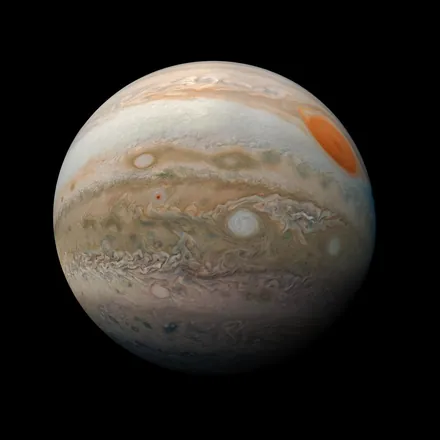
Jupiter is easy to find whenever it is above the horizon. Near opposition, when Earth passes closest to it, Jupiter reaches magnitude −2.9 (the astronomers' brightness scale runs backward, so lower numbers mean brighter), outshining even Sirius, the brightest star. It also shines with a noticeably steady light: its disk spans 30 to 50 arcseconds depending on distance (an arcsecond is 1/3600 of a degree), wide enough to smooth over the atmospheric shimmer that makes point-like stars twinkle.
Binoculars turn Jupiter into a system. Brace them on a fence or wall and you will see up to four pinpoints strung in a line beside the planet: Io, Europa, Ganymede and Callisto, the same four moons Galileo recorded in January 1610 with a far cruder instrument. Their arrangement changes from night to night, and Io shifts noticeably within a single evening. Sketch their positions on two consecutive nights and you have repeated one of the founding observations of modern astronomy.
A telescope raises the stakes. Around 100×, the two dark equatorial cloud belts stand out against brighter zones, and the disk looks visibly squashed: Jupiter's 9.9-hour rotation, the fastest of any planet, flattens it by about 6 percent. In steady moments, and only when that side of the planet faces Earth, the Great Red Spot shows as a pale oval, far subtler than the vivid storm in spacecraft photos (the image on this page is a spacecraft view, not what an eyepiece delivers). On a good night a modest telescope can also catch a shadow transit, the crisp black dot a moon casts on the clouds below.
Jupiter's cycles
Jupiter's slow lap of the sky is one of the oldest cycles humans ever tracked. It orbits 5.2 times farther from the Sun than Earth, and Kepler's third law sets the pace that distance demands: one circuit every 11.86 years. Spread around the ecliptic's constellations, that works out to about one constellation of eastward drift per year, so dependable that ancient Chinese astronomers named Jupiter the Year Star and counted years by it. The sky map shows where it sits tonight.
On top of that runs the 399-day synodic rhythm: Earth, on its faster inner track, laps Jupiter about every 13 months, so opposition, the night we pass between Jupiter and the Sun, comes about a month later each year. Each lap swings Jupiter's distance between roughly 588 and 968 million kilometers, which is why it brightens toward opposition, and around each one it traces a retrograde loop, seeming to back up as Earth overtakes it.
The fastest cycles belong to the moons. The four Galilean satellites reshuffle from night to night, and the inner three are locked in a true orbital resonance, a gravitational gearing that keeps their rhythm exact. That clockwork keeps a steady schedule of moons crossing Jupiter's face, casting shadows on its clouds, and vanishing into its shadow. The Today page runs a live timeline of them, and the telescope calculator shows whether your setup is up to Jupiter's belts and the Great Red Spot.
The grandest beat pairs Jupiter with Saturn. Five Jupiter orbits last almost exactly as long as two Saturn orbits, a 5:2 near-commensurability (a timing coincidence, not a gravitational lock), so Jupiter overtakes its slower neighbor every 19.86 years in a great conjunction, the rhythm behind the celebrated close pairing of 2020.
To see where these periods fit among everything else that repeats overhead, read the full the Jupiter synodic period profile, or find it sorted by length in the complete cycles list.
What's next for Jupiter
Over the next few years, Jupiter's calendar comes down to two kinds of event: the oppositions worth circling, and the solar conjunctions that hide it behind the Sun for a few weeks. Computed with the same engine that runs this site's live sky tools; dates are in Universal Time.
| Date | Event |
|---|---|
| Feb 11, 2027 | Opposition: closest and brightest for the year (magnitude −2.6) in Leo |
| Aug 31, 2027 | Solar conjunction: passes behind the Sun and out of view for a few weeks |
| Mar 12, 2028 | Opposition: closest and brightest for the year (magnitude −2.5) in Leo |
| Sep 30, 2028 | Solar conjunction: passes behind the Sun and out of view for a few weeks |
| Apr 12, 2029 | Opposition: closest and brightest for the year (magnitude −2.5) in Virgo |
| Oct 31, 2029 | Solar conjunction: passes behind the Sun and out of view for a few weeks |
| May 13, 2030 | Opposition: closest and brightest for the year (magnitude −2.5) in Libra |
| Nov 30, 2030 | Solar conjunction: passes behind the Sun and out of view for a few weeks |
| Jun 15, 2031 | Opposition: closest and brightest for the year (magnitude −2.6) in Ophiuchus |
| Jan 1, 2032 | Solar conjunction: passes behind the Sun and out of view for a few weeks |
Frequently asked questions
Can I see Jupiter's moons with binoculars?
Yes. Any binoculars, braced steadily against a wall or fence, will show up to four faint points in a line beside Jupiter: Io, Europa, Ganymede and Callisto, the same four moons Galileo discovered in 1610. You will not always count all four, because at any moment one or two can be hidden in front of or behind the planet. Their positions change noticeably from one night to the next, which is half the fun.
Is Jupiter a failed star?
Not really. Jupiter is made of roughly the same ingredients as the Sun, about 90 percent hydrogen and 10 percent helium, but it falls far short of the mass a star needs to ignite fusion in its core. Even at 318 times the mass of Earth, it would need to be far more massive still before fusion could start. It is best described as an exceptionally large planet, not a small star.
Can I see the Great Red Spot with my telescope?
Sometimes, with honest expectations. You need roughly 100× magnification, a steady night, and good timing: Jupiter rotates in 9.9 hours, so the spot faces Earth only about half the time. Through a small telescope it appears as a pale, salmon-tinted oval nestled against a dark cloud belt, far subtler than spacecraft photos suggest. If you cannot see it at first, keep watching; the moments of steady air that reveal it come and go.
Why is Jupiter so bright in the night sky?
Two reasons: it is enormous and it is reflective. Jupiter is about 143,000 kilometers across, and its ammonia clouds reflect about half of the sunlight that reaches them. Together those outweigh its great distance, which never drops below about 588 million kilometers. At its best Jupiter reaches magnitude −2.9 on the astronomers' scale, where lower numbers mean brighter; that beats every star, and among the planets only Venus outshines it.
How long is a day on Jupiter?
Just 9.9 hours, the shortest day of any planet in the solar system, even though Jupiter is by far the largest. That furious spin has a visible consequence: the planet bulges at the equator and flattens at the poles by about 6 percent, an out-of-round shape you can actually notice through a telescope. The spin also stretches its clouds into the parallel belts and zones that give Jupiter its striped look.
When is the next Jupiter opposition?
Jupiter reaches opposition on February 11, 2027. At opposition Earth passes directly between Jupiter and the Sun, so it rises around sunset, stays visible all night, and is at its closest and brightest for the year, about magnitude −2.6 in Leo.
Keep exploring
- Today page: live timeline of Galilean moon transits, shadows and eclipses
- Jupiter-Saturn great conjunctions: the 19.86-year rhythm and every upcoming meeting
- Telescope Calculator: what magnification your scope really delivers on Jupiter
- Sky Map: find Jupiter among the stars from your location tonight
- Retrograde motion lesson: why Jupiter backs up around every opposition