Mars
Mars is the Red Planet: the only planet whose solid surface we can see in any detail from Earth, and the sky's classic comeback act. Most of the time it is a modest amber dot, but once every 26 months Earth catches up and passes it. For a few weeks around that moment, called opposition, Mars rises at sunset, stays up all night, and can blaze at magnitude −2.94 (the astronomers' brightness scale, where lower numbers mean brighter), briefly rivaling Jupiter.
The live panel below shows what Mars is doing right now: the constellation it currently occupies, how bright it shines tonight, and when it rises and sets at your location. All of it is computed in your browser as you read.
On this page
Mars reaches opposition next on February 19, 2027, when Earth passes between it and the Sun. Around that date it rises near sunset, stays up all night, and shines at its brightest for the apparition (magnitude −1.2) in the constellation Leo.
Tonight's position and rise and set times for your location are in the live panel below; the month-by-month table shows where Mars sits through the coming year.
A day on Mars, called a sol, lasts 24.66 hours, only about 40 minutes longer than an Earth day. That near-match is why rovers and their teams can almost keep Earth-like schedules, though the sols slowly drift out of step with our own clock over a mission.
Mars tonight from your location
Enter coordinates
This panel computes tonight's position and rise and set times for Mars in your browser, and it needs JavaScript to run. The rest of this page, including the month-by-month table below, is fully readable without it. For a live all-sky view, open the Sky Map or Today in the Sky.
Everything is computed on your device. Tapping "Use my location" names your city from a place index served with this page. Times appear in your device's time zone.
Mars at a glance
| Mean distance from the Sun | 228.0 million km (1.52 AU) |
|---|---|
| Distance from Earth | 54.6 to 401.4 million km (why some oppositions are far better than others) |
| Equatorial diameter | 6,792 km (0.53 of Earth's) |
| Mass | 6.42 × 10²³ kg (0.11 of Earth's) |
| Surface gravity | 3.73 m/s² (0.38 of Earth's) |
| Escape velocity | 5.03 km/s |
| Rotation period (sidereal) | 24.62 hours |
| Day length (a "sol") | 24.66 hours, barely longer than ours |
| Orbital period | 687.0 days (1.88 years) |
| Synodic period (opposition to opposition) | 779.9 days, about 26 months |
| Axial tilt | 25.19° (Earth-like seasons, nearly twice as long) |
| Mean surface temperature | about −59 °C |
| Atmosphere | 95% carbon dioxide, under 1% of Earth's surface pressure |
| Moons | 2 (Phobos and Deimos) |
| Rings | none |
| Brightest apparent magnitude | −2.9 at a close opposition |
Physical data: NASA NSSDCA Mars Fact Sheet. Orbital period: the mean sidereal value from Meeus, Astronomical Algorithms, ch. 31, in Julian years of 365.25 days.
Where is Mars month by month?
The table below tracks Mars through the next twelve months: the constellation it sits in on the 15th of each month (dates in Universal Time), whether it is a morning object, an evening object or up all night, and how bright it looks.
| Month | Constellation | Where to look | Magnitude |
|---|---|---|---|
| Oct 2026 | Cancer | Morning sky, before dawn | +1.0 |
| Nov 2026 | Leo | Morning sky, before dawn | +0.7 |
| Dec 2026 | Leo | Morning sky, before dawn | +0.2 |
| Jan 2027 | Leo | Morning sky, before dawn | −0.5 |
| Feb 2027 | Leo | Up most of the night | −1.2 |
| Mar 2027 | Leo | Up most of the night | −0.8 |
| Apr 2027 | Leo | Evening sky, after dusk | 0.0 |
| May 2027 | Leo | Evening sky, after dusk | +0.5 |
| Jun 2027 | Leo | Evening sky, after dusk | +0.9 |
| Jul 2027 | Virgo | Evening sky, after dusk | +1.2 |
| Aug 2027 | Virgo | Evening sky, after dusk | +1.3 |
| Sep 2027 | Libra | Evening sky, after dusk | +1.4 |
How to see Mars
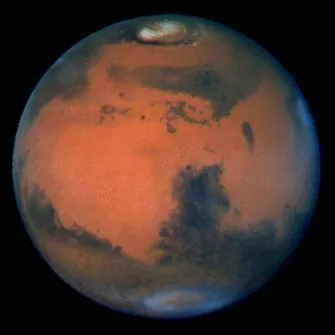
To the naked eye Mars is unmistakable once you know its color: a steady amber-orange point with a warmth no bright star quite matches. How impressive it looks depends entirely on geometry. Near a close opposition it outshines every nighttime star; in the long stretches between, it fades back to an ordinary-looking reddish dot ambling through the constellations. Its distance from Earth swings from 54.6 million to just over 400 million kilometers, a factor of about seven, and its brightness swings with it.
A telescope tells the same story. The disk grows from a hopeless 3.5 arcseconds when Mars is remote (an arcsecond is 1/3600 of a degree) to 25.6 arcseconds at the rare closest approaches. In the weeks around opposition, a good 4-to-6-inch telescope at 150× or more on a steady night can show a bright polar cap and the dark surface markings, and occasionally a planet-wide dust storm that hides everything for weeks. Away from opposition, expect a tiny featureless orange ball, and treat that as the real telescopic view; the labeled photo on this page is a spacecraft image, not what any eyepiece will show.
Patience is the real instrument here. Mars rewards long looks: the eye catches fine detail only in brief instants of steady air, and an experienced observer at the same telescope sees more than a first-timer simply by waiting. The two little moons, Phobos and Deimos, hug the planet's glare and are a specialist's challenge, not a backyard target.
Mars's cycles
Two clocks set the Mars watcher's calendar. Mars circles the Sun in 687 days; Earth, on its faster inner track, takes just over 365 and steadily gains, lapping Mars once every 779.94 days, about 26 months. That lap is the synodic period, and the instant of lapping is opposition: Mars opposite the Sun in our sky, rising at sunset, closest and brightest. The synodic vs sidereal lesson explains the two clocks, and the Synodic Period Calculator runs the same arithmetic for any pair of planets.
Around every opposition Mars stages the sky's most famous illusion. As Earth sweeps past, Mars appears to halt against the stars, run backward toward the west, then turn and resume its eastward drift, tracing a loop. This retrograde motion confused astronomers for two thousand years, inspiring ever more elaborate systems of circles upon circles, until the Sun-centered model dissolved it into simple perspective; the retrograde lesson shows the loop forming in motion. Mars gave astronomy one more gift: its orbit refused to fit any circle, forcing Kepler to the ellipse, the story told in Kepler's laws.
That ellipse is also why oppositions are not created equal. Mars's distance from the Sun ranges from about 207 to 249 million kilometers (an orbital eccentricity of 0.0935), so an opposition that catches Mars near its perihelion (its closest point to the Sun) can bring it within about 55 million kilometers of Earth, while an average one leaves it near 78 million. And since 26 months is not a whole number of Martian years, each opposition lands at a different spot on the ellipse; the truly close ones return only after seven or eight laps, roughly every 15 to 17 years.
The same lap arithmetic also sets Mars's meetings with the slower planets beyond it, like the pairings tracked on the Mars-Jupiter conjunctions page. To see where all of this puts Mars over your own horizon on any given night, open the Sky Map and search for it.
To see where these periods fit among everything else that repeats overhead, read the full the Mars synodic period profile, or find it sorted by length in the complete cycles list.
What's next for Mars
Over the next few years, Mars's calendar comes down to two kinds of event: the oppositions worth circling, and the solar conjunctions that hide it behind the Sun for a few weeks. Computed with the same engine that runs this site's live sky tools; dates are in Universal Time.
| Date | Event |
|---|---|
| Feb 19, 2027 | Opposition: closest and brightest for the year (magnitude −1.2) in Leo |
| Mar 21, 2028 | Solar conjunction: passes behind the Sun and out of view for a few weeks |
| Mar 25, 2029 | Opposition: closest and brightest for the year (magnitude −1.3) in Virgo |
| May 25, 2030 | Solar conjunction: passes behind the Sun and out of view for a few weeks |
| May 4, 2031 | Opposition: closest and brightest for the year (magnitude −1.8) in Libra |
| Jul 11, 2032 | Solar conjunction: passes behind the Sun and out of view for a few weeks |
Frequently asked questions
Why is Mars red?
Its surface dust is rich in iron oxides, essentially rust, which reflect more red and orange light than blue. The tint is obvious even to the naked eye, which is why cultures around the world linked the planet with fire and war. Up close the palette is subtler: landers see butterscotch, tan and gray terrain, and the dark markings telescopes have mapped for centuries are exposed volcanic rock.
Why is Mars so much brighter in some years than others?
Two rhythms stack. Earth only catches up to Mars every 779.94 days, about 26 months, so Mars is near us for just a few weeks per cycle. And because Mars's orbit is noticeably elliptical, some catch-ups happen when Mars is unusually close: its distance from Earth ranges from about 55 million to just over 400 million kilometers. At its best Mars reaches magnitude −2.94, where lower numbers mean brighter, outshining every nighttime star; at its faintest it looks like an ordinary reddish star.
What is Mars retrograde motion?
For a stretch around each opposition, Mars appears to reverse course and drift westward against the stars before resuming its usual eastward path. Nothing changes in Mars's actual orbit: the faster-moving Earth is overtaking it, just as a slower car seems to slide backward as you pass. The loop repeats once per opposition, about every 26 months, and it puzzled astronomers for some two thousand years until the Sun-centered model explained it as simple perspective.
How many moons does Mars have?
Two: Phobos and Deimos, both far smaller than our Moon. Phobos circles only about 9,400 kilometers from the planet's center and completes an orbit in under eight hours, faster than Mars itself rotates, so from the Martian surface it rises in the west and sets in the east. Deimos, farther out, takes about 30 hours per orbit. Both are faint and sit deep in Mars's glare, well beyond a typical backyard telescope.
How long is a day on Mars?
A Martian solar day, called a sol, lasts 24.66 hours, only about 40 minutes longer than ours. Mars's axis is tilted 25.19 degrees, close to Earth's tilt, so it has genuine seasons: spring, summer, autumn and winter, with polar caps that grow and shrink. But because the Martian year lasts 687 Earth days, nearly twice ours, each season runs roughly twice as long as its Earth counterpart.
When is the next Mars opposition?
Mars reaches opposition on February 19, 2027. At opposition Earth passes directly between Mars and the Sun, so it rises around sunset, stays visible all night, and is at its closest and brightest for the year, about magnitude −1.2 in Leo.
Keep exploring
- Retrograde Motion lesson: watch the Mars loop form as Earth overtakes it
- Retrograde Right Now: the live status board for every planet, with station dates
- Synodic vs Sidereal lesson: the two clocks behind the 26-month opposition rhythm
- Mars-Jupiter Conjunctions: every meeting of the two great opposition planets
- Sky Map: plot Mars over your own horizon in real time
- Telescope Calculator: work out the magnification you need on Mars's small disk