On this page
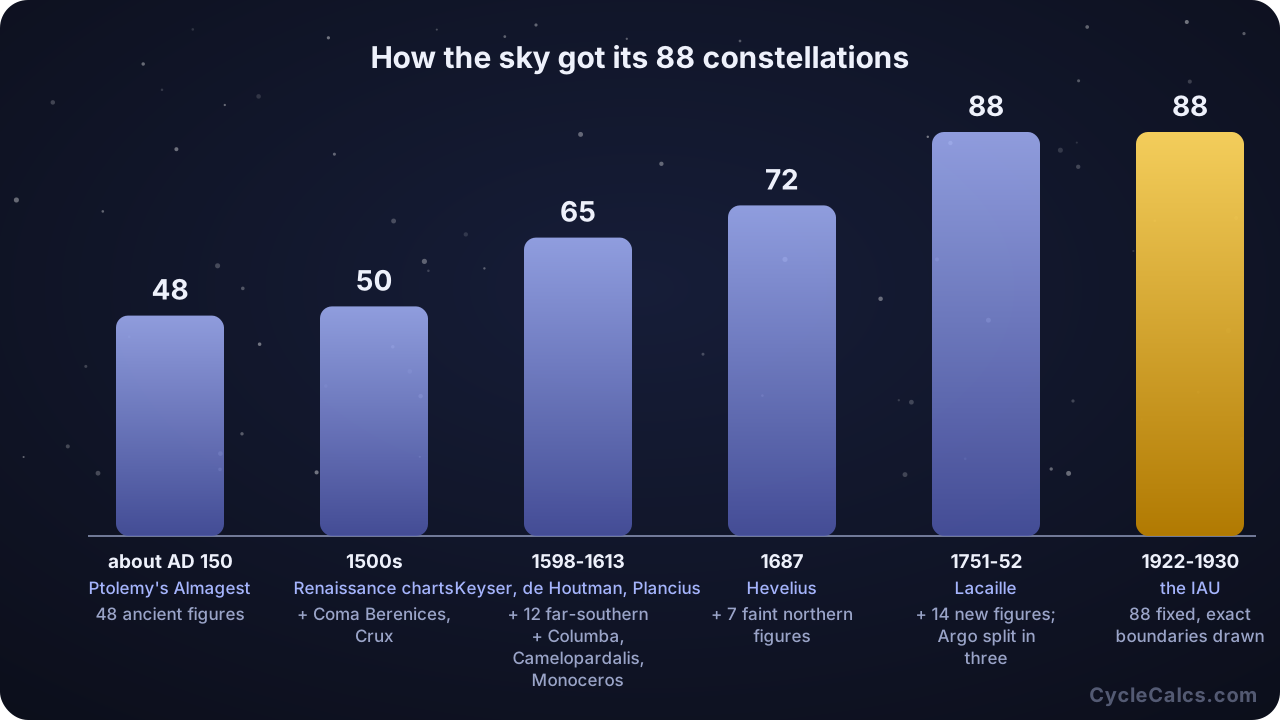
There are 88 constellations. The International Astronomical Union adopted the list in 1922 and fixed exact boundaries between them by 1930, so the entire sky is divided into 88 regions and every star belongs to exactly one.
- Largest: Hydra, 1,303 square degrees
- Smallest: Crux, 68 square degrees
- Zodiac: 12 (the Sun also crosses Ophiuchus)
- Brightest star: Sirius, in Canis Major
- Oldest: 48 come down from Ptolemy's catalog, about AD 150
- Newest: 14 named by Lacaille, 1751-52
The whole-sky constellation map
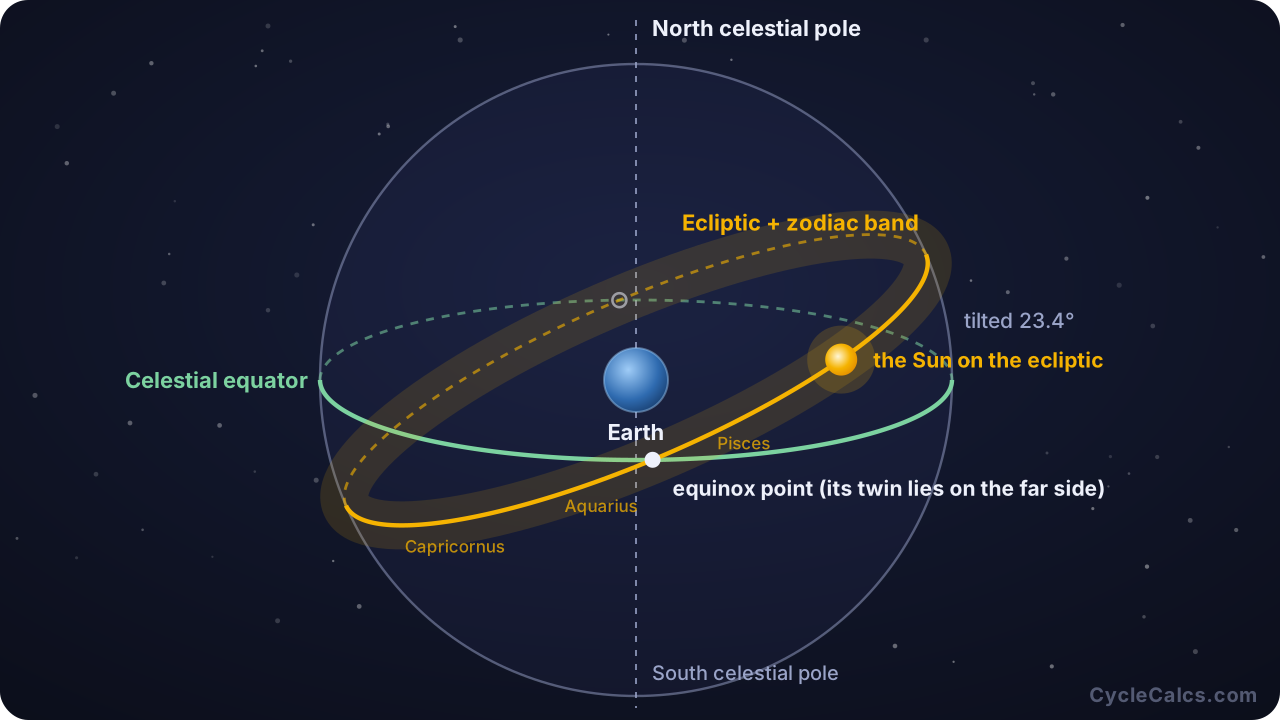
Ecliptic (orange): the Sun's yearly path through the constellations, with the zodiac strung along it Celestial equator (green): Earth's own equator projected out onto the sky
Pick any constellation, on the map or in the catalog below, to read its story here.
The complete catalog of all 88 constellations
This table is the whole sky. Every officially recognized constellation is here with its three-letter IAU abbreviation, its Latin genitive (the form used in star names such as Alpha Orionis), a rough pronunciation, what the name means, the family of sky lore it belongs to, its brightest star with magnitude, its area in square degrees, and the month its evening viewing peaks. Click any column heading to sort, use the chips to filter, and click a row to fly the map to that constellation. Every name links to a fuller guide further down the page.
| Constellation | Abbr. | Genitive | Pronunciation | Meaning | Family | Brightest star (mag.) | Area (sq. deg.) | Sky | Best evenings |
|---|---|---|---|---|---|---|---|---|---|
| Andromeda | And | Andromedae | an-DROM-eh-duh | the Chained Maiden | Perseus | Alpheratz (2.06) | 722 | Northern | Nov |
| Antlia | Ant | Antliae | ANT-lee-uh | the Air Pump | La Caille | Alpha Antliae (4.25) | 239 | Southern | Apr |
| Apus | Aps | Apodis | AY-puss | the Bird of Paradise | Bayer | Alpha Apodis (3.83) | 206 | Southern | Jul |
| Aquariuszodiac | Aqr | Aquarii | uh-KWAIR-ee-us | the Water Bearer | Zodiac | Sadalsuud (2.87) | 980 | Southern | Oct |
| Aquila | Aql | Aquilae | uh-KWIL-uh | the Eagle | Hercules | Altair (0.76) | 652 | Equatorial | Aug |
| Ara | Ara | Arae | AIR-uh | the Altar | Hercules | Beta Arae (2.84) | 237 | Southern | Jul |
| Arieszodiac | Ari | Arietis | AIR-eez | the Ram | Zodiac | Hamal (2.00) | 441 | Northern | Dec |
| Auriga | Aur | Aurigae | aw-RYE-guh | the Charioteer | Perseus | Capella (0.08) | 657 | Northern | Jan |
| Bootes | Boo | Bootis | boh-OH-teez | the Herdsman | Ursa Major | Arcturus (-0.05) | 907 | Northern | Jun |
| Caelum | Cae | Caeli | SEE-lum | the Chisel | La Caille | Alpha Caeli (4.45) | 125 | Southern | Jan |
| Camelopardalis | Cam | Camelopardalis | kuh-MEL-oh-PAR-duh-liss | the Giraffe | Ursa Major | Beta Camelopardalis (4.03) | 757 | Northern | Jan |
| Cancerzodiac | Cnc | Cancri | KAN-ser | the Crab | Zodiac | Tarf (3.53) | 506 | Northern | Mar |
| Canes Venatici | CVn | Canum Venaticorum | KAY-neez veh-NAT-ih-sigh | the Hunting Dogs | Ursa Major | Cor Caroli (2.90) | 465 | Northern | May |
| Canis Major | CMa | Canis Majoris | KAY-niss muh-JOR-iss | the Great Dog | Orion | Sirius (-1.46) | 380 | Southern | Feb |
| Canis Minor | CMi | Canis Minoris | KAY-niss my-NOR-iss | the Little Dog | Orion | Procyon (0.34) | 183 | Equatorial | Feb |
| Capricornuszodiac | Cap | Capricorni | kap-rih-KOR-nus | the Sea Goat | Zodiac | Deneb Algedi (2.85) | 414 | Southern | Sep |
| Carina | Car | Carinae | kuh-RYE-nuh | the Keel | Heavenly Waters | Canopus (-0.74) | 494 | Southern | Mar |
| Cassiopeia | Cas | Cassiopeiae | kass-ee-oh-PEE-uh | the Seated Queen | Perseus | Schedar (2.24) | 598 | Northern | Nov |
| Centaurus | Cen | Centauri | sen-TOR-us | the Centaur | Hercules | Rigil Kentaurus (-0.27) | 1,060 | Southern | May |
| Cepheus | Cep | Cephei | SEE-fee-us | the King | Perseus | Alderamin (2.46) | 588 | Northern | Oct |
| Cetus | Cet | Ceti | SEE-tus | the Sea Monster | Perseus | Diphda (2.02) | 1,231 | Southern | Nov |
| Chamaeleon | Cha | Chamaeleontis | kuh-MEEL-yun | the Chameleon | Bayer | Alpha Chamaeleontis (4.06) | 132 | Southern | Apr |
| Circinus | Cir | Circini | SER-sih-nus | the Compasses | La Caille | Alpha Circini (3.19) | 93 | Southern | Jun |
| Columba | Col | Columbae | koh-LUM-buh | the Dove | Heavenly Waters | Phact (2.65) | 270 | Southern | Jan |
| Coma Berenices | Com | Comae Berenices | KOH-muh bair-eh-NYE-seez | Berenice's Hair | Ursa Major | Beta Comae Berenices (4.26) | 386 | Northern | May |
| Corona Australis | CrA | Coronae Australis | koh-ROH-nuh aw-STRAH-liss | the Southern Crown | Hercules | Meridiana (4.10) | 128 | Southern | Aug |
| Corona Borealis | CrB | Coronae Borealis | koh-ROH-nuh bor-ee-AL-iss | the Northern Crown | Ursa Major | Alphecca (2.23) | 179 | Northern | Jun |
| Corvus | Crv | Corvi | KOR-vus | the Crow | Hercules | Gienah (2.59) | 184 | Southern | May |
| Crater | Crt | Crateris | KRAY-ter | the Cup | Hercules | Delta Crateris (3.56) | 282 | Southern | Apr |
| Crux | Cru | Crucis | KRUKS | the Southern Cross | Hercules | Acrux (0.76) | 68 | Southern | May |
| Cygnus | Cyg | Cygni | SIG-nus | the Swan | Hercules | Deneb (1.25) | 804 | Northern | Sep |
| Delphinus | Del | Delphini | del-FYE-nus | the Dolphin | Heavenly Waters | Rotanev (3.63) | 189 | Northern | Sep |
| Dorado | Dor | Doradus | doh-RAH-doh | the Dolphinfish | Bayer | Alpha Doradus (3.27) | 179 | Southern | Jan |
| Draco | Dra | Draconis | DRAY-koh | the Dragon | Ursa Major | Eltanin (2.23) | 1,083 | Northern | Jul |
| Equuleus | Equ | Equulei | eh-KWOO-lee-us | the Little Horse | Heavenly Waters | Kitalpha (3.92) | 72 | Equatorial | Sep |
| Eridanus | Eri | Eridani | eh-RID-uh-nus | the River | Heavenly Waters | Achernar (0.46) | 1,138 | Southern | Dec |
| Fornax | For | Fornacis | FOR-naks | the Furnace | La Caille | Dalim (3.85) | 398 | Southern | Dec |
| Geminizodiac | Gem | Geminorum | JEM-ih-nye | the Twins | Zodiac | Pollux (1.14) | 514 | Northern | Feb |
| Grus | Gru | Gruis | GRUSS | the Crane | Bayer | Alnair (1.74) | 366 | Southern | Oct |
| Hercules | Her | Herculis | HER-kyuh-leez | Hercules | Hercules | Kornephoros (2.77) | 1,225 | Northern | Jul |
| Horologium | Hor | Horologii | hor-oh-LOH-jee-um | the Pendulum Clock | La Caille | Alpha Horologii (3.85) | 249 | Southern | Dec |
| Hydra | Hya | Hydrae | HYE-druh | the Water Snake | Hercules | Alphard (1.98) | 1,303 | Southern | Apr |
| Hydrus | Hyi | Hydri | HYE-drus | the Lesser Water Snake | Bayer | Beta Hydri (2.80) | 243 | Southern | Dec |
| Indus | Ind | Indi | IN-dus | the Indian | Bayer | Alpha Indi (3.11) | 294 | Southern | Sep |
| Lacerta | Lac | Lacertae | luh-SER-tuh | the Lizard | Perseus | Alpha Lacertae (3.77) | 201 | Northern | Oct |
| Leozodiac | Leo | Leonis | LEE-oh | the Lion | Zodiac | Regulus (1.36) | 947 | Northern | Apr |
| Leo Minor | LMi | Leonis Minoris | LEE-oh my-NOR-iss | the Little Lion | Ursa Major | Praecipua (3.83) | 232 | Northern | Apr |
| Lepus | Lep | Leporis | LEE-pus | the Hare | Orion | Arneb (2.58) | 290 | Southern | Jan |
| Librazodiac | Lib | Librae | LEE-bruh | the Scales | Zodiac | Zubeneschamali (2.61) | 538 | Southern | Jun |
| Lupus | Lup | Lupi | LOO-pus | the Wolf | Hercules | Alpha Lupi (2.30) | 334 | Southern | Jun |
| Lynx | Lyn | Lyncis | LINKS | the Lynx | Ursa Major | Alpha Lyncis (3.14) | 545 | Northern | Mar |
| Lyra | Lyr | Lyrae | LYE-ruh | the Lyre | Hercules | Vega (0.03) | 286 | Northern | Aug |
| Mensa | Men | Mensae | MEN-suh | Table Mountain | La Caille | Alpha Mensae (5.09) | 153 | Southern | Jan |
| Microscopium | Mic | Microscopii | my-kroh-SKOH-pee-um | the Microscope | La Caille | Gamma Microscopii (4.68) | 210 | Southern | Sep |
| Monoceros | Mon | Monocerotis | muh-NOSS-er-us | the Unicorn | Orion | Beta Monocerotis (3.74) | 482 | Equatorial | Feb |
| Musca | Mus | Muscae | MUSS-kuh | the Fly | Bayer | Alpha Muscae (2.69) | 138 | Southern | May |
| Norma | Nor | Normae | NOR-muh | the Carpenter's Level | La Caille | Gamma-2 Normae (4.02) | 165 | Southern | Jul |
| Octans | Oct | Octantis | OK-tanz | the Octant | La Caille | Nu Octantis (3.76) | 291 | Southern | Sep |
| Ophiuchus | Oph | Ophiuchi | oh-fee-YOO-kus | the Serpent Bearer | Hercules | Rasalhague (2.08) | 948 | Equatorial | Jul |
| Orion | Ori | Orionis | oh-RYE-un | the Hunter | Orion | Rigel (0.13) | 594 | Equatorial | Jan |
| Pavo | Pav | Pavonis | PAY-voh | the Peacock | Bayer | Peacock (1.94) | 378 | Southern | Aug |
| Pegasus | Peg | Pegasi | PEG-uh-sus | the Winged Horse | Perseus | Enif (2.39) | 1,121 | Northern | Oct |
| Perseus | Per | Persei | PER-see-us | Perseus | Perseus | Mirfak (1.79) | 615 | Northern | Dec |
| Phoenix | Phe | Phoenicis | FEE-niks | the Phoenix | Bayer | Ankaa (2.38) | 469 | Southern | Nov |
| Pictor | Pic | Pictoris | PIK-tor | the Painter's Easel | La Caille | Alpha Pictoris (3.27) | 247 | Southern | Jan |
| Pisceszodiac | Psc | Piscium | PYE-seez | the Fishes | Zodiac | Alpherg (3.62) | 889 | Northern | Nov |
| Piscis Austrinus | PsA | Piscis Austrini | PYE-siss aw-STRY-nus | the Southern Fish | Heavenly Waters | Fomalhaut (1.16) | 245 | Southern | Oct |
| Puppis | Pup | Puppis | PUP-iss | the Stern | Heavenly Waters | Naos (2.25) | 673 | Southern | Feb |
| Pyxis | Pyx | Pyxidis | PIK-siss | the Compass | Heavenly Waters | Alpha Pyxidis (3.68) | 221 | Southern | Mar |
| Reticulum | Ret | Reticuli | reh-TIK-yuh-lum | the Reticle | La Caille | Alpha Reticuli (3.35) | 114 | Southern | Dec |
| Sagitta | Sge | Sagittae | suh-JIT-uh | the Arrow | Hercules | Gamma Sagittae (3.47) | 80 | Northern | Aug |
| Sagittariuszodiac | Sgr | Sagittarii | saj-ih-TAIR-ee-us | the Archer | Zodiac | Kaus Australis (1.85) | 867 | Southern | Aug |
| Scorpiuszodiac | Sco | Scorpii | SKOR-pee-us | the Scorpion | Zodiac | Antares (0.96) | 497 | Southern | Jul |
| Sculptor | Scl | Sculptoris | SKULP-tor | the Sculptor | La Caille | Alpha Sculptoris (4.31) | 475 | Southern | Nov |
| Scutum | Sct | Scuti | SKYOO-tum | the Shield | Hercules | Alpha Scuti (3.85) | 109 | Southern | Aug |
| Serpens | Ser | Serpentis | SER-penz | the Serpent | Hercules | Unukalhai (2.63) | 637 | Equatorial | Jul |
| Sextans | Sex | Sextantis | SEKS-tanz | the Sextant | Hercules | Alpha Sextantis (4.49) | 314 | Equatorial | Apr |
| Tauruszodiac | Tau | Tauri | TOR-us | the Bull | Zodiac | Aldebaran (0.85) | 797 | Northern | Jan |
| Telescopium | Tel | Telescopii | tel-eh-SKOH-pee-um | the Telescope | La Caille | Alpha Telescopii (3.49) | 252 | Southern | Aug |
| Triangulum | Tri | Trianguli | try-ANG-gyuh-lum | the Triangle | Perseus | Beta Trianguli (3.00) | 132 | Northern | Dec |
| Triangulum Australe | TrA | Trianguli Australis | try-ANG-gyuh-lum aw-STRAH-lee | the Southern Triangle | Hercules | Atria (1.91) | 110 | Southern | Jul |
| Tucana | Tuc | Tucanae | too-KAY-nuh | the Toucan | Bayer | Alpha Tucanae (2.86) | 295 | Southern | Oct |
| Ursa Major | UMa | Ursae Majoris | ER-suh muh-JOR-iss | the Great Bear | Ursa Major | Alioth (1.77) | 1,280 | Northern | Apr |
| Ursa Minor | UMi | Ursae Minoris | ER-suh my-NOR-iss | the Little Bear | Ursa Major | Polaris (1.98) | 256 | Northern | Jun |
| Vela | Vel | Velorum | VEE-luh | the Sails | Heavenly Waters | Gamma Velorum (1.75) | 500 | Southern | Mar |
| Virgozodiac | Vir | Virginis | VER-goh | the Maiden | Zodiac | Spica (0.97) | 1,294 | Equatorial | May |
| Volans | Vol | Volantis | VOH-lanz | the Flying Fish | Bayer | Beta Volantis (3.77) | 141 | Southern | Feb |
| Vulpecula | Vul | Vulpeculae | vul-PEK-yuh-luh | the Fox | Hercules | Anser (4.44) | 268 | Northern | Sep |
Tip: click a row to fly the sky map to that constellation; click a constellation's name for its full guide below.
The zodiac and the ecliptic
Twelve of the 88 are the zodiac constellations: Aries, Taurus, Gemini, Cancer, Leo, Virgo, Libra, Scorpius, Sagittarius, Capricornus, Aquarius and Pisces. They matter because they line the ecliptic, the path the Sun appears to trace through the stars as Earth goes around it in a year. The Moon and planets never wander far from this same line, which is why every planet you will ever spot is standing in or beside a zodiac constellation. On the map above, the ecliptic is the orange curve.
An honest count gives thirteen, not twelve. The IAU boundaries put a stretch of the ecliptic inside Ophiuchus, the Serpent Bearer, and the Sun crosses it every year from about November 30 to December 18. Ophiuchus was simply never adopted into the traditional twelve-sign zodiac, which was fixed more than two thousand years before the modern boundaries were drawn.
The zodiac here is a band of sky and a coordinate reference, nothing more. Astrological signs are equal 30-degree segments of the ecliptic counted from the March equinox; they stopped lining up with the constellations of the same names long ago, because precession slides the equinox westward through the stars, one full sign every 2,160 years of the 25,920-year cycle. The real constellations are also nothing like equal: the Sun spends about six weeks crossing Virgo but less than a week in Scorpius. For how the Sun's path sets the seasons, see Seasons & the Sun.
The eight constellation families
Astronomy writers group the 88 into eight traditional families, each a chapter in how the sky was mapped: the circumpolar company around the Great Bear, the zodiac, the cast of the Perseus legend, the sprawling Hercules group, Orion's winter hunting scene, the celestial waters, the exotic southern creatures charted by Dutch navigators around 1600, and the instruments Lacaille added from the Cape of Good Hope in 1751-52.
The Zodiac 12
The twelve constellations strung along the ecliptic, the Sun's apparent yearly path. The Moon and planets travel through this same band.
The Ursa Major family 10
The circumpolar company around the Great Bear: the two bears, their keeper, the dragon between them, and the fillers charted later in the far northern sky.
The Perseus family 9
The cast of one royal legend: Perseus, Andromeda, her royal parents, the sea monster, the winged horse, and their neighbors in the autumn sky.
The Hercules family 19
The largest family, spread along and south of the summer Milky Way: Hercules and the creatures and props of his labors, plus the ancient southern altar, centaur and crosses.
The Orion family 5
The winter hunting scene: Orion, his two dogs, the hare at his feet and the unicorn added between them.
The Heavenly Waters 9
The celestial waters and everything afloat on them: the river, the dolphin, the southern fish, the dove, and the pieces of the great ship Argo.
The Bayer family 11
The eleven exotic creatures, mostly birds and sea animals, that Dutch navigators charted in the far southern sky around 1600.
The La Caille family 13
The twelve faint southern instruments of science and art that Lacaille named in 1751-52, plus Mensa for Table Mountain. (His thirteenth instrument, Pyxis, sails with the Heavenly Waters.)
The constellations by theme
People also remember the sky by what the names depict. Grouped that way, the 88 sort into birds and beasts, people and props:
- Birds (9): Apus (the Bird of Paradise), Aquila (the Eagle), Columba (the Dove), Corvus (the Crow), Cygnus (the Swan), Grus (the Crane), Pavo (the Peacock), Phoenix (the Phoenix), Tucana (the Toucan).
- Water & sea creatures (12): Aquarius (the Water Bearer), Cancer (the Crab), Capricornus (the Sea Goat), Cetus (the Sea Monster), Delphinus (the Dolphin), Dorado (the Dolphinfish), Eridanus (the River), Hydra (the Water Snake), Hydrus (the Lesser Water Snake), Pisces (the Fishes), Piscis Austrinus (the Southern Fish), Volans (the Flying Fish).
- Land animals (20): Aries (the Ram), Camelopardalis (the Giraffe), Canes Venatici (the Hunting Dogs), Canis Major (the Great Dog), Canis Minor (the Little Dog), Chamaeleon (the Chameleon), Equuleus (the Little Horse), Lacerta (the Lizard), Leo (the Lion), Leo Minor (the Little Lion), Lepus (the Hare), Lupus (the Wolf), Lynx (the Lynx), Musca (the Fly), Scorpius (the Scorpion), Serpens (the Serpent), Taurus (the Bull), Ursa Major (the Great Bear), Ursa Minor (the Little Bear), Vulpecula (the Fox).
- People & heroes (14): Andromeda (the Chained Maiden), Aquarius (the Water Bearer), Auriga (the Charioteer), Bootes (the Herdsman), Cassiopeia (the Seated Queen), Cepheus (the King), Coma Berenices (Berenice's Hair), Gemini (the Twins), Hercules (Hercules), Indus (the Indian), Ophiuchus (the Serpent Bearer), Orion (the Hunter), Perseus (Perseus), Virgo (the Maiden).
- Mythical beasts (9): Capricornus (the Sea Goat), Centaurus (the Centaur), Cetus (the Sea Monster), Draco (the Dragon), Hydra (the Water Snake), Monoceros (the Unicorn), Pegasus (the Winged Horse), Phoenix (the Phoenix), Sagittarius (the Archer).
- Instruments & inventions (15): Antlia (the Air Pump), Caelum (the Chisel), Circinus (the Compasses), Fornax (the Furnace), Horologium (the Pendulum Clock), Lyra (the Lyre), Microscopium (the Microscope), Norma (the Carpenter's Level), Octans (the Octant), Pictor (the Painter's Easel), Pyxis (the Compass), Reticulum (the Reticle), Sculptor (the Sculptor), Sextans (the Sextant), Telescopium (the Telescope).
- Objects & symbols (11): Ara (the Altar), Corona Australis (the Southern Crown), Corona Borealis (the Northern Crown), Crater (the Cup), Crux (the Southern Cross), Libra (the Scales), Mensa (Table Mountain), Sagitta (the Arrow), Scutum (the Shield), Triangulum (the Triangle), Triangulum Australe (the Southern Triangle).
- The ship Argo (4): Carina (the Keel), Puppis (the Stern), Pyxis (the Compass), Vela (the Sails).
What a constellation is, and is not
A constellation is two things at once. It is a figure: a pattern our eyes and our ancestors drew between bright stars. And since 1930 it is a region: the IAU divided the entire celestial sphere into 88 territories with exact boundaries, the way a map divides a continent into countries. Every star, galaxy and nova belongs to exactly one constellation, whether or not it is part of the classic figure. When astronomers say a comet is "in Pegasus," they mean the region, not the winged horse.
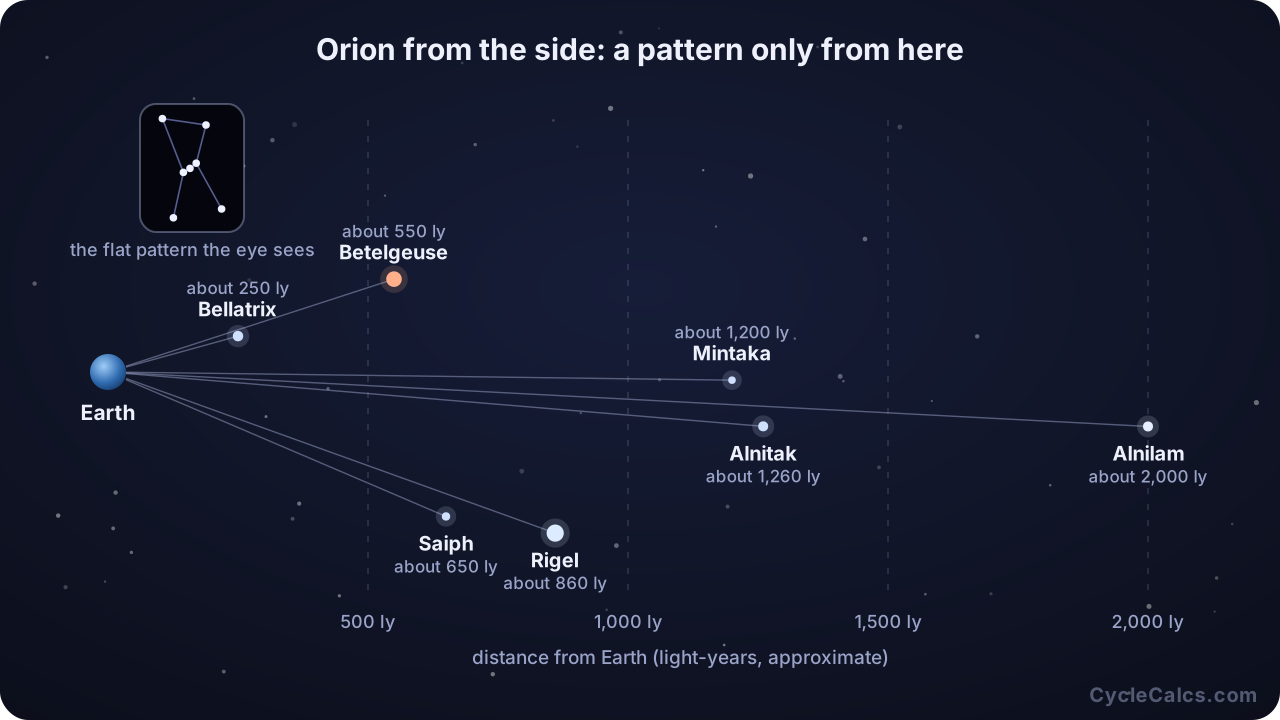
What a constellation is not is a physical group. The stars of a figure usually have nothing to do with one another; they merely sit in similar directions as seen from Earth. Orion makes the point well: Bellatrix shines from about 250 light-years away while Alnilam, the middle star of the Belt, is roughly 2,000 light-years out, eight times farther. Fly a few hundred light-years to the side and Orion would dissolve; no hunter, no belt. The stick figures drawn on the map above are a drawing convention, a memory aid that varies from atlas to atlas, not a set of real connections.
Two more distinctions keep the vocabulary honest. An asterism is a recognizable star pattern that is not one of the 88: the Big Dipper is an asterism within Ursa Major, the Summer Triangle is drawn across three constellations, and the Teapot is the bright core of Sagittarius. And the meanings of the names are cultural astronomy: mythology carried across Mesopotamian, Greek, Arabic and Age-of-Sail tradition. They are part of the sky's story and worth telling. What they are not is a basis for prediction; you will find no horoscopes here.
The patterns are not even permanent. Each star moves through space with its own velocity, and over tens of thousands of years the figures deform; the Big Dipper's bowl is slowly opening. On a shorter clock, precession swings Earth's axis around a 25,920-year circle, so the constellations rise and set differently down the millennia even though the figures barely change.
All 88 constellations, one by one
The complete field guide, in alphabetical order. Each entry gives the story behind the name, the brightest star, the deep-sky objects worth hunting, a practical way to find the constellation, and a small chart of its figure. The "fully visible" latitudes come from the IAU boundaries (star positions for the standard J2000 epoch): between them, every part of the constellation clears the geometric horizon at some point in the year, though a figure at the edge of its band still hugs the horizon. Each entry has its own link (for example #orion), so you can point someone straight at any of the 88.
Andromeda, the Chained Maiden
Chained to a rock to appease a sea monster, the princess Andromeda owes her rescue to Perseus and her place in the sky to that legend, already old when Ptolemy set it down in the Almagest. Alpheratz, magnitude 2.06 and 97 light-years away, marks her head while doing double duty as a corner of the Great Square of Pegasus. Star-hop along her chains of stars and you arrive at the Andromeda Galaxy (M31), the classic naked-eye galaxy of northern autumn evenings. Telescope owners should linger at Almach, whose gold and blue components form one of the finest color-contrast double stars anywhere, and binoculars pick up the loose open cluster NGC 752.
How to find it: Start from the Great Square of Pegasus; the corner star Alpheratz belongs to Andromeda. Her two chains of stars run beneath Cassiopeia's W toward Perseus. Count two bright stars along the brighter chain to Mirach, turn toward the W past two fainter stars, and binoculars show M31's misty oval.
See it on the map above See it over your horizon tonight Back to the catalog
Antlia, the Air Pump
Antlia commemorates the air pump, one of the laboratory instruments Nicolas-Louis de Lacaille set among the southern stars after his survey from the Cape of Good Hope in 1751-52. It asks patience of the observer, for its brightest star, Alpha Antliae, glimmers at only magnitude 4.25, and the whole 239 square degrees can vanish under suburban light pollution. There is treasure for telescopes all the same. NGC 2997 is a graceful face-on spiral galaxy, a longtime favorite of southern observers, and U Antliae is a carbon star so soot-laden that it glows deep red, worth hunting with binoculars for the color alone.
How to find it: This one needs a dark rural sky and a chart. Locate the bright stars of Vela, then work toward the long chain of Hydra; Antlia's thin triangle of fourth-magnitude stars floats in the quiet space between them.
See it on the map above See it over your horizon tonight Back to the catalog
Apus, the Bird of Paradise
Apus takes its name from the Greek for footless, recalling the bird of paradise, which reached Europe as prepared trade skins with the legs removed and so was rumored to spend its whole life on the wing. Keyser and de Houtman charted it during their southern voyages of 1597-98, and Bayer engraved it in his atlas of 1603. The constellation huddles near the south celestial pole across a mere 206 square degrees, and its leading star, Alpha Apodis, manages only magnitude 3.83, so expect a dim, shapeless scatter. The globular cluster NGC 6101 is the one deep-sky target of note, a quiet reward for a patient telescope.
How to find it: Find Triangulum Australe, the compact bright triangle near the pointers Alpha and Beta Centauri, then look on its far side toward the south celestial pole. Apus is the faint handful of stars in that gap; give your eyes ten minutes to adjust and its little arc emerges from the gloom.
See it on the map above See it over your horizon tonight Back to the catalog
Aquarius, the Water Bearer
The Water Bearer is among the oldest figures in the sky, a man pouring an endless stream from a jar, often identified with the cup-bearer who served the gods. For all its 980 square degrees of zodiacal territory, Aquarius is dim; its leader Sadalsuud, an old Arabic name rendered as the luckiest of the lucky, shines at a modest magnitude 2.87. The deep sky is where it earns its keep. The Helix Nebula (NGC 7293) is a vast, ghostly shell cast off by a dying star. The little Saturn Nebula (NGC 7009) really does mimic the ringed planet in a telescope, and the globular cluster M2 rounds out the tour.
How to find it: Face the Great Square of Pegasus, then drop your gaze toward lonely Fomalhaut, the one bright star in that region. Aquarius fills the space between. Its most recognizable piece is the Water Jar, a tight Y of four faint stars near the celestial equator.
See it on the map above See it over your horizon tonight Back to the catalog
Aquila, the Eagle
Altair, a mere 16.7 light-years away, leads the eagle that carried the thunderbolts of Zeus, and at magnitude 0.76 it holds down one corner of the Summer Triangle. The constellation lies squarely on the summer Milky Way, where the Great Rift, a lane of foreground dust, cleaves the star clouds in two; few binocular sweeps are richer than a slow drift through Aquila on a moonless August night. Keep an eye on Eta Aquilae as well, a Cepheid variable bright enough to follow without optics as it pulses, brightening and fading against its steady neighbors. Ptolemy knew this eagle; the figure has soared here since antiquity.
How to find it: Pick out the Summer Triangle; Altair is the corner attended by a close fainter star on either side, like an eagle with escorts. The bird's elongated diamond of stars extends from Altair along the Milky Way toward little Scutum.
See it on the map above See it over your horizon tonight Back to the catalog
Ara, the Altar
On this altar the gods of Olympus were said to swear their oath before the war on the Titans, and some classical writers read the Milky Way as the smoke rising from its fires. Ptolemy included Ara among his 48, though from mid-northern latitudes it scarcely clears the horizon. Its brightest star never earned a proper name; Beta Arae leads at magnitude 2.84. Within a modest 237 square degrees the southern Milky Way runs deep, holding NGC 6397, one of the nearest globular clusters known, along with the young cluster NGC 6193 set against the glowing wall of nebulosity cataloged as NGC 6188.
How to find it: Follow the curved tail of Scorpius out to its stinger, then continue past the stinger away from the Scorpion's body; Ara's small box of moderately bright stars stands just beyond, deep in the Milky Way. From mid-northern latitudes it barely rises; southern skies show it properly.
See it on the map above See it over your horizon tonight Back to the catalog
Aries, the Ram
Jason and the Argonauts sailed to the far shore of the Black Sea for the golden fleece of this ram. The pattern is only a short bent line of stars, yet it once carried real authority: when Greek astronomers framed the zodiac, the Sun stood here at the March equinox, and navigators still call that crossing the First Point of Aries even though precession has since walked it into neighboring Pisces. Hamal leads at magnitude 2.00. Aim a small telescope at Mesarthim, at the faint end of the line, and it splits into a neatly matched pair, a double star discovered early in the telescopic era.
How to find it: Sweep the stretch of sky between the Pleiades and the Great Square of Pegasus. Aries shows itself as a compact bent line of two moderately bright stars with a fainter third; Hamal, the brightest, sits at the line's blunt end.
See it on the map above See it over your horizon tonight Back to the catalog
Auriga, the Charioteer
Auriga's charioteer is drawn cradling a she-goat and her kids, and his brilliant star continues the story, Capella being Latin for the little she-goat. At magnitude 0.08 and a distance of 43 light-years, Capella dominates the constellation's pentagon, which straddles the winter Milky Way. Sweep that pentagon with binoculars and three Messier open clusters, M36, M37 and M38, turn up in a row, each showing a different character in the eyepiece. Then consider Epsilon Aurigae, one of the Kids near Capella, an eclipsing binary that fades at long intervals when a vast dark disk of material glides across the face of its star, a puzzle observers have tracked for generations.
How to find it: From Orion, look beyond the horns of Taurus to the brightest star in that direction, golden Capella. Auriga's pentagon hangs together around it, and the figure quietly borrows one corner star from Taurus the Bull.
See it on the map above See it over your horizon tonight Back to the catalog
Bootes, the Herdsman
Ptolemy's herdsman strides behind the Great Bear, driving it around the pole, and his name is properly Bo-o-tes, a diaeresis over the second o marking two o sounds said separately, a nicety modern print tends to drop. Arcturus anchors the kite-shaped figure, an orange giant of magnitude -0.05, only 37 light-years distant, the brightest star north of the celestial equator and a notably fast mover against the background stars. The constellation sprawls across 907 square degrees, and a small telescope at high power splits Izar into a close orange-and-blue pair that repays the effort more than almost any double in the region.
How to find it: Follow the arc of the Big Dipper's handle and keep the curve going until it runs into brilliant orange Arcturus. The rest of the Herdsman hangs off that star as a large, dim kite stretching back toward the handle.
See it on the map above See it over your horizon tonight Back to the catalog
Caelum, the Chisel
Honesty serves best here, because Caelum offers the naked eye almost nothing. Lacaille carved it out during his southern survey from the Cape of Good Hope in 1751-52, naming it for the engraver's chisel, one of his thirteen tributes to the instruments of science and art. At 125 square degrees it ranks among the smallest of the 88, and its leading light, Alpha Caeli, glimmers at magnitude 4.45, close to the limit of a suburban sky. No showpiece cluster or nebula redeems it. Caelum survives as a boundary on the map, evidence that the sky's real estate was parceled out to the last corner.
How to find it: Sweep from Sirius through Columba the Dove and continue about as far again; Caelum fills the blank between Columba and the river Eridanus. Its stars are fainter than the Dove's, so bring a dark sky and a chart.
See it on the map above See it over your horizon tonight Back to the catalog
Camelopardalis, the Giraffe
Petrus Plancius set a giraffe among the far northern stars in 1613 to fill the wide emptiness near the pole; the Greek name Camelopardalis reads literally as camel-leopard, the ancients' description of a beast with a camel's neck and a leopard's spots. Nothing in it outdoes Beta Camelopardalis at magnitude 4.03, yet the figure covers a substantial 757 square degrees, dim acreage hiding two genuine rewards. Kemble's Cascade is a chain of faint stars spilling down to the little cluster NGC 1502, a favorite binocular target, and IC 342 is a large spiral galaxy dimmed by the dust of our own Milky Way lying in the line of sight.
How to find it: Aim at the large dark gap framed by Capella, Polaris and Cassiopeia's W; the Giraffe fills it. With nothing brighter than fourth magnitude it shows best in binoculars, where Kemble's Cascade appears as a straight thread of faint stars.
See it on the map above See it over your horizon tonight Back to the catalog
Cancer, the Crab
Hera sent a crab to pinch at Heracles while he wrestled the Hydra; he crushed it underfoot, and the crab earned a place among the zodiac stars for its trouble. As a figure Cancer asks for charity, since its brightest star, Tarf, shines at just magnitude 3.53 and moonlight erases the pattern entirely. The interior makes amends. The Beehive Cluster, M44, known since antiquity as Praesepe, the Manger, is a naked-eye mist that binoculars resolve into dozens of stars, and nearby M67 ranks among the oldest open clusters known, a rarity worth a slow look in any telescope.
How to find it: Scan the seemingly empty sky between Castor and Pollux in Gemini and the Sickle of Leo; that gap is Cancer. Under a dark sky the Beehive shows to the naked eye as a small misty patch, the surest way in.
See it on the map above See it over your horizon tonight Back to the catalog
Canes Venatici, the Hunting Dogs
Two hunting dogs strain at the leash of Bootes, hard on the heels of the Great Bear; Johannes Hevelius assembled them in 1687 from the sparse stars beneath the Bear's tail. The leader is Cor Caroli, the Heart of Charles, a name honoring an English king, shining at magnitude 2.90 in an otherwise quiet field. Beyond that one star the draw is galaxies: the Whirlpool, M51, the archetypal face-on spiral with a small companion caught at the end of one arm, and the Sunflower, M63, both within reach of a backyard telescope, while the globular cluster M3 completes a first-rate deep-sky trio.
How to find it: Trace the Big Dipper's handle, then look to the area its curve wraps around; the brightest point there is Cor Caroli. The Whirlpool Galaxy hides close to the star at the handle's end, a faint binocular smudge under dark skies.
See it on the map above See it over your horizon tonight Back to the catalog
Canis Major, the Great Dog
Sirius, at magnitude -1.46, ends any argument about the brightest star of the night, and much of that brilliance is plain proximity, a distance of just 8.6 light-years. The Great Dog it leads is one of Ptolemy's 48, the larger of Orion's two hunting companions, and Egyptian skywatchers timed the Nile flood by the star's first dawn rising, while its midsummer association with heat gave us the dog days. The constellation stands in a rich stretch of winter Milky Way, with the open cluster M41 a short sweep from Sirius and Thor's Helmet, NGC 2359, a winged bubble of gas blown by a massive hot star.
How to find it: Extend the line of Orion's Belt away from Aldebaran and it points nearly straight at Sirius, unmistakable once seen. The Dog's body trails off from Sirius along the Milky Way, with M41 a short binocular hop away.
See it on the map above See it over your horizon tonight Back to the catalog
Canis Minor, the Little Dog
Prokyon is Greek for "before the dog," and the name records an observation, since from Mediterranean latitudes the Little Dog's leading star rises ahead of Sirius. Procyon shines at magnitude 0.34 from 11.5 light-years, close enough to rank among the nearest stars the naked eye can pick out. The constellation itself is a small allotment of 183 square degrees holding little beyond its one famous star, yet Ptolemy counted it among his 48 all the same, a compact strip of sky wedged between Gemini and the head of Hydra.
How to find it: Procyon closes the Winter Triangle with Sirius and Betelgeuse, the lone bright star roughly between Gemini's twins and Sirius. Once you have Procyon you have the constellation; little else in it catches the eye.
See it on the map above See it over your horizon tonight Back to the catalog
Capricornus, the Sea Goat
Goat before, fish behind: the sea goat is one of the oldest figures in the sky, and Greek tellers attached it to Pan, who in one story leapt into a river to escape the monster Typhon, his lower half turning to fish as he dove. Ptolemy carried the figure into his 48. Its stars are humble, with Deneb Algedi leading at only magnitude 2.85, and the figure as a whole is among the faintest in the zodiac, yet the December solstice once stood here, and the Tropic of Capricorn still keeps the name. Sharp eyes split Algedi into a naked-eye double, and the globular cluster M30 rewards a telescope.
How to find it: Extend the line from Vega through Altair well beyond Altair and you arrive at Capricornus, a wide flattened triangle of third and fourth magnitude stars often likened to a boat's hull. It rides low for northern observers, so pick a night with a clean horizon.
See it on the map above See it over your horizon tonight Back to the catalog
Carina, the Keel
Carina is the keel of the great ship Argo, which sailed the southern sky whole from antiquity until Lacaille divided it into keel, stern and sails in 1751-52. When the ship was broken up, the keel kept Canopus, at magnitude -0.74 the second-brightest star of the night sky, shining from about 310 light-years away. Along the Milky Way behind it lie the Carina Nebula (NGC 3372), a vast stellar nursery wrapped around the unstable star Eta Carinae, the Southern Pleiades (IC 2602), and the rich Wishing Well Cluster (NGC 3532). Little of this rises for observers at mid-northern latitudes; from the southern hemisphere it is among the finest real estate in the sky.
How to find it: From Sirius, the night's brightest star, continue away from Orion and the next dazzling star you reach is Canopus. The nebula and clusters lie farther along, in the bright Milky Way between the Southern Cross and the False Cross.
See it on the map above See it over your horizon tonight Back to the catalog
Cassiopeia, the Seated Queen
Vanity earned Cassiopeia her throne in the sky. The boastful queen of the Perseus legend, mother of Andromeda, circles the pole as one of Ptolemy's 48, her five main stars drawing a W astride the Milky Way that beginners learn on their first night out. Schedar, magnitude 2.24, is nominally the brightest, though Gamma Cassiopeiae, the middle star of the W, is an erratic variable that at times outshines it. A small telescope turns up the Owl Cluster (NGC 457), two bright stars for eyes and a scatter of fainter ones for wings, and the open cluster M52; long exposures bring out the Heart and Soul Nebulae (IC 1805 and IC 1848).
How to find it: Cassiopeia and the Big Dipper stand on opposite sides of Polaris, so when the Dipper hangs low the W rides high. From mid-northern latitudes it never sets; look for five stars of similar brightness making a wide, flattened W or M in the Milky Way.
See it on the map above See it over your horizon tonight Back to the catalog
Centaurus, the Centaur
Chiron, the learned tutor of Greek heroes, is the usual identification for the centaur of the deep south, a figure Ptolemy cataloged among his 48. It covers 1,060 square degrees and nearly encloses the Southern Cross. Rigil Kentaurus gleams at magnitude -0.27, the combined light of the close pair Alpha Centauri A and B just 4.4 light-years away, and their dim companion Proxima Centauri is the closest star to the Sun. Deeper in space lie Omega Centauri (NGC 5139), the largest globular cluster of the Milky Way and an easy naked-eye glow from dark sites, and Centaurus A (NGC 5128), a nearby active galaxy crossed by a thick dust lane.
How to find it: Locate the Southern Cross and you are already close; Centaurus folds around three sides of it. The two Pointers, Alpha and Beta Centauri, aim at the head of the Cross, and Alpha, the outer and brighter of the pair, is Rigil Kentaurus itself.
See it on the map above See it over your horizon tonight Back to the catalog
Cepheus, the King
Five modest stars sketch what generations of observers have called a child's drawing of a house, peak aimed toward the pole. This is Cepheus, king of Aethiopia in the old royal legend, husband of Cassiopeia and father of Andromeda, in the catalogs since Ptolemy's Almagest. Alderamin, magnitude 2.46, marks one corner. A quiet constellation to the eye, it is famous out of all proportion among astronomers, because Delta Cephei is the prototype of the Cepheid variables, the rhythmically pulsing stars that became the yardstick for cosmic distances. Mu Cephei, the Garnet Star, is one of the reddest naked-eye stars, and the Elephant's Trunk Nebula curls through the sprawling complex IC 1396.
How to find it: Use Cassiopeia's W as the anchor. Cepheus fills the dimmer ground between the W and Polaris, its house-shaped pentagon tipped so the roof peak points in the pole's general direction. Under city lights expect only the five outline stars.
See it on the map above See it over your horizon tonight Back to the catalog
Cetus, the Sea Monster
The sea monster sent against Andromeda swims through a dim, watery quarter of sky, far from the crowds of the Milky Way. Cetus is ancient, recorded in the Almagest, and enormous at 1,231 square degrees, yet its stars run faint; Diphda, the leading light at magnitude 2.02, carries only the designation Beta Ceti. The celebrated resident is Mira, Omicron Ceti, the first periodic variable star ever discovered, which climbs to easy naked-eye brightness and fades from sight again on a cycle of about eleven months. Catch it near peak and you are watching an aging red star breathe. M77, a bright Seyfert galaxy, waits here for telescope owners.
How to find it: Run a line down the side of the Great Square of Pegasus that touches Andromeda, Alpheratz through Algenib, and continue well beyond it; the lone bright star in that empty stretch is Diphda. The rest of the monster sprawls from there toward Orion's neighborhood.
See it on the map above See it over your horizon tonight Back to the catalog
Chamaeleon, the Chameleon
Few constellations are as faint as Chamaeleon, whose brightest star, Alpha Chamaeleontis, manages only magnitude 4.06, and whose whole figure fits into 132 square degrees near the south celestial pole. Dutch navigators Keyser and de Houtman recorded it during their southern voyages of 1597-98, and Bayer engraved it in 1603 among the exotic creatures of the new southern sky, the color-changing lizard taking its place beside Musca the fly. What the pattern lacks in stars it holds in raw material, for the Chamaeleon dark clouds, a nearby star-forming region, blacken the field here while new suns condense inside them.
How to find it: This one needs a dark southern sky and a chart. From the Southern Cross, pass through neighboring Musca and continue toward the south celestial pole; Chamaeleon's faint, elongated diamond lies in the sparse ground along the way.
See it on the map above See it over your horizon tonight Back to the catalog
Circinus, the Compasses
Lacaille, mapping the southern heavens from the Cape of Good Hope in 1751-52, filled the gaps between older figures with the instruments of science, and Circinus is his drafting compasses, the hinged dividers used to step distances off a chart. At 93 square degrees it is among the smallest of the 88, and faint besides; Alpha Circini, magnitude 3.19, is the one star most people will pick out, findable chiefly because brilliant Alpha Centauri blazes close by. Its hidden asset is the Circinus Galaxy, a nearby active galaxy concealed behind the dense star clouds and dust of the Milky Way.
How to find it: Aim for Alpha Centauri, the brighter of the two Pointers near the Southern Cross. Alpha Circini is the modest star just beside it, and the little compasses open out from there. A dark sky helps; the rest of the figure is faint.
See it on the map above See it over your horizon tonight Back to the catalog
Columba, the Dove
Noah's dove found a perch in the sky when Petrus Plancius formed Columba in 1592 from stars south of Lepus and Canis Major, close to the celestial waters where old Argo Navis rides. Phact, the brightest at magnitude 2.65, bears a name descended from the Arabic for a ring dove. The pattern is compact and reasonably easy under a decent sky, if never showy. Two residents repay attention: the globular cluster NGC 1851, a fine target for small telescopes, and Mu Columbae, a runaway star flung out of Orion and still speeding away from its birthplace.
How to find it: Start at Orion, drop through Lepus the hare below the Hunter's feet, and continue about as far again to reach the dove's compact pattern, with Sirius glittering off to one side.
See it on the map above See it over your horizon tonight Back to the catalog
Coma Berenices, Berenice's Hair
Berenice II, queen of Egypt, vowed her hair to the gods for her husband's safe return from war; the shorn locks vanished from the temple and reappeared, courtiers assured her, in the sky. An asterism since antiquity, the Hair was only charted as a constellation in its own right in the 1500s. Its leading star, Beta Comae Berenices, shines at just magnitude 4.26, so the whole figure reads as a faint shimmer. Much of that shimmer is the Coma star cluster, Melotte 111, whose members travel through space together. Telescopes pick out the Black Eye Galaxy, M64, with its dark dust arc, and the slender edge-on Needle Galaxy, NGC 4565.
How to find it: Look roughly midway between brilliant Arcturus and Denebola, the tail star of Leo. Under a dark sky that spot dissolves into a loose glitter of faint stars, the Coma cluster itself, with the rest of the figure spread faintly around it.
See it on the map above See it over your horizon tonight Back to the catalog
Corona Australis, the Southern Crown
Ptolemy counted a southern crown among his 48, a wreath to match the northern one, tucked beneath the feet of Sagittarius. It is a modest thing on the sky, 128 square degrees with no bright stars; Meridiana, the Alpha, manages magnitude 4.10. Yet the arc itself is neat and surprisingly convincing once found, a tidy curl of similar stars. Behind it lies the Corona Australis molecular cloud, one of the nearest nurseries where stars are being born right now, its dust hiding the newborns from ordinary eyepieces, while the globular cluster NGC 6541 offers a rounder, older target close by.
How to find it: Find the Teapot of Sagittarius, then look just below its base, where a short, even arc of faint stars curls between the Teapot and the tail of Scorpius. From mid-northern latitudes it hugs the horizon, so a flat, clear view in that direction helps.
See it on the map above See it over your horizon tonight Back to the catalog
Corona Borealis, the Northern Crown
Ariadne's wedding crown, tossed into the heavens by Dionysus, survives as one of the most graceful small figures in the northern sky, a near-perfect semicircle of stars. Alphecca, at magnitude 2.23, is the gem set in the middle of the band. Ptolemy charted it in the Almagest, and modern observers keep watch on it for two misbehaving members: T Coronae Borealis, the Blaze Star, a recurrent nova that has flared to naked-eye brightness roughly every 80 years, and R Coronae Borealis, which plays the opposite trick, fading without warning as soot condenses in its atmosphere.
How to find it: Draw a line from Arcturus toward Vega; not far from Arcturus, a small semicircle of stars opens like a bowl, with Alphecca its one obvious jewel. The pattern sits beside the sprawling figure of Hercules and holds together even under a bright town sky.
See it on the map above See it over your horizon tonight Back to the catalog
Corvus, the Crow
Apollo's crow earned its place in the sky through disgrace. Sent to fetch water, the bird dawdled over ripening figs, then blamed a water snake for the delay, and the god fixed crow, cup and snake in the heavens together. Corvus itself is a compact quadrilateral of stars, 184 square degrees in all, with Gienah the brightest corner at magnitude 2.59. The figure stands out well in an otherwise sparse patch of sky near Spica. A telescope turns up the planetary nebula NGC 4361 inside the trapezoid, and the Antennae, NGC 4038 and 4039, a pair of galaxies caught in mid-collision, trailing the long streamers that give them their name.
How to find it: Follow the arc of the Big Dipper's handle to Arcturus, continue the same curve to Spica, and look just past Spica for a compact, slightly crooked four-sided figure like a sail. Corvus is small, but once seen its shape is hard to mistake.
See it on the map above See it over your horizon tonight Back to the catalog
Crater, the Cup
In the story that links this stretch of sky, the Cup is the goblet Apollo's crow was sent to fill, placed beside the bird and the water snake Hydra as a lasting reprimand. Observers have been squinting after it since Ptolemy's day; the brightest member is plain Delta Crateris at magnitude 3.56, faint enough that town lights erase the pattern entirely. Showpiece clusters and nebulae are absent as well. On a moonless night, though, the goblet shape, stem and bowl spread across 282 square degrees, is a quietly satisfying catch, and tracing it at all is a fair badge of a decent observing site.
How to find it: Start from Corvus, the crooked sail of stars past the end of the Arcturus-to-Spica arc; the Cup tilts just beside it, along Hydra's back toward the lone bright star Alphard. Expect to need a dark sky, patience, and a chart.
See it on the map above See it over your horizon tonight Back to the catalog
Crux, the Southern Cross
Sixteenth-century navigators, sailing far enough south to lose the Pole Star, carved these four bright stars out of Centaurus and gave them standing as a cross of their own. At 68 square degrees Crux is the smallest of the 88 constellations and among the most recognizable, familiar from the flags of several nations. Acrux marks the foot at magnitude 0.76, its light the combined glow of a tight blue pair. Beside the crossbar hangs the Jewel Box, NGC 4755, whose blue and orange stars earn the name in any small telescope, and next to it spreads the Coalsack, the most prominent dark nebula in the sky, a blot of dust against the Milky Way.
How to find it: Alpha and Beta Centauri, the two brilliant Pointers, aim straight at the top of the cross; follow their line and you arrive at Crux. Beware the larger, dimmer False Cross in Vela and Carina; the genuine article is compact, with the dark Coalsack tucked beside it.
See it on the map above See it over your horizon tonight Back to the catalog
Cygnus, the Swan
Zeus took the form of a swan in more than one tale, and Ptolemy set the bird flying down the Milky Way in his ancient catalog. Cygnus rewards every instrument you can point at it. Deneb, magnitude 1.25 at the tail, is one of the most luminous stars the naked eye can see, and it anchors a corner of the Summer Triangle. At the swan's beak lies Albireo, a celebrated gold-and-sapphire double for small telescopes. Binoculars sweep across the North America Nebula, NGC 7000, near Deneb, while wide-field telescopes trace the filaments of the Veil Nebula, the shredded remains of a supernova draped near the swan's wing.
How to find it: Deneb is the least dazzling of the Summer Triangle's three bright beacons. From it the Northern Cross extends along the Milky Way toward Albireo at the foot, roughly midway between Vega and Altair. Under a dark sky the whole swan swims in star clouds.
See it on the map above See it over your horizon tonight Back to the catalog
Delphinus, the Dolphin
A dolphin, in the Greek telling, coaxed the sea nymph Amphitrite into marrying Poseidon, or in another version carried the poet Arion safely home from pirates; either way the grateful gods gave it stars, and Ptolemy duly cataloged it. Delphinus is tiny, 189 square degrees, and short on bright stars; Rotanev, the leader, sits at magnitude 3.63. The compact diamond-with-a-tail shape does the work instead, a figure that honestly resembles its namesake arcing clear of the water. Gamma Delphini, at the dolphin's nose, splits into a fine golden double in modest telescopes, and the globular cluster NGC 6934 waits off the tail for larger apertures.
How to find it: From Altair at the Summer Triangle's southern corner, a short hop toward the Great Square of Pegasus lands on a tight little diamond of stars with one more trailing behind as the tail. It is small but distinctive enough to pop out even from suburban skies.
See it on the map above See it over your horizon tonight Back to the catalog
Dorado, the Dolphinfish
The dorado is the tropical fish that chases flying fish across warm seas, a sight the navigators Keyser and de Houtman knew well from their 1597-98 voyages south; Bayer engraved their new constellation in 1603. Dorado's own stars are modest, Alpha Doradus leading at magnitude 3.27, yet few patches of the deep south are richer. Most of the Large Magellanic Cloud, a companion galaxy of the Milky Way, lies inside its 179 square degrees, and within the Cloud burns the Tarantula Nebula (NGC 2070), the most active star factory in the Local Group and an easy catch for binoculars.
How to find it: First find the Large Magellanic Cloud, a detached shred of Milky Way glow between Canopus and Achernar, somewhat nearer Canopus. The fish's faint chain of stars extends from the Cloud's edge; southern skies and a chart are required.
See it on the map above See it over your horizon tonight Back to the catalog
Draco, the Dragon
Ptolemy inherited this dragon from far older skywatchers; in the Greek telling it is Ladon, guardian of the golden apples, slain by Hercules, whose kneeling figure still rests a foot on its head. The beast winds through 1,083 square degrees between the two bears and never sets for most northern observers. Eltanin, magnitude 2.23, marks the head, but the historic star is Thuban, which held the north celestial pole while the Egyptian pyramids rose; precession, the slow wobble of Earth's axis, has since carried the pole away to Polaris. Telescopes come here for the Cat's Eye Nebula (NGC 6543), a small and intricately layered planetary nebula.
How to find it: Anchor on the two Dippers. Draco's tail slips between the Big Dipper's bowl and Polaris, and the body coils around the Little Dipper before ending in a compact quadrilateral of a head, Eltanin at its brightest corner, partway toward Vega.
See it on the map above See it over your horizon tonight Back to the catalog
Equuleus, the Little Horse
Equuleus asks for a little faith. At 72 square degrees it is the second-smallest of the 88 constellations, and its leader Kitalpha shines at only magnitude 3.92; the name descends from an Arabic phrase meaning a piece of the horse, which is about all the sky delivers, a head and neck without a body. The foal is nonetheless ancient, one of Ptolemy's 48, and later tradition cast it as Celeris, a swift brother of Pegasus said to have been given by Mercury to Castor. It holds no bright deep-sky objects, which at least keeps the visit brief.
How to find it: Start at Enif, the nose of Pegasus, and slide toward the little kite of Delphinus; the faint trapezoid between them is Equuleus. Suburban glow erases it entirely, so use a chart and a dark night.
See it on the map above See it over your horizon tonight Back to the catalog
Eridanus, the River
Achernar, the river's end in Arabic, marks the southern terminus of this ancient stream. At magnitude 0.46 and 139 light-years, it spins so fast it is the flattest bright star known. From there Eridanus, one of Ptolemy's 48, wanders across 1,138 square degrees to rise beside Rigel at Orion's foot. Classical poets made it the river into which Phaethon plunged after losing the reins of the sun chariot. Along the banks lie Epsilon Eridani, a nearby young star with a planet of its own, the barred spiral NGC 1300, and Cleopatra's Eye (NGC 1535), a small bright planetary nebula.
How to find it: The river rises just beside Rigel and meanders away from Orion in long, lazy loops. Northern observers lose it below the horizon partway along; from southern latitudes you can trace it all the way down to brilliant Achernar.
See it on the map above See it over your horizon tonight Back to the catalog
Fornax, the Furnace
Lacaille spent 1751-52 at the Cape of Good Hope cataloging the southern sky, and he filled its empty spaces with the instruments of science; this one is his chemist's furnace. Nothing in it is bright, Dalim topping the list at magnitude 3.85, and the figure occupies a quiet bend of the river Eridanus well away from the Milky Way's clutter. That emptiness is precisely what astronomers prize. With little foreground dust or starlight in the way, the view runs deep, taking in the Fornax galaxy cluster and the grand barred spiral NGC 1365, whose sweeping arms have made it a favorite of southern imagers.
How to find it: Faint enough that you hop by geography. Trace the long river Eridanus flowing below Cetus; Fornax nests inside one of its broad southern bends. From town it is effectively invisible, so wait for a dark sky and sweep with binoculars.
See it on the map above See it over your horizon tonight Back to the catalog
Gemini, the Twins
For twins, Castor and Pollux could hardly be less alike. Pollux, 34 light-years away and shining at magnitude 1.14, is a single orange-tinted giant, while Castor splits in a telescope and resolves, with spectroscopy, into a sextuple system, six suns in one point of light. Greek sailors invoked the pair, the Dioscuri, as protectors in storms at sea, and since the constellation lies on the zodiac the Moon and planets routinely pass through it. At the feet of Castor's stick figure sits M35, a rich open cluster that rewards the smallest binoculars, and a telescope picks out the compact, round Eskimo Nebula (NGC 2392).
How to find it: Carry a line from Rigel through Betelgeuse and keep going; it runs to Castor and Pollux, two nearly matched bright stars sitting side by side. The twins' fainter figures stretch back from them toward Orion.
See it on the map above See it over your horizon tonight Back to the catalog
Grus, the Crane
Of the eleven exotic creatures the Dutch navigators Keyser and de Houtman added to the far southern sky in 1597-98, the crane may be the most convincing; Bayer engraved the whole menagerie in 1603. A gently curving line of stars really does trace a long-necked wader in flight, and several of them were borrowed outright from the Southern Fish next door. Alnair, from an Arabic phrase for the bright one, leads at magnitude 1.74. The constellation covers 366 square degrees of galaxy country, and its showpiece for telescopes is the Grus Quartet, a tight knot of interacting spirals caught in a slow mutual tangle.
How to find it: Locate Fomalhaut, the one brilliant star in an otherwise empty quarter of sky, then look on its far side from the Great Square of Pegasus. Alnair and the crane's curved neck of stars lie in that direction, best seen from southern latitudes.
See it on the map above See it over your horizon tonight Back to the catalog
Hercules
Strange to say, the strongman of Greek myth musters no first-magnitude star; his brightest, Kornephoros, the club bearer, manages only magnitude 2.77, and by long convention the figure kneels head downward with one foot planted on Draco. The Greeks before Ptolemy knew it only as Engonasin, the kneeler, its identity a mystery even to them. What Hercules lacks in dazzle it repays in depth across 1,225 square degrees. The Keystone, a wedge of four stars marking the hero's torso, points the way to M13, the Great Globular Cluster, while M92 nearby is almost as fine and oddly overlooked. Rasalgethi, a red giant double, splits handsomely in small telescopes.
How to find it: Run a line from Vega toward Arcturus; about a third of the way along you meet the Keystone, a lopsided square of four medium-bright stars. Sweep its edge facing Corona Borealis with binoculars and M13 appears as a small round glow.
See it on the map above See it over your horizon tonight Back to the catalog
Horologium, the Pendulum Clock
Lacaille charted the deep southern sky from the Cape of Good Hope in 1751 and 1752, and where the ancients saw heroes he saw laboratory equipment. Horologium is his pendulum clock, the precision timekeeper of his century, drawn as a sparse chain of stars alongside the winding course of Eridanus. Alpha Horologii, the brightest at magnitude 3.85, barely survives suburban skyglow, and tracing the full outline across 249 square degrees demands a properly dark night. The one deep-sky prize is NGC 1261, a compact globular cluster within reach of a modest telescope. A clock that asks patience of its observers seems fitting enough.
How to find it: Anchor on Achernar at the end of Eridanus; Horologium's faint arc begins nearby and runs along the river's last stretch toward Caelum. Under bright skies nothing shows, so find dark country and bring a chart.
See it on the map above See it over your horizon tonight Back to the catalog
Hydra, the Water Snake
Sprawling across 1,303 square degrees, Hydra is the largest of the 88 constellations, its head near Cancer and its tail ending a quarter of the sky away. The Greeks saw the many-headed monster of Lerna, which grew two heads for each one cut off until Hercules had the severed stumps seared with fire; Ptolemy cataloged it around AD 150. Alphard, magnitude 1.98 and 177 light-years distant, is the serpent's only bright star, and its Arabic name, the solitary one, describes its empty patch of sky fairly. Strung along the body are the binocular cluster M48, the blue-green planetary nebula called the Ghost of Jupiter, and the Southern Pinwheel Galaxy M83.
How to find it: Look for a conspicuously lonely star in the blank region south of a line from Procyon to Regulus: that is Alphard, the serpent's heart. The head, a neat knot of five stars, lies farther toward Procyon, just south of Cancer.
See it on the map above See it over your horizon tonight Back to the catalog
Hydrus, the Lesser Water Snake
Keyser and de Houtman, the Dutch navigators who measured the far southern stars on the trading voyages of 1597 and 1598, drew this lesser water snake as a counterpart to the great Hydra, and Bayer engraved it in his atlas of 1603. Hydrus winds through 243 square degrees hard by the south celestial pole. Beta Hydri, its brightest star at magnitude 2.80, counts as a beacon in a region where bright stars are scarce. No celebrated cluster or nebula lies within its borders, but the neighborhood compensates handsomely, with the two Magellanic Clouds glowing on either flank and brilliant Achernar just past the snake's head.
How to find it: On a dark night find the two Magellanic Clouds, the detached misty patches of the far south. Hydrus zigzags through the space between them; one end reaches nearly to Achernar, while Beta Hydri lies deeper toward the pole.
See it on the map above See it over your horizon tonight Back to the catalog
Indus, the Indian
A native man with spears in hand strides across Bayer's atlas of 1603, standing for the indigenous peoples European navigators were then encountering; the stars behind the figure came from the southern catalog of Keyser and de Houtman. Alpha Indi, the brightest at magnitude 3.11, carries the old nickname the Persian, though the IAU has never adopted that name officially. The constellation's quiet distinction is Epsilon Indi, one of the nearest Sun-like stars to our own. The rest is a thin scatter of faint stars, best appreciated under a dark southern sky.
How to find it: Find Alnair, the brightest star of Grus, and Peacock, the lone bright star of Pavo; Indus occupies the dim stretch between them. Under good skies its few brightest stars sketch a slender triangle.
See it on the map above See it over your horizon tonight Back to the catalog
Lacerta, the Lizard
Hevelius squeezed Lacerta into the northern Milky Way in 1687, inventing a lizard from the unclaimed stars between Cygnus, Cassiopeia and Andromeda. It is the sort of constellation you confirm with a chart rather than notice, covering 201 square degrees with nothing brighter than Alpha Lacertae at magnitude 3.77. Binoculars pull out NGC 7243, a loose open cluster on the Milky Way's fringe. The real fame belongs to BL Lacertae, cataloged as an ordinary variable star until astronomers recognized it as the flaring core of a distant galaxy; it is now the prototype of an entire class of active galaxies that borrow its name.
How to find it: Sweep the stretch of Milky Way between Deneb and the W of Cassiopeia; Lacerta's little zigzag, sometimes called a miniature Cassiopeia, hides there among rich star fields. A moonless night makes all the difference.
See it on the map above See it over your horizon tonight Back to the catalog
Leo, the Lion
Greek myth made this the Nemean lion, strangled by Hercules as the first of his labors; Mesopotamian stargazers had drawn a lion here long before, and Ptolemy fixed it among his 48 around AD 150. For once the stars cooperate: the Sickle, a backward question mark, really does suggest a maned head. Regulus, the lion's heart, shines at magnitude 1.36 from 79 light-years away; the name is Latin for little king, and because it sits nearly on the ecliptic the Moon and bright planets pass close by it regularly. Galaxy hunters graze on the Leo Triplet of M65, M66, and NGC 3628, and Algieba rewards a telescope as a close golden double.
How to find it: Follow the Big Dipper's Pointer stars away from Polaris and the first bright star you reach is Regulus, at the base of the Sickle. Old guides joked that a leaky Dipper would drip onto the Lion.
See it on the map above See it over your horizon tonight Back to the catalog
Leo Minor, the Little Lion
The narrow gap between the Lion and the Great Bear sat unclaimed until 1687, when Hevelius filled it with a little lion of his own. Modest it has remained: 232 square degrees with nothing brighter than magnitude 3.83. That brightest star, Praecipua, is a catalog curiosity, formally 46 Leonis Minoris, because a charting quirk left this constellation with no star labeled Alpha at all. The name means the chief one in Latin, a grand title for so faint a chief. Deep-sky observers come for NGC 3344, a spiral galaxy presented nearly face-on; otherwise the Little Lion is proof that not every patch of sky got a myth.
How to find it: Search the quiet zone between the Sickle of Leo and the bowl of the Big Dipper; Leo Minor's flat little triangle of fourth-magnitude stars lies about midway. Without a reasonably dark sky there is honestly nothing to see.
See it on the map above See it over your horizon tonight Back to the catalog
Lepus, the Hare
Ancient commentators claimed the hare was set at Orion's feet so the hunter and his dogs would never lack quarry, and the chase has run nightly ever since; the constellation was already old when Ptolemy set it down. Compact at 290 square degrees, it holds its own beneath a famous neighbor. Arneb, the brightest star at magnitude 2.58, takes its name from the Arabic for hare. A small telescope reaches the globular cluster M79, and variable-star observers treasure R Leporis, Hind's Crimson Star, whose deep red at the eyepiece is often likened to a glowing coal dropped among white sparks.
How to find it: Fix on Rigel and Saiph, Orion's two foot stars, then drop southward, away from the Belt; the next compact pattern of moderately bright stars, shaped rather like a bow tie, is the Hare, with Sirius blazing to its east.
See it on the map above See it over your horizon tonight Back to the catalog
Libra, the Scales
The star names give the game away. Zubeneschamali and Zubenelgenubi mean the northern and southern claw in Arabic, relics of the centuries when these stars were counted as the pincers of the neighboring Scorpion. Rome reimagined them as a balance, and Libra has been the zodiac's scales of justice, its only inanimate figure, ever since. Zubeneschamali shines at magnitude 2.61, with a long-running observers' argument over whether it shows a faint green tint, a color the eye almost never concedes to a star. Zubenelgenubi splits into a wide double in any binoculars, and the globular cluster NGC 5897 waits for telescope owners across Libra's 538 square degrees of mostly dim sky.
How to find it: Draw a line from blue-white Spica to red Antares; the tilted diamond of Libra fills the gap between them, with Zubeneschamali and Zubenelgenubi marking its brightest corners.
See it on the map above See it over your horizon tonight Back to the catalog
Lupus, the Wolf
Ptolemy knew this figure only as Therion, the Beast, a wild creature the neighboring Centaur holds impaled on a pole; the wolf identity settled on it much later. Alpha Lupi, its brightest star at magnitude 2.30, never received a proper name, which says something about how little attention northern astronomers paid this far south. The constellation sits in a rich stretch of the southern Milky Way and rewards slow sweeping with binoculars. Its most famous resident is gone now. In the year 1006 a supernova flared here, the brightest in recorded history. The globular cluster NGC 5986 makes a quieter modern target.
How to find it: Start at the two brilliant Pointer stars of Centaurus and look along the Milky Way toward the head of Scorpius; Lupus is the tangle of moderately bright stars between them, too far south for most mid-northern observers.
See it on the map above See it over your horizon tonight Back to the catalog
Lynx, the Lynx
Hevelius drew this one almost as a dare. He charted the Lynx in 1687 to fill the blank between Ursa Major and Auriga, remarking that only the lynx-eyed would ever trace it, and the warning still holds. Nothing here outshines Alpha Lyncis at magnitude 3.14, yet the constellation sprawls across 545 square degrees, more sky than many famous figures command. Telescopes turn up two worthwhile residents. NGC 2419, the Intergalactic Wanderer, is a globular cluster so remote it was once suspected of leaving the galaxy altogether, and NGC 2683 is a handsome edge-on spiral galaxy.
How to find it: Honestly a chart job. Aim binoculars at the seemingly empty region between the Big Dipper's bowl and bright Capella, then patiently trace the faint zigzag; under town lights the Lynx is not there at all.
See it on the map above See it over your horizon tonight Back to the catalog
Lyra, the Lyre
Orpheus played this lyre well enough, the Greeks said, to charm stones and very nearly reclaim his wife from the underworld; Hermes was credited with building it from a tortoise shell. The instrument is small, 286 square degrees, but it carries Vega, magnitude 0.03 and just 25 light-years away, the brilliant blue-white anchor of the Summer Triangle. Beside Vega sits Epsilon Lyrae, a wide pair that a telescope resolves again into two close pairs, the celebrated Double Double. Between the southern stars of the little parallelogram floats the Ring Nebula, M57, a dying star's cast-off shell and a favorite of small-telescope owners everywhere.
How to find it: Vega is the easy way in, the brightest of the three Summer Triangle stars and nearly overhead on northern summer evenings. The compact parallelogram of the Lyre hangs just beside it, on the side toward Altair.
See it on the map above See it over your horizon tonight Back to the catalog
Mensa, Table Mountain
Table Mountain, the flat-topped landmark above Cape Town, is the only piece of earthly geography honored among the 88 constellations. Lacaille, who spent 1751-52 cataloging the southern sky from the Cape, set Mensa near the pole, and the Large Magellanic Cloud drapes across its border much as the famous tablecloth of cloud drapes the real mountain. That neighboring galaxy is the main attraction, because Mensa's own stars are a famously dim cast; Alpha Mensae, the brightest, manages only magnitude 5.09, and no constellation anywhere has a fainter leader. The figure itself covers a modest 153 square degrees.
How to find it: First find the Large Magellanic Cloud, an unmistakable glowing patch in a dark southern sky; Mensa is the near-empty region between the Cloud and the south celestial pole. Expect to need a chart and averted vision, glancing a little to one side, for its stars.
See it on the map above See it over your horizon tonight Back to the catalog
Microscopium, the Microscope
Candor is required here. Microscopium is one of the faint scientific instruments Lacaille scattered across the southern sky in 1751-52, and its leading star, Gamma Microscopii, glimmers at magnitude 4.68, close to the limit for suburban eyes. What redeems the constellation is astrophysical rather than visual. AU Microscopii, a young red dwarf within its borders, wears an edge-on disk of planet-forming debris and has become a natural laboratory for watching a planetary system assemble. The constellation's 210 square degrees otherwise offer patient chart work, a fitting tribute, perhaps, to an instrument built for examining the barely visible.
How to find it: Look directly south of the broad triangle of Capricornus, well to the west of bright Fomalhaut; the dim trapezoid of Microscopium fills that gap. Moonlight or town glow erases it completely; expect to confirm the field against a map rather than recognize a shape.
See it on the map above See it over your horizon tonight Back to the catalog
Monoceros, the Unicorn
Between Orion's two dogs, in a stretch of winter Milky Way that looks nearly blank to the naked eye, Plancius set a unicorn in 1613. A legendary animal suits so shy a figure; the brightest star, Beta Monocerotis, reaches only magnitude 3.74, and even that is the pooled light of a triple system that a small telescope opens into three close white gems. Binoculars recover what the eye misses. The Rosette Nebula, NGC 2237, wreathes a young star cluster in a ring of glowing gas, and the Christmas Tree Cluster, NGC 2264, earns its name at the eyepiece.
How to find it: Sirius, Procyon and Betelgeuse make a huge, nearly equilateral triangle in the winter sky, and Monoceros fills its interior. Sweep the middle with binoculars along the Milky Way and let the clusters, rather than the faint stars, mark the unicorn.
See it on the map above See it over your horizon tonight Back to the catalog
Musca, the Fly
Dutch navigators Keyser and de Houtman charted this little southern figure on their voyages of 1597-98, and Bayer engraved it in 1603 under the name Apis, the Bee; later chart-makers turned the bee into a fly, and Musca remains the only insect among the 88 constellations. Small it certainly is, 138 square degrees tucked against the Southern Cross, but the neighborhood is grand. Alpha Muscae shines at magnitude 2.69 in a tidy pattern that holds up even in moonlight. The surrounding Milky Way carries two fine targets, the globular cluster NGC 4833 and the Dark Doodad, a slender dark nebula that binoculars trace like a thin ink stroke across the star clouds.
How to find it: Follow the long axis of the Southern Cross through Acrux and continue a short way onward; Musca is the first compact star pattern you reach, with the dark Coalsack lying alongside the route.
See it on the map above See it over your horizon tonight Back to the catalog
Norma, the Carpenter's Level
Lacaille set a carpenter's square among the southern stars in 1751-52, one of the thirteen constellations he named for the instruments of science and art. History then treated Norma roughly. The stars he had labeled Alpha and Beta ended up inside Scorpius when the boundaries were later drawn, leaving Gamma-2 Normae, magnitude 4.02, as the brightest star in a figure of 165 square degrees. Its saving grace is location. The Milky Way runs dense through Norma, and binoculars pick out NGC 6087, a bright open cluster gathered around S Normae, a Cepheid variable that swells and fades on a metronome-steady cycle.
How to find it: Norma sits in the bright Milky Way between the stinger of Scorpius and the pointer stars Alpha and Beta Centauri. Its own stars are dim, so sweep that stretch with binoculars and a chart; finding the cluster NGC 6087 confirms you have arrived.
See it on the map above See it over your horizon tonight Back to the catalog
Octans, the Octant
Anyone hoping the south celestial pole comes with a spectacle should temper expectations. Octans, which Lacaille introduced from the Cape of Good Hope in 1751-52 to commemorate the octant, the angle-measuring instrument of the sea navigator, wraps around the pole itself. Its leading star, Nu Octantis, manages only magnitude 3.76 in 291 square degrees of sparse sky. The one star every southern observer eventually hunts is Sigma Octantis, the southern pole star, faint enough that picking it out is a small exercise in patience and dark skies. The sailors whose instrument the constellation honors had no southern Polaris, and observers today are no better served.
How to find it: Extend the long axis of the Southern Cross past its foot star Acrux and keep going, into the blankest quarter of the far southern sky; the pole, and Octans with it, lies in that dim stretch. A chart is essential, since nothing here is bright.
See it on the map above See it over your horizon tonight Back to the catalog
Ophiuchus, the Serpent Bearer
Ptolemy listed the Serpent Bearer among his 48, and the figure is older still: Asclepius, the legendary healer, gripping the great snake whose likeness survives in the emblems of medicine. The pattern is subdued, a broad outline covering 948 square degrees with Rasalhague, magnitude 2.08, at its peak, yet the Sun spends part of each December inside its borders, a detail the traditional zodiac of twelve never made room for. Globular clusters crowd the region, M10 and M12 the pick of them for small telescopes, and dark skies show the Pipe Nebula's shadowy lanes against the star clouds. Barnard's Star hides here too, the second-closest star system to the Sun, far below naked-eye reach.
How to find it: Rasalhague crowns a broad, dim polygon between orange Antares and blue-white Vega. Locate those two beacons on a July evening, then trace the large, sparsely starred region partway from Antares toward Vega; that emptiness, bigger than it first appears, is the Serpent Bearer.
See it on the map above See it over your horizon tonight Back to the catalog
Orion, the Hunter
No constellation teaches the sky faster. Ptolemy inherited the Hunter from traditions far older than his Almagest, and the pattern explains itself at a glance, bright shoulders and knees framing the three Belt stars Alnitak, Alnilam and Mintaka. Rigel leads at magnitude 0.13, a hot luminous star about 860 light-years away, though Betelgeuse, the red shoulder, occasionally rivals it. The sword, a short line of stars hanging below the Belt, carries the Orion Nebula, M42, plain to the unaided eye as a soft glow; a telescope resolves the Trapezium, the compact cluster of newborn stars lighting the gas. Close by, the Horsehead Nebula rewards long-exposure photography with a celebrated dark silhouette.
How to find it: Three equally bright stars in a short, straight row: nothing else in the heavens imitates Orion's Belt, and it settles any doubt in seconds. Brilliant Rigel and ruddy Betelgeuse frame the Hunter around it, and the Belt's own line runs onward to Sirius.
See it on the map above See it over your horizon tonight Back to the catalog
Pavo, the Peacock
A peacock joined the far southern sky through the star catalog of Keyser and de Houtman, compiled on the Dutch voyages of 1597-98 and engraved by Bayer in 1603. Its brightest star is called, with pleasing economy, Peacock, and at magnitude 1.94 it anchors 378 square degrees of otherwise quiet territory. Telescopes turn up two residents worth the trip south. NGC 6752 ranks among the brightest globular clusters in the sky, a dense ball of ancient suns, while the galaxy NGC 6744 is a near twin of the Milky Way, about as close as we come to a portrait of our own home seen from outside.
How to find it: Peacock stands nearly alone in a sparse region roughly between the Teapot of Sagittarius and the south celestial pole. Sweep from the Teapot toward the pole until you meet a solitary bright star; the rest of the bird is faint, so bring a chart.
See it on the map above See it over your horizon tonight Back to the catalog
Pegasus, the Winged Horse
Enif marks the muzzle of the winged horse that sprang, in the Greek telling, from the blood of the slain Medusa; Ptolemy fixed the figure in his Almagest around AD 150. At magnitude 2.39, Enif outshines the three corners Pegasus lends to the Great Square, the landmark box of the autumn sky whose fourth corner belongs to Andromeda. Across the constellation's 1,121 square degrees sit some choice targets: the globular cluster M15 close by Enif, Stephan's Quintet of galaxies for owners of large telescopes, and the unassuming star 51 Pegasi, host of the first planet ever found around another Sun-like star.
How to find it: Hunt the Great Square first, four moderately bright stars enclosing a strangely empty box of autumn sky. Enif and the horse's neck extend from the corner opposite Andromeda's chain of stars, reaching out in the direction of Delphinus and Aquila.
See it on the map above See it over your horizon tonight Back to the catalog
Perseus
Medusa's slayer stands waist-deep in the northern Milky Way, another of Ptolemy's ancient 48, and he still carries the Gorgon's head. Algol marks it: the Demon Star, named from the Arabic for a ghoul, drops sharply in brightness on a regular schedule as the fainter star of an eclipsing binary crosses the brighter, the behavior that made it the prototype of its class. Mirfak, magnitude 1.79, leads the constellation from within a loose stream of stars lovely in binoculars, and the Double Cluster, NGC 869 and 884, fits two rich open clusters into a single eyepiece field. Photographers seek out the California Nebula, NGC 1499, glowing faintly along the hero's reach.
How to find it: Find Cassiopeia's W, then follow the Milky Way toward the Pleiades; the sprawling chain of stars around Mirfak, midway along, is Perseus. The Double Cluster shows as a paired misty patch between the W and Mirfak, easy in binoculars.
See it on the map above See it over your horizon tonight Back to the catalog
Phoenix, the Phoenix
Among the exotic creatures Keyser and de Houtman charted on the Dutch voyages of 1597-98, the Phoenix stands apart as pure legend, the bird that burns on its own pyre and rises renewed from the ashes, a tale the Greeks credited to Egypt. Bayer engraved it alongside the others in 1603. Ankaa, the brightest star at magnitude 2.38, bears an Arabic name that itself belongs to a fabulous bird, a tidy meeting of traditions. Across 469 square degrees the Phoenix offers little else to the naked eye, though variable-star observers keep watch on SX Phoenicis, which races through its whole pulsation cycle in a fraction of a single night.
How to find it: Draw a line from Fomalhaut to the brilliant star Achernar; Ankaa sits near that line, a solitary second-magnitude star in a dim neighborhood. The bird's fainter body unfolds from Ankaa only under real country darkness.
See it on the map above See it over your horizon tonight Back to the catalog
Pictor, the Painter's Easel
Lacaille set a painter's easel among the far southern stars during his Cape survey of 1751-52, one of the thirteen constellations he named for the instruments of science and art. The pattern itself demands charity: Alpha Pictoris shines at magnitude 3.27, and the 247 square degrees beside brilliant Canopus hold little else the eye can catch. Astronomers keep returning anyway, because Beta Pictoris wears an edge-on disk of planet-forming debris, a solar system caught under construction, and Kapteyn's Star, a fast-moving wanderer from the galactic halo, is sliding through the same field.
How to find it: Locate Canopus, then look between it and the Large Magellanic Cloud; Pictor's thin zigzag of faint stars fills that gap. Suburban skies erase it entirely, so save this one for a dark site and bring a chart.
See it on the map above See it over your horizon tonight Back to the catalog
Pisces, the Fishes
When the monster Typhon stormed Olympus, Aphrodite and her son dove into the river and escaped as two fishes, their tails tied with a cord so they would not drift apart. That cord of dim stars is most of what Pisces offers the eye; Alpherg, the brightest member, reaches only magnitude 3.62 across a sprawling 889 square degrees. Ptolemy cataloged the pair in the Almagest, and the Sun still crosses into the northern sky here each March, at the point astronomers call the vernal equinox. Deep exposures reveal the graceful face-on spiral M74, while van Maanen's Star, the nearest solitary white dwarf, drifts through the constellation unnoticed.
How to find it: Start at the Great Square of Pegasus. The Circlet, a small ring of faint stars, floats just below the Square; from it one dim cord runs east toward Aries to meet the second, which drops from the direction of Andromeda. A moonless country sky is essential.
See it on the map above See it over your horizon tonight Back to the catalog
Piscis Austrinus, the Southern Fish
Fomalhaut, from the Arabic for the fish's mouth, carries the Southern Fish almost alone. It is a white star of magnitude 1.16 only 25 light-years away, circled by a great ring of cold debris that telescopes have photographed directly. Ptolemy drew this ancient figure drinking the stream that pours from the jar of Aquarius, and on the old atlases the water falls straight into the fish's open mouth. Everything else in these 245 square degrees is faint, which is precisely why Fomalhaut commands attention; it burns by itself in a barren stretch of sky, with no bright neighbor for a long way in any direction.
How to find it: Extend the western edge of the Great Square of Pegasus, from Scheat through Markab, and keep going well beyond the Square; the line runs nearly straight to Fomalhaut, a bright solitary star in an empty region. The fish's dim body trails off to one side.
See it on the map above See it over your horizon tonight Back to the catalog
Puppis, the Stern
Argo Navis, the ship of the Argonauts, sprawled so widely that Lacaille finally broke it into pieces in 1751-52; Puppis is the stern, 673 square degrees deep in the winter Milky Way. Because the old ship's Greek letters were divided along with its timbers, Puppis begins at Zeta: Naos, magnitude 2.25, a blue O-type supergiant and one of the hottest stars the naked eye can reach. Binoculars earn their keep here. M46 and M47 sit side by side yet could hardly differ more, one a rich distant swarm, the other coarse and bright, with M93 and the crowded cluster NGC 2477 waiting nearby.
How to find it: From Sirius, sweep along the Milky Way away from Orion; the star fields thicken almost immediately, and M46 with M47 arrive within a few binocular fields. Naos burns farther along, past the tangle of clusters.
See it on the map above See it over your horizon tonight Back to the catalog
Pyxis, the Compass
Pyxis represents the magnetic compass, an instrument no ancient ship ever carried, so Lacaille charted it as a constellation of its own beside the stern of Argo rather than as a piece of the old ship. He set it in place during his Cape of Good Hope survey of 1751-52. The stars are humble; Alpha Pyxidis is magnitude 3.68 and the whole box spans 221 square degrees. The compass's one celebrity is T Pyxidis, a recurrent nova, a white dwarf that erupts whenever enough hydrogen from its companion has piled onto its surface, then quiets down to build toward the next outburst.
How to find it: Fair warning, Pyxis needs a dark sky. Continue along the Milky Way from Sirius through Puppis; just past the stern, on the side away from Canis Major, three modest stars stand in a short line, the compass needle itself. A chart settles any doubt.
See it on the map above See it over your horizon tonight Back to the catalog
Reticulum, the Reticle
A reticle is the grid of fine crosshairs in a telescope eyepiece, and Lacaille placed one in the sky in 1751-52 to commemorate the instrument that let him fix star positions from the Cape of Good Hope. At 114 square degrees Reticulum is tiny, its brightest star Alpha Reticuli a modest magnitude 3.35, yet the compact diamond holds together better than many grander figures. Zeta Reticuli rewards the unaided eye with a wide pair of Sun-like stars, a genuine double you can split without optics, and a telescope adds NGC 1313, the aptly nicknamed Topsy-Turvy Galaxy, a barred spiral in cheerful disarray.
How to find it: Sight from Achernar toward Canopus and pause about midway, a little toward the Large Magellanic Cloud; the small diamond of Reticulum sits there. Faint but compact, it snaps into view from a dark southern site once you know the spot.
See it on the map above See it over your horizon tonight Back to the catalog
Sagitta, the Arrow
Third-smallest of the 88 at just 80 square degrees, Sagitta has been an arrow since antiquity; Ptolemy listed it in the Almagest, and mythographers argued over the archer, whether Hercules shooting at the Stymphalian birds or Apollo taking revenge on the Cyclopes. The shaft is drawn in faint stars, Gamma Sagittae the brightest at magnitude 3.47, yet the shape is so distinct that no one who traces it once ever mistakes it again. Midway along the arrow lies M71, a globular cluster so loosely packed that astronomers spent decades unsure whether to call it a globular at all.
How to find it: Look inside the Summer Triangle, a short hop from Altair toward Albireo at the foot of the Northern Cross: a slim line of stars with a forked tail, plainly an arrow in flight. Binoculars show it whole in one field, with M71 embedded midway along the shaft.
See it on the map above See it over your horizon tonight Back to the catalog
Sagittarius, the Archer
Kaus Australis marks the southern tip of the archer's bow, its name a blend of Arabic kaus, bow, and Latin australis, southern. At magnitude 1.85 it anchors the Teapot, the homely pattern nearly every stargazer traces where Ptolemy drew a centaur leveling his arrow at the neighboring Scorpion. Whatever figure you prefer, the ground beneath is remarkable, for the center of the Milky Way lies within these 867 square degrees, home of the black hole Sagittarius A*, hidden behind thick star clouds and dust. The Lagoon Nebula, M8, hangs in the steam above the spout, and the globular cluster M22 breaks into a swarm of stars in a small telescope.
How to find it: Trace the Milky Way from Antares past the Scorpion's curved stinger and the Teapot appears, tilted as if pouring onto the tail. Its spout aims into the thickest star clouds, the direction of the galactic center; from mid-northern latitudes the figure rides low, so find an open horizon.
See it on the map above See it over your horizon tonight Back to the catalog
Scorpius, the Scorpion
Greek sky-lore placed the Scorpion opposite Orion, so the hunter slips below the horizon as his killer rises. Antares, the red supergiant at the creature's heart, shines at magnitude 0.96 from about 550 light-years away; the name means rival of Mars, and when that planet passes nearby the color match is uncanny. Ptolemy cataloged Scorpius in the Almagest, and it remains one of the few constellations that resembles its namesake, a long fishhook of bright stars curled through the Milky Way. Binoculars pick up the globular cluster M4 beside Antares, while the tail region holds Ptolemy's Cluster (M7) and the Butterfly Cluster (M6).
How to find it: Antares is the brightest reddish star along the Milky Way between Libra and the Teapot of Sagittarius; a vertical row of three stars marks the claws beside it, and the fishhook tail curls away toward the Teapot, ending in a paired stinger.
See it on the map above See it over your horizon tonight Back to the catalog
Sculptor, the Sculptor
A sculptor's studio, tools and all, is what Lacaille saw in this dim stretch of southern sky in 1751-52; later charts trimmed the scene to Sculptor alone. No star here reaches fourth magnitude, the leader Alpha Sculptoris managing only 4.31, so the figure itself asks for patience. What draws observers lies beyond it. The Sculptor Galaxy (NGC 253) is a long, dust-streaked spiral and the showpiece of the region, while the Cartwheel Galaxy is a ring punched out when a smaller galaxy tore through its disk. This patch of sky also holds the south galactic pole, where the view runs straight out of the Milky Way's disk into deep space.
How to find it: This one takes a dark sky and a chart. Sweep the sparse region between Fomalhaut and Diphda, the tail star of Cetus; the Sculptor Galaxy lies close to Diphda, and the constellation's faint stars scatter from there toward Phoenix.
See it on the map above See it over your horizon tonight Back to the catalog
Scutum, the Shield
The shield of King John III Sobieski hangs in the summer Milky Way; Hevelius drew it in 1684 after the relief of Vienna and introduced it in 1687 as Scutum Sobiescianum, the only constellation introduced in the modern era to honor a living person. The figure is modest, 109 square degrees with nothing brighter than Alpha Scuti at magnitude 3.85, yet it occupies a remarkable piece of sky. The Scutum Star Cloud, among the densest patches of Milky Way the naked eye can find, glows like a raft of pale smoke, and set into its edge is the Wild Duck Cluster (M11), whose tight wedge of stars suggested a flight of ducks to earlier observers.
How to find it: Run along the Milky Way from Altair toward the Teapot of Sagittarius; past the tail of the Eagle you meet a compact bright patch, the Scutum Star Cloud. The Wild Duck Cluster sits at the cloud's northern edge, an easy binocular catch.
See it on the map above See it over your horizon tonight Back to the catalog
Serpens, the Serpent
Alone among the 88 constellations, Serpens comes in two pieces: Serpens Caput, the head, and Serpens Cauda, the tail, separated by Ophiuchus, the serpent bearer who grips the animal in both hands. Ptolemy treated the arrangement as one figure, and the IAU kept it, the two halves sharing a single area of 637 square degrees. Unukalhai, an Arabic name for the serpent's neck, leads at magnitude 2.63 in the head; the tail wades through the Milky Way and holds the Eagle Nebula (M16), whose Pillars of Creation became one of astronomy's defining photographs. The head's prize is M5, a grand globular cluster, with the odd ring galaxy called Hoag's Object nearby.
How to find it: The serpent's head is the small knot of stars between Corona Borealis and Ophiuchus, with Unukalhai its brightest; the tail is a separate hop, running along the Milky Way beside Aquila from the Teapot toward Altair.
See it on the map above See it over your horizon tonight Back to the catalog
Sextans, the Sextant
Hevelius set a sextant among the stars in 1687 in honor of the instrument he used to measure star positions, sighting along it by eye long after telescopes were available. His constellation, as it happens, all but requires a telescope. Alpha Sextantis, its brightest member, glimmers at magnitude 4.49, near the limit of a suburban sky, and the whole figure covers 314 square degrees of quiet territory between Leo and Hydra. The one celebrated resident is the Spindle Galaxy (NGC 3115), a lens-shaped system seen almost exactly edge-on, its starlight compressed into the bright sliver that earned the name.
How to find it: Sextans hides in the empty-looking gap between Regulus in Leo and Alphard, the solitary bright star of Hydra; center a slow sweep about midway between the two, and bring a chart, because nothing here is bright.
See it on the map above See it over your horizon tonight Back to the catalog
Taurus, the Bull
Zeus took the form of a white bull to carry off the princess Europa, and the sky keeps only the front half of the animal, horns lowered toward Orion. Aldebaran, orange at magnitude 0.85 and 65 light-years away, marks the glaring eye; it lies in front of the V-shaped Hyades, the nearest open cluster, without actually belonging to it. On the bull's shoulder ride the Pleiades (M45), the compact cluster that figures in star lore worldwide, from the Seven Sisters of Greek myth to the Japanese Subaru. At the tip of the southern horn floats the Crab Nebula (M1), the still-expanding wreck of the supernova witnessed in 1054.
How to find it: Follow the line of Orion's Belt away from Sirius; the first bright star it reaches is orange Aldebaran, set in the V of the Hyades. Continue the same line about as far again and you arrive at the unmistakable Pleiades.
See it on the map above See it over your horizon tonight Back to the catalog
Telescopium, the Telescope
Of all the scientific apparatus Lacaille installed in the southern sky in 1751-52, the telescope received perhaps the shabbiest tribute: a strip of faint stars just south of Corona Australis with no bright showpiece to its name. Alpha Telescopii, at magnitude 3.49, is respectable but unaccompanied, and the constellation's 252 square degrees pass mostly as a quiet suburb of the grander star fields next door in Sagittarius and Corona Australis. Lacaille drew a long-tubed aerial telescope suspended from a pole; later cartographers trimmed the instrument back within tidier boundaries. Faint as it is, it records how thoroughly the instruments of science came to occupy the far southern heavens.
How to find it: No bright star will hand you this one. Find the small arc of Corona Australis beside the Teapot of Sagittarius; Telescopium is the sparse strip just south of the arc, and its modest stars only emerge under dark rural skies.
See it on the map above See it over your horizon tonight Back to the catalog
Triangulum, the Triangle
Ancient observers knew this slim figure as Deltoton, after the Greek letter delta, and some saw in it the Nile delta or the island of Sicily. Ptolemy carried it into the Almagest, a compact 132 square degrees whose stars are honest but unremarkable; Beta Trianguli, the brightest, is magnitude 3.00. What earns Triangulum a place on any observing list is the Triangulum Galaxy (M33), the third spiral of the Local Group after Andromeda and the Milky Way. Face-on and diffuse, M33 spreads its light so thinly that it serves as a classic test of sky quality; under an excellent dark sky, sharp-eyed observers can catch it without optical aid.
How to find it: Start at the Great Square of Pegasus and follow Andromeda's chain of stars; Triangulum's slender, pinched triangle hangs between that chain and Hamal, the brightest star of Aries. M33 lies roughly between the triangle and Mirach in Andromeda.
See it on the map above See it over your horizon tonight Back to the catalog
Triangulum Australe, the Southern Triangle
Three stars make a triangle so tidy that the Dutch navigators Keyser and de Houtman, charting the far southern sky on their voyages of 1597-98, needed little imagination to name it; Bayer engraved their Southern Triangle in 1603. At 110 square degrees it is one of the smallest constellations, yet its corners are respectably bright, Atria leading them at magnitude 1.91. The figure sits in a rich stretch of Milky Way close to Alpha Centauri, and binoculars swept along its northern edge will pick up NGC 6025, an elongated open cluster that a dark sky resolves into a spray of faint stars.
How to find it: Start from Alpha and Beta Centauri, the Pointers to the Southern Cross, and look on the far side of Alpha Centauri from the Cross. The compact, nearly equilateral triangle sits close by, with faint Circinus squeezed into the gap.
See it on the map above See it over your horizon tonight Back to the catalog
Tucana, the Toucan
A big-billed bird from the tropics was strange enough news in Europe to deserve a place in the sky. Keyser and de Houtman charted the Toucan during their southern voyages of 1597-98, and Bayer's atlas of 1603 gave it a permanent perch. Its own stars stay modest, Alpha Tucanae leading at magnitude 2.86, yet few patches of sky carry richer cargo. The Small Magellanic Cloud, a companion galaxy of the Milky Way, floats inside the borders like a detached wisp of cloud, and near its edge hangs 47 Tucanae, the second-brightest globular cluster, which the naked eye catches as a soft star and a small telescope opens into a blizzard of suns.
How to find it: Locate the Small Magellanic Cloud, the smaller of the two misty naked-eye patches deep in the southern sky; Tucana's stars frame it. Brilliant Achernar, at the end of the river Eridanus, burns nearby as a check on your bearings.
See it on the map above See it over your horizon tonight Back to the catalog
Ursa Major, the Great Bear
Callisto, in the Greek telling, was turned into a bear and lifted into the northern sky, where Ptolemy cataloged her among his 48 constellations around AD 150. The seven-star Dipper, or Plough, is only her hindquarters and tail; the whole bear sprawls across 1,280 square degrees. Alioth, magnitude 1.77 and 81 light-years away, is the brightest of the seven, and at the bend of the handle Mizar and Alcor make a naked-eye pair long used as a test of eyesight. Telescopes find M81 and M82 here, a clean spiral and a smoking starburst galaxy in one low-power field, with the face-on Pinwheel, M101, drifting near the handle.
How to find it: The Big Dipper is itself the anchor from which most star-hops begin, wheeling around Polaris through the night; from mid-northern latitudes it never sets. On a dark evening trace the fainter stars of the bear's head and paws stretching away from the bowl.
See it on the map above See it over your horizon tonight Back to the catalog
Ursa Minor, the Little Bear
Sailors have steered by the Little Bear since antiquity, and Ptolemy duly listed it in the Almagest around AD 150. The bear's tail ends at Polaris, magnitude 1.98 and about 430 light-years away, which stands within a degree of the north celestial pole, so the sky appears to wheel around it while it barely moves. Kochab and Pherkad, the outer stars of the little bowl, earned the name Guardians of the Pole for their tight, endless circuit. A word of honesty about the rest of the figure: the four middle stars are faint, and town skies usually swallow them, leaving Polaris and the Guardians on their own.
How to find it: Draw a line from Merak through Dubhe, the two stars at the outer edge of the Big Dipper's bowl, and carry it on for about five times their separation. It lands on Polaris, and the Little Dipper hangs from that star.
See it on the map above See it over your horizon tonight Back to the catalog
Vela, the Sails
When Lacaille broke the oversized ship Argo into keel, stern and sails in 1751-52, the pieces kept the old vessel's shared Greek letters, which is why Vela begins at Gamma and owns no Alpha or Beta. That Gamma is a prize anyway. At a combined magnitude of 1.75 it is the brightest Wolf-Rayet system in the sky, a massive star stripping itself bare in a ferocious wind, and observers informally call it Regor. Vela also holds the torn shell of an ancient supernova remnant with its pulsar, the Eight-Burst Nebula NGC 3132, and IC 2391, the cluster around Omicron Velorum, visible without optics from a dark site.
How to find it: Sweep along the Milky Way from Sirius through Puppis and you arrive among the Sails. Watch for the False Cross, a four-star kite often mistaken for the Southern Cross; two of its stars belong to Vela, two to Carina.
See it on the map above See it over your horizon tonight Back to the catalog
Virgo, the Maiden
The maiden of the zodiac has worn many faces, Demeter of the harvest and Dike, goddess of justice, among them, but she always carries the ear of wheat whose Latin name, spica, her brightest star preserves. Ptolemy included her in his 48 around AD 150. Spica shines at magnitude 0.97 from about 250 light-years, and the constellation behind it spreads over 1,294 square degrees. Its northern reaches open onto the Virgo cluster, a swarm of galaxies gathered around the giant elliptical M87. The Sombrero Galaxy tips its dusty brim near the southern border, and Porrima gives telescopes a double star whose components swing around each other quickly enough to watch across the years.
How to find it: Follow the arc of the Big Dipper's handle to orange Arcturus, then continue the same curve an equal distance onward to Spica. The old rhyme, arc to Arcturus and spike to Spica, has guided generations.
See it on the map above See it over your horizon tonight Back to the catalog
Volans, the Flying Fish
Flying fish glided alongside the Dutch ships that carried Keyser and de Houtman through southern waters in 1597-98, and the navigators repaid the escort with a constellation, which Bayer charted in 1603. Volans is dim, though. Its leading star Beta Volantis reaches only magnitude 3.77, and the whole figure covers 141 square degrees pressed against the bright stars of Carina, so the fish tends to vanish in any moonlight. Astrophotographers know it for NGC 2442, the Meathook Galaxy, a spiral bent into the lopsided hook that earned the nickname, and casual observers can at least enjoy how close it sails to the Large Magellanic Cloud.
How to find it: You will want a dark southern sky and a chart. Scan the stretch between the Large Magellanic Cloud and Miaplacidus, a brilliant star in Carina; the faint pattern of the flying fish hides in that gap.
See it on the map above See it over your horizon tonight Back to the catalog
Vulpecula, the Fox
Hevelius drew a little fox with a goose in its jaws when he formed this constellation in 1687, and though the goose later fell out of the name, it lingers as Anser, the brightest star, at a humble magnitude 4.44. Faint though its stars run, the fox keeps famous company. M27, the Dumbbell Nebula, was the first planetary nebula ever found, the cast-off shell of a dying star, and small telescopes show the two-lobed glow that observing logs call the apple core. Binoculars pick out the Coathanger, Brocchi's Cluster, a bar and hook of stars whose name explains itself, and in 1967 radio astronomers detected the first pulsar from a point within these borders.
How to find it: Look inside the Summer Triangle. From Albireo, the star at the head of Cygnus the swan, slide toward Sagitta's little arrow; the fox's dim stars fill the strip between them, and the Coathanger makes a handy binocular signpost.
See it on the map above See it over your horizon tonight Back to the catalog
Frequently asked questions
How many constellations are there?
There are 88 official constellations. The International Astronomical Union adopted the list in 1922 and fixed exact boundaries between them by 1930, so the entire sky is divided into 88 regions and every star, nebula and galaxy belongs to exactly one constellation.
What are the 12 zodiac constellations?
The twelve zodiac constellations lie along the ecliptic, the Sun's apparent yearly path: Aries, Taurus, Gemini, Cancer, Leo, Virgo, Libra, Scorpius, Sagittarius, Capricornus, Aquarius and Pisces. The Sun also crosses a thirteenth constellation, Ophiuchus, from about November 30 to December 18, but it was never adopted into the traditional zodiac.
What is the largest constellation?
Hydra, the Water Snake, is the largest of the 88 constellations at 1,303 square degrees, winding more than a quarter of the way around the sky. Virgo is second at 1,294 square degrees and Ursa Major third at 1,280.
What is the smallest constellation?
Crux, the Southern Cross, is the smallest constellation at just 68 square degrees. It still packs two first-magnitude stars, Acrux and Mimosa, into that little patch, which is why it is one of the most recognizable sights in the southern sky.
Can you see all 88 constellations from one place?
Not on one night, and from most places not even in a year. An observer sees at most half the celestial sphere at a time, and constellations close to the pole you face away from never rise. From mid-northern latitudes the far-southern groups around the south celestial pole stay permanently below the horizon; only observers near the equator can, over a full year, see all 88.
Who named the constellations?
They accumulated over millennia. Most northern and zodiac constellations come from Mesopotamian and Greek tradition and were cataloged by Ptolemy about AD 150. The far-southern sky, invisible from the Mediterranean, was filled in by Dutch navigators around 1600, by Hevelius in 1687 and by Lacaille in 1751-52. The International Astronomical Union standardized the final list of 88, with official names, abbreviations and boundaries, between 1922 and 1930.
Is the Big Dipper a constellation?
No. The Big Dipper is an asterism, a familiar star pattern that is not itself one of the 88 constellations; its seven stars form the hindquarters and tail of Ursa Major, the Great Bear. Other famous asterisms include the Summer Triangle, which spans three constellations, and the Teapot of Sagittarius.
Are the stars in a constellation actually close to each other?
Usually not. A constellation is a line-of-sight pattern, not a physical group: its stars sit at wildly different distances and merely lie in similar directions from Earth. In Orion, Bellatrix is about 250 light-years away while Alnilam, the middle star of the Belt, is roughly 2,000 light-years out. Seen from another vantage point in the galaxy, the familiar figures would dissolve.
Why do the constellations change with the seasons?
Because Earth orbits the Sun, the night side of Earth faces a different direction in space each month. Constellations opposite the Sun rule the evening sky, and each one drifts about 30 degrees westward per month, returning to the same evening position one year later. That annual parade is why Orion belongs to northern winter evenings and Scorpius to summer.
Do the zodiac constellations match the astrological signs?
No. Astrological signs are twelve equal 30-degree segments of the ecliptic measured from the March equinox, while the constellations are unequal regions of sky; the Sun spends about six weeks crossing Virgo but less than a week in Scorpius. Precession has also carried the equinox westward by about one full sign over the past two millennia, so a sign no longer lines up with the constellation it was named for. The zodiac on this page is a band of sky, not a forecast.
What is the oldest constellation?
No single figure can claim the title with certainty, but the oldest recorded constellations go back well over 3,000 years to Mesopotamia, where the lion, the bull and the scorpion were already established along the zodiac. They passed through Babylonian and Greek star lore into Ptolemy's catalog of 48, and from there, essentially unchanged, into the modern 88.
Keep exploring
Live Sky Map
The sky over your location right now, full screen; tap anything to identify it.
SkyToday in the Sky
Tonight's Moon, the planets' places and the next sky events from your location.
InteractivePrecession of the Equinoxes
Why the constellations and the pole star slowly change over 25,920 years.
InteractiveSeasons & the Sun
How the Sun's path through the zodiac sets the rhythm of the year.
Cite this page
CycleCalcs, "The 88 Constellations: Full List, Map & Meanings", CycleCalcs LLC, https://www.cyclecalcs.com/constellations.html (add your access date).
The computed values on this page (positions, rise and set times, visibility) are public domain under CC0, stated here. The identifications and names derive from public astronomical catalogs whose terms travel with them; the register is on the engine and sources.