Eclipses
An eclipse needs two things at once: a new or full moon, and the Moon near a lunar node. Set the time of year, slide the Moon through a month, and watch why most months miss. The orbit (left) and the shadows edge-on (right) move together.
On this page
Why isn't there an eclipse every month? The Moon's orbit is tilted about 5 degrees, so an eclipse needs a new or full moon near a lunar node. That alignment recurs about every 173 days, a window called an eclipse season. After one Saros cycle, 18 years and 11 days, a nearly identical eclipse returns, its track shifted about a third of the way (roughly 120 degrees) westward.
Why eclipses cluster near the nodes
At every new moon the Moon passes between Earth and the Sun, and at every full moon Earth passes between the Sun and the Moon. So you might reasonably expect a solar eclipse every new moon and a lunar eclipse every full moon. We do not get them, and the reason is a small tilt.
The Moon's orbit is tipped about 5 degrees out of the plane in which Earth circles the Sun, the plane astronomers call the ecliptic. Five degrees sounds tiny, but it is roughly ten times the apparent width of the Moon itself.
So at most new moons the Moon rides a little above or below the Sun and its shadow misses Earth entirely, shooting off into space; at most full moons the Moon passes above or below Earth's shadow and sails on untouched. The alignment is just slightly off.
A tilted circle and a flat circle can only meet at two points, opposite each other. For the Moon's orbit those two crossings are the lunar nodes, the only places where the Moon sits exactly in the ecliptic, level with the Sun and Earth.
An eclipse therefore needs two conditions at the same instant: the Moon must be new or full, and it must be passing through a node. You can watch the rule at work in the view above.
Set the time of year so the line of nodes points toward the Sun, then move the Moon through its month, and you get a solar eclipse at new moon and a lunar eclipse at full moon. Now turn the nodes away from the Sun, and a whole month slides by with no eclipse, because the new and full moons fall where the orbit is tilted out of line.
Solar versus lunar
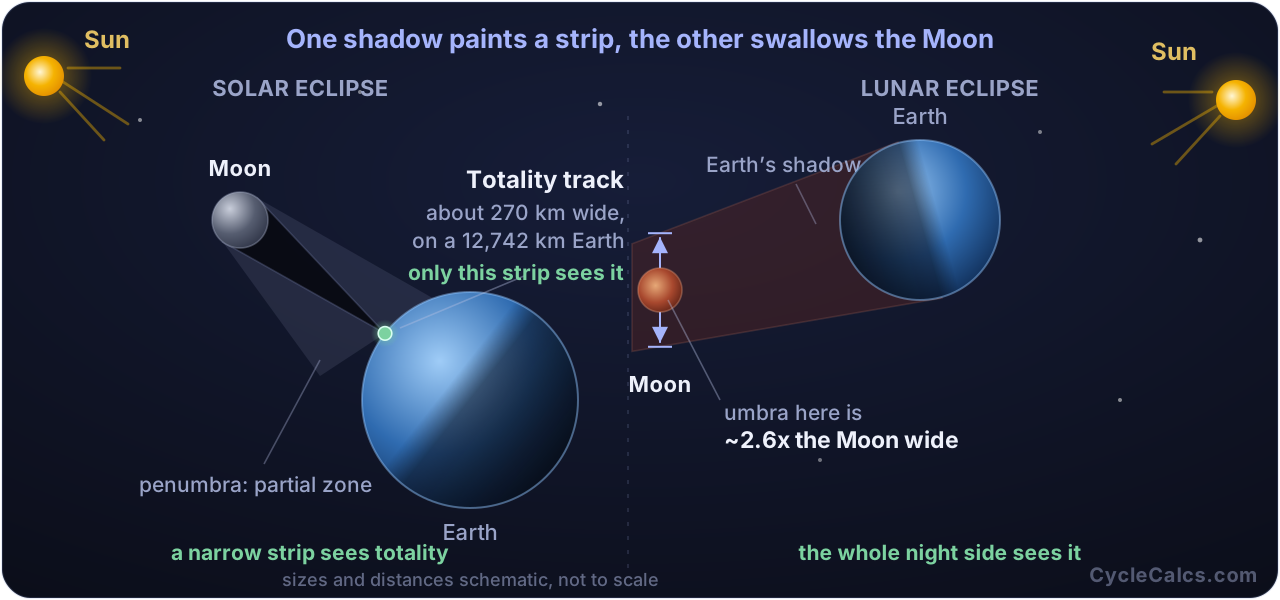
- A solar eclipse happens at new moon, when the Moon slips between Earth and the Sun and casts its shadow onto us. Because that shadow is small, the eclipse is visible only from the narrow track it sweeps across Earth's surface.
- A lunar eclipse happens at full moon, when Earth lies between the Sun and the Moon and the Moon drifts through Earth's shadow. It often glows a deep coppery red, lit only by sunlight bent through the edges of Earth's atmosphere, and it can be seen from the entire night side of Earth at once.
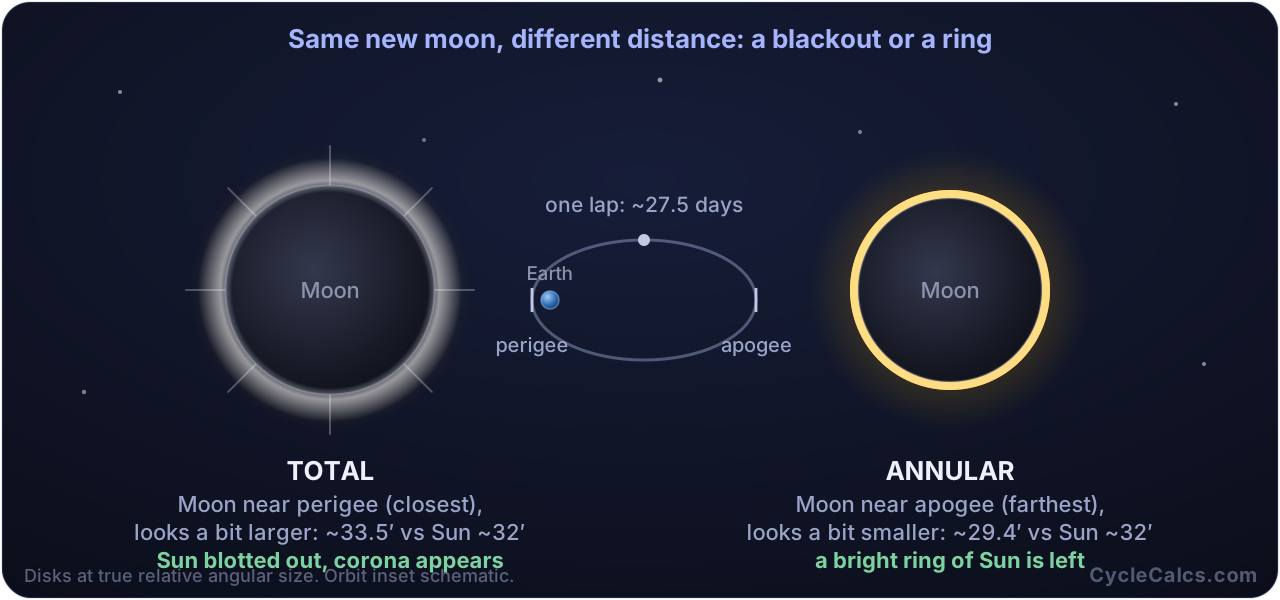
Solar eclipses come in three kinds: total, annular, and partial. Whether a central eclipse turns out total or annular comes down to distance. The Moon's orbit is slightly oval, so its distance from Earth, and with it the Moon's apparent size, changes through the month.
When the Moon is near its closest point it looks just large enough to cover the Sun completely, and we get a total eclipse. When it is near its farthest point its disk is a touch too small, and a brilliant ring of sunlight is left showing all around it, an annular eclipse (from anulus, Latin for ring).
The month-to-month change in distance comes simply from the orbit being an ellipse: the Moon runs from its closest point to its farthest and back over about 27.5 days. The long axis of that ellipse also turns slowly, all the way around about every 8.85 years, a drift called the orbit's apsidal precession, which shifts the longer-term pattern of where total and annular eclipses fall.
Eclipse seasons and the Saros
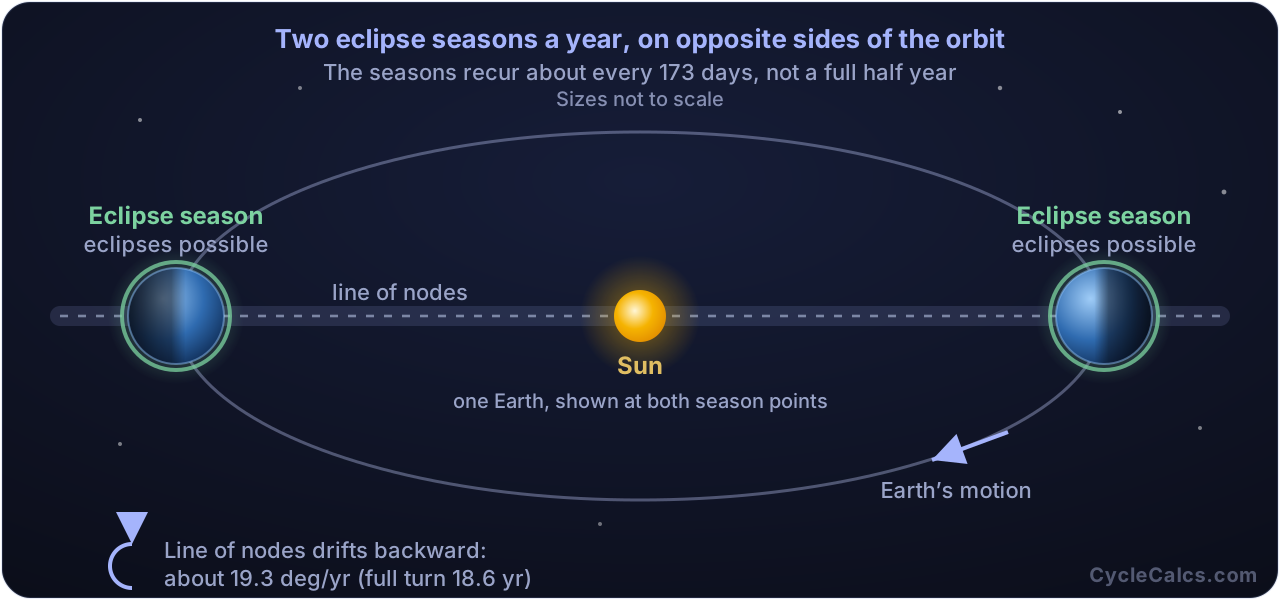
Because an eclipse needs the line of nodes aimed roughly at the Sun, eclipses do not scatter evenly through the year. They cluster into eclipse seasons, windows about a month long that come around every 173 days, a little under six months apart. Meanwhile the nodes themselves slowly swing backward around the sky (the subject of the lunar nodes), which nudges each eclipse season a little earlier from one year to the next.
A longer rhythm is hidden here too. Wait about 18 years and 11 days, a span the ancient astronomers called the Saros, and the Sun, the Moon, and a node return to almost exactly the same positions, producing an eclipse that is nearly a twin of the one before. You can find the Saros, the eclipse year, and the nodal cycle on the cycles by length page.
How the Saros marches west
Because the Saros runs about a third of a day longer than a whole number of days, each eclipse in a series arrives roughly eight hours later than the one before. In those eight hours Earth turns further east, so the new track falls about a third of the way around the globe to the west. After three Saroses, close to 54 years (a span called the exeligmos), the track has nearly circled all the way back. Step through one series below and watch it walk westward.
Look up real eclipses
To see exactly when and where eclipses happen, the next solar and lunar eclipses, the next one visible from your own location with local times, and the Saros series behind any of them, use our Eclipse & Saros Explorer. To watch one happen, with your own contact times, a countdown to each of them and the shadow moving across Earth, open the Eclipse Control Center: the same geometry on this page, driven by a live clock you can also wind forward to any eclipse you like.
Frequently asked questions
Why isn't there an eclipse every new and full moon?
The Moon's orbit is tilted about 5 degrees to Earth's orbit around the Sun, so at most new and full moons the Moon passes above or below the Sun-Earth line and its shadow misses. An eclipse needs the new or full moon to fall near a lunar node, where the two orbits cross.
What is the difference between a solar and a lunar eclipse?
A solar eclipse happens at new moon, when the Moon passes between the Sun and Earth and casts its shadow on Earth. A lunar eclipse happens at full moon, when Earth passes between the Sun and Moon and the Moon moves through Earth's shadow.
What are eclipse seasons?
Eclipse seasons are the roughly month-long windows, about every 173 days, when the line of nodes points toward the Sun so eclipses can occur. Because the nodes slowly drift, eclipse seasons come a little earlier each year.
What is the Saros cycle?
The Saros is a period of about 18 years 11 days after which the Sun, Moon, and a lunar node return to almost the same geometry, producing a nearly identical eclipse. Eclipses are grouped into numbered Saros series.
Sources & further reading
- NASA: Eclipses: overview of how solar and lunar eclipses happen.
- NASA: Types of Solar Eclipses: total, annular, partial, and hybrid explained.
- NASA SVS: 2023 and 2024 Solar Eclipses, Map and Data: shadow-path maps and eclipse geometry.
- NASA SVS: 5000 Years of Total Solar Eclipses: long-term pattern from the Five Millennium Canon.
- Jean Meeus, Astronomical Algorithms: the standard reference for eclipse and Saros computation.
See how these figures are computed on the methodology and sources page.
The eclipse cycle family
Eclipses run on a family of interlocking cycles; each has a reference page with its period, the math, and the next occurrences computed years ahead.
The Draconic Month
The 27.21-day node-to-node month that times every eclipse.
ReferenceThe Eclipse Year
346.62 days, the year that paces the eclipse seasons.
ReferenceThe Saros
18 years 11 days, the cycle that makes eclipses repeat.
ReferenceThe Inex
About 29 years, the Saros's great complement.
ReferenceThe Tritos
11 years less a month, one inex minus one Saros.
ReferenceThe Exeligmos
Three Saroses, an eclipse back at nearly the same longitude.
Keep exploring
The Moon
Tonight’s Moon plus the next lunar and solar eclipses, computed years ahead on one page.
InteractiveMoon Phases
The new and full moons that eclipses depend on, and why the cycle runs 29.5 days.
InteractiveThe Lunar Nodes
The crossing points that make eclipses possible, and their 18.6-year drift.
CalculatorLunar Node Calculator
Pick any date for the node crossings behind an eclipse season, mean model and true node compared.
InteractiveThe Metonic Cycle
The Saros returns eclipses; the Metonic cycle's 235 months in 19 years return the Moon's phases to the same dates.