The Lunar Nodes
The Moon's orbit is tilted, so it crosses the Sun's path at just two points: the nodes. That crossing line slowly turns all the way around every 18.6 years. Scrub the years and watch it go; the orbit (left, from above) and the tilted ring (right, in 3-D) move together.
The lunar nodes are the two points where the Moon's tilted orbit crosses the ecliptic. The line joining them turns all the way around once every 18.6 years (the regression of the nodes), which paces the eclipse seasons and the lunar standstills. The last major standstill, when the Moon's monthly swing was widest, peaked in early 2025; the next minor standstill falls around 2034 and the next major standstill around 2043.
What the nodes are
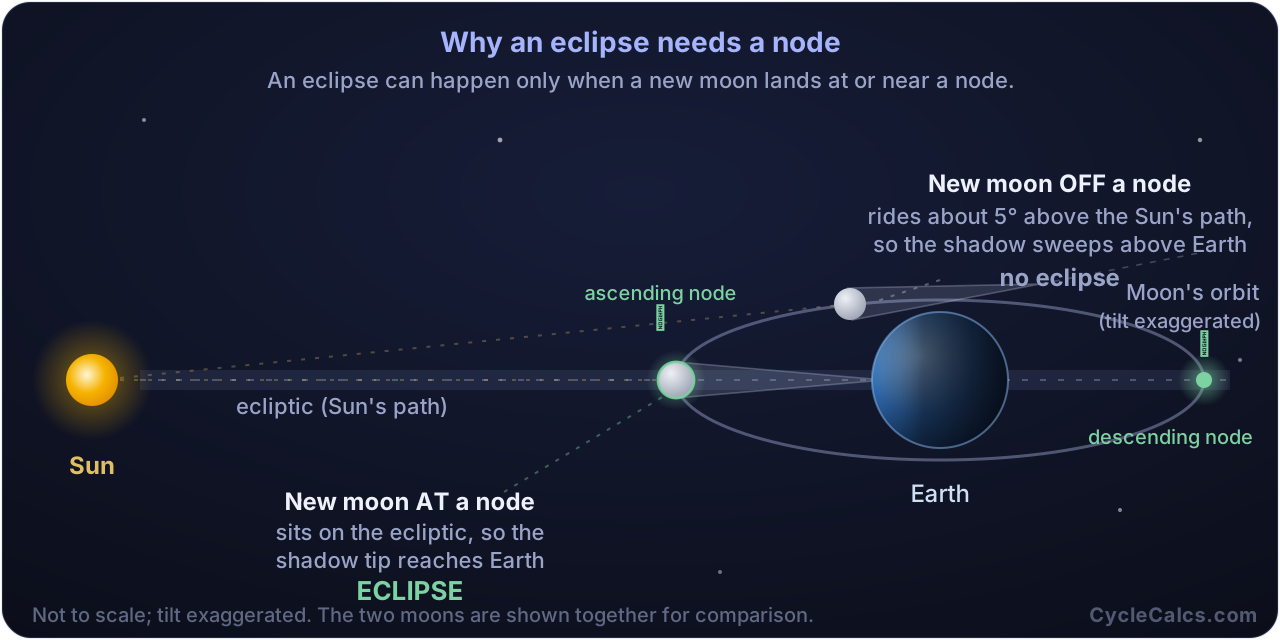
Picture two great rings sharing the same center. One is the flat plane of Earth's orbit around the Sun, which we call the ecliptic (it is also the Sun's apparent path through the year). The other is the Moon's orbit around Earth, tilted about 5 degrees to the first. Two rings tilted against each other can only meet at two points, on opposite sides. Those two meeting points are the lunar nodes. At the ascending node (☊) the Moon is climbing from south of the ecliptic to north of it; half an orbit later, at the descending node (☋), it is sinking back from north to south. Halfway between the nodes the Moon rides at its full 5 degrees above or below the Sun's path. The nodes matter for one big reason: they are the only points where the Moon can sit exactly level with the line from Earth to the Sun, so when a new or full moon happens to fall on a node, the three bodies line up and an eclipse can occur.
The line of nodes turns: 18.6 years
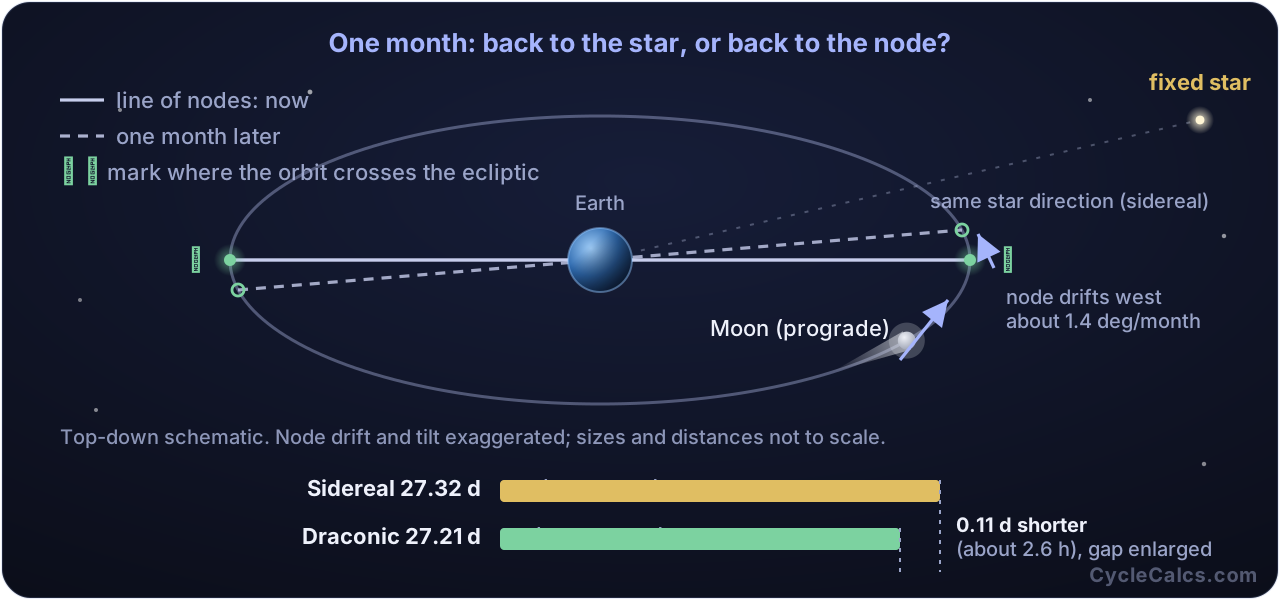
The nodes do not stay fixed among the stars. The whole line of nodes slowly rotates westward, opposite to the Moon's monthly motion, completing one full circle around the ecliptic every 18.6 years. Astronomers call this the regression of the nodes. It happens because the Sun's gravity is constantly tugging on the Moon's tilted orbit, swinging it around in much the same way gravity makes a leaning, spinning top wheel its axis in a slow circle. When you scrub the years in the view above, that 18.6-year drift is what you are watching, sped up enormously.
Why it matters
- Eclipses. An eclipse needs a new or full moon to happen near a node. As the nodes turn, the eclipse seasons creep earlier each year, by about 19 days a year. See Eclipses for the full picture.
- The draconic month. The Moon returns to the same node every 27.21 days, a touch shorter than the 27.32-day sidereal month, because the node has shifted to meet it.
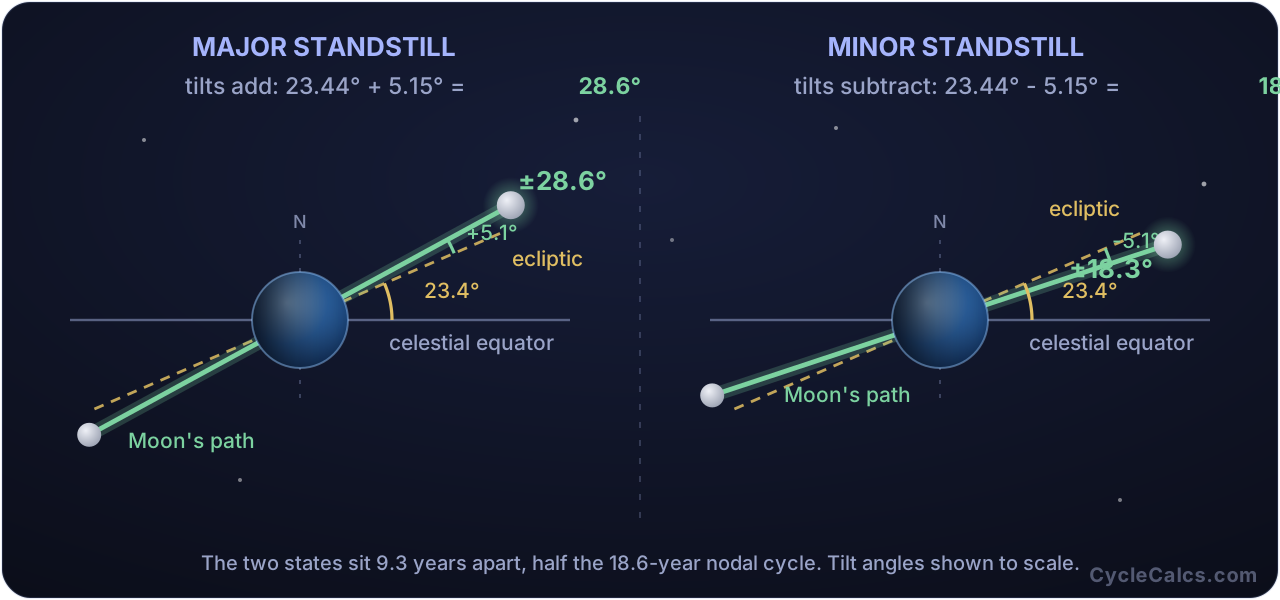
- Lunar standstills. The Moon's 5-degree tilt adds to or subtracts from Earth's 23.4-degree axial tilt as the nodes turn. So the Moon's monthly swing in the sky grows and shrinks: a major standstill of about ±28.6 degrees and, 9.3 years later, a minor standstill of about ±18.3 degrees. Ancient sites such as Callanish and the standing stones at Stonehenge appear to track this rhythm.
- The 18.6-year nodal tide. The same cycle gently modulates the tides and even long-term sea level.
You will find the nodal cycle, the draconic month, and the eclipse year on the cycles by length page.
Lunar standstill clock
The same 18.6-year turn of the nodes drives the lunar standstills. When the nodes line up one way, the Moon's 5-degree tilt adds to Earth's 23.4-degree tilt and the Moon's monthly swing in declination grows to its widest, a major standstill of about ±28.6°; 9.3 years later the tilts partly cancel and the swing shrinks to a minor standstill of about ±18.3°. At a major standstill the full moon rides unusually high and low through the month and casts long shadows, which is why monuments such as Callanish and Stonehenge appear to mark it. Read where the Moon stands today, or check any date.
Mean values from a linear node model. The true node nutates by about ±1.5°, so a real standstill peak can fall a few months either side of these mean dates, and a major standstill is a window roughly two years wide rather than a single day.
Frequently asked questions
What are the lunar nodes?
The lunar nodes are the two points where the Moon's tilted orbit crosses the ecliptic, the plane of Earth's orbit. At the ascending node the Moon crosses going north; at the descending node it crosses going south.
How long is the cycle of the lunar nodes?
The line of nodes slowly turns westward, completing one full circle around the ecliptic in about 18.6 years. This regression of the nodes is what makes eclipse seasons drift earlier each year.
What is a lunar standstill?
Because the Moon's 5-degree tilt adds to or subtracts from Earth's 23.4-degree axial tilt as the nodes turn, the Moon's monthly range of declination swings between a major standstill of about 28.6 degrees and a minor standstill of about 18.3 degrees over the 18.6-year cycle.
When is the next lunar standstill?
The most recent major lunar standstill, when the Moon's monthly swing was widest, peaked in early 2025. The next minor standstill, when the swing is narrowest, falls around 2034, and the next major standstill around 2043. The pattern repeats every 18.6 years as the line of nodes turns.
Sources & further reading
- NASA, Why Do Eclipses Happen?: how the Moon's roughly 5-degree orbital tilt and the eclipse seasons work.
- NASA, The Moon & Eclipses: the tilted lunar orbit and why alignments recur only a few times a year.
- U.S. Naval Observatory, Phases of the Moon: the Astronomical Applications Department's reference on the lunar cycle.
- Lunar node: general-reference overview of the ascending and descending nodes and their 18.6-year regression.
- Jean Meeus, Astronomical Algorithms (Willmann-Bell): the standard reference for the node, draconic month, and standstill computations.
See how these figures are computed on the methodology and sources page.
Keep exploring
Lunar Node Calculator
Pick any date: the mean node and the true node from a real crossing, side by side, with the difference between them.
LiveThe Moon
The Moon’s own page: tonight’s position, the next eclipses, and its orbit’s vital numbers.
InteractiveEclipses
The nodes are what make eclipses possible. See how a new or full moon at a node lines the shadows up.
InteractiveMoon Phases
The monthly cycle of new and full moons that the nodes turn into eclipses.
InteractiveApsidal Precession
The Moon’s other slow turning: its perigee swings forward every 8.85 years.
ReferenceThe numbers and where we stand: the lunar nodal cycle
The regression's exact 6,798.38-day period, where the node points right now, and when the cycle next completes.
ReferenceThe numbers and where we stand: the lunar standstill
The +/-28.6 vs +/-18.3 degree declination limits, where the Moon's swing stands now, and the next major and minor standstills.