The lunar standstill
When does the Moon rise and set at its widest extremes?
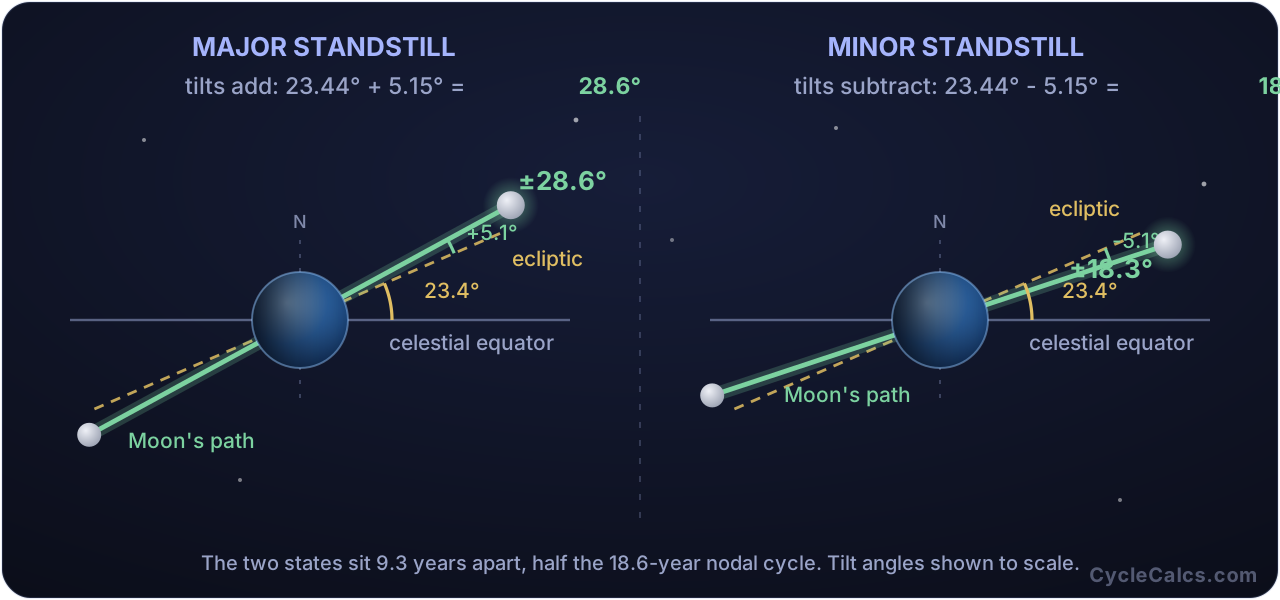
Each month the Moon rides north and south across the sky, but the width of that swing is not fixed. It grows and shrinks over about 18.6 years, the time the Moon's orbital nodes take to regress once around the ecliptic. At a major lunar standstill the monthly swing is at its widest, carrying the Moon to roughly +/-28.6 degrees of declination; at a minor standstill, about 9.3 years later, the swing narrows to only about +/-18.3 degrees.
The word borrows from the solstice. Near a standstill the Moon's extreme rising and setting points on the horizon barely move for months, holding almost still before they reverse. The most recent major standstill spanned 2024 into 2025, and it is the same event that ancient builders tracked: monuments from Stonehenge to the Callanish stones frame a moonrise or moonset that reaches its limit only at the major standstill. The slow turning of the nodes that drives it all is the subject of the lunar nodal cycle.
How it works, in plain language: The lunar nodes. This page carries the numbers.
On this page
The next minor standstill falls around May 21, 2034, when the Moon's monthly swing reaches about 18.4 degrees of declination.
At a major standstill that swing is widest, close to 28.6 degrees; at a minor standstill it narrows to about 18.3 degrees, give or take a fraction of a degree from one cycle to the next. The rhythm follows the 18.6-year regression of the lunar nodes.
Where we are in the lunar standstill right nowcomputed live
The next minor standstill is around May 21, 2034, when the Moon reaches about 18.4 degrees of declination at the edges of its month. Standstills alternate major and minor about every 9.3 years. With JavaScript on, this panel shows the node's position now.
Computed live in your browser from the open-source Astronomy Engine. See every cycle together on the cosmic clock.
The lunar standstill at a glance
| Period | 18.6 years (major to major) |
|---|---|
| Major standstill declination | about +/-28.6 deg |
| Minor standstill declination | about +/-18.3 deg |
| Major-to-minor interval | about 9.3 years |
| Cause | 23.44 deg axial +/- 5.14 deg orbit tilt |
| Most recent major | 2024 into 2025 |
| "Standstill" means | extreme rise/set azimuth holds nearly still |
| Seen at | Stonehenge, Callanish, Chimney Rock |
Sources: U.S. Naval Observatory, Astronomical Information Center.
The lunar standstill in every unit
The standstill cycle can be written several ways, and its two extremes follow directly from adding or subtracting a pair of fixed tilts.
| In years | 18.61 years (major to major) |
|---|---|
| In days | about 6,798.4 days |
| Half-cycle (major to minor) | about 9.3 years, about 3,399 days |
| Major declination | 23.44 deg + 5.14 deg = 28.58 deg |
| Minor declination | 23.44 deg - 5.14 deg = 18.30 deg |
| In draconic months | 6,798.4 d / 27.212221 d = about 249.8 |
| In synodic months | 6,798.4 d / 29.530589 d = about 230.2 |
| Node regression rate | 360 deg / 18.61 yr = about 19.34 deg/yr |
Periods from the USNO and Jean Meeus, Astronomical Algorithms. The 18.61-year nodal period is a mean value; the true monthly swing wanders by a few tenths of a degree from year to year, so the standstill maxima quoted are close bounds rather than sharp lines. Earth's axial tilt (23.44 deg) drifts very slowly, and the Moon's orbital tilt varies by about +/-0.15 deg around 5.14 deg.
What the lunar standstill is and how it arises
A lunar standstill is not a moment but a season, the part of the 18.6-year cycle when the Moon's monthly range of declination reaches an extreme. Declination is angular distance north or south of the celestial equator, the same coordinate that fixes how high a body climbs and where it clears the horizon. In a single month the Moon runs through its full span of declination once, so at a major standstill it swings from far north to far south and back within about 27 days, touching roughly +/-28.6 degrees at the two ends.
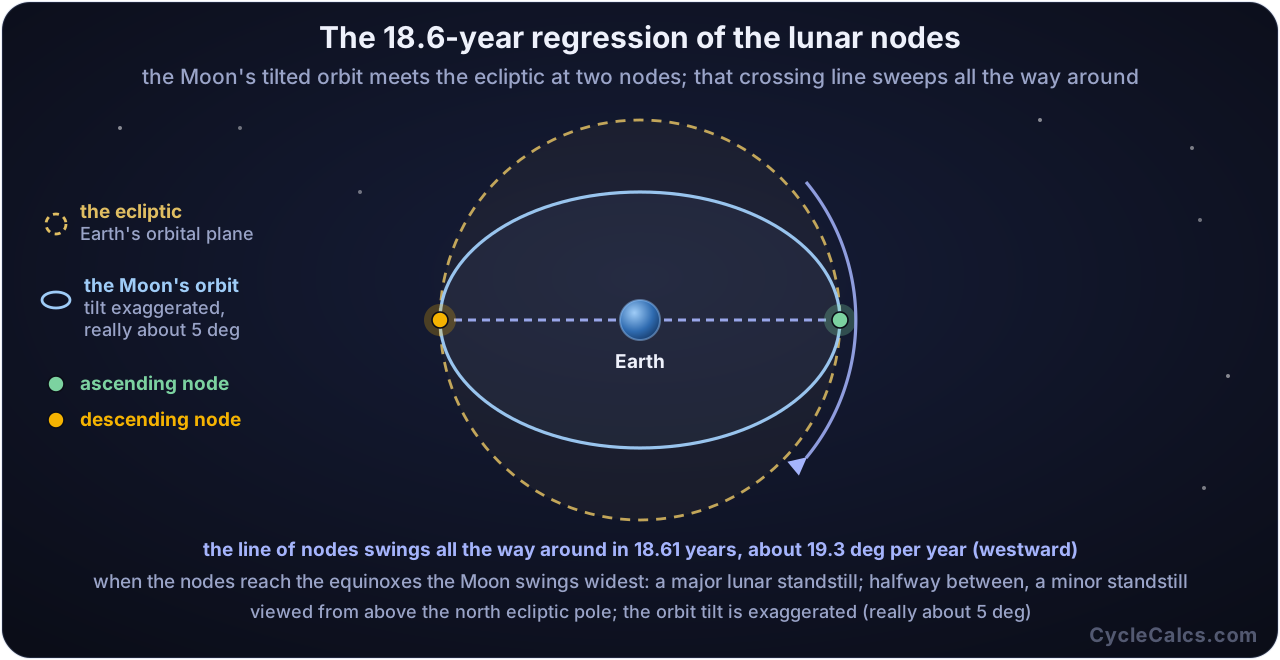
The width of that swing is set by two tilts. Earth's axis leans 23.44 degrees from the plane of its orbit, which is why the Sun itself ranges +/-23.44 degrees over a year. The Moon's orbit is tilted a further 5.14 degrees to the ecliptic. Where the Moon's ascending node, the point where its orbit crosses the ecliptic going north, happens to sit decides whether these tilts add or oppose. When the ascending node lies near the March equinox the two tilts stack, 23.44 + 5.14 = 28.6 degrees, and the Moon can stand higher and lower than the Sun ever does. About 9.3 years later the node has swung to the opposite point, the tilts subtract, 23.44 - 5.14 = 18.3 degrees, and the monthly swing is at its narrowest. That is the minor standstill.
On the ground the effect shows up at the horizon. Through the year the Moon's rise and set points march north and south much as the Sun's do, a link explained under declination and the seasons, but at a major standstill those points reach well beyond the solstice Sun and then, like the Sun at solstice, seem to pause for a month or two before turning back. Many ancient monuments are built to that pause. The station-stone rectangle at Stonehenge frames the southernmost major-standstill moonrise, the Callanish stones in the Outer Hebrides catch the low Moon skimming the hills, and at Chimney Rock in Colorado the full Moon rises between two rock pillars only around the major standstill.
The math
The peak declination at any time follows from the angle between the Moon's orbit plane and the celestial equator. When the two tilts are aligned that angle is the simple sum, 23.44 + 5.14 = 28.58 degrees; when they oppose it is the difference, 23.44 - 5.14 = 18.30 degrees. The Moon's monthly declination extreme therefore breathes between about +/-28.6 and +/-18.3 degrees as the node moves. The controlling quantity is the ecliptic longitude of the ascending node, which slides backward at 360 / 18.61 = about 19.34 degrees per year, completing one turn in 18.61 years, or 6,798.4 days.
Because the node governs both the standstill and the eclipse seasons, the same 18.61-year clock underlies both. The draconic month, the Moon's return to the same node in 27.212221 days, marks each pass through the extremes, and 6,798.4 / 27.212221 gives about 249.8 draconic months in one full standstill cycle. To watch the node's current position and the Moon's declination against these bounds, open the lunar nodal cycle profile and the Moon dashboard.
The next lunar standstills
| Approximate date | Standstill | Peak monthly declination |
|---|---|---|
| May 21, 2034 | Minor standstill | about 18.4 degrees |
| Sep 10, 2043 | Major standstill | about 28.7 degrees |
| Dec 30, 2052 | Minor standstill | about 18.4 degrees |
| Apr 21, 2062 | Major standstill | about 28.6 degrees |
How the lunar standstill relates to other cycles
The standstill is the visible face of the lunar nodal cycle. That page explains the mechanism, the 18.61-year regression of the nodes; this one follows what the regression does to the Moon in the sky. The nodes themselves, and why they matter for eclipses as well as standstills, are covered in the Learn lesson on the lunar nodes.
The monthly half of the story belongs to the draconic month, the 27.212221-day return of the Moon to the same node, which sets how quickly the Moon sweeps between its declination extremes within any one lunation. The idea of declination steering rise and set points along the horizon is the same one behind the solar year; the Learn lesson on the seasons works through it for the Sun before the Moon exaggerates it at a standstill.
Frequently asked questions
What is a lunar standstill?
A lunar standstill is the part of an 18.6-year cycle when the Moon's monthly north-south range in the sky reaches an extreme. At a major standstill the Moon swings to about plus or minus 28.6 degrees of declination each month, rising and setting at its most extreme points on the horizon. At a minor standstill, about 9.3 years later, the swing narrows to about plus or minus 18.3 degrees.
When is the next major lunar standstill?
Major lunar standstills recur every 18.6 years, and the most recent one spanned 2024 into 2025. The next follows one full cycle later, with a minor standstill roughly 9.3 years in between. Because the extreme rise and set points hold nearly still for months, a standstill is a season rather than a single date; the live panel and table on this page give the computed dates from current ephemerides.
What is the difference between a major and minor lunar standstill?
The difference is how far the Moon swings north and south each month. At a major standstill the Moon's orbital tilt of 5.14 degrees adds to Earth's 23.44-degree axial tilt, giving about plus or minus 28.6 degrees of declination. At a minor standstill, about 9.3 years later, the two tilts subtract, 23.44 minus 5.14, so the swing shrinks to about plus or minus 18.3 degrees. Major to major is 18.6 years.
Why does Stonehenge align with the lunar standstill?
Several ancient monuments frame the major-standstill Moon, when it rises and sets at its farthest north and south points. At Stonehenge the station-stone rectangle marks the southernmost major-standstill moonrise. The Callanish stones in Scotland and Chimney Rock in Colorado track the same extreme, which returns only every 18.6 years. Builders could watch the rise points hold nearly still for months, making the limit easy to fix in stone.
What causes the lunar standstill cycle?
The cycle comes from the slow turning of the Moon's orbital nodes, the two points where its tilted orbit crosses the ecliptic. Those nodes regress once around the sky in 18.6 years. As they move, the Moon's 5.14-degree orbital tilt lines up with or against Earth's 23.44-degree axial tilt, widening or narrowing the monthly declination swing between about 28.6 and 18.3 degrees. The same nodal motion also drives the eclipse seasons.
When is the next lunar standstill?
The next minor standstill is around May 21, 2034, when the Moon's monthly range in declination reaches about 18.4 degrees. Major and minor standstills alternate roughly every 9.3 years, following the 18.6-year regression of the lunar nodes. The most recent major standstill spanned 2024 into 2025.
Keep exploring
- Lunar Nodal Cycle: the 18.61-year mechanism behind it
- The Lunar Nodes: where the orbit crosses the ecliptic
- Draconic Month: the 27.21-day return to a node
- The Moon: live declination and phase dashboard
- The Seasons: declination and the horizon