Which planets are retrograde right now?
On this page
Right now, four planets are retrograde: Venus (since October 3), Saturn (since July 26), Uranus (since September 10) and Neptune (since July 7). The next change comes when Mercury stations retrograde on October 24.
Station instants are computed to the minute with the same open-source ephemeris that runs this site's live tools, and the board and tables convert every instant to your own time zone.
| Planet | Right now | The dates |
|---|---|---|
| Mercury | Direct | Retrograde again October 24 to November 13. |
| Venus | Retrograde | Since October 3; direct again November 14. |
| Mars | Direct | Retrograde again January 10, 2027 to April 1, 2027. |
| Jupiter | Direct | Retrograde again December 13 to April 13, 2027. |
| Saturn | Retrograde | Since July 26; direct again December 10. |
| Uranus | Retrograde | Since September 10; direct again February 8, 2027. |
| Neptune | Retrograde | Since July 7; direct again December 12. |
| Pluto dwarf planet | Direct | Retrograde again May 8, 2027 to October 18, 2027. |
The board reads from the station catalog on this page and re-checks itself every time you load it. Dates follow your time zone, so they can sit a day off a UTC-based list you read elsewhere; both are correct.
A retrograde planet has not turned around. Its steady eastward orbit continues exactly as before; what changes is the view from a moving Earth. When our faster planet overtakes a slower outer one, or an inner planet overtakes us, the line of sight swings backward for a few weeks or months and the planet appears to drift westward against the stars. The full geometry, with an interactive you can steer, lives in our retrograde motion lesson; this page is the calendar it points at.
Every retrograde of 2026 and 2027
| Planet | Stations retrograde | Stations direct | Length | Loops in |
|---|---|---|---|---|
| Uranus | September 6, 2025, 04:42 UTC | February 4, 2026, 02:17 UTC | 151 days | Taurus |
| Jupiter | November 11, 2025, 16:45 UTC | March 11, 2026, 03:26 UTC | 119 days | Gemini |
| Mercury | February 26, 2026, 06:47 UTC | March 20, 2026, 19:35 UTC | 23 days | Pisces into Aquarius |
| Pluto dwarf planet | May 6, 2026, 15:45 UTC | October 16, 2026, 02:24 UTC | 162 days | Capricornus |
| Mercury | June 29, 2026, 17:37 UTC | July 23, 2026, 22:57 UTC | 24 days | Gemini |
| Neptune | July 7, 2026, 11:21 UTC | December 12, 2026, 22:14 UTC | 158 days | Pisces |
| Saturn | July 26, 2026, 19:58 UTC | December 10, 2026, 23:24 UTC | 137 days | Pisces into Cetus |
| Uranus | September 10, 2026, 18:40 UTC | February 8, 2027, 12:24 UTC | 151 days | Taurus |
| Venus | October 3, 2026, 07:10 UTC | November 14, 2026, 00:21 UTC | 42 days | Virgo |
| Mercury | October 24, 2026, 07:16 UTC | November 13, 2026, 15:52 UTC | 20 days | Libra into Virgo |
| Jupiter | December 13, 2026, 00:59 UTC | April 13, 2027, 02:13 UTC | 121 days | Leo into Cancer |
| Mars | January 10, 2027, 13:01 UTC | April 1, 2027, 14:10 UTC | 81 days | Leo |
| Mercury | February 9, 2027, 17:36 UTC | March 3, 2027, 12:35 UTC | 22 days | Aquarius into Capricornus |
| Pluto dwarf planet | May 8, 2027, 12:15 UTC | October 18, 2027, 03:51 UTC | 163 days | Capricornus |
| Mercury | June 10, 2027, 18:19 UTC | July 4, 2027, 19:41 UTC | 24 days | Gemini into Taurus |
| Neptune | July 9, 2027, 22:50 UTC | December 15, 2027, 09:43 UTC | 158 days | Pisces |
| Saturn | August 9, 2027, 17:53 UTC | December 24, 2027, 02:49 UTC | 136 days | Pisces |
| Uranus | September 15, 2027, 09:15 UTC | February 12, 2028, 23:40 UTC | 151 days | Taurus |
| Mercury | October 7, 2027, 14:40 UTC | October 28, 2027, 14:10 UTC | 21 days | Virgo |
Times shown in your local time zone.
The pattern in the table is worth a second look. During 2026, the busiest overlap runs from October 24 to November 13, when five of the seven planets are retrograde at once. At the other extreme, from March 21 to June 29, not one of the seven is retrograde: about 14 weeks when every planet tracks steadily eastward. Both extremes are ordinary geometry, nothing more.
What a station actually is
The moments bracketing each window are the stations, and they are gentler than the word suggests. A planet approaching its station does not brake and stop; its apparent eastward drift simply slows, reaches zero for an instant, and reverses. Near the station a planet crawls, covering only arcminutes per day, which is why the dates in the table carry exact times: the instant is real and computable even though nothing visible happens at that moment. The whole cycle looks like this:
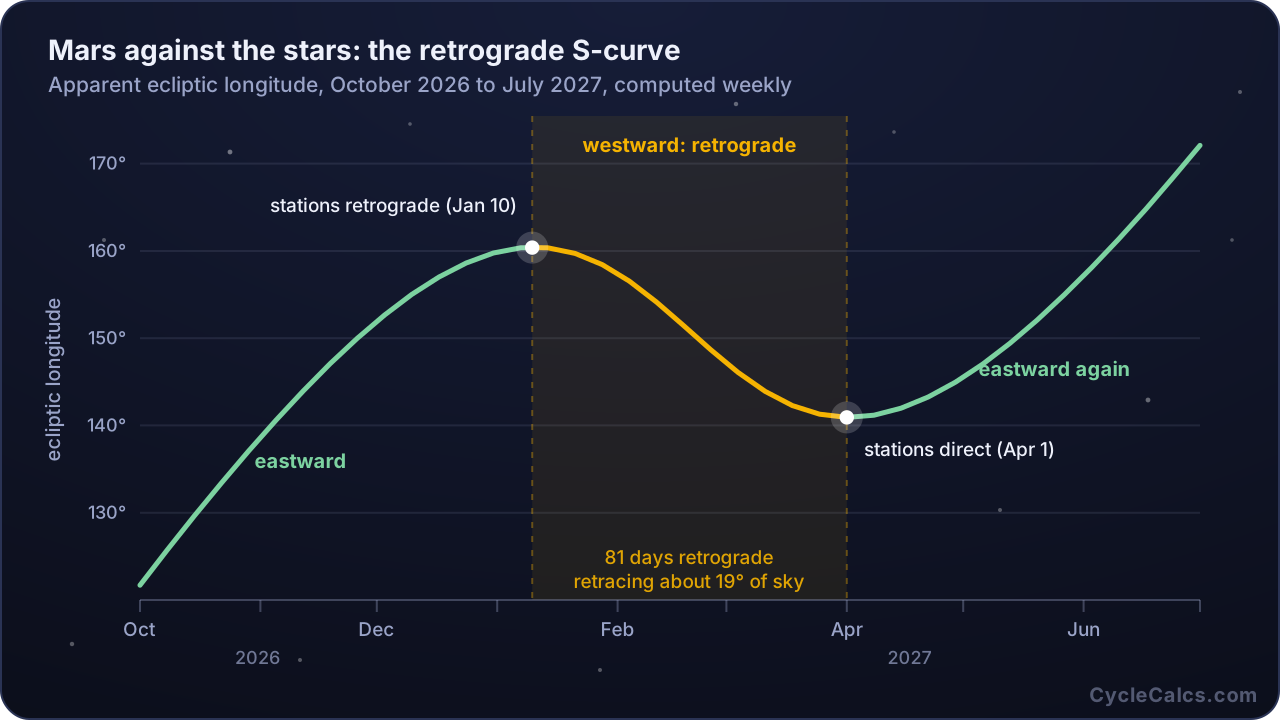
How sharply the curve turns depends on the planet. Mercury sprints through its whole loop in about three weeks; Mars takes about two and a half months; Neptune's version is a five-month glacial drift so slow that only a telescope and careful charting would ever reveal it.
Retrograde is routine
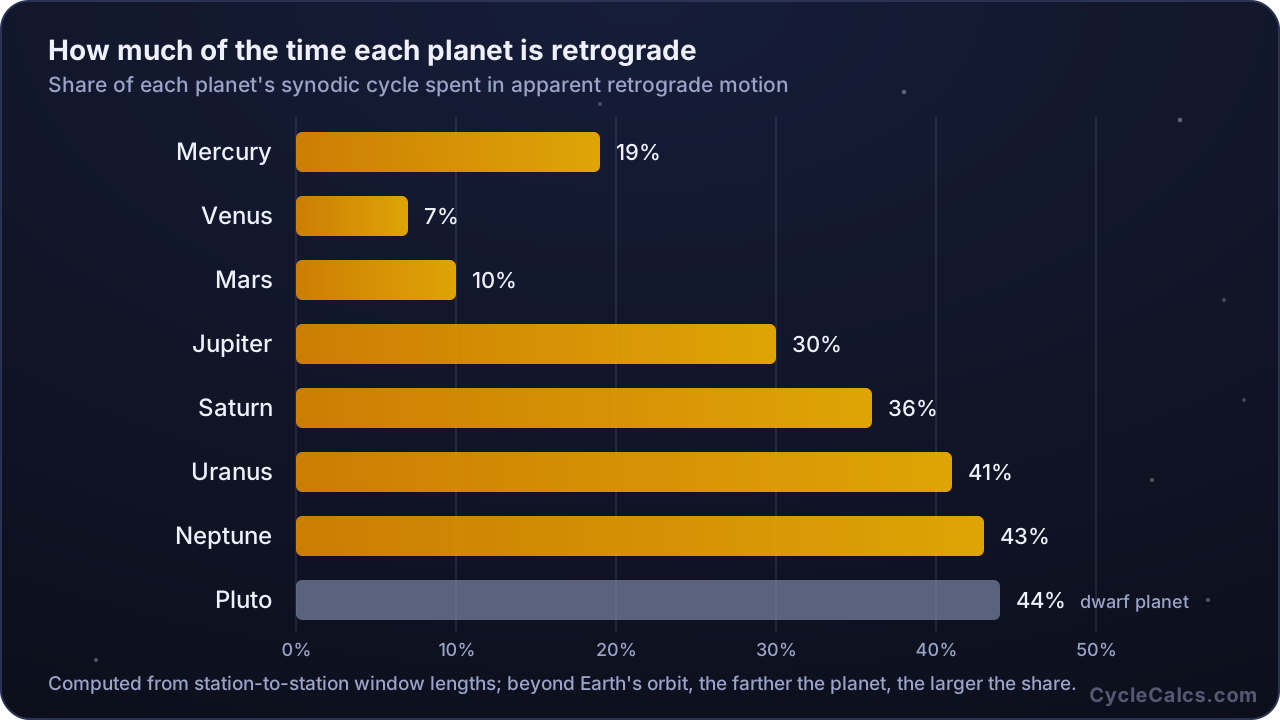
Among the planets beyond Earth's orbit, the farther one sits from the Sun, the larger the share of its time it spends retrograde: each pass through opposition brings a retrograde window, and for the slow outer planets those windows stretch for months. Mercury plays by a different rule: it laps Earth about every 116 days, and those frequent short windows add up to a bigger share than Venus or Mars manages. Averaged over their synodic cycles: Mercury about 19%, Venus about 7%, Mars about 10%, Jupiter about 30%, Saturn about 36%, Uranus about 41% and Neptune about 43%. Pluto, for completeness, is near 44%. Venus is the rarity: its retrograde comes only once every 19 to 20 months, and whole calendar years pass without one (2027 has not a single Venus retrograde day).
Why the dates you read elsewhere can differ
A station is one instant, the same everywhere on Earth; the calendar square it lands on is not. A station at 06:47 UTC belongs to that date in London, but in Los Angeles the clock still reads the previous evening. Sites that publish bare dates without times have silently chosen a time zone for you, usually US Eastern. This page refuses to choose: the table above shows the exact instants, your browser converts them to your own zone, and if your date sits one calendar square off a date you read somewhere else, the two are describing the same moment.
Seeing it for yourself
Retrograde motion is one of the few planetary phenomena you can genuinely measure with your eyes and patience. Pick the next bright-planet window from the table, for instance Saturn from July 26 to December 10, and note the planet's position against two or three nearby stars every few nights. The drift is slowest near the stations and fastest around the middle of the window: follow it there and over three or four weeks the westward march becomes unmistakable, and you will have repeated the observation that forced astronomy to put the Sun at the center of the solar system.
Our Sky Map flags any planet currently retrograde on its object card, and the Live Orrery's geocentric trails draw the loops for any date range. To watch the current or next loop of Mars unfold with its real dates, open why Mars goes backward in the orrery. For the deeper question of why the loops happen at all, the retrograde lesson walks the geometry with an interactive, and the synodic rhythm sets the lap-cycle beat that times every window on this page.
Frequently asked questions
What does it mean when a planet is retrograde?
For a stretch of weeks or months, the planet appears to drift westward against the background stars instead of its usual eastward creep, tracing a slow loop or zigzag before resuming normal motion. Nothing about the planet's real orbit changes. The reversal is a line-of-sight effect that appears whenever Earth and the planet lap one another on their orbits around the Sun.
How many planets can be retrograde at the same time?
Several at once is routine, because the four outermost planets each spend about a third or more of their time retrograde and their windows overlap heavily. During 2026, the busiest stretch runs from October 24 to November 13, when five of the seven planets are retrograde at once.
Is retrograde motion rare?
No. Averaged over time, Mercury is retrograde about 19% of the time, Venus about 7%, Mars about 10%, Jupiter about 30%, Saturn about 36%, Uranus about 41% and Neptune about 43%. Overlap is the norm rather than the exception, though the opposite also happens: 2026 has a stretch of about 14 weeks, from March 21 to June 29, with none of the seven planets retrograde.
Can I watch retrograde motion happen?
Not in a single night; over one evening a planet rises and crosses the sky with the stars like everything else. The loop reveals itself over weeks. Note a planet's position against nearby background stars once or twice a week and the westward drift becomes obvious; our Sky Map flags any planet that is currently retrograde, and the Live Orrery's Earth-view trails draw the loops for any date range you like.
Do retrograde planets affect anything on Earth?
No. A retrograde planet is exactly as far away and exactly as bright as it would otherwise be; the only thing that changes is the direction it appears to drift against the stars, and even that is an artifact of Earth's own motion. Claims that retrograde periods disrupt technology or decision-making have no physical mechanism and no statistical support.
Why do retrograde dates differ between websites?
A station is a single instant, and its calendar date depends on your time zone: a station at 06:47 UTC is still the previous evening in California. Many astrology sites publish dates in US Eastern time without saying so, and some also list longer "shadow" periods before and after the event, which are not part of the astronomical motion. This page shows the exact instants and converts them to your own time zone.
Keep exploring: every Mercury retrograde through 2031 with exact times, the retrograde motion lesson for the geometry, the synodic period calculator for the lap arithmetic behind the rhythm, and tonight's sky map to find the planets themselves.
Cite this page
CycleCalcs, "Which Planets Are Retrograde Right Now?", CycleCalcs LLC, https://www.cyclecalcs.com/retrograde.html (add your access date).
Every computed value on this page is public domain: CycleCalcs asserts no copyright in calculated astronomical facts and dedicates any such right to CC0, stated here. Quote the numbers freely, with or without credit. Conventions and sources: the engine and sources.