Neptune
Neptune is the most distant planet, a 17-Earth-mass giant orbiting about 30 times farther from the Sun than Earth, and the only planet located by calculation before anyone knowingly saw it. Uranus kept drifting off its predicted course, so John Couch Adams and Urbain Le Verrier independently computed where an unseen world's gravity must be pulling it. In 1846 Johann Galle pointed a telescope at the predicted spot and found Neptune within a degree of it, on his first night of searching.
One Neptune year lasts 164.77 Earth years, so the planet has completed just one full orbit since its discovery. It is the only planet that never reaches naked-eye brightness; you need binoculars to spot it and a telescope to see a disk. The live panel below shows where it sits in your sky tonight.
On this page
Neptune reaches opposition next on September 28, 2027, when Earth passes between it and the Sun. Around that date it rises near sunset, stays up all night, and shines at its brightest for the apparition (magnitude +7.8) in the constellation Pisces.
Tonight's position and rise and set times for your location are in the live panel below; the month-by-month table shows where Neptune sits through the coming year.
Neptune spins once about every 16.11 hours, so a day on the most distant major planet is close to two thirds of an Earth day. It also has the fastest winds in the solar system, clocked near 2,000 kilometers per hour.
Neptune tonight from your location
Enter coordinates
This panel computes tonight's position and rise and set times for Neptune in your browser, and it needs JavaScript to run. The rest of this page, including the month-by-month table below, is fully readable without it. For a live all-sky view, open the Sky Map or Today in the Sky.
Everything is computed on your device. Tapping "Use my location" names your city from a place index served with this page. Times appear in your device's time zone.
Neptune at a glance
| Mean distance from the Sun | 4,515.0 million km (30.1 AU) |
|---|---|
| Distance from Earth | 4,319.0 to 4,711.0 million km |
| Equatorial diameter | 49,528 km (3.9 × Earth's) |
| Mass | 1.02 × 10²⁶ kg (17.1 Earths) |
| Gravity (mean, at the cloud tops) | 11.27 m/s² (1.15 × Earth's) |
| Escape velocity | 23.5 km/s |
| Rotation period (sidereal) | 16.11 hours |
| Orbital period | 164.77 years (one full orbit since its discovery) |
| Synodic period (opposition to opposition) | 367.5 days |
| Axial tilt | 28.32° |
| Temperature at the cloud tops | about −201 °C (at the 1-bar level) |
| Atmosphere | 80% hydrogen, 19% helium, 1.5% methane; winds up to 580 m/s |
| Moons | 16 known |
| Rings | yes: faint |
| Brightest apparent magnitude | +7.7 (never visible to the naked eye) |
| Discovered | Johann Galle, 1846, within a degree of Le Verrier's prediction |
Physical data: NASA NSSDCA Neptune Fact Sheet. Orbital period: the mean sidereal value from Meeus, Astronomical Algorithms, ch. 31, in Julian years of 365.25 days.
Where is Neptune month by month?
The table below tracks Neptune through the next twelve months: the constellation it sits in on the 15th of each month (dates in Universal Time), whether it is a morning object, an evening object or up all night, and how bright it looks.
| Month | Constellation | Where to look | Magnitude |
|---|---|---|---|
| Oct 2026 | Pisces | Up most of the night | +7.8 |
| Nov 2026 | Pisces | Evening sky, after dusk | +7.8 |
| Dec 2026 | Pisces | Evening sky, after dusk | +7.9 |
| Jan 2027 | Pisces | Evening sky, after dusk | +7.9 |
| Feb 2027 | Pisces | Evening sky, after dusk | +7.9 |
| Mar 2027 | Pisces | Lost in the Sun's glare | +8.0 |
| Apr 2027 | Pisces | Morning sky, before dawn | +8.0 |
| May 2027 | Pisces | Morning sky, before dawn | +7.9 |
| Jun 2027 | Pisces | Morning sky, before dawn | +7.9 |
| Jul 2027 | Pisces | Morning sky, before dawn | +7.9 |
| Aug 2027 | Pisces | Up most of the night | +7.8 |
| Sep 2027 | Pisces | Up most of the night | +7.8 |
How to see Neptune
Neptune never becomes bright enough for the naked eye; no ancient culture ever recorded it. Astronomers grade brightness on the magnitude scale, where lower numbers mean brighter objects. At its very best, around opposition (the point in the year when Earth passes between Neptune and the Sun and the planet is closest), it reaches magnitude 7.67, still below what an unaided eye can detect even under a perfect dark sky.
Binoculars bridge the gap easily. From a reasonably dark spot, any ordinary pair will pull Neptune in, but it looks like nothing more than a faint bluish star, so the real work is identification: know which field it sits in tonight, star-hop there, and pick out the one point that does not belong on the chart.
A telescope is where Neptune finally gives itself away. Push the magnification as high as the night's steady air allows and the star-like point resolves into a tiny, even, blue-gray disk, about 2.3 arcseconds across at opposition (an arcsecond is 1/3600 of a degree), the smallest disk any planet shows us. Do not expect surface detail; at this distance you are only confirming a disk. Stars stay sharp points and twinkle, while Neptune holds a calm, rounded softness with a distinctly cool tint. Return a week later and the "star" will have crept against its neighbors.
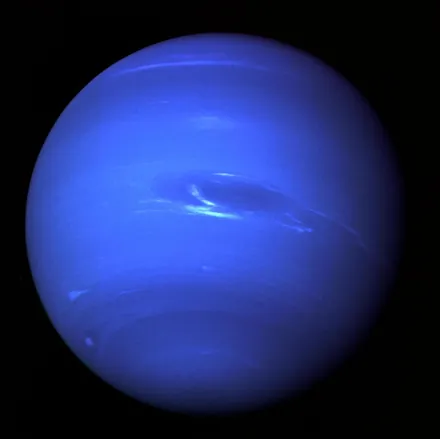
The color is easy to misjudge, too. The deep azure in famous Voyager 2 portraits is a close-range spacecraft view; at the eyepiece the tint is a muted blue-gray. That serene shade hides the fiercest weather in the solar system, with winds measured at up to 580 meters per second, around 1,300 miles per hour.
Neptune's cycles
Neptune's defining rhythm is sheer slowness. One trip around the Sun takes 164.77 years, so the planet creeps only about 2 degrees eastward against the stars each year; it spends years crossing a single constellation, and a whole human lifetime covers barely half of its single trip around the sky. Watch it on the Sky Map and it looks nailed in place from month to month; only the slow year-over-year drift betrays it as a wanderer.
That slowness sets the pace of the observing calendar. Neptune's synodic period, the time from one opposition to the next, is 367.49 days, barely more than a calendar year: Earth laps a target that has hardly moved, so each opposition falls just two or three days later than the last. The synodic vs sidereal lesson explains why those two clocks differ, and the weeks around opposition are the time to run your gear through the Telescope Calculator and see what magnification a 2.3-arcsecond disk demands.
Farther out, Neptune is tied to something stranger still. It is locked in a true 3:2 orbital resonance with Pluto: Neptune completes three orbits in the time Pluto completes two. Pluto's stretched path even brings it closer to the Sun than Neptune for part of each circuit, yet the resonance choreographs their motion so that they are never near the crossing region at the same time. They can never collide. Gravity itself governs the timing, and that is what a true resonance means.
No two planets meet less often. A conjunction of Uranus and Neptune, the two outermost giants passing each other in our sky, comes around less than once in a typical human lifetime. Fittingly, Uranus is the planet whose wanderings gave Neptune away in the first place.
To see where these periods fit among everything else that repeats overhead, read the full the Neptune synodic period profile, or find it sorted by length in the complete cycles list.
What's next for Neptune
Over the next few years, Neptune's calendar comes down to two kinds of event: the oppositions worth circling, and the solar conjunctions that hide it behind the Sun for a few weeks. Computed with the same engine that runs this site's live sky tools; dates are in Universal Time.
| Date | Event |
|---|---|
| Mar 24, 2027 | Solar conjunction: passes behind the Sun and out of view for a few weeks |
| Sep 28, 2027 | Opposition: closest and brightest for the year (magnitude +7.8) in Pisces |
| Mar 26, 2028 | Solar conjunction: passes behind the Sun and out of view for a few weeks |
| Sep 30, 2028 | Opposition: closest and brightest for the year (magnitude +7.8) in Cetus |
| Mar 28, 2029 | Solar conjunction: passes behind the Sun and out of view for a few weeks |
| Oct 2, 2029 | Opposition: closest and brightest for the year (magnitude +7.8) in Cetus |
| Mar 31, 2030 | Solar conjunction: passes behind the Sun and out of view for a few weeks |
| Oct 5, 2030 | Opposition: closest and brightest for the year (magnitude +7.8) in Pisces |
| Apr 2, 2031 | Solar conjunction: passes behind the Sun and out of view for a few weeks |
| Oct 7, 2031 | Opposition: closest and brightest for the year (magnitude +7.8) in Pisces |
Frequently asked questions
How was Neptune discovered?
By mathematics first. Uranus kept straying from its computed orbit, and John Couch Adams and Urbain Le Verrier independently worked out that the gravity of an unknown planet farther out could explain the drift. Le Verrier sent his predicted position to the Berlin Observatory, and on the night of September 23, 1846, Johann Galle found Neptune within about a degree of that prediction.
Can you see Neptune without a telescope?
Not with the naked eye. Neptune peaks at magnitude 7.67 (lower magnitude numbers mean brighter), which is below what an unaided eye can reach even under a very dark sky. Ordinary binoculars will show it from a dark site, but only as a faint star-like point, so you need a chart of its current position to know which point is the planet.
Why is Neptune blue?
Its atmosphere is mostly hydrogen and helium with about 1.5 percent methane, and methane absorbs the red part of sunlight while the blue part scatters back into space, so the planet reflects a blue tone. Through an amateur telescope the color is a subtle blue-gray; the deep azure in famous spacecraft images is the same methane effect, boosted by close range and image processing.
How long is a day and a year on Neptune?
Neptune spins fast for its size: one rotation takes about 16.1 hours, so its day is far shorter than Earth's. Its year is enormous: one full orbit of the Sun takes 164.77 Earth years, which means Neptune has completed only one orbit since its discovery in 1846.
Will Neptune and Pluto ever collide?
No. Pluto's stretched orbit does bring it closer to the Sun than Neptune for part of each circuit, but the two are locked in a 3:2 orbital resonance: Neptune completes three orbits in the time Pluto completes two. That repeating rhythm always keeps them far apart whenever their paths come near each other, so a collision cannot happen.
When is the next Neptune opposition?
Neptune reaches opposition on September 28, 2027. At opposition Earth passes directly between Neptune and the Sun, so it rises around sunset, stays visible all night, and is at its closest and brightest for the year, about magnitude +7.8 in Pisces.
Keep exploring
- Sky Map: star-hop to Neptune's exact field from your location tonight
- Telescope Calculator: what your scope can make of a 2.3-arcsecond disk
- Uranus: the drifting planet that gave Neptune away, and an easier first target
- Pluto: Neptune's 3:2 resonance partner, forever kept out of reach
- Synodic vs Sidereal lesson: why Neptune's opposition slips only two or three days a year