The Equation of Time and the Analemma
A clock keeps a perfectly even day, but the real Sun does not. Through the year the Sun runs a little ahead of the clock, then a little behind, by as much as a quarter of an hour. Slide through the months and watch the two causes add up (left), then watch the Sun trace its figure-eight analemma in the noon sky (right).
On this page
How a sundial drifts from the clock
If you set up a perfect sundial in your garden and a perfect clock beside it, you might expect them to agree at noon every day. They almost never do. On some dates the Sun reaches its highest point in the sky several minutes before your clock strikes twelve, and on others several minutes after.
The gap, measured day by day, is called the equation of time. Here the word equation keeps its old meaning of a correction you add to make two things equal, not a formula with an equals sign.
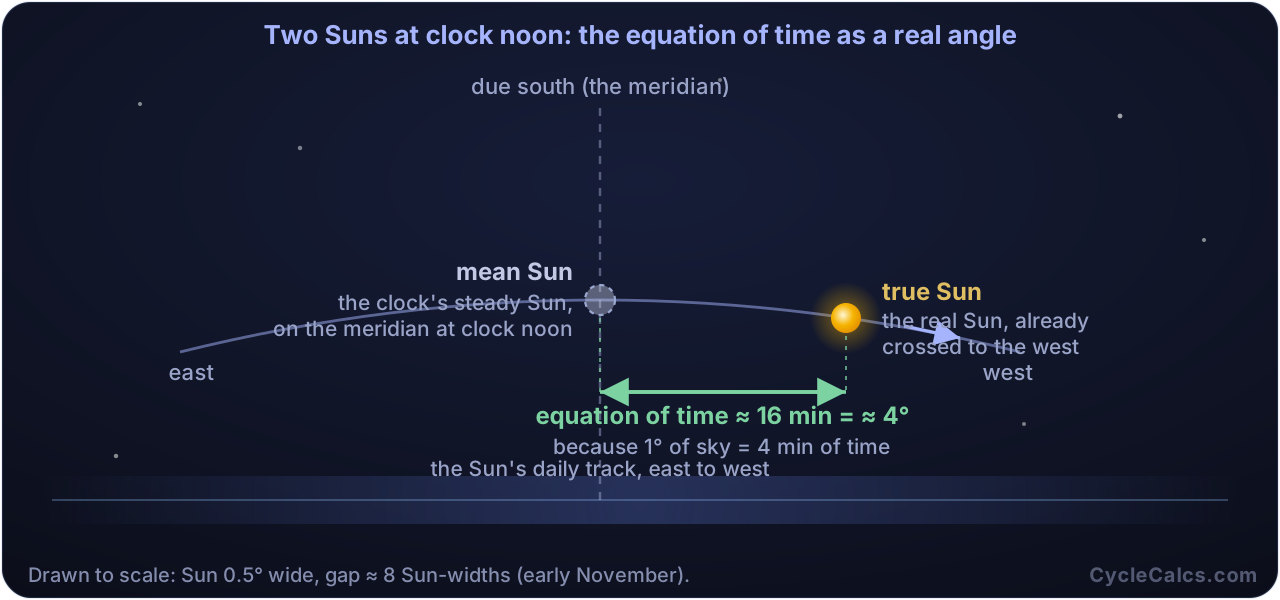
Across a year the gap is never large, but it is surprisingly stubborn. It reaches about 16 minutes ahead of the clock in early November and about 14 minutes behind in mid February, and it passes through zero four times. None of this is the Sun misbehaving. It comes from two simple facts about Earth's motion that the clock quietly ignores, and the live curve on the left shows each one as its own gentle wave.
Two kinds of time
There are really two different Suns in this story. The first is the actual Sun in the sky. The moment it crosses due south and stands at its highest is called apparent solar noon, and a sundial faithfully tracks this apparent solar time. The trouble is that apparent solar days are not all the same length. From one real noon to the next can be a little more or a little less than 24 hours, and those small differences pile up.
So for everyday timekeeping we invented a second, imaginary Sun that moves at a perfectly steady pace all year. The time it would keep is called mean solar time, and that is what your clock shows. The equation of time is simply the first minus the second: apparent time minus mean time, the sundial minus the clock.
When it is positive the sundial is ahead, meaning the real Sun reaches the meridian before clock noon. When it is negative the sundial lags behind. The readout above turns this into a plain sentence, including the clock time at which the Sun really crosses the meridian, its highest point, each day.
Cause one: Earth's lopsided orbit
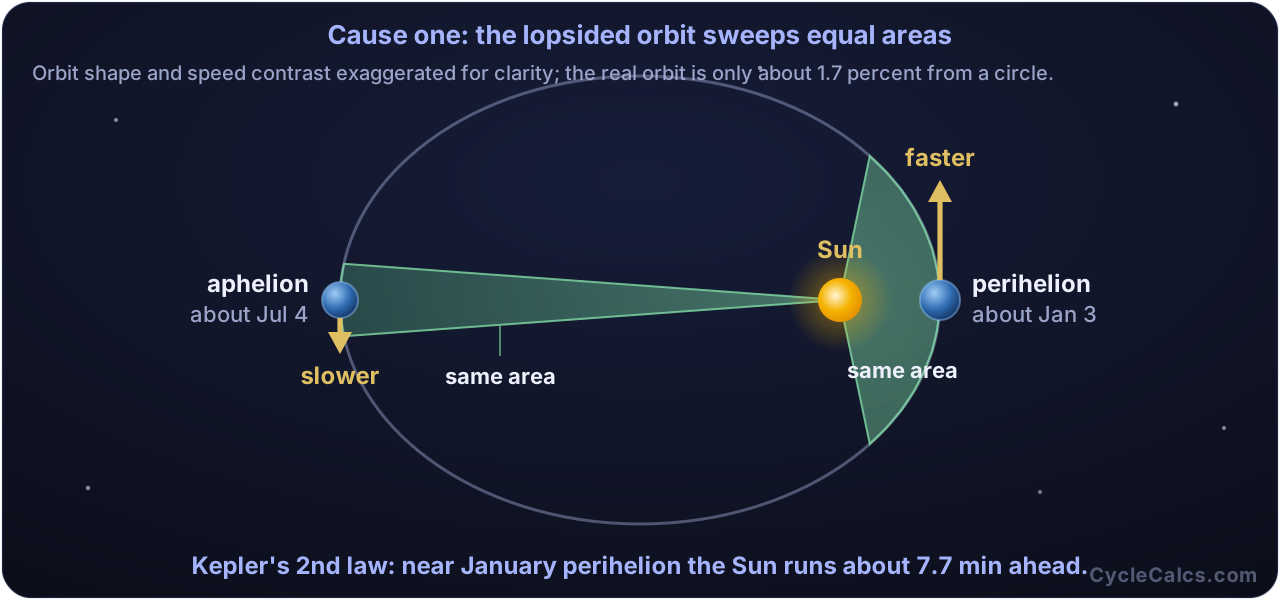
Earth's orbit is not a perfect circle but a slightly flattened ellipse. That means our distance from the Sun changes a little through the year, and by Kepler's second law our speed changes with it. Earth sweeps along fastest at perihelion, its closest approach around the 3rd of January, and slowest at aphelion, its farthest point around the 4th of July. Because we are the ones moving, the Sun appears to slide across the background sky faster in January and slower in July.
The steady mean Sun cannot keep up with these changes, so the true Sun runs ahead of it for half the year and behind it for the other half. This is the eccentricity effect, drawn in green on the curve. It is a single smooth wave that rises and falls once a year, about 7.7 minutes at its largest, and it passes through zero right at perihelion and aphelion, where the true Sun and the steady mean Sun momentarily draw level again: the lead the true Sun builds up over half the orbit is exactly repaid over the other half.
Cause two: the tilt of the axis
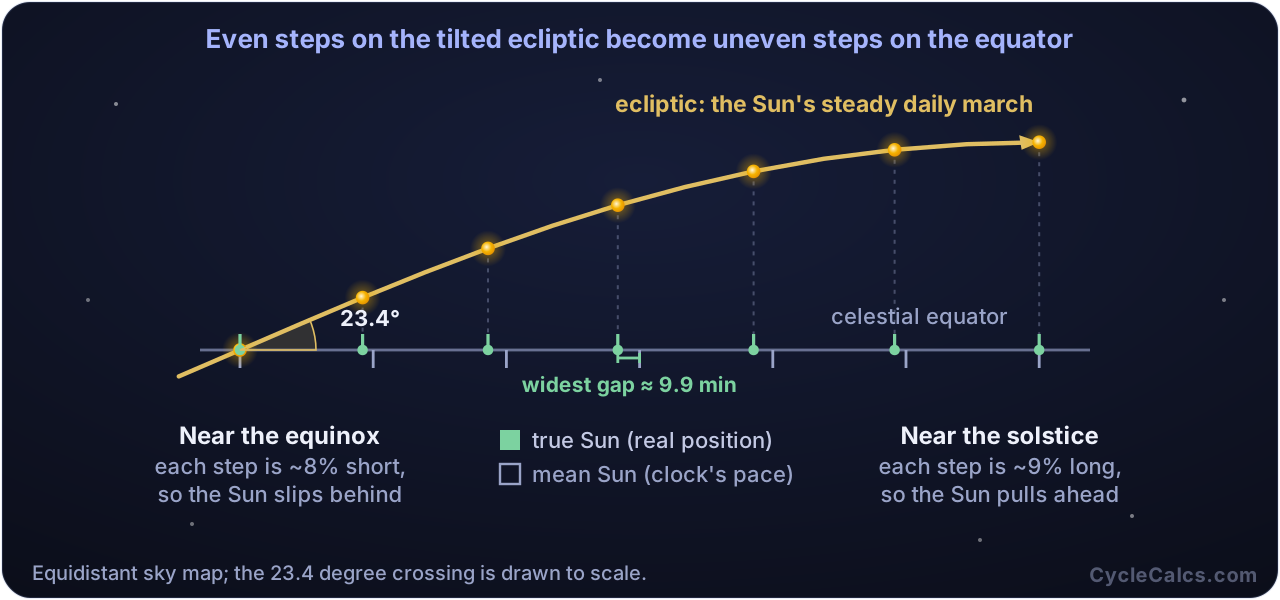
The second cause is the 23.4 degree tilt of Earth's axis, the same tilt that gives us the seasons. Because of it the Sun does not travel along the celestial equator, the line our clocks effectively measure against, but along the tilted circle of the ecliptic. Even if the Sun moved along the ecliptic at a perfectly even speed, its progress measured eastward along the equator would not be even.
Near the equinoxes the Sun's path slants steeply across the equator, so a day's worth of motion adds up to less eastward progress and the Sun seems to fall behind.
Near the solstices the Sun's path runs almost parallel to the equator, and the Sun sits far from it, where the sky's lines of longitude crowd closer together. A single step along the path then counts for more eastward progress, so the Sun runs ahead. This obliquity effect, drawn in gold, is a faster wave that rises and falls twice a year, about 9.9 minutes at its largest, and it passes through zero at all four turning points of the seasons: both equinoxes and both solstices.
Adding the two waves
The white curve is just the green wave plus the gold wave, added day by day. Two ordinary waves of different rhythm combine into the lopsided shape that has puzzled sundial readers for centuries.
It has four turning points: the deep minimum near the 11th of February, around 14 minutes behind; a small hump near the 14th of May, only about 4 minutes ahead; a shallow dip near the 26th of July, about 6.5 minutes behind; and the tall maximum near the 3rd of November, about 16.5 minutes ahead.
In between it crosses zero, when sundial and clock briefly agree, around the 15th of April, the 13th of June, the 1st of September, and the 25th of December.
Tap the turning-point buttons to jump straight to each of these moments, or press Play to let a year roll past. Notice how the tall November peak and deep February trough happen when the two waves push the same way at once, while the gentle summer stretch happens when they pull against each other.
The analemma: a year of noon Suns
Now look at the right panel. Imagine photographing the Sun from the same spot at exactly the same clock time, say noon, on many days through the year, then laying all the photos on top of one another. The Sun does not land in the same place each time. It drifts up and down as its declination climbs toward summer and sinks toward winter, and it drifts left and right by exactly the equation of time. Trace all those positions and you get a tall, slender figure-eight called the analemma.
The height of the figure-eight comes from the Sun's declination swinging between plus and minus 23.4 degrees, so the top of the loop is the high June Sun and the bottom is the low December Sun. The width comes from the equation of time.
The two loops are not the same size: the lower loop is fat and the upper loop is pinched. That is because near the December solstice the orbit and tilt effects reinforce each other and the equation of time swings widely, while near the June solstice they nearly cancel and the swing is small.
The two loops do not meet in the center either. Their crossover rides high, above the midline at about nine degrees of declination, so the fat December loop hangs well below it while the pinched June loop sits just above. That upward offset traces back to Earth reaching perihelion in early January, a few weeks after the December solstice rather than exactly on it. The same figure-eight is why globes often carry a curious figure-eight mark out in the empty ocean.
Why the earliest sunset beats the shortest day
The equation of time is not just a curiosity for sundial builders. It explains a puzzle many people notice in December: in the northern hemisphere the earliest sunset arrives a week or two before the shortest day, and the latest sunrise a week or two after it. The solstice still has the least daylight overall, but because solar noon keeps sliding later on the clock through that stretch, the whole solar day shifts and sunset bottoms out early. The same effect runs in reverse around the June solstice.
It is also why precise timekeeping abandoned the Sun long ago. Clocks, time zones, navigation, and the satellites in the global positioning system all run on smooth mean time, with the Sun's wandering folded into corrections rather than lived with directly. The sundial in the garden keeps the older, truer, but less convenient time, and the equation of time is the bridge between the two.
How this visual works
The curve and the analemma are built from a compact day-of-year approximation: an annual sine wave for the orbit-shape effect plus a twice-yearly sine wave for the tilt effect, with the Sun's declination from the standard cosine approximation. By construction the green and gold waves add up to the white total, and the model reproduces the real turning points and zero crossings to within a few days, which is more than enough to show how the cycle works.
For minute-accurate values on a specific date, an almanac or a precise tool such as the NOAA Solar Calculator uses the full astronomical expressions. The distances and sizes in the diagrams are not to scale. You can see the lengths of the tropical and sidereal year, and every other rhythm, among the cycles by length.
Frequently asked questions
What is the equation of time?
The equation of time is the difference between time told by the Sun (apparent solar time, what a sundial reads) and the even clock time we keep (mean solar time). Over a year it swings from about 16 minutes ahead of the clock in early November to about 14 minutes behind in mid February, because Earth's orbit is slightly elliptical and its axis is tilted.
Why is a sundial sometimes ahead of or behind a clock?
A clock keeps a perfectly even day, but the real Sun does not. Earth moves faster in its orbit near perihelion in early January and slower near aphelion in early July, and the tilt of Earth's axis makes the Sun's daily progress measured along the celestial equator speed up near the solstices and slow near the equinoxes. Together these shift the moment of real solar noon earlier or later than clock noon, so a sundial can read up to about a quarter of an hour off.
What is an analemma?
An analemma is the figure-eight curve the Sun traces in the sky when you mark its position at the same clock time, usually noon, on many days through a year. Its tall axis comes from the Sun's declination swinging plus or minus 23.4 degrees with the seasons, and its width comes from the equation of time. The two loops are unequal because the orbit and tilt effects reinforce each other near the December solstice and nearly cancel near the June solstice.
Why is the earliest sunset not on the shortest day?
Because the equation of time is still changing around the December solstice, the clock time of solar noon keeps drifting later for a few weeks. That drift shifts the whole solar day, so in the northern hemisphere the earliest sunset falls a week or two before the solstice and the latest sunrise a week or two after it, even though the solstice itself has the least daylight.
Sources & further reading
- NOAA Solar Calculator Glossary: NOAA definitions of the equation of time, solar noon, and declination.
- US Naval Observatory: Sun altitude and azimuth: official data service for the Sun's apparent position and meridian crossing on any date.
- JPL Horizons System: NASA's high-accuracy ephemeris for precise apparent solar times.
- Jean Meeus, Astronomical Algorithms (Willmann-Bell): the standard reference for the full equation-of-time and solar-position expressions.
- Wikipedia: Equation of time: a well-sourced overview of the obliquity and eccentricity components and the analemma.
See how these figures are computed on the methodology and sources page.
Keep exploring
The Sun
Today’s solar noon and day length for your location, plus the Sun’s facts and cycles.
InteractiveSidereal vs Solar Day
The steady 4-minute cousin of this seasonal wobble: one full spin against the stars versus against the Sun.
InteractiveSun's Declination & Seasons
The up-and-down swing that gives the analemma its height, and makes the seasons.
InteractiveApsidal Precession
The elliptical orbit behind the eccentricity wave, and how its perihelion slowly turns.
InteractivePrecession of the Equinoxes
The slow wobble of the very same tilted axis that bends the Sun's daily progress.
SkySunrise & Sunset
Solar noon, sunrise, sunset and day length for any location and date.