The Moon
The Moon is Earth's only natural satellite and the one world beyond our own that everyone can watch change, night after night, with no equipment at all. It circles Earth every 27.3 days, always showing us the same face; as the Sun-Moon-Earth angle changes through each orbit, sunlight creeps across that face and gives us the familiar cycle of phases: new, crescent, quarter, gibbous, full, and back again every 29.5 days.
The live panel below tells you what the Moon is doing right now: tonight's phase, how much of the disk is lit, and when it rises and sets at your location. Everything is computed in your browser.
On this page
The Moon runs through its full cycle of phases every 29.53 days. The next full moons fall on Oct 26, 2026, Nov 24, 2026, Dec 24, 2026 (Universal Time).
Tonight's phase, how much of the disk is lit, and the Moon's rise and set times for your location are in the live panel below. The phase calendar lists every phase for the next twelve months.
The Moon turns once every 27.32 days, exactly the time it takes to circle Earth, which is why the same face always points our way. From one sunrise to the next at a spot on the surface takes about 29.53 days, so a lunar day and its night each run close to two Earth weeks.
The Moon tonight from your location
Enter coordinates
This panel computes tonight's position and rise and set times for the Moon in your browser, and it needs JavaScript to run. The rest of this page, including the calendars and event dates below, is fully readable without it. For a live all-sky view, open the Sky Map or Today in the Sky.
Everything is computed on your device. Tapping "Use my location" names your city from a place index served with this page. Times appear in your device's time zone.
The Moon at a glance
| Mean distance from Earth | 384,400 km (about 1.28 light-seconds) |
|---|---|
| Distance range (perigee to apogee) | 363,300 km to 405,500 km on average (extreme perigees dip near 356,500 km) |
| Equatorial diameter | 3,476 km (0.27 of Earth's) |
| Mass | 7.35 × 10²² kg (0.0123 of Earth's) |
| Surface gravity | 1.62 m/s² (about 1/6 of Earth's) |
| Escape velocity | 2.38 km/s |
| Sidereal rotation period | 655.7 hours (27.32 days, locked to its orbit) |
| Sidereal month (orbit vs the stars) | 27.32 days |
| Synodic month (new moon to new moon) | 29.53 days |
| Orbit tilt to the ecliptic | 5.1° |
| Surface temperature range | about −178 °C to +117 °C at the equator |
| Atmosphere | essentially none (a vanishingly thin exosphere) |
| Apparent magnitude at full moon | −12.7 on average (a perigee full moon is a touch brighter) |
Physical data: NASA NSSDCA Moon Fact Sheet.
Moon phase calendar
One row per lunar month: the date of each principal phase, new moon through last quarter, for the next thirteen lunations. Dates are in Universal Time, so a phase can land a calendar day earlier in the Americas; the Moon Phase Calendar shows exact times in your own time zone.
| New moon | First quarter | Full moon | Last quarter |
|---|---|---|---|
| Nov 9, 2026 | Nov 17, 2026 | Nov 24, 2026 | Dec 1, 2026 |
| Dec 9, 2026 | Dec 17, 2026 | Dec 24, 2026 | Dec 30, 2026 |
| Jan 7, 2027 | Jan 15, 2027 | Jan 22, 2027 | Jan 29, 2027 |
| Feb 6, 2027 | Feb 14, 2027 | Feb 20, 2027 | Feb 28, 2027 |
| Mar 8, 2027 | Mar 15, 2027 | Mar 22, 2027 | Mar 30, 2027 |
| Apr 6, 2027 | Apr 13, 2027 | Apr 20, 2027 | Apr 28, 2027 |
| May 6, 2027 | May 13, 2027 | May 20, 2027 | May 28, 2027 |
| Jun 4, 2027 | Jun 11, 2027 | Jun 19, 2027 | Jun 27, 2027 |
| Jul 4, 2027 | Jul 10, 2027 | Jul 18, 2027 | Jul 26, 2027 |
| Aug 2, 2027 | Aug 9, 2027 | Aug 17, 2027 | Aug 25, 2027 |
| Aug 31, 2027 | Sep 7, 2027 | Sep 15, 2027 | Sep 23, 2027 |
| Sep 30, 2027 | Oct 7, 2027 | Oct 15, 2027 | Oct 22, 2027 |
| Oct 29, 2027 | Nov 6, 2027 | Nov 14, 2027 | Nov 21, 2027 |
How to see the Moon
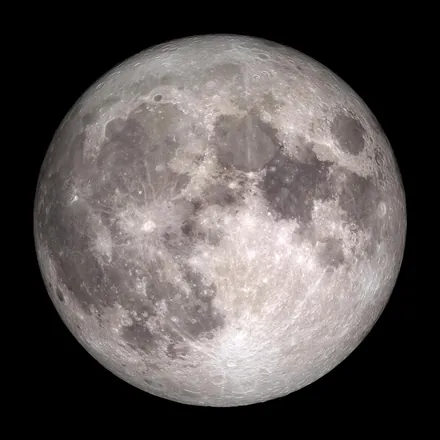
The Moon is the easiest target in the sky, but when you look changes what you see. Around full moon it rises near sunset and shines all night, yet the view is at its flattest: the Sun is hitting it face-on, so there are almost no shadows. The most dramatic views come in the days around first and last quarter, when the terminator, the line dividing lunar day from night, cuts across the middle of the disk and every crater along it stands out in sharp relief.
With the naked eye you can trace the dark maria, ancient plains of frozen lava that form the familiar face. Ordinary binoculars, held steady or braced on a fence, already show craters, the bright rays splashing out of Tycho, and the rugged terminator. A small telescope at 50× or more turns the terminator into a landscape of crater walls, central peaks and mountain shadows that changes visibly from one night to the next. Unlike the Sun, the Moon is completely safe to observe with any instrument.
Earthshine and the daytime Moon are worth a second look. Earthshine is the faint glow that fills in the unlit part of a young crescent, sunlight bounced back off Earth. The daytime Moon rides above the horizon in daylight for roughly half of every month, easiest to catch around the quarter phases.
The Moon's cycles
The Moon gave us the month, and several of the cycles this site tracks begin with it. The most familiar is the synodic month of 29.53 days, the full cycle of phases from one new moon to the next. It is about two days longer than the 27.32-day sidereal month, the time the Moon takes to lap the stars once, because Earth is also moving around the Sun and the Moon needs extra time to catch up to the Sun's new direction. Our Moon phases lesson shows both cycles running side by side, and the Moon Phase Calendar maps every phase for any month.
The Moon's gravity drags two tidal bulges around Earth each day, which is why most coasts see two high tides roughly 12 hours 25 minutes apart; the tides lesson walks through the mechanics. The same tidal forces, acting the other way, long ago locked the Moon's rotation to its orbit, which is why we only ever see one face; the tidal locking lesson explains the lock and the small wobbles, called libration, that let us see about 59% of the surface over time.
Eclipses follow their own lunar rhythms. The Moon's orbit is tilted 5.1° to Earth's orbit, so eclipses only happen when full or new moon lands near one of the two crossing points, the lunar nodes, which themselves drift all the way around the sky every 18.6 years. Eclipses repeat in the 18-year Saros family pattern, and the phases return to the same calendar dates every 19 years in the Metonic cycle. The Eclipse Explorer lists every upcoming eclipse and shows where each one is visible.
To see where these periods fit among everything else that repeats overhead, read the full the synodic month profile, or find it sorted by length in the complete cycles list. The Moon also runs the draconic month of node crossings behind every eclipse, and the 18.6-year swing to its widest and narrowest reach, the lunar standstill.
What's next for the Moon
Beyond the everyday phases, a few lunar dates are worth planning around. Eclipse visibility depends on where you are; the Eclipse Explorer maps each one. Dates are in Universal Time.
- Oct 16, 2026: apogee, the month's farthest point, 404,632 km away
- Oct 28, 2026: perigee, the month's closest point, 364,397 km away
- Dec 24, 2026: perigee full moon (a "supermoon"), full at only 356,729 km
- Feb 6, 2027: annular solar eclipse (the new moon passing in front of the Sun)
- Feb 20, 2027: penumbral lunar eclipse
- Jul 18, 2027: penumbral lunar eclipse
- Aug 2, 2027: total solar eclipse (the new moon passing in front of the Sun)
- Aug 17, 2027: penumbral lunar eclipse
Frequently asked questions
Why does the Moon have phases?
The Sun always lights half of the Moon. As the Moon orbits Earth every 29.5 days, we see that lit half from a changing angle: none of it at new moon, all of it at full moon, and the crescent, quarter and gibbous shapes in between. Phases are a matter of viewing angle, not of Earth's shadow; the shadow only touches the Moon during a lunar eclipse.
Is there a dark side of the Moon?
No. The Moon keeps one face turned toward Earth, so there is a far side we never see from here, but it receives just as much sunlight as the near side. During new moon the far side is in full daylight.
Why does the Moon look so large near the horizon?
It is an illusion. The Moon's disk is essentially the same size at the horizon as overhead (in fact very slightly smaller, because you are farther from it by about an Earth radius). The brain judges things near the horizon against trees and buildings and inflates them. A camera, or your thumb at arm's length, shows no difference.
What is a supermoon?
The Moon's orbit is an ellipse, so its distance swings between about 363,300 km at an average perigee and 405,500 km at an average apogee, and the closest perigees come nearer still. A supermoon is a full moon that happens near perigee: it looks up to about 14% wider and about 30% brighter than a full moon at apogee. The difference is real but subtle to the eye.
How long is a day on the Moon?
Two answers, depending on which day you mean. Being tidally locked, the Moon spins once per orbit, every 27.32 days measured against the stars. Sunrise to sunrise takes longer, about 29.53 days, for the same reason the cycle of phases does: while the Moon circles us, Earth is carrying it along its own orbit of the Sun, so the surface has to turn a little extra each time to bring the Sun back overhead.
When is the next full moon?
The next full moons are October 26, 2026; November 24, 2026; December 24, 2026 (Universal Time). The phase calendar on this page lists every new moon, quarter and full moon for the next twelve months, and the live panel above shows tonight's exact phase for your location.
When is the next lunar eclipse?
The next lunar eclipse is a penumbral eclipse on February 20, 2027 (Universal Time). A lunar eclipse happens at full moon when the Moon passes through Earth's shadow, and it is visible from the entire night side of Earth at once. The Eclipse Explorer shows whether your location is on that night side.
Keep exploring
- Moon Phase Calendar: every phase, any month, from your location
- Moon Phases lesson: why the Moon waxes and wanes
- Eclipses lesson: how the Sun, Earth and Moon line up
- Eclipse Explorer: every upcoming solar and lunar eclipse
- Tides lesson: how the Moon moves the oceans
Cite this page
CycleCalcs, "The Moon: Phase Tonight, Facts and Cycles", CycleCalcs LLC, https://www.cyclecalcs.com/the-moon.html (add your access date). The underlying event datasets are archived with a permanent DOI: 10.5281/zenodo.21905241, which always resolves to the newest version. Since v1.1.0 that archived record also carries the engine's accuracy study against JPL Horizons, with every raw residual and the code that reproduces it; the same files are browsable in the data repository.
Every computed value on this page is public domain: CycleCalcs asserts no copyright in calculated astronomical facts and dedicates any such right to CC0, stated here. Quote the numbers freely, with or without credit. Conventions and sources: the engine and sources.