Tidal Locking & Libration: One Face, and the 59% We Can See
The Moon always shows us the same face. That is no accident and no sign that it fails to turn. The Moon is tidally locked, spinning exactly once for every trip around Earth, so the same near side stays pointed our way. Yet its face is not frozen. It rocks gently back and forth in a motion called libration, and that slow rocking lets us peek around the edges and glimpse about 59 percent of the surface over time. Watch the lock and the rocking together below.
On this page
The Moon is tidally locked: it spins exactly once per 27.3-day orbit, so it always turns the same face toward Earth. But its slightly elliptical, tilted orbit makes that face rock a little, a motion called libration, up to about 7.9° east or west and 6.7° north or south. Over time this lets us see about 59 percent of the lunar surface. The far side is not the dark side: it gets just as much sunlight, we simply never see it from Earth.
Why the Moon keeps one face toward Earth
It is a common surprise that the Moon rotates at all. Since it always shows us the same features, the Sea of Tranquility and the bright rays of Tycho night after night, it can look as though it simply hangs there, fixed. In fact it is turning. It rotates exactly once for every orbit it makes of Earth, about every 27.3 days. Because the spin and the orbit take the same time, the same hemisphere stays turned toward us the whole way around. This matched-up turning is called synchronous rotation.
Picture the difference. If the Moon did not spin at all, it would keep pointing in one fixed direction in space while it circled Earth, and over a month we would see every side of it in turn, front, side, far, other side, front again. Because it does spin, once per lap, that reveal never happens. The near side is held toward us as if by an invisible tether.
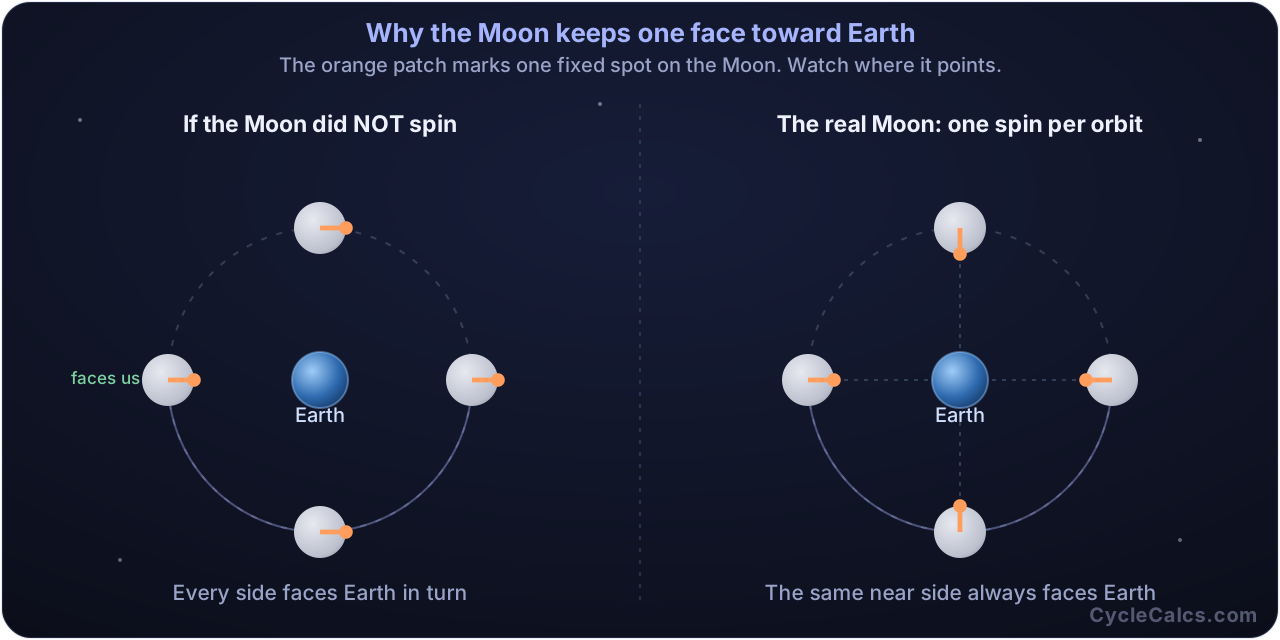
Why should the spin and the orbit match so precisely? The answer is tidal friction, the same family of forces behind the ocean tides. Earth's gravity stretches the Moon very slightly into an egg shape, raising a small bulge on the side facing us. Long ago the Moon spun faster, and that bulge was dragged a little off the Earth line. Earth's pull on the offset bulge acted as a brake, gradually slowing the Moon's spin, until the spin settled into step with the orbit and the bulge pointed straight at Earth. Once locked, the arrangement is stable, so the Moon has kept one face toward us for billions of years. Most large moons in the solar system are locked to their planets the same way.
Libration: the Moon's slow rock
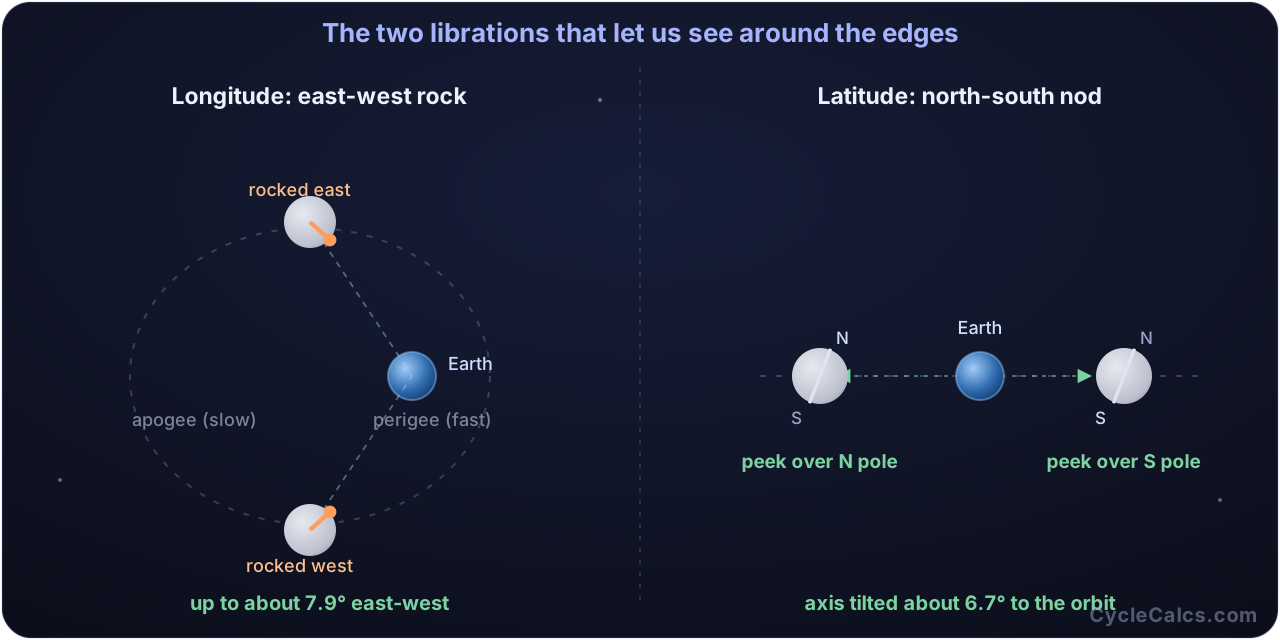
The lock is not perfectly rigid. If you watch the Moon carefully month after month, its face appears to nod and sway by a few degrees, so that features near the edge slip into view and then hide again. This gentle rocking is libration, and it comes in three parts.
Libration in longitude is the east-west rock, and it comes from the shape of the orbit. The Moon's spin is beautifully steady, always the same rate. Its orbit, though, is a slight ellipse, so by Kepler's second law the Moon travels faster when it is near perigee (closest to Earth) and slower near apogee (farthest). The steady spin therefore runs a little ahead of the orbit for half the month and a little behind for the other half, swinging the face east and west by up to about 7.9° and letting us see a sliver around each side edge.
Libration in latitude is the north-south nod, and it comes from a tilt. The Moon's spin axis is tipped about 6.7° from the axis of its orbit, much as Earth's axis is tilted to its orbit around the Sun. So as the Moon rides around Earth, first its north pole leans toward us and then, half an orbit later, its south pole does, letting us peer a little over the top and then under the bottom.
The third and smallest part is diurnal libration, worth about 1°. It comes from us, not the Moon. As Earth turns through a night, it carries you a few thousand kilometers, from one side of the planet toward the other relative to the Moon, so you view the Moon from a slightly different angle at moonrise than at moonset and see a touch farther around the near edge. That 7.9° is the extreme, not the everyday value. In a typical month the east-west rock is closer to 6.3°; it reaches the full 7.9° only when the Sun's pull has stretched the Moon's orbit to its most elongated, because the eccentricity itself waxes and wanes over the months. The interactive above uses a steady, average-shaped orbit, so its longitude libration tops out near that typical 6.3°.
How we come to see 59 percent
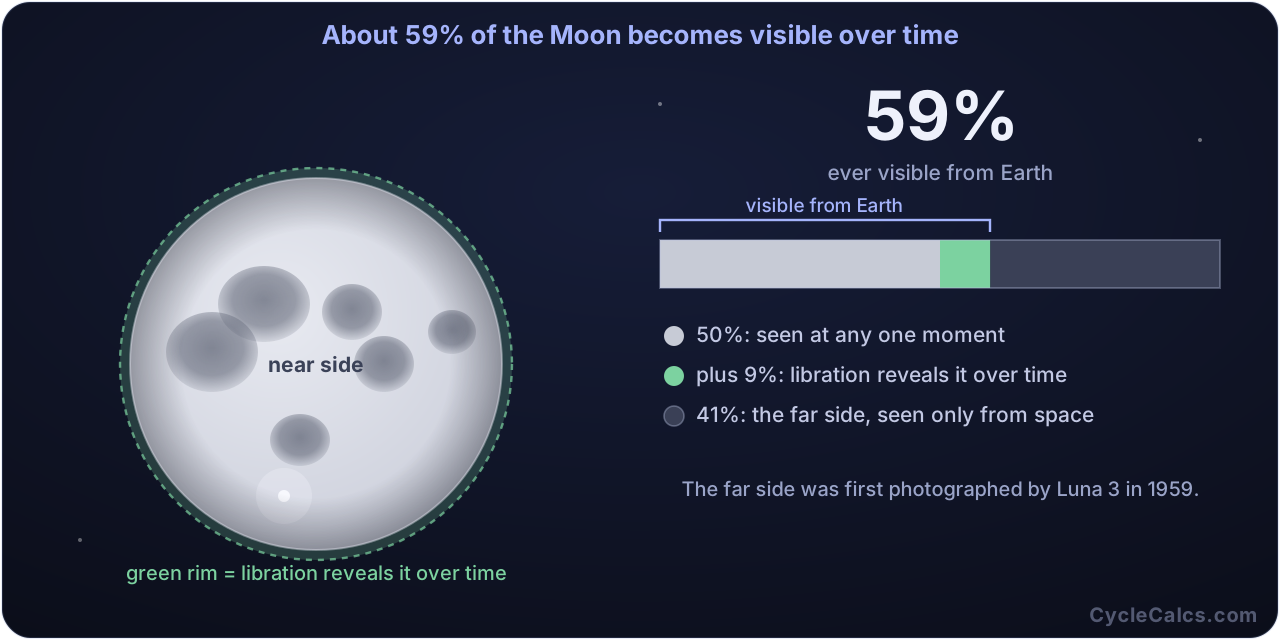
At any single glance, we see exactly one hemisphere of the Moon, half of its whole surface. Libration does not change that instantaneous half; what it does is slowly shift which half we are looking at. The east-west rock brings a curved sliver of the eastern and western edges into view; the north-south nod adds slivers at the top and bottom; and the daily wobble trims a little more all the way around.
Add up all the edges that libration ever swings into view, over a month and then over the years as the different librations drift in and out of step, and the total comes to about 59 percent of the surface. The interactive above keeps a running tally: as you let time run, the fraction climbs from the 50 percent of a single view up toward that 59 percent ceiling. The remaining 41 percent, the true far side, never turns toward Earth and was first seen only in 1959, when the Soviet probe Luna 3 flew behind the Moon and sent back the first grainy photographs.
The far side is not the dark side
It is worth clearing up one of the most common misunderstandings about the Moon. The far side and the dark side are not the same thing, and mixing them up gets the physics backward.
The far side is the hemisphere that permanently faces away from Earth, the roughly 41 percent we cannot see from the ground. It is a fixed piece of the Moon, defined by the tidal lock. The dark side, on the other hand, is just whichever half is not being lit by the Sun at a given moment, and it sweeps steadily around the Moon as the Moon runs through its phases. At new moon, when the near side is dark, it is actually the far side that is bathed in full sunlight. Over a month the far side gets exactly as much daylight as the near side. So the far side is not perpetually dark. It is simply hidden from Earth, and it experiences the same slow lunar day of about 29.5 days as everywhere else on the Moon.
Frequently asked questions
Does the Moon rotate?
Yes. The Moon rotates exactly once for every orbit it makes of Earth, about every 27.3 days. Because its spin and its orbit take the same time, it always keeps the same face toward us. This one-spin-per-orbit match is called synchronous rotation, and it is the reason people sometimes mistakenly think the Moon does not turn at all.
Why do we see more than half of the Moon?
Because of libration, a slow rocking of the Moon's face. The Moon's orbit is a slight ellipse, so its steady spin runs a little ahead of and behind its changing orbital speed, letting us see up to about 7.9 degrees around its eastern and western edges. Its axis is also tilted about 6.7 degrees to its orbit, so we peek alternately over its north and south poles. Together, over time, these reveal about 59 percent of the surface.
What is the difference between the far side and the dark side of the Moon?
They are not the same thing. The far side is the hemisphere that always faces away from Earth, which we never see from the ground. The dark side is simply whichever half is not lit by the Sun at the moment, and it sweeps around the Moon as it goes through its phases. The far side receives just as much sunlight as the near side over a month, so calling it the dark side is a mistake.
How much of the Moon can we see from Earth?
About 59 percent of the Moon's surface can be seen from Earth over time, thanks to libration. At any single moment we see only one hemisphere, half the sphere, but the rocking of the Moon's face brings extra slivers around all four edges into view across a month and across the years. The remaining roughly 41 percent, the far side, can only be seen from spacecraft.
Sources & further reading
- NASA Science: Earth's Moon: NASA's overview of the Moon, its rotation and its phases.
- NASA Scientific Visualization Studio: Moon Phase and Libration: yearly visualizations that show the libration rocking in detail.
- NASA JPL: Approximate Positions: the orbital elements behind the Moon's elliptical, tilted orbit.
- Jean Meeus, Astronomical Algorithms (Willmann-Bell): the standard reference for the Moon's motion and the optical librations.
See how these figures are computed on the methodology and sources page.
Keep exploring
The Moon
The locked world itself: tonight’s phase, rise and set times, and its vital facts.
InteractiveMoon Phases
The lit half of the Moon that sweeps around each month, the real meaning of the dark side.
InteractiveThe Tides
The same tidal forces that lock the Moon also raise the seas and are slowly pushing the Moon away.
InteractiveApsidal Precession
The slow turning of the Moon's elliptical orbit, the ellipse behind libration in longitude.
InteractiveSky Map
See the Moon's current libration and phase live in the full-screen planetarium.