Sidereal vs Solar Day: Why a Day Is Not Quite 24 Hours
There are two honest ways to measure a day. Time Earth's spin against the Sun, from one noon to the next, and you get the solar day of about 24 hours that your clock keeps. Time it against the distant stars instead, from when a star crosses due south to when it returns there, and you get the sidereal day of 23 hours 56 minutes 4 seconds, about 4 minutes shorter. Below, the view from above your shoulder and the view of your own sky move together so you can see exactly where those 4 minutes go.
On this page
A solar day (noon to noon) averages 24 hours, but a sidereal day (one full spin measured against the stars) is only 23 hours 56 minutes 4 seconds, about 4 minutes shorter. The gap exists because Earth moves about 1 degree along its orbit each day, so after one full turn it must rotate roughly 1 degree more to face the Sun again. Over a year that extra degree a day adds up to exactly one whole extra rotation: 366.24 turns against the stars, but only 365.24 solar days.
Why the solar day is longer
Start at local noon, with the Sun due south and directly over your meridian, the imaginary north-south line overhead. Earth begins to spin toward the east. If nothing else moved, then after one full turn the Sun would be back on your meridian and the day would be done.
But something does move. While Earth spins once, it also slides a little further along its year-long orbit around the Sun, covering about 1 degree of that circle in a day (a full 360-degree circle spread across the 365 days of the year). So when your meridian has completed a full 360-degree turn, it points once more at the same distant star, but the Sun has drifted about 1 degree to the side. Earth has to keep turning for another degree, which takes about 4 minutes, before the Sun is back on your meridian and it is noon again.
That is the whole story in one sentence: a sidereal day is one turn relative to the stars, and a solar day is that same turn plus the little extra needed to catch up with the moving Sun. The two clocks differ by the time it takes to spin that one extra degree.
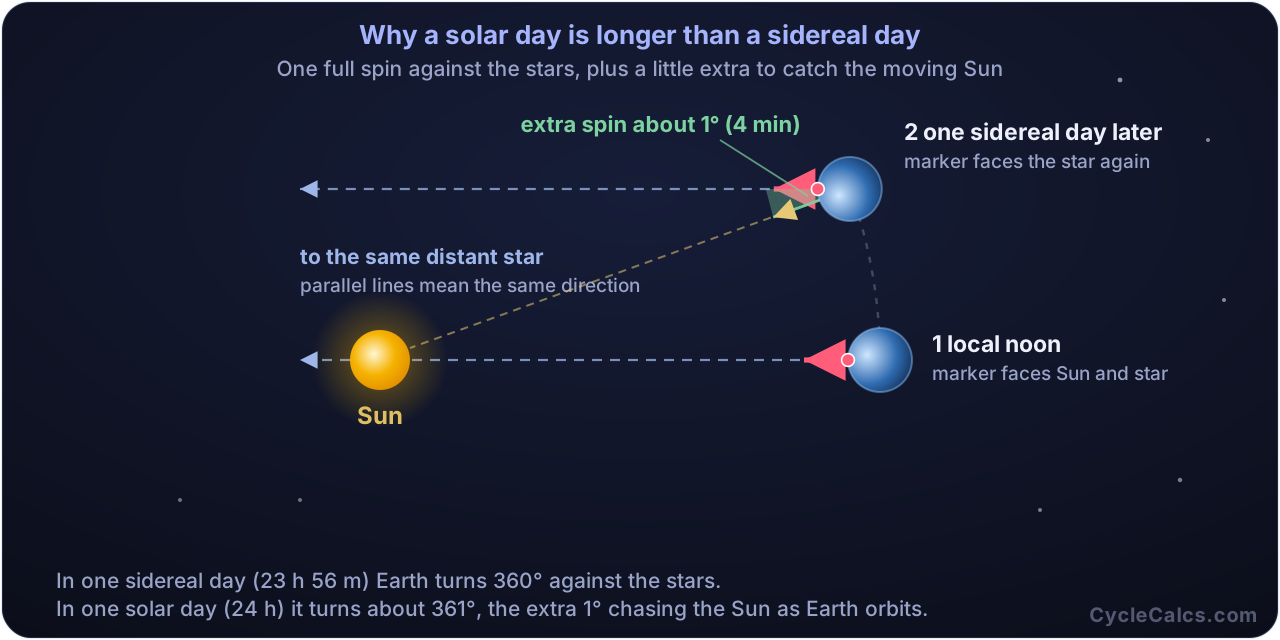
Putting numbers to it: a mean sidereal day is 23 hours 56 minutes 4.09 seconds, and a mean solar day is 24 hours 00 minutes 00 seconds. The difference is 3 minutes 55.9 seconds, which we usually round to about 4 minutes. That is the time it takes Earth, spinning at its steady rate, to cover the extra roughly 1 degree that its orbital motion demands.
One extra rotation every year
Follow the extra degree around a whole orbit and it becomes a whole extra rotation. Here is the surprising bookkeeping: over one year Earth spins 366.24 times relative to the stars, yet the Sun rises only 365.24 times. There is exactly one more turn against the stars than there are days.
Where does that extra turn come from? From the orbit itself. Imagine, as a thought experiment, an Earth that did not spin at all relative to the stars. As it coasted once around the Sun, an observer on it would still see the Sun swing all the way around the sky exactly once, one sunrise and one sunset, purely because the planet had circled to the far side and back. So a single orbit is worth one solar day even with no spin. Earth's real 366.24 spins, minus that one turn accounted for by the orbit, leave the 365.24 solar days we live by.
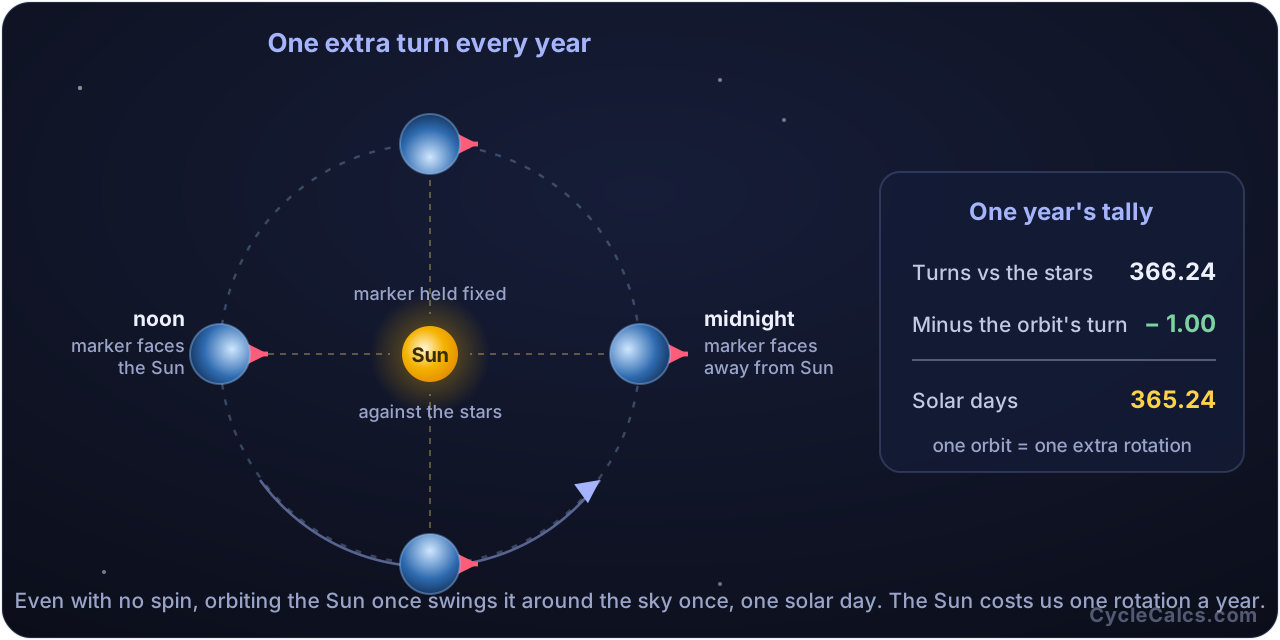
This is the same reasoning that separates a moon's synodic and sidereal periods, and it is why the accountant's version of a year, the number of sidereal rotations, is always one more than the number of calendar days. The Sun, being the thing we orbit, quietly costs us one rotation per year.
Why the stars rise about 4 minutes earlier each night
Your clock is built to keep solar time, ticking off 24 hours between one noon and the next. The stars, though, come back around in a sidereal day of 23 hours 56 minutes. Those two rhythms disagree by about 4 minutes a day, and that small disagreement is something anyone can watch.
Look for a particular star at, say, 9 o'clock one evening and mark where it sits. At 9 o'clock the next night it will have risen about 4 minutes earlier, so it sits a little further west. A week later it is about half an hour ahead of where it started; a month later, about two hours; and after a full year it has gained a complete 24 hours and is back exactly where it began. That slow westward creep, 4 minutes a night, is why each season brings its own evening constellations, and why Orion rules winter evenings while the Summer Triangle owns July.
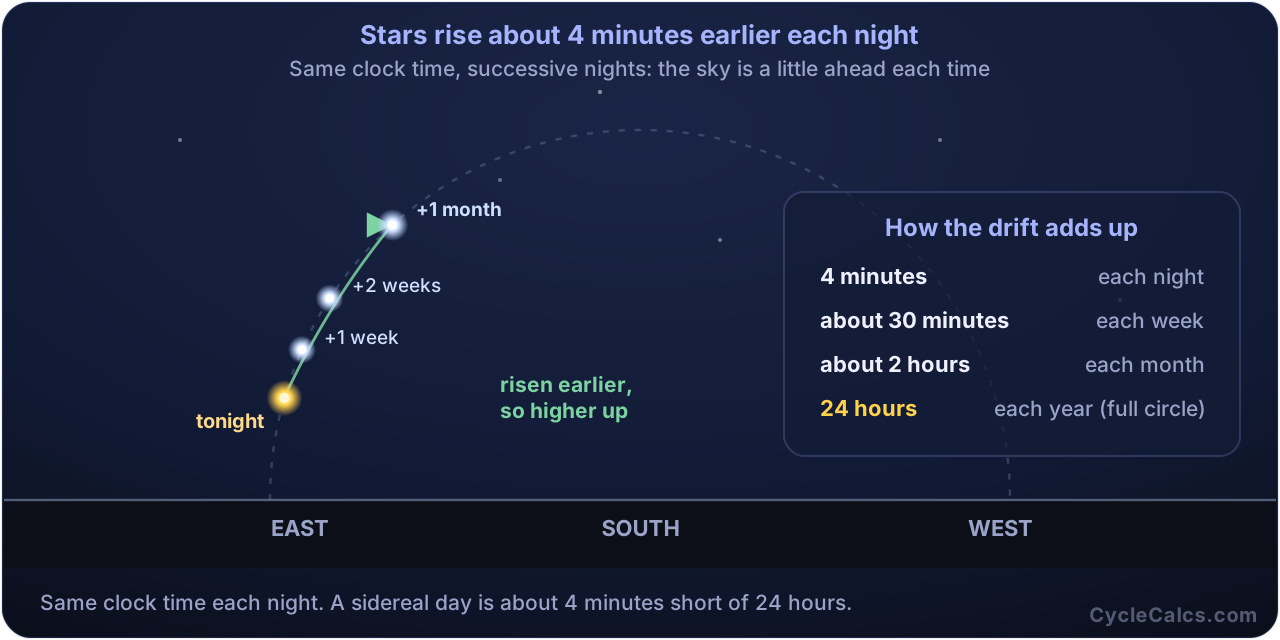
Astronomers turn this to their advantage with sidereal time, a clock tuned to the stars rather than the Sun. A telescope pointed at the same sidereal time on any night finds the same stars overhead. It is also why star charts and planetarium tools ask for both your date and your clock time: they have to convert your everyday solar time into the sky's own sidereal time before they can tell you what is up.
The true solar day is not perfectly 24 hours
One honest caveat. The 4-minute figure compares the sidereal day with the mean solar day, a smoothed 24-hour average. The true solar day, measured from one real passage of the Sun across your meridian to the next, is not perfectly constant. It runs a little long in some seasons and a little short in others, from about 21 seconds shorter to about 30 seconds longer than 24 hours over the course of the year.
That wobble is a different effect entirely, driven by Earth's elliptical orbit and the tilt of its axis. It is the cause of the equation of time, the reason a sundial can run up to about 16 minutes ahead of the clock in early November and about 14 minutes behind in mid February, and the reason the analemma traces a figure eight in the sky. The sidereal day, by contrast, stays almost perfectly steady. So keep the two ideas apart: the roughly 4-minute sidereal-versus-solar gap is the fixed cost of orbiting the Sun, while the equation of time is a separate, smaller seasonal ripple on top of it.
Frequently asked questions
Why is a solar day longer than a sidereal day?
Because Earth is orbiting the Sun as it spins. A sidereal day is one full 360-degree turn measured against the distant stars, 23 hours 56 minutes 4 seconds. But in that time Earth has also moved about 1 degree along its orbit, so it must turn roughly 1 degree more, about 4 minutes, to bring the Sun back to the meridian. That longer turn, noon to noon, is the solar day of about 24 hours.
How long is a sidereal day?
A mean sidereal day is 23 hours 56 minutes 4.09 seconds, about 3 minutes 56 seconds shorter than the 24-hour mean solar day. It is the time Earth takes to spin once relative to the stars, rather than relative to the Sun.
Why do the stars rise about 4 minutes earlier each night?
Clocks keep solar time, 24 hours to a day, but the stars return in a sidereal day of 23 hours 56 minutes. Each night a given star therefore rises and crosses the sky about 4 minutes earlier by the clock. That adds up to about half an hour a week, two hours a month, and a full 24 hours over a year, which is why the constellations of each season slowly change.
Is the sidereal versus solar day difference the same as the equation of time?
No. The roughly 4-minute gap between the sidereal and mean solar day is a steady average from Earth's orbital motion. The equation of time is a separate, smaller effect, up to about 16 minutes ahead in early November and about 14 minutes behind in mid February, caused by Earth's elliptical orbit and axial tilt. It makes the true solar day vary slightly around 24 hours and shifts when a sundial reads noon, but it does not change the sidereal day.
Sources & further reading
- U.S. Naval Observatory: Sidereal Time: the definition of the sidereal day and its relation to solar time.
- NASA Space Place: How long is a day?: a plain-language walk through sidereal and solar days.
- NASA JPL: Approximate Positions of the Planets: Earth's orbital rate, the source of the extra degree a day.
- Jean Meeus, Astronomical Algorithms (Willmann-Bell): the standard reference for sidereal time and the length of the day.
See how these figures are computed on the methodology and sources page.
Keep exploring
Synodic vs Sidereal Periods
The same idea for the Moon: why it orbits in 27.3 days but cycles its phases in 29.5.
InteractiveThe Equation of Time
The separate seasonal wobble that makes the true solar day drift and draws the analemma.
InteractiveSeasons & the Sun
How Earth's orbit and tilt move the Sun through the year, the motion behind the extra degree.
InteractivePrecession of the Equinoxes
The far slower turning of Earth's axis, another way the sky drifts over time.