Apsidal Precession
Orbits are ellipses, and the ellipse itself slowly turns. The long axis joining the nearest and farthest points, the line of apsides, swings around over time. For the Moon it comes full circle in just 8.85 years. Scrub the years and watch the orbit pivot (left); slide the Moon around and watch its size change (right).
The orbit that turns
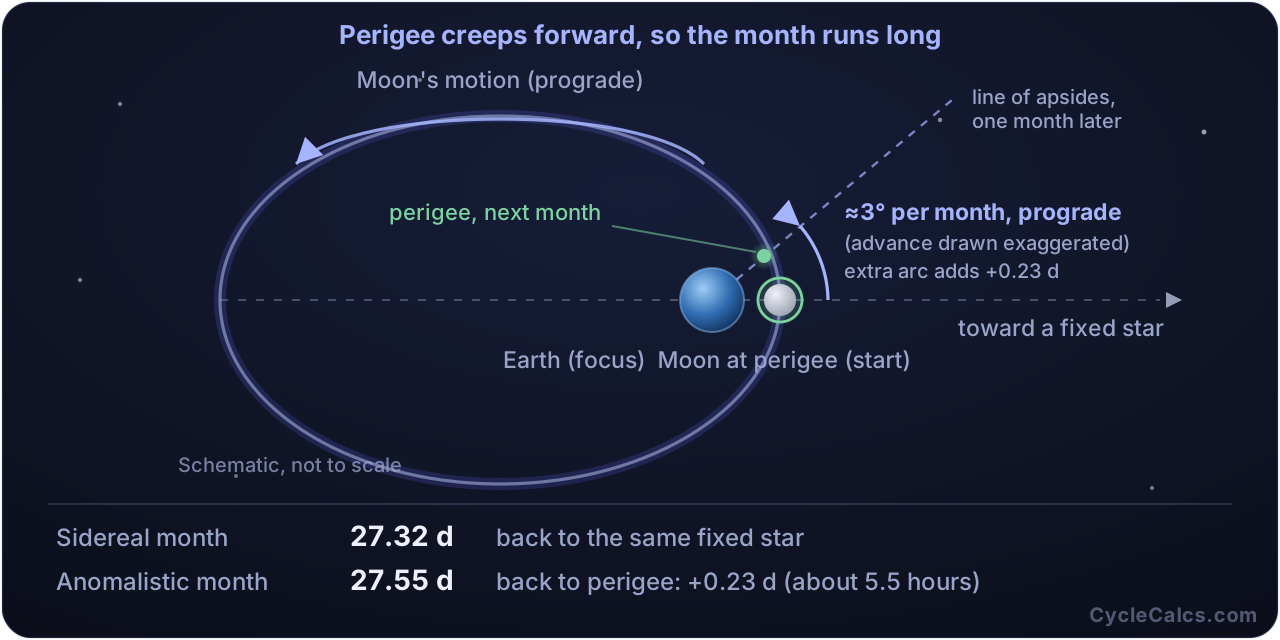
No orbit is a perfect circle. The Moon’s path is an ellipse with Earth at one focus, so there is a near point (perigee) and a far point (apogee). The straight line through both is the line of apsides. Apsidal precession is the slow rotation of that line: the whole ellipse pivots in its plane, carrying perigee and apogee around with it.
The Moon’s apsides turn forward (the same way the Moon orbits), completing a full turn in about 8.85 years. That is the opposite sense to the Moon’s nodes, which regress over 18.6 years. They are two different slow turnings of the same tilted, elliptical orbit.
Why it matters: longer months, super-Moons, and eclipses
- The anomalistic month. Because perigee creeps forward to meet the returning Moon, the anomalistic month (perigee to perigee, 27.55 days) is a touch longer than the 27.32-day sidereal month. You will find both on the cycles by length page.
- Super-Moons. When a full or new Moon lands near perigee, the Moon is closest and looks largest, a “super-Moon.” Near apogee it is a smaller “micro-Moon.” The distance swings from roughly 356,500 km to 406,700 km, changing the apparent size by about 14%.
- Total vs annular eclipses. A solar eclipse near perigee shows a large Moon that fully covers the Sun (total); near apogee the Moon is too small and leaves a bright ring (annular). The Moon’s changing distance, paced by the apsides, decides which you get. See eclipses.
Apsidal precession of the planets
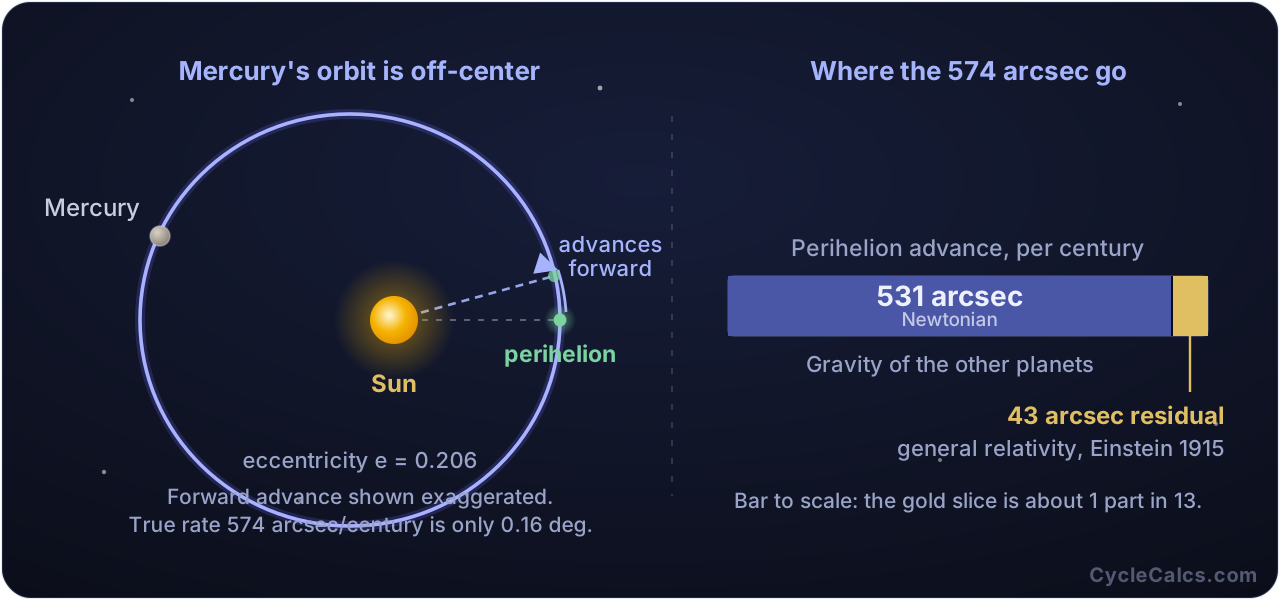
Every planet’s orbit precesses too. The steady gravitational tugs of the other planets make each perihelion (the orbit’s closest point to the Sun) creep forward, century after century. The amounts are tiny, measured in arcseconds per century, but they are real, and they were mapped out long before anyone could explain them.
Each orbit comes full circle over tens of thousands to many millions of years, a span called its apsidal period. That motion is almost entirely Newtonian, but general relativity adds a tiny extra advance on top, largest for the planets closest to the Sun. The table shows both:
| Body | Eccentricity | Apsidal period (one full turn) | of which, relativity (″/cy) |
|---|---|---|---|
| Mercury | 0.206 | ~224,000 yr | 42.98 |
| Venus | 0.007 | ~13,000,000 yr* | 8.62 |
| Earth | 0.017 | ~112,000 yr | 3.84 |
| Mars | 0.093 | ~81,000 yr | 1.35 |
| Jupiter | 0.049 | ~169,000 yr | 0.062 |
| Saturn | 0.056 | ~86,000 yr† | 0.014 |
The apsidal period is the time for the perihelion to circle once relative to the stars, from current secular rates (JPL); it is set almost entirely by the gravitational pull of the other planets, of which the general-relativistic part (last column) is only a tiny slice. *Venus’s orbit is so nearly circular that its perihelion barely moves, so its period is extremely long and not well defined. †Saturn’s perihelion is currently drifting backward. For comparison, the Moon’s apsides come full circle in just 8.85 years.
Mercury’s 43 arcseconds: a clue to relativity
Mercury’s perihelion advances about 574″ per century relative to the fixed stars. Painstaking 19th-century calculations of the other planets’ pull accounted for about 531″, leaving a stubborn 43″ per century that Newton’s gravity simply could not explain. Astronomers even proposed an unseen planet, “Vulcan,” to make up the difference. In 1915, Einstein’s general relativity predicted an extra advance of almost exactly 43″ for Mercury, with no new planet required. It was one of the first and most celebrated confirmations of the theory.
Frequently asked questions
What is apsidal precession?
Apsidal precession is the slow rotation of the long axis of an elliptical orbit, the line of apsides that joins the closest and farthest points. The whole ellipse gradually turns in its plane, so the orientation of perigee and apogee (for the Moon) or perihelion and aphelion (for a planet) drifts over time.
How long is the Moon's apsidal precession cycle?
The Moon's line of apsides turns all the way around once about every 8.85 years, in the forward (prograde) direction. This is why the anomalistic month of 27.55 days, measured perigee to perigee, is a little longer than the 27.32-day sidereal month.
Why was Mercury's perihelion precession important?
Mercury's perihelion advances about 574 arcseconds per century relative to the fixed stars. Newtonian gravity from the other planets explains about 531 arcseconds, leaving a 43-arcsecond-per-century residual that Newton's theory could not account for. Einstein's general relativity predicted exactly that extra amount in 1915, an early triumph of the theory.
Sources & further reading
- NASA JPL, Approximate Positions of the Planets: Keplerian orbital elements and their secular rates, the source of the perihelion-precession figures.
- NASA Goddard Scientific Visualization Studio, Moon Phase and Libration: the Moon's changing distance at perigee and apogee that drives super-Moons.
- ESA, BepiColombo: the mission to Mercury, whose orbit gave the classic test of general relativity.
- Apsidal precession (Wikipedia): a broad overview with the historical and mathematical background.
- Jean Meeus, Astronomical Algorithms (2nd ed., Willmann-Bell): the standard reference for the anomalistic month and orbital-element calculations.
See how these figures are computed on the methodology and sources page.
Keep exploring
The Lunar Nodes
The Moon’s other slow turning: its nodes regress over 18.6 years.
InteractivePrecession of the Equinoxes
The wobble of Earth’s axis, and the nutation that rides on it.
InteractiveEclipses
Why the Moon’s distance decides between a total and an annular eclipse.
InteractiveThe Equation of Time
Earth’s elliptical orbit also makes a sundial drift ahead of and behind the clock.
InteractiveKepler’s Three Laws
The ellipse that pivots here is Law 1’s; see all three rules of orbits run live.
ReferenceThe numbers and where we stand: the anomalistic month
The 27.55-day perigee-to-perigee month: its exact length, where the Moon is in the current one, and upcoming perigees.
ReferenceThe numbers and where we stand: the anomalistic year
Perihelion to perihelion in 365.2596 days: the exact figure, where Earth is in the current lap, and the next perihelion dates.