Saturn
Saturn is the planet that creates amateur astronomers. To the naked eye it is a bright, golden, steady point of light; through a telescope it becomes a globe wrapped in rings, and no photograph quite prepares you for the first live view. It is the most distant planet that is easy to see without any help, circling the Sun nine and a half times farther out than Earth and completing one orbit every 29 and a half years.
The live panel below shows Saturn right now from your location: when it rises and sets, which constellation it currently sits in, and how bright it appears tonight. Everything is computed in your browser as you read.
On this page
Saturn reaches opposition next on October 18, 2027, when Earth passes between it and the Sun. Around that date it rises near sunset, stays up all night, and shines at its brightest for the apparition (magnitude −0.1) in the constellation Pisces.
Tonight's position and rise and set times for your location are in the live panel below; the month-by-month table shows where Saturn sits through the coming year.
Saturn turns almost as fast as Jupiter, once about every 10.66 hours, so a Saturnian day is under eleven hours despite the planet being nearly ten times the width of Earth. The quick spin bulges its equator and helps hold the rings flat in their plane.
Saturn tonight from your location
Enter coordinates
This panel computes tonight's position and rise and set times for Saturn in your browser, and it needs JavaScript to run. The rest of this page, including the month-by-month table below, is fully readable without it. For a live all-sky view, open the Sky Map or Today in the Sky.
Everything is computed on your device. Tapping "Use my location" names your city from a place index served with this page. Times appear in your device's time zone.
Saturn at a glance
| Mean distance from the Sun | 1,432.0 million km (9.5 AU) |
|---|---|
| Distance from Earth | 1,205.5 to 1,658.6 million km |
| Equatorial diameter | 120,536 km (9.4 × Earth's), not counting the rings |
| Mass | 5.68 × 10²⁶ kg (95 Earths) |
| Gravity (mean, at the cloud tops) | 11.19 m/s² (1.14 × Earth's) |
| Escape velocity | 35.5 km/s |
| Rotation period (sidereal) | 10.66 hours |
| Orbital period | 29.46 years |
| Synodic period (opposition to opposition) | 378.1 days |
| Axial tilt | 26.73° (why the rings open and close on a roughly 15-year rhythm) |
| Temperature at the cloud tops | about −139 °C (at the 1-bar level) |
| Atmosphere | about 96% hydrogen, 3% helium |
| Mean density | 687 kg/m³, less than water |
| Moons | 274 confirmed, the most of any planet |
| Rings | yes: the brightest ring system in the solar system |
| Apparent magnitude at opposition | about +0.4 for the planet alone; up to −0.6 with the rings wide open |
Physical data: NASA NSSDCA Saturn Fact Sheet. Orbital period: the mean sidereal value from Meeus, Astronomical Algorithms, ch. 31, in Julian years of 365.25 days.
Where is Saturn month by month?
The table below tracks Saturn through the next twelve months: the constellation it sits in on the 15th of each month (dates in Universal Time), whether it is a morning object, an evening object or up all night, and how bright it looks.
| Month | Constellation | Where to look | Magnitude |
|---|---|---|---|
| Oct 2026 | Cetus | Up most of the night | +0.3 |
| Nov 2026 | Cetus | Up most of the night | +0.5 |
| Dec 2026 | Cetus | Evening sky, after dusk | +0.7 |
| Jan 2027 | Cetus | Evening sky, after dusk | +0.7 |
| Feb 2027 | Cetus | Evening sky, after dusk | +0.7 |
| Mar 2027 | Pisces | Evening sky, after dusk | +0.6 |
| Apr 2027 | Pisces | Lost in the Sun's glare | +0.5 |
| May 2027 | Pisces | Morning sky, before dawn | +0.5 |
| Jun 2027 | Pisces | Morning sky, before dawn | +0.5 |
| Jul 2027 | Pisces | Morning sky, before dawn | +0.4 |
| Aug 2027 | Pisces | Morning sky, before dawn | +0.3 |
| Sep 2027 | Pisces | Up most of the night | +0.1 |
How to see Saturn
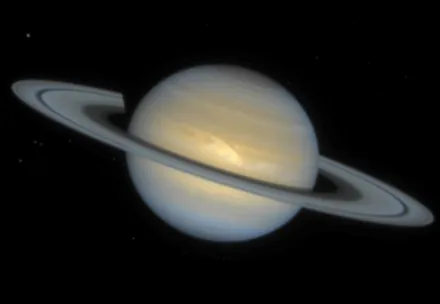
With the naked eye, look for a bright golden star that shines steadily while the true stars around it twinkle. Saturn is at its best near opposition, when Earth passes between it and the Sun: it rises around sunset, stays out all night, and shines near magnitude 0.5 (magnitude is astronomy's brightness scale, where lower numbers mean brighter). When the rings are tipped wide open they reflect extra sunlight and can push the planet to about magnitude −0.5, noticeably brighter.
Binoculars stop short of the rings. They show only that Saturn is not quite star-like, a slightly stretched blob, and cannot separate the rings from the globe. That takes the higher magnification of a telescope, and almost any telescope can do it: even a small beginner scope at low power shows the rings unmistakably, a sight that has startled observers for as long as telescopes have existed. On steady nights, larger apertures add the dark gap between the two brightest rings and Saturn's soft butterscotch cloud bands, far more muted than Jupiter's. The globe itself is visibly out of round: Saturn spins in under 11 hours, and its equator bulges about 10 percent wider than its poles.
Then find Titan. Saturn's biggest moon shows in any small telescope as a faint star-like point near the planet, and because it circles Saturn about every 16 days its position visibly changes from night to night; sketch where it sits, then look again two evenings later. Saturn has 274 confirmed moons, the most of any planet, but Titan is the only easy one; a handful more appear in medium and large telescopes.
Saturn's cycles
Saturn is the slowest-moving planet you can easily see, and that slowness sets its rhythms. One orbit takes 10,759 days, about 29 and a half years, exactly what Kepler's laws require of a planet nine and a half times farther from the Sun than Earth. Because Saturn creeps, Earth laps it often: oppositions arrive every 378 days, about two weeks later each calendar year. Around each one, Saturn drifts backward against the stars for a few months, the overtaking illusion explained in our retrograde motion lesson.
The cycle that belongs to Saturn alone is the opening and closing of its rings. The planet's axis is tipped 26.73° and holds its direction in space around the whole orbit, so Earth sees the rings at a constantly changing angle. Over each 29.5-year circuit they open wide twice, once showing their north face and once their south, and twice they turn edge-on. The rings are so thin relative to their width that at the edge-on crossings, roughly 15 years apart, they all but vanish. The opposition table on this page lists the ring tilt year by year, showing where the cycle stands now.
Saturn also keeps a slower appointment with Jupiter: the two giants meet in a great conjunction about every 20 years, the rarest meeting among the bright planets. Their orbital periods sit near a 5:2 ratio, a near-commensurability rather than a true resonance, and each successive meeting steps about a third of the way around the sky.
To turn these long rhythms into tonight's plan, the Today page lists Saturn's rise and set times alongside the rest of the sky, the Sky Map plots exactly where it sits from your location, and the telescope calculator works out the magnification each of your eyepieces delivers, so you know which one to reach for first.
To see where these periods fit among everything else that repeats overhead, read the full the Saturn synodic period profile, or find it sorted by length in the complete cycles list.
What's next for Saturn
Over the next few years, Saturn's calendar comes down to two kinds of event: the oppositions worth circling, and the solar conjunctions that hide it behind the Sun for a few weeks. Computed with the same engine that runs this site's live sky tools; dates are in Universal Time.
| Date | Event |
|---|---|
| Apr 7, 2027 | Solar conjunction: passes behind the Sun and out of view for a few weeks |
| Oct 18, 2027 | Opposition: closest and brightest for the year (magnitude −0.1) in Pisces, rings tilted 13° |
| Apr 20, 2028 | Solar conjunction: passes behind the Sun and out of view for a few weeks |
| Oct 30, 2028 | Opposition: closest and brightest for the year (magnitude −0.3) in Aries, rings tilted 18° |
| May 4, 2029 | Solar conjunction: passes behind the Sun and out of view for a few weeks |
| Nov 13, 2029 | Opposition: closest and brightest for the year (magnitude −0.4) in Aries, rings tilted 22° |
| May 19, 2030 | Solar conjunction: passes behind the Sun and out of view for a few weeks |
| Nov 27, 2030 | Opposition: closest and brightest for the year (magnitude −0.6) in Taurus, rings tilted 25° |
| Jun 3, 2031 | Solar conjunction: passes behind the Sun and out of view for a few weeks |
| Dec 11, 2031 | Opposition: closest and brightest for the year (magnitude −0.6) in Taurus, rings tilted 26° |
Frequently asked questions
Can you see Saturn's rings with binoculars?
No, not as rings. Binoculars show Saturn as a bright point that looks slightly stretched, an elongated blob rather than a ringed planet. Separating the rings from the globe takes the higher magnification of a telescope, though even a small beginner telescope clears that bar easily. The first clear view of the rings is a moment most people never forget, so it is worth borrowing a telescope or visiting a local astronomy club to get it.
Why do Saturn's rings sometimes seem to disappear?
Because we see them from a changing angle. Saturn's axis is tilted 26.73 degrees, so as the planet moves through its 29.5-year orbit the rings appear to open and close from Earth's point of view. Twice per orbit, roughly every 15 years, they turn exactly edge-on to us, and because the rings are extremely thin compared with their width, they all but vanish for a while before slowly opening again.
Would Saturn really float in water?
In principle, yes. Saturn's average density is 687 kilograms per cubic meter, about two thirds the density of water and the lowest of any planet, because it is made almost entirely of hydrogen and helium. It is only a thought experiment, since no ocean could hold a planet, but it captures something real: Saturn is about 95 times Earth's mass, yet remarkably lightweight for its enormous size.
How many moons does Saturn have?
Saturn has 274 confirmed moons, more than any other planet; 128 small ones were confirmed in a single batch in March 2025. Almost all are tiny bodies far beyond amateur equipment. The grand exception is Titan, easy in any small telescope as a faint star-like point near the planet. It circles Saturn about every 16 days, so you can watch it shift position from one night to the next.
What does Saturn look like to the naked eye?
A bright golden star that shines with a steadier light than the true stars near it, which twinkle. Around opposition it reaches roughly magnitude 0.5 on the astronomers' brightness scale, where lower numbers mean brighter, so only a handful of stars and the brighter planets outshine it. The rings are far too small to see without magnification; to the eye Saturn is simply a calm amber point of light.
How long is a day on Saturn?
About 10.66 hours. Saturn spins almost as fast as Jupiter, so despite being the second-largest planet its day is under eleven hours. Because Saturn is a ball of gas with no solid surface, that figure comes from tracking its magnetic field and cloud features rather than any fixed ground.
When is the next Saturn opposition?
Saturn reaches opposition on October 18, 2027. At opposition Earth passes directly between Saturn and the Sun, so it rises around sunset, stays visible all night, and is at its closest and brightest for the year, about magnitude −0.1 in Pisces.
Keep exploring
- Telescope Calculator: check what magnification your scope and eyepieces deliver for the rings
- Jupiter-Saturn conjunctions: the great conjunction that comes around about every 20 years
- Retrograde Motion lesson: why Saturn backs up against the stars around each opposition
- Jupiter: the other giant planet, with bold cloud belts and moons in the same small telescope
- Sky Map: plot exactly where Saturn sits in your sky right now