Meteor Showers: Comet Dust, Radiants & the Nights They Return
A “shooting star” is a speck of comet dust, often no bigger than a grain of sand, meeting Earth at cosmic speed. On a handful of special nights each year the specks arrive in crowds, because our planet is plowing through a debris stream an entire comet has been shedding for centuries. Sweep through the year below: watch Earth run into each stream on schedule, and see why every meteor in a shower traces back to a single point in the sky, the radiant.
On this page
Meteor showers happen when Earth crosses a stream of debris left along a comet’s (or asteroid’s) orbit, which is why each shower returns on nearly the same dates every year. The meteors ride parallel paths, so perspective makes them appear to fan out from one point, the radiant, which gives each shower its constellation name. The advertised ZHR is an ideal-sky ceiling, not a promise, and rates are best after midnight, when your side of Earth faces into the stream. In 2026 the Perseids peak on August 12-13 under a new moon, just hours after the total solar eclipse that crosses northern Spain that evening.
Comet dust on Earth’s highway
Every time a comet swings near the Sun, sunlight boils gas and dust off its surface, and the debris does not simply vanish: it spreads slowly along the comet’s own path, on stretched Keplerian orbits of its own, until the entire track is littered with grit. Astronomers call the result a meteoroid stream. The parent comet may pass only once in decades or centuries, but its dusty wake stays parked across the solar system year-round.
Earth’s orbit is a fixed highway through that landscape. Wherever the highway happens to cross a stream, our planet gets sandblasted, and because Earth returns to each crossing on the same date every year, the showers keep an annual calendar you can set a watch by: Quadrantids in early January, Eta Aquariids in early May, Perseids in mid-August, Geminids in mid-December. The orbit view above shows exactly this: pick a shower, press Play, and Earth hits the stream at the same spot on every lap.
The particles themselves are humbler than the show suggests. A typical visible meteor is made by a grain between a sand speck and a small pea, vaporizing 80 to 100 kilometers overhead. What makes it brilliant is speed: Earth-crossing debris arrives at anywhere from about 11 to 72 kilometers per second, and at those speeds even a milligram carries the punch to light a streak seen a hundred kilometers away. The spread has a simple cause: streams that meet Earth head-on, like Halley’s dust, arrive fastest, while streams that catch up to us from behind, like the Geminids, arrive slowest. A word on names, since three similar ones get tangled: the particle in space is a meteoroid, the streak of light is a meteor, and a piece that survives to reach the ground (from bigger, rarer objects, essentially never from shower dust) is a meteorite.
The radiant: a trick of perspective
On a shower’s night, meteors can flash anywhere in the sky. Yet if you trace each streak backward, the lines all converge on one small patch among the stars. That patch is the radiant, and it is not a physical place the meteors come from: it is pure perspective.
Within a stream, the particles travel on essentially parallel paths, all moving in the same direction through space as Earth runs into them. Parallel lines seen in perspective always appear to converge, the way railroad tracks meet at a point on the horizon or snowflakes seem to stream outward from a spot ahead of a moving windshield. The sky view above is exactly this experiment: a long exposure of shower meteors that, extended backward, all point home to the radiant, while the stray sporadics (background meteors belonging to no shower, a few every hour all year) point every which way.
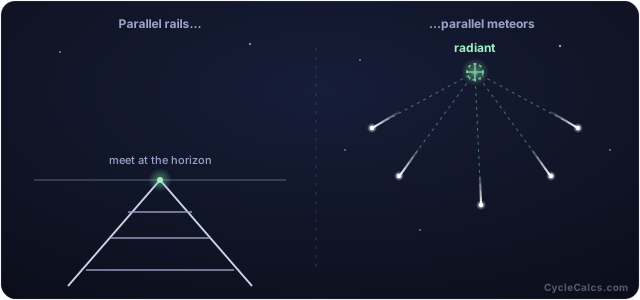
The radiant also explains the names. A shower is christened for the constellation, or the nearest bright star, that hosts its radiant: Perseids from Perseus, Geminids from Gemini, Eta Aquariids from the star Eta Aquarii in Aquarius. The Quadrantids are the charming exception that proves the rule: their radiant sits in a constellation that no longer exists, Quadrans Muralis, dropped when the modern constellation list was fixed in 1922. The name outlived the map; today the radiant falls within Boötes. One practical corollary: the higher the radiant climbs in your sky, the more of the shower you see, which feeds directly into the next section.
ZHR, moonlight, and the after-midnight edge
Shower forecasts quote a number called the ZHR, the zenithal hourly rate. It is a carefully idealized figure: the count a single alert observer would make under a perfectly dark rural sky (faintest stars visible at magnitude 6.5) with the radiant straight overhead at the zenith. Real nights rarely check every box, so treat ZHR as a ceiling. With the radiant halfway up the sky, or suburban light pollution, or a bright moon, actual counts commonly run a half to a tenth of the headline number. That is not the forecast failing; it is what the number means.
Moonlight is the great spoiler, which makes shower planning partly moon-phase planning: a full moon can wash out all but the brightest meteors, while a new moon leaves the sky black. 2026 delivers the best case in style: the Perseids peak on the night of August 12-13, 2026, at new moon, and that very new moon is the one that causes the total solar eclipse sweeping across northern Spain on August 12. Anyone traveling for totality gets a second show for free: a moonless, dark-sky Perseid peak that same night.
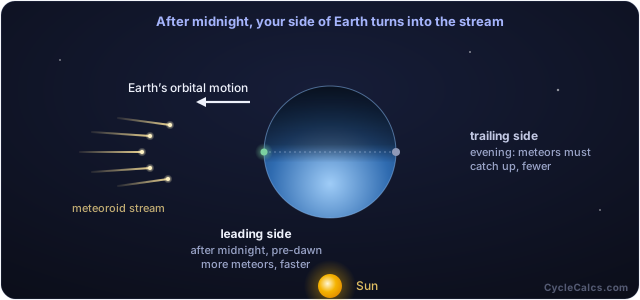
The other rule of thumb: after midnight beats the evening. Before midnight you are standing on the trailing side of Earth, where meteors must catch up to the planet from behind; after midnight your patch of the globe rotates onto the leading side, facing into the oncoming stream, the way a car’s front windshield collects far more raindrops than the rear window. Meteors on the leading side are both more numerous and faster. Most radiants also ride higher in the pre-dawn hours, stacking both advantages. For any specific night, the Today in the Sky meteor calendar computes each shower’s exact peak and a moon-aware watch window for your location, and the Sky Map marks active radiants so you know where in your sky to trace the streaks back to.
The big four showers
The Perseids (peak around August 12-13, ZHR about 100, meteors at 59 km/s) are the people’s favorite: rich, reliable, laced with bright meteors, and delivered in warm vacation weather for the Northern Hemisphere. Their parent is Comet 109P/Swift-Tuttle, a 26-kilometer mountain of ice on a 133-year orbit; every August we recross its wake.
The Geminids (December 13-14, ZHR about 150, a stately 35 km/s) are, by the numbers, the best shower of the year, and the strangest. Their parent, 3200 Phaethon, is not a comet but an asteroid. The faint tail it grows near the Sun is sodium gas, not dust; the Geminid dust is thought to date from some disruptive event a few thousand years ago, and what that event was remains a mystery. Slow, bright, and often golden, Geminid meteors reward anyone willing to brave a December night.
The Quadrantids (January 3-4, ZHR about 80 in recent years and historically up to 120, 41 km/s) would rival the Geminids except for their punishing schedule: the stream is so narrow that the peak lasts only a few hours, and if those hours fall in daylight for your longitude, you largely miss the year’s show. Their parent is the small asteroid 2003 EH1, likely a dormant comet fragment.
The Eta Aquariids (May 5-6, ZHR about 50, a blazing 66 km/s) are dust from the most famous comet of all, 1P/Halley, and the Southern Hemisphere’s premier shower; from northern latitudes the radiant rises only shortly before dawn. Halley’s dust actually reaches Earth twice a year: we cross the stream again each October as the Orionids. And for a sense of what these streams can do at their wildest, the November Leonids, usually modest, have historically erupted into true meteor storms of thousands per hour (1833, 1966) when Earth strikes a fresh, dense filament, roughly every 33 years when their parent comet, 55P/Tempel-Tuttle, swings by.
Frequently asked questions
What causes a meteor shower?
Comets (and a few asteroids) shed dust and grit along their orbits, and that debris keeps orbiting the Sun as a stream. When Earth's orbit passes through a stream, the particles slam into the upper atmosphere at tens of kilometers per second and burn up as streaks of light. Because Earth returns to the same crossing point on the same dates each year, each shower is an annual event.
Why do meteors in a shower all seem to come from one point?
The particles in a stream travel on essentially parallel paths, and parallel lines seen in perspective appear to converge, the way railroad tracks meet at the horizon. That convergence point is the radiant, and a shower is named for the constellation its radiant sits in: the Perseids radiate from Perseus. The meteors themselves can flash anywhere in the sky; traced backward, their paths point to the radiant.
What does ZHR mean?
ZHR is the zenithal hourly rate: the number of meteors per hour a single observer would count under a perfectly dark sky with the radiant directly overhead. Real skies rarely deliver it. With the radiant low, light pollution, or moonlight, actual counts are often a half to a tenth of the ZHR, so treat it as a ceiling rather than a promise.
When do the Perseids peak in 2026?
On the night of August 12-13, 2026, under a new moon, so no moonlight will interfere. The same new moon causes the total solar eclipse that crosses northern Spain on August 12, making it a remarkable double feature: totality by day, a dark-sky Perseid peak that night. Rates are best after local midnight, when your side of Earth faces into the oncoming stream.
Sources & further reading
- International Meteor Organization: Meteor Shower Calendar: the working-list peaks, ZHRs, and radiant data this page (and the site’s meteor calendar) use.
- NASA Science: Meteors and Meteorites: meteoroids, meteors, meteorites, and the major annual showers.
- American Meteor Society: Meteor FAQ: observing practicalities, sporadic rates, and shower behavior.
- Peter Jenniskens, Meteor Showers and Their Parent Comets (Cambridge University Press): the definitive reference tying each stream to its source body.
See how the site’s figures are computed on the methodology and sources page.
Keep exploring
The Moon
The shower-watcher’s enemy is moonlight: check the phase calendar before you plan a night out.
SkyToday in the Sky
The live meteor calendar: exact peak times and a moon-aware watch window for your location.
SkyLive Sky Map
Active shower radiants marked on tonight’s sky, so you know where the streaks trace back to.
SkyEclipse Explorer
The August 12, 2026 total eclipse shares its new moon with that night’s Perseid peak.
SkyMoon Phase Calendar
Moonlight decides how many meteors you see; find the dark nights around each peak.