Kepler’s Three Laws: the Rules Every Orbit Obeys
Four centuries ago, Johannes Kepler read three simple rules out of the best measurements of his age, and every orbit we have examined since, from planets to comets to stars circling the black hole at the center of our galaxy, has obeyed them to within a hair’s breadth. Below, all three laws run live: drag the slider to move a planet along its ellipse, raise the eccentricity to stretch the orbit, and watch the equal-area wedges explain why a world races at perihelion and crawls at aphelion.
On this page
Kepler’s three laws: (1) each planet orbits the Sun on an ellipse with the Sun at one focus; (2) the Sun-planet line sweeps out equal areas in equal times, so planets move fastest at perihelion; (3) the square of the period equals the cube of the semi-major axis, T² = a³ in years and astronomical units. Kepler distilled them from Tycho Brahe’s observations in 1609 and 1619, Newton derived them from gravity in 1687, and every position this site computes traces back to them.
Law 1: ellipses, not circles
For two thousand years, astronomy’s deepest assumption was that the heavens move in perfect circles. Even Copernicus, who moved the Sun to the center in 1543, kept the circles, and had to stack corrective circles on top of circles to make the model track the sky. The assumption finally broke against data.
Tycho Brahe spent decades measuring planetary positions with giant naked-eye instruments, reaching a precision of about one to two arcminutes, the best the world had ever seen. Kepler, his assistant and successor, set out to fit Tycho’s observations of Mars with circles, and came agonizingly close: his best model missed by just 8 arcminutes, roughly a quarter of the full Moon’s width. Rather than blame the data, Kepler trusted it, and after years of what he called his “war with Mars” he found the shape that fit exactly: an ellipse.
An ellipse is a stretched circle with two special interior points called foci. Pin a loop of string at two points, pull it taut with a pencil, and trace: the sum of the distances to the two pins stays constant, and the curve you draw is an ellipse. Kepler’s first law says each planet travels such a curve with the Sun sitting at one focus. The other focus is empty, a mathematical ghost (the interactive marks it once the orbit is stretched enough for the two foci to pull visibly apart). The nearest point of the orbit to the Sun is perihelion; the farthest is aphelion.
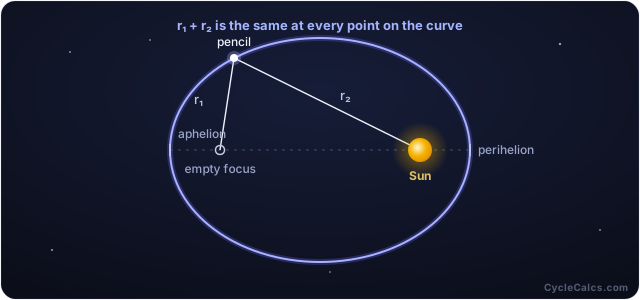
The stretch of an ellipse is measured by its eccentricity e, running from 0 (a perfect circle) toward 1 (a cigar). The planets are gentler ellipses than most drawings suggest: Venus’s eccentricity is 0.007, Earth’s is 0.017, Mars’s is 0.093, and even Mercury, the most eccentric planet, sits at 0.206. Drawn to scale, Earth’s orbit looks like a perfect circle with the Sun very slightly off center. Comets are another matter: Halley’s comet swings around at e = 0.967. (The slider above stops at e = 0.85; much beyond that, the drawing squeezes too thin to read.)
Subtle as it is, Earth’s ellipse has real consequences. We pass perihelion in early January at 147.1 million kilometers from the Sun and aphelion in early July at 152.1 million, which surprises most people in the Northern Hemisphere: Earth is closest to the Sun in northern winter. Distance is not what makes the seasons; the tilt is. And the ellipse itself does not stay put: each orbit’s long axis slowly pivots around the Sun over the ages, the subject of the apsidal precession lesson.
Law 2: equal areas in equal times
Kepler’s second discovery is about speed. Imagine a line drawn from the Sun to the planet, sweeping along like a windshield wiper as the planet moves. The law says this line sweeps out equal areas in equal times. Near perihelion the line is short, so to cover the same area it must swing quickly: the planet races. Near aphelion the line is long and barely needs to turn: the planet crawls.
The interactive above makes the law visible. The twelve shaded wedges all have exactly the same area, and the moving planet crosses one wedge per twelfth of the period: long, thin wedges out at aphelion, and short, fat ones at perihelion. Push the eccentricity up to the comet setting and the effect becomes dramatic, with the planet spending most of its time drifting through the far wedges and then whipping around the Sun.
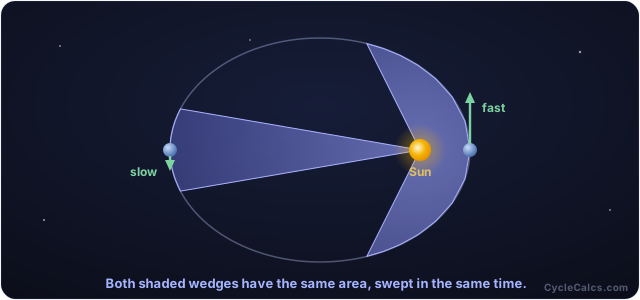
The intuition is free fall. From aphelion inward, the Sun’s gravity has a component pulling the planet forward along its path, so it gains speed the whole way down; as it climbs back out, the same pull now drags backward and the planet slows. Newton later showed the rule holds for any force aimed straight at the Sun, the insight we now call conservation of angular momentum, the same physics that speeds up a spinning skater who pulls in her arms.
You live inside this law. Earth moves about 3.4 percent faster at January’s perihelion than at July’s aphelion, which is why the northern winter (December solstice to March equinox) lasts about 89.0 days while the northern summer stretches to about 93.7: we cross the winter quarter of the orbit at higher speed. That same speed wobble makes sundials run ahead of and behind the clock through the year, one of the two causes explored in the equation of time lesson. For a comet like Halley’s the law is even starker: decades spent crawling out beyond Neptune, then a few frantic weeks rounding the Sun.
Law 3: the harmony of the periods
The first two laws describe one orbit at a time. The third, which Kepler found ten years later and loved best, ties the whole solar system together: the square of the orbital period is proportional to the cube of the semi-major axis. Measure periods T in Earth years and orbit sizes a in astronomical units (1 AU is the average Earth-Sun distance), and the law becomes simply T² = a³.
Try it on Mars. Its semi-major axis is 1.524 AU; cube that and you get about 3.54; take the square root and out comes 1.88 years, which is exactly the Martian year. It works everywhere: Mercury at 0.39 AU orbits in 0.24 years, Jupiter at 5.2 AU in 11.9 years, Neptune at 30 AU in 165 years. The chart above plots all eight planets on logarithmic axes, along with Halley’s comet, and they land on a single straight line. No exceptions at the precision of any chart you could draw.
Notice what the law does not depend on: the shape of the orbit and the mass of the planet. A world on a wild comet-like ellipse and a world on a perfect circle take exactly the same time around if their semi-major axes match; you can verify that above, where changing the eccentricity never changes the period. That is why Halley’s comet, at e = 0.967, still sits on the planets’ line: its semi-major axis of 17.8 AU fixes its 75-year period, stretch and all. And a pebble at 1 AU orbits the Sun in one year just as Earth does.
The law also repeats at every scale, with a different constant for each central body. Jupiter’s four big moons obey their own T² ∝ a³ around Jupiter. Newton showed the constant encodes the central mass, which turned Kepler’s harmony into a scale: it is how we weigh the Sun, the planets (by their moons), distant binary stars, exoplanet systems, and the black hole at the Milky Way’s center, whose four million solar masses we read straight off the orbits of stars that whip around it. To watch all eight planets run at their true relative rates, open the Live Orrery, and find every one of their periods in the cycles catalog.
From patterns to physics
It is worth being honest about what Kepler’s laws are: empirical patterns, rules distilled from data, discovered before anyone knew why they should be true. Kepler himself searched for far more than three laws. He tried nesting the planets’ orbits inside the five Platonic solids, and he sought literal musical harmonies in their motions; the book announcing the third law is titled Harmonice Mundi, “The Harmony of the World.” The difference between those ideas and the three laws is that the laws survived every test the data could throw at them, and the harmonies did not. Keeping only what fits the measurements is the discipline this whole site tries to honor.
The “why” arrived in 1687, when Isaac Newton showed in the Principia that all three laws follow mathematically from two assumptions: bodies obey his laws of motion, and gravity pulls with a force that weakens as the square of the distance. The ellipse, the equal areas, and T² = a³ stopped being three separate mysteries and became one consequence of gravitation. Newton’s derivation also widened the family of orbits: an object at or beyond escape speed traces a parabola or hyperbola instead of an ellipse, which is exactly what the interstellar visitors ‘Oumuamua and comet Borisov did when they swung through in 2017 and 2019, never to return.
Reality adds one refinement. Because the planets also tug on each other, no orbit is a perfect, frozen ellipse: each one slowly pivots, as the apsidal precession lesson shows, and by 1859 astronomers knew Mercury’s pivot carried a tiny unexplained extra, eventually pinned at 43 arcseconds per century, that Newtonian gravity could not produce. Explaining that leftover was one of the first triumphs of Einstein’s general relativity. The lineage from Tycho’s ledgers to Kepler’s laws to Newton’s dynamics is what modern planetary theory, including the ephemeris engine behind this site’s numbers, is built on. Even the familiar puzzle of planets appearing to drift backward in our sky is just two of Kepler’s ellipses viewed one from the other.
Frequently asked questions
What are Kepler's three laws of planetary motion?
First law: each planet orbits the Sun on an ellipse, with the Sun at one focus of that ellipse. Second law: the line from the Sun to the planet sweeps out equal areas in equal times, so a planet moves fastest when closest to the Sun. Third law: the square of the orbital period is proportional to the cube of the orbit's semi-major axis; in years and astronomical units, T squared equals a cubed for everything orbiting the Sun.
Why do planets move faster at perihelion?
As a planet falls inward from aphelion toward perihelion, part of the Sun's pull points forward along its path, so it gains speed; as it climbs back out, that same part points backward and it slows. Kepler captured the pattern as equal areas in equal times, and Newton later showed it follows from the pull always pointing straight at the Sun, what we now call conservation of angular momentum: the shorter the Sun-planet line, the faster the planet must sweep to cover the same area.
What does T squared equals a cubed mean?
Measure a planet's period T in Earth years and its average distance a (the semi-major axis) in astronomical units, and T times T equals a times a times a. Mars sits at 1.524 AU, and 1.524 cubed is about 3.54, whose square root is 1.88: exactly Mars's period in years. The rule depends only on the size of the orbit, not on its shape or on the planet's mass.
How did Kepler discover his laws?
By trusting Tycho Brahe's naked-eye observations, the most precise ever made, over the perfect circles every astronomer assumed. A stubborn 8-arcminute mismatch in the orbit of Mars, about a quarter of the full Moon's width, refused to fit any circle, and Kepler concluded the orbit had to be an ellipse. The first two laws appeared in 1609 and the third in 1619, and Newton derived all three from the law of gravitation in 1687.
Sources & further reading
- NASA Science: Orbits and Kepler’s Laws: a plain-language overview of all three laws.
- NASA JPL: Approximate Positions of the Planets: the real orbital elements (semi-major axes and eccentricities) used above.
- Johannes Kepler, Astronomia Nova (1609) and Harmonice Mundi (1619): the original statements of the laws.
- Jean Meeus, Astronomical Algorithms (Willmann-Bell): how Kepler’s equation is solved in practice for real ephemerides.
See how the site’s figures are computed on the methodology and sources page.
Keep exploring
Sun, Moon & Planets
Every world obeying those three laws: live positions, cited facts and the next events, one page each.
InteractiveLive Orrery
Kepler’s laws running the real solar system: all eight planets at their true positions and speeds.
InteractiveApsidal Precession
The ellipse is not frozen: each orbit’s long axis slowly pivots around the Sun.
InteractiveRetrograde Motion
Two Keplerian orbits seen one from the other: why planets seem to loop backward.
InteractiveMilankovitch Cycles
Earth’s eccentricity itself slowly flexes over 100,000 years, pacing the ice ages.
CalculatorKepler Orbital Period Calculator
The third law worked both directions: period from orbit size, or orbit size from period, for any star mass.