Synodic vs Sidereal Periods: Two Ways to Time an Orbit
The Moon circles Earth once every 27.32 days, yet its phases take 29.53 days to come back around. Both numbers are right; they just measure different things. A sidereal period is one orbit against the fixed stars. A synodic period is the time to return to the same arrangement with the Sun, like the same phase or the next conjunction. They differ because we watch from a moving Earth. Think of it as two hands on a clock: the faster one keeps lapping the slower one. Pick a body below and watch both clocks at once.
On this page
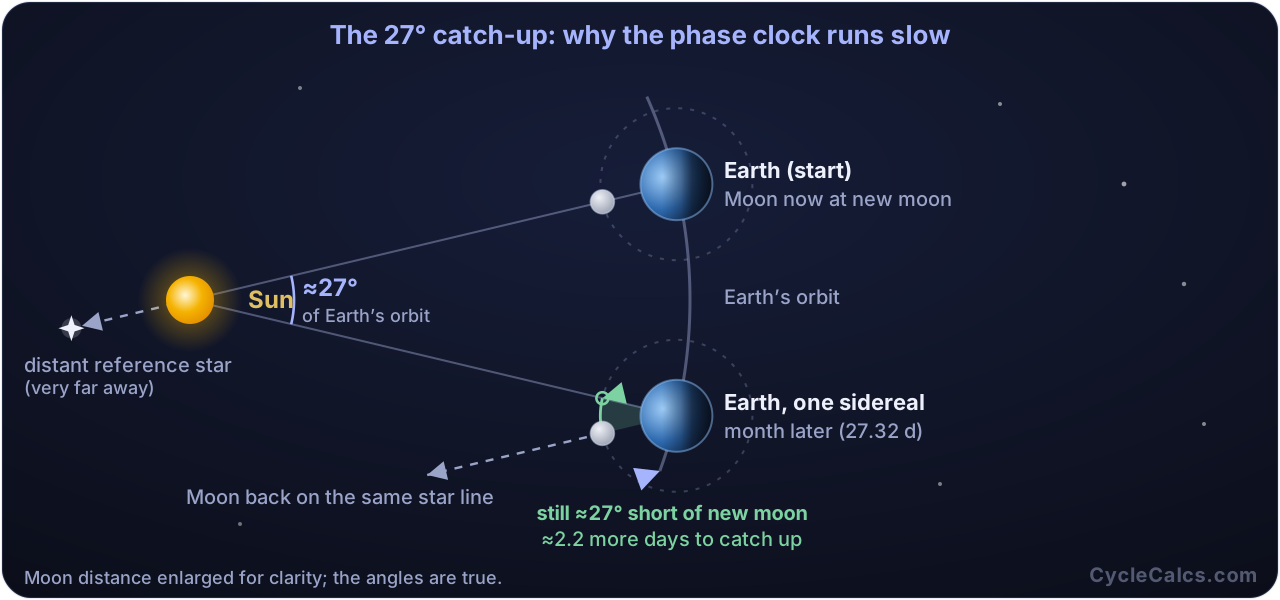
Synodic vs sidereal month: the sidereal month (one orbit against the stars) is 27.32 days, while the synodic month (new moon to new moon) is 29.53 days. The synodic month is longer because Earth moves along its own orbit, so the Moon must travel about two extra days to catch the same Sun-Earth-Moon alignment.
Two clocks for one orbit
Every orbiting body can be timed two ways. The sidereal period measures one full circuit against the fixed stars: the body leaves a star behind and returns to it. The synodic period measures the return to the same arrangement with the Sun: for the Moon that is the same phase, for a planet the next time it lines up with the Sun in our sky. The word synodic comes from the Greek for a meeting or coming together.
If Earth stood still, the two would be identical. But Earth is also moving, so the Sun’s direction in our sky keeps shifting through the year. The body has to chase a moving target to repeat its Sun arrangement, and that is why the synodic clock runs at a different speed from the sidereal one.
The Moon: 27.32 days against the stars, 29.53 against the Sun
The Moon is the clearest case. It returns to the same star in 27.32 days, the sidereal month. But during that month the Earth and Sun have slid about 27° onward around Earth’s orbit, so the Moon is not yet lined up with the Sun the same way; it is not back to new moon yet.
It has to travel about 27° further, which takes roughly 2.2 more days, to catch the Sun again. That gives the synodic month of 29.53 days, the familiar cycle of the phases. The phase clock is slower than the orbit clock because the Sun keeps moving the finish line. This is exactly why the Moon’s phases run on 29.5 days, not 27.3.
The lapping formula
Picture two runners on a circular track, a fast one and a slow one. How long until the fast runner laps the slow one and they are side by side again? You subtract their rates. In exactly the same way, the synodic period S comes from the two sidereal periods T1 and T2:
1 / S = | 1/T1 − 1/T2 |
For the Moon (27.32 days) against the Sun’s yearly march (365.26 days), that gives 29.53 days. For any two planets it gives the gap between their conjunctions. You can run it for any pair on the Synodic-Period Calculator, and every synodic period on the site, from the lunar month to the 19.86-year Jupiter-Saturn cycle, is listed among the cycles by length.
Planets: why synodic can be longer or shorter than sidereal
For a planet, the second “hand” on the clock is Earth itself, going around once a year. Which way the two periods differ depends on whether the planet is faster or slower than us.
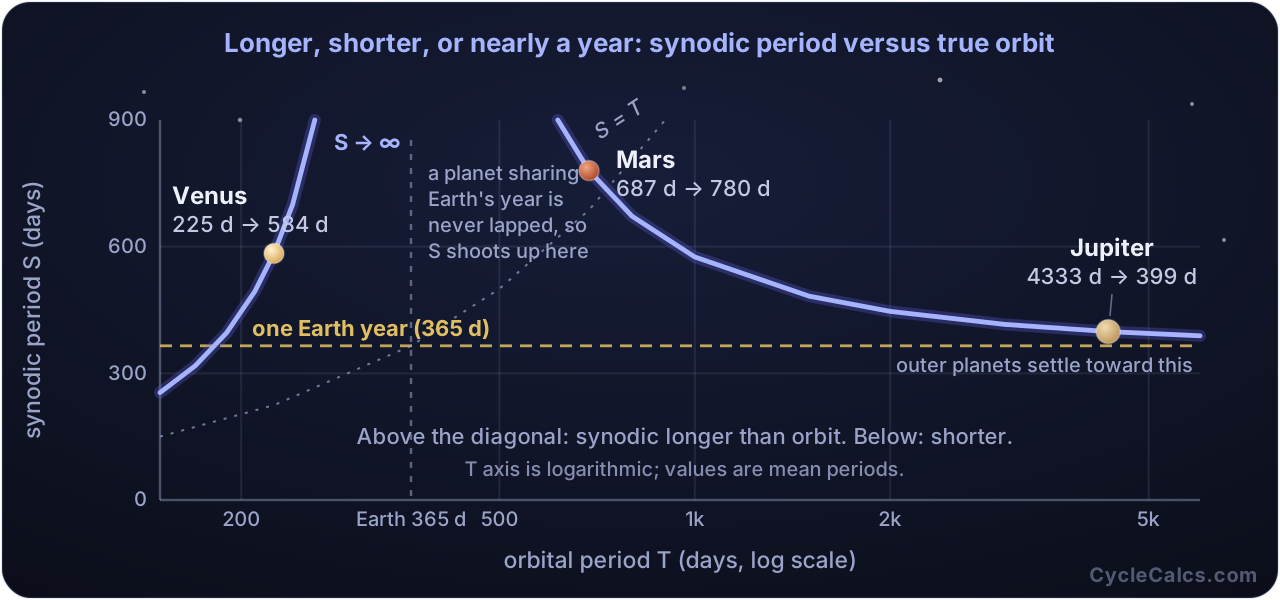
Inner planets are faster than Earth and lap us from inside. Venus orbits in 224.7 days but does not return to the same Sun arrangement until 583.9 days later, because in that time Earth has moved on too. The synodic period is longer than the orbit.
Mars, just outside us, behaves similarly: it orbits in 687 days but Earth needs 780 days to catch and pass it, so its synodic period is again the longer of the two, and that 780-day rhythm is exactly when Mars reaches opposition and turns retrograde.
Far-out planets flip the result. Jupiter takes nearly 12 years to orbit the Sun, but it crawls so slowly that Earth laps it almost every year: its synodic period is just 399 days, far shorter than its 12-year orbit. That is why Jupiter comes to opposition, its brightest, about a month later each year. The more distant the planet, the closer its synodic period creeps toward one Earth year.
Why the distinction matters
Almost every rhythm we actually watch in the sky is a synodic one. The cycle of moonlight that orders calendars is the synodic month, not the sidereal. The dates planets are best seen, at opposition or greatest elongation, follow their synodic periods. The timing of retrograde loops, the return of Venus as morning or evening star, and the spacing of eclipse seasons are all set by bodies lapping one another. Sidereal periods are the true orbits; synodic periods are what our moving viewpoint lets us see.
A third clock: the tropical period
There is a third way to time an orbit. Ecliptic longitude, the usual measure of position along the Sun's path, is counted from the March equinox, and precession slides that zero point west along the ecliptic by about 50.3 arcseconds a year. A planet travelling east therefore reaches its starting longitude a little before it reaches its starting star, so its tropical period, the return to the same ecliptic longitude, is shorter than its sidereal one. The gap grows with the length of the orbit: about 20 minutes for the Sun's yearly circuit (the tropical year of 365.242 days against the sidereal 365.256), about 100 days for Uranus (83.75 years against 84.02) and more than a year for Neptune (163.72 against 164.77).
| Planet | Sidereal: against the stars | Synodic: the same arrangement with the Sun | Tropical: from the March equinox |
|---|---|---|---|
| Mercury | 87.969 | 115.88 | 87.968 |
| Venus | 224.701 | 583.92 | 224.695 |
| Earth | 365.256 | none: Earth is the viewpoint | 365.242 |
| Mars | 686.980 | 779.94 | 686.930 |
| Jupiter | 4,332.59 (11.86 yr) | 398.88 | 4,330.60 (11.86 yr) |
| Saturn | 10,759.2 (29.46 yr) | 378.09 | 10,746.9 (29.42 yr) |
| Uranus | 30,688.5 (84.02 yr) | 369.66 | 30,588.7 (83.75 yr) |
| Neptune | 60,182.3 (164.77 yr) | 367.49 | 59,799.9 (163.72 yr) |
Years in brackets are Julian years of 365.25 days. Sidereal and tropical periods come from the planets' mean motions in Jean Meeus, Astronomical Algorithms, chapter 31, measured against the fixed J2000 equinox and against the moving equinox of date; synodic periods follow from 1/S = |1/T − 1/TEarth|. NASA's planetary fact sheets agree on the synodic periods to the precision shown here, and on the tropical periods for every planet but Mars: Mars's sheet gives 686.972 days, Mars's tropical year counted from its own equinox rather than Earth's. Their sidereal periods for Saturn, Uranus and Neptune come from a different fit of the orbits and differ from these by 3 to 7 days.
The Moon’s five months
Synodic and sidereal are the two most useful ways to time the Moon, but they are not the only ones. The Moon’s “month” depends on what you measure it against, and there are five standard answers. Four of them are within a day of the true orbit; only the synodic month, which chases the moving Sun, stands well apart. The small differences come from slow turnings of the orbit itself.
| Month | Length | Measured against | Why it differs from one orbit |
|---|---|---|---|
| Sidereal | 27.32 days | the fixed stars | the true orbit, the baseline the others are compared to |
| Tropical | 27.32 days | the March equinox | shorter by about 7 seconds, because the equinox creeps slowly westward (precession) |
| Anomalistic | 27.55 days | perigee, the closest point | longer, because the orbit’s long axis swings forward once every 8.85 years |
| Draconic (nodical) | 27.21 days | the orbital nodes | shorter, because the nodes slide backward once every 18.6 years |
| Synodic | 29.53 days | the Sun (the phases) | much longer, because the Sun’s direction keeps moving as Earth orbits |
To more decimals the published values are 27.321662 days (sidereal), 27.321582 (tropical), 27.554550 (anomalistic), 27.212221 (draconic) and 29.530589 (synodic). The tropical month is a hair shorter than the sidereal because the equinox itself drifts; the anomalistic is longer and the draconic shorter because the orbit’s perigee and its nodes are slowly turning in opposite senses.
Why eclipses care about three of them at once
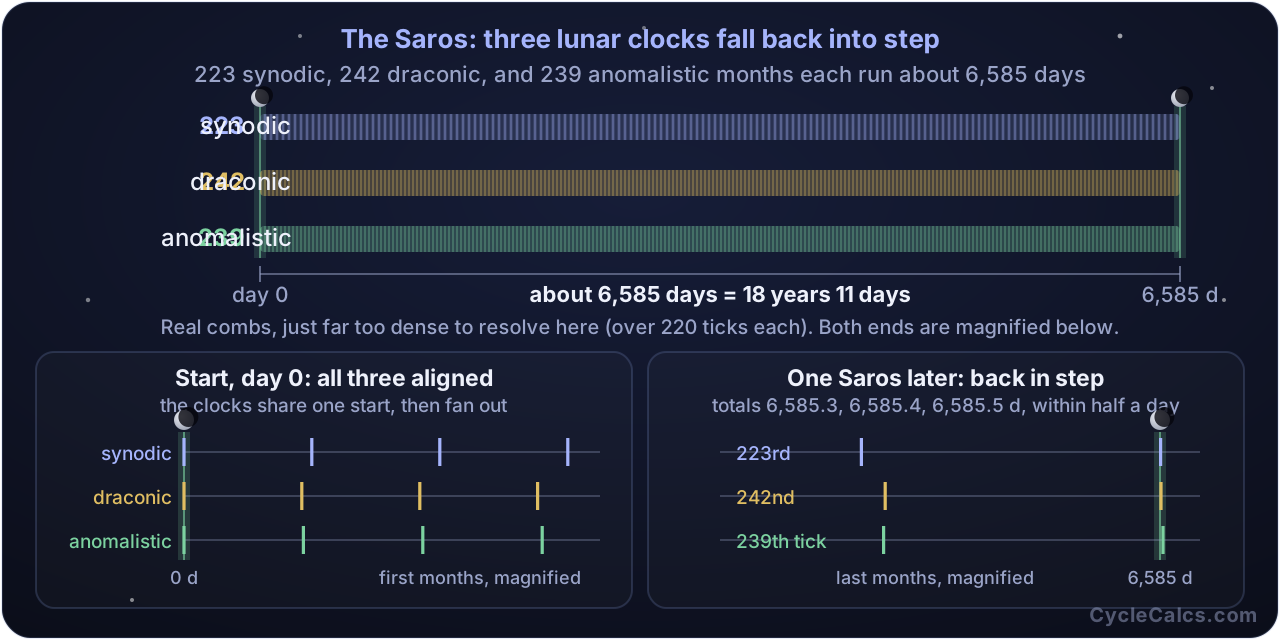
These obscure months are exactly what makes the eclipse tick. An eclipse needs the Moon both new or full (the synodic month) and near a node (the draconic month), and how total it looks depends on whether the Moon is near perigee (the anomalistic month).
About every 18 years and 11 days all three come back into step: 223 synodic months, 242 draconic months and 239 anomalistic months are each almost the same span, close to 6,585 days. That triple harmony is the Saros, the reason a near-identical eclipse returns on a predictable beat.
Frequently asked questions
What is the difference between a sidereal and a synodic period?
A sidereal period is one full orbit measured against the fixed stars. A synodic period is the time to return to the same arrangement with the Sun, such as the same Moon phase or the next conjunction of a planet. They differ because the observer is moving too: while the body orbits, Earth carries us around the Sun, so the Sun-relative geometry takes a little longer to repeat than one star-to-star orbit.
Why is the synodic month longer than the sidereal month?
The Moon returns to the same star in 27.32 days, its sidereal month. But in that time the Earth and Sun have moved about 27 degrees along Earth's orbit, so the Moon is not yet back to the same phase. It needs about 2.2 more days to catch up to the new Sun direction, giving a synodic month of 29.53 days. The phase cycle is longer than the orbit because the target, the Sun's direction, keeps moving.
How do you calculate a synodic period?
Combine the two orbital rates: one over the synodic period equals the absolute difference of one over each sidereal period, written 1/S = |1/T1 - 1/T2|. For the Moon and the Sun's yearly motion that gives 29.53 days; for two planets it gives the time between their conjunctions. You can run the numbers for any pair on the Synodic-Period Calculator.
How many kinds of lunar month are there?
There are five. The sidereal month (27.32 days) is one orbit against the stars; the tropical month (27.32 days) is measured against the March equinox; the anomalistic month (27.55 days) runs from perigee to perigee; the draconic or nodical month (27.21 days) runs from node to node; and the synodic month (29.53 days) is new moon to new moon. The synodic month is the longest because it is measured against the moving Sun.
Sources & further reading
- NASA StarChild: sidereal vs synodic month: NASA GSFC explainer on why the orbit is 27.3 days but the phases take 29.5.
- US Naval Observatory: Astronomical Almanac glossary: authoritative definitions of synodic period, sidereal month, and synodic month.
- NASA Science: Moon phases: the phase cycle and the 27.3-day orbit versus the 29.5-day new-moon-to-new-moon return.
- Durham University: lunar sidereal and synodic months: a worked explanation of the lapping math behind the two periods.
- Jean Meeus, Astronomical Algorithms (2nd ed., Willmann-Bell): the standard reference for the precise lengths of the five lunar months.
- NASA NSSDCA: planetary fact sheets: the sidereal, tropical and synodic periods the period table is checked against.
- NASA GISS Mars24: technical notes on Mars solar time: Mars's tropical year of 686.9725 days, counted from its own equinox.
See how these figures are computed on the methodology and sources page.
Keep exploring
Mars
The synodic period in action: 26 months between Mars oppositions, all computed on its page.
InteractiveSidereal vs Solar Day
The same lapping idea applied to Earth's spin: why a solar day runs about 4 minutes longer than a sidereal day.
InteractiveRetrograde Motion
The synodic period sets exactly when Earth overtakes a planet and it loops backward.
InteractiveMoon Phases
The 29.5-day phase cycle is the Moon's synodic month, longer than its 27.3-day orbit.
InteractiveThe Metonic Cycle
Where 235 of those synodic months stack up to almost exactly 19 years, so the phases repeat on the calendar.
CalculatorSynodic-Period Calculator
Plug in any two bodies and get the synodic period and the dates they line up.
ReferenceThe numbers and where we stand: the synodic month
New moon to new moon in 29.530589 days: the exact figure, where the current lunation stands, and the next new moons.
ReferenceThe numbers and where we stand: the sidereal month
One circuit against the stars in 27.321661 days: the exact figure and where the Moon is in the current one.