On this page
The Messier catalog holds 110 objects: 40 galaxies, 29 globular clusters, 26 open clusters, 12 nebulae (4 of them planetary nebulae) and 3 curiosities, compiled in Paris between 1758 and 1781 and completed by historians in 1966. Every one is visible from mid-northern latitudes with amateur equipment.
- Naked-eye objects: 8 from a dark site; 48 more need only binoculars
- Brightest: the Pleiades (M45), magnitude 1.6
- Nearest: the Pleiades (M45), about 390 to 460 light-years
- Farthest: M109 in Ursa Major, roughly 84 million light-years
- Best single month: March, when all 110 can be seen in one night from the right latitudes
The whole-sky object map
- Galaxy
- Globular cluster
- Open cluster
- Nebula
- Planetary nebula
- Star cloud, double star or asterism
Pick an object on the map, or a row in the table below; what it is, how far away it sits and how to see it will appear here.
The complete table
All 110 objects, sortable by any column. The distance column gives the accepted distance in light-years; where the literature spans a range, the guide sections below quote it honestly. "Best month" is when the object crosses the evening sky's meridian at about 9 pm, the most comfortable time to observe it. The gear column is the minimum that shows the object at all, not what does it justice.
| M | NGC / ID | Name | Type | Constellation | Mag | Distance | Size' | Best | Gear |
|---|---|---|---|---|---|---|---|---|---|
| M1 | NGC 1952 | Crab Nebula | Supernova remnant | Taurus | 8.4 | 6,500 ly | 6x4 | Feb | Telescope |
| M2 | NGC 7089 | Globular cluster | Aquarius | 6.5 | 33,000 ly | 13 | Oct | Binoculars | |
| M3 | NGC 5272 | Globular cluster | Canes Venatici | 6.4 | 33,900 ly | 16 | Jun | Binoculars | |
| M4 | NGC 6121 | Globular cluster | Scorpius | 5.9 | 7,200 ly | 26 | Jul | Binoculars | |
| M5 | NGC 5904 | Globular cluster | Serpens | 5.8 | 24,500 ly | 17 | Jul | Binoculars | |
| M6 | NGC 6405 | Butterfly Cluster | Open cluster | Scorpius | 4.2 | 1,600 ly | 15 | Aug | Binoculars |
| M7 | NGC 6475 | Ptolemy's Cluster | Open cluster | Scorpius | 3.3 | 980 ly | 80 | Aug | Naked eye |
| M8 | NGC 6523 | Lagoon Nebula | Nebula | Sagittarius | 5.8 | 4,100 ly | 90x40 | Aug | Binoculars |
| M9 | NGC 6333 | Globular cluster | Ophiuchus | 7.9 | 25,800 ly | 9 | Aug | Telescope | |
| M10 | NGC 6254 | Globular cluster | Ophiuchus | 6.6 | 14,300 ly | 15 | Aug | Binoculars | |
| M11 | NGC 6705 | Wild Duck Cluster | Open cluster | Scutum | 5.8 | 6,200 ly | 14 | Sep | Binoculars |
| M12 | NGC 6218 | Globular cluster | Ophiuchus | 6.6 | 15,700 ly | 14 | Aug | Binoculars | |
| M13 | NGC 6205 | Great Hercules Cluster | Globular cluster | Hercules | 5.9 | 22,200 ly | 17 | Aug | Binoculars |
| M14 | NGC 6402 | Globular cluster | Ophiuchus | 7.6 | 30,300 ly | 12 | Aug | Binoculars | |
| M15 | NGC 7078 | Globular cluster | Pegasus | 6.4 | 33,000 ly | 12 | Oct | Binoculars | |
| M16 | NGC 6611 | Eagle Nebula | Nebula | Serpens | 6.0 | 7,000 ly | 7 | Aug | Binoculars |
| M17 | NGC 6618 | Omega Nebula | Nebula | Sagittarius | 7.0 | 5,500 ly | 46x37 | Aug | Binoculars |
| M18 | NGC 6613 | Open cluster | Sagittarius | 6.9 | 4,900 ly | 9 | Aug | Binoculars | |
| M19 | NGC 6273 | Globular cluster | Ophiuchus | 7.2 | 28,700 ly | 14 | Aug | Binoculars | |
| M20 | NGC 6514 | Trifid Nebula | Nebula | Sagittarius | 6.3 | 5,200 ly | 29x27 | Aug | Binoculars |
| M21 | NGC 6531 | Open cluster | Sagittarius | 5.9 | 4,300 ly | 13 | Aug | Binoculars | |
| M22 | NGC 6656 | Globular cluster | Sagittarius | 5.1 | 10,600 ly | 24 | Sep | Binoculars | |
| M23 | NGC 6494 | Open cluster | Sagittarius | 5.5 | 2,200 ly | 27 | Aug | Binoculars | |
| M24 | IC 4715 | Small Sagittarius Star Cloud | Star cloud | Sagittarius | 4.5 | 10,000 ly | 90 | Aug | Naked eye |
| M25 | IC 4725 | Open cluster | Sagittarius | 4.6 | 2,000 ly | 32 | Sep | Binoculars | |
| M26 | NGC 6694 | Open cluster | Scutum | 8.0 | 5,000 ly | 15 | Sep | Telescope | |
| M27 | NGC 6853 | Dumbbell Nebula | Planetary nebula | Vulpecula | 8.1 | 1,330 ly | 8x4 | Sep | Binoculars |
| M28 | NGC 6626 | Globular cluster | Sagittarius | 6.9 | 17,900 ly | 11 | Aug | Binoculars | |
| M29 | NGC 6913 | Open cluster | Cygnus | 6.6 | 7,200 ly | 7 | Sep | Binoculars | |
| M30 | NGC 7099 | Globular cluster | Capricornus | 7.5 | 29,400 ly | 11 | Oct | Binoculars | |
| M31 | NGC 224 | Andromeda Galaxy | Galaxy | Andromeda | 3.4 | 2.5 Mly | 190x60 | Dec | Naked eye |
| M32 | NGC 221 | Galaxy | Andromeda | 8.2 | 2.5 Mly | 9x7 | Dec | Telescope | |
| M33 | NGC 598 | Triangulum Galaxy | Galaxy | Triangulum | 5.7 | 2.7 Mly | 71x42 | Dec | Binoculars |
| M34 | NGC 1039 | Open cluster | Perseus | 5.2 | 1,500 ly | 35 | Jan | Binoculars | |
| M35 | NGC 2168 | Open cluster | Gemini | 5.1 | 2,800 ly | 28 | Feb | Binoculars | |
| M36 | NGC 1960 | Open cluster | Auriga | 6.0 | 4,100 ly | 12 | Feb | Binoculars | |
| M37 | NGC 2099 | Open cluster | Auriga | 5.6 | 4,500 ly | 24 | Feb | Binoculars | |
| M38 | NGC 1912 | Open cluster | Auriga | 6.4 | 4,200 ly | 21 | Feb | Binoculars | |
| M39 | NGC 7092 | Open cluster | Cygnus | 4.6 | 820 ly | 32 | Oct | Binoculars | |
| M40 | Winnecke 4 | Double star | Ursa Major | 8.0 | May | Binoculars | |||
| M41 | NGC 2287 | Open cluster | Canis Major | 4.5 | 2,300 ly | 38 | Mar | Naked eye | |
| M42 | NGC 1976 | Orion Nebula | Nebula | Orion | 4.0 | 1,340 ly | 66x60 | Feb | Naked eye |
| M43 | NGC 1982 | Nebula | Orion | 9.0 | 1,300 ly | 20x15 | Feb | Telescope | |
| M44 | NGC 2632 | Praesepe | Open cluster | Cancer | 3.1 | 580 ly | 95 | Apr | Naked eye |
| M45 | Melotte 22 | Pleiades | Open cluster | Taurus | 1.6 | 430 ly | 110 | Jan | Naked eye |
| M46 | NGC 2437 | Open cluster | Puppis | 6.1 | 5,400 ly | 27 | Mar | Binoculars | |
| M47 | NGC 2422 | Open cluster | Puppis | 4.4 | 1,600 ly | 30 | Mar | Naked eye | |
| M48 | NGC 2548 | Open cluster | Hydra | 5.8 | 1,500 ly | 54 | Mar | Binoculars | |
| M49 | NGC 4472 | Galaxy | Virgo | 8.4 | 56 Mly | 10x8 | May | Telescope | |
| M50 | NGC 2323 | Open cluster | Monoceros | 5.9 | 3,200 ly | 16 | Mar | Binoculars | |
| M51 | NGC 5194/5 | Whirlpool | Galaxy | Canes Venatici | 8.1 | 23 Mly | 11x8 | Jun | Telescope |
| M52 | NGC 7654 | Open cluster | Cassiopeia | 6.9 | 5,000 ly | 13 | Nov | Binoculars | |
| M53 | NGC 5024 | Globular cluster | Coma Berenices | 7.7 | 58,000 ly | 13 | Jun | Binoculars | |
| M54 | NGC 6715 | Globular cluster | Sagittarius | 7.7 | 87,400 ly | 9 | Sep | Binoculars | |
| M55 | NGC 6809 | Globular cluster | Sagittarius | 7.0 | 17,600 ly | 19 | Sep | Binoculars | |
| M56 | NGC 6779 | Globular cluster | Lyra | 8.2 | 32,900 ly | 7 | Sep | Telescope | |
| M57 | NGC 6720 | Ring Nebula | Planetary nebula | Lyra | 9.0 | 2,700 ly | 1 | Sep | Telescope |
| M58 | NGC 4579 | Galaxy | Virgo | 9.8 | 63 Mly | 6x5 | Jun | Telescope | |
| M59 | NGC 4621 | Galaxy | Virgo | 9.8 | 60 Mly | 5x4 | Jun | Telescope | |
| M60 | NGC 4649 | Galaxy | Virgo | 8.8 | 55 Mly | 7x6 | Jun | Telescope | |
| M61 | NGC 4303 | Galaxy | Virgo | 9.7 | 53 Mly | 7x6 | May | Telescope | |
| M62 | NGC 6266 | Globular cluster | Ophiuchus | 6.6 | 22,200 ly | 14 | Aug | Binoculars | |
| M63 | NGC 5055 | Sunflower Galaxy | Galaxy | Canes Venatici | 8.6 | 37 Mly | 13x7 | Jun | Telescope |
| M64 | NGC 4826 | Black Eye Galaxy | Galaxy | Coma Berenices | 8.5 | 17 Mly | 10x5 | Jun | Telescope |
| M65 | NGC 3623 | Galaxy | Leo | 9.3 | 42 Mly | 10x3 | May | Telescope | |
| M66 | NGC 3627 | Galaxy | Leo | 9.0 | 36 Mly | 9x4 | May | Telescope | |
| M67 | NGC 2682 | Open cluster | Cancer | 6.9 | 2,800 ly | 30 | Apr | Binoculars | |
| M68 | NGC 4590 | Globular cluster | Hydra | 8.2 | 33,600 ly | 12 | Jun | Telescope | |
| M69 | NGC 6637 | Globular cluster | Sagittarius | 7.7 | 29,700 ly | 7 | Sep | Binoculars | |
| M70 | NGC 6681 | Globular cluster | Sagittarius | 8.1 | 29,400 ly | 8 | Sep | Telescope | |
| M71 | NGC 6838 | Globular cluster | Sagitta | 8.3 | 13,000 ly | 7 | Sep | Telescope | |
| M72 | NGC 6981 | Globular cluster | Aquarius | 9.4 | 54,600 ly | 6 | Oct | Telescope | |
| M73 | NGC 6994 | Asterism | Aquarius | 10.0 | Oct | Telescope | |||
| M74 | NGC 628 | Galaxy | Pisces | 9.2 | 30 Mly | 11x10 | Dec | Telescope | |
| M75 | NGC 6864 | Globular cluster | Sagittarius | 8.6 | 67,500 ly | 6 | Sep | Telescope | |
| M76 | NGC 650/1 | Little Dumbbell Nebula | Planetary nebula | Perseus | 10.1 | 2,500 ly | 2x1 | Dec | Telescope |
| M77 | NGC 1068 | Cetus A | Galaxy | Cetus | 8.8 | 47 Mly | 7x6 | Jan | Telescope |
| M78 | NGC 2068 | Nebula | Orion | 8.0 | 1,600 ly | 8x6 | Feb | Telescope | |
| M79 | NGC 1904 | Globular cluster | Lepus | 8.0 | 41,000 ly | 9 | Feb | Telescope | |
| M80 | NGC 6093 | Globular cluster | Scorpius | 7.2 | 32,600 ly | 9 | Jul | Binoculars | |
| M81 | NGC 3031 | Bode's Galaxy | Galaxy | Ursa Major | 6.8 | 12 Mly | 27x14 | Apr | Telescope |
| M82 | NGC 3034 | Cigar Galaxy | Galaxy | Ursa Major | 8.4 | 12 Mly | 11x4 | Apr | Telescope |
| M83 | NGC 5236 | Southern Pinwheel | Galaxy | Hydra | 7.6 | 15 Mly | 13x12 | Jun | Binoculars |
| M84 | NGC 4374 | Galaxy | Virgo | 9.3 | 60 Mly | 7x6 | May | Telescope | |
| M85 | NGC 4382 | Galaxy | Coma Berenices | 9.2 | 60 Mly | 7x5 | May | Telescope | |
| M86 | NGC 4406 | Galaxy | Virgo | 9.2 | 52 Mly | 9x6 | May | Telescope | |
| M87 | NGC 4486 | Virgo A | Galaxy | Virgo | 8.6 | 54 Mly | 8x7 | Jun | Telescope |
| M88 | NGC 4501 | Galaxy | Coma Berenices | 9.5 | 48 Mly | 7x4 | Jun | Telescope | |
| M89 | NGC 4552 | Galaxy | Virgo | 9.8 | 50 Mly | 5 | Jun | Telescope | |
| M90 | NGC 4569 | Galaxy | Virgo | 9.5 | 59 Mly | 10x5 | Jun | Telescope | |
| M91 | NGC 4548 | Galaxy | Coma Berenices | 10.2 | 63 Mly | 5x4 | Jun | Telescope | |
| M92 | NGC 6341 | Globular cluster | Hercules | 6.5 | 26,700 ly | 11 | Aug | Binoculars | |
| M93 | NGC 2447 | Open cluster | Puppis | 6.2 | 3,600 ly | 22 | Mar | Binoculars | |
| M94 | NGC 4736 | Cat's Eye Galaxy | Galaxy | Canes Venatici | 8.1 | 16 Mly | 11x9 | Jun | Telescope |
| M95 | NGC 3351 | Galaxy | Leo | 9.7 | 33 Mly | 3 | May | Telescope | |
| M96 | NGC 3368 | Galaxy | Leo | 9.2 | 31 Mly | 8x5 | May | Telescope | |
| M97 | NGC 3587 | Owl Nebula | Planetary nebula | Ursa Major | 9.9 | 2,000 ly | 3 | May | Telescope |
| M98 | NGC 4192 | Galaxy | Coma Berenices | 10.1 | 44 Mly | 10x3 | May | Telescope | |
| M99 | NGC 4254 | Galaxy | Coma Berenices | 9.8 | 50 Mly | 5 | May | Telescope | |
| M100 | NGC 4321 | Galaxy | Coma Berenices | 9.4 | 55 Mly | 7x6 | May | Telescope | |
| M101 | NGC 5457 | Pinwheel | Galaxy | Ursa Major | 7.7 | 21 Mly | 29x27 | Jun | Telescope |
| M102 | NGC 5866 | Spindle | Galaxy | Draco | 9.9 | 50 Mly | 5x2 | Jul | Telescope |
| M103 | NGC 581 | Open cluster | Cassiopeia | 7.4 | 10,000 ly | 6 | Dec | Binoculars | |
| M104 | NGC 4594 | Sombrero | Galaxy | Virgo | 8.3 | 30 Mly | 9x4 | Jun | Telescope |
| M105 | NGC 3379 | Galaxy | Leo | 9.3 | 32 Mly | 5 | May | Telescope | |
| M106 | NGC 4258 | Galaxy | Canes Venatici | 8.3 | 24 Mly | 19x7 | May | Telescope | |
| M107 | NGC 6171 | Globular cluster | Ophiuchus | 8.1 | 20,900 ly | 10 | Aug | Telescope | |
| M108 | NGC 3556 | Galaxy | Ursa Major | 10.0 | 46 Mly | 9x2 | May | Telescope | |
| M109 | NGC 3992 | Galaxy | Ursa Major | 9.8 | 84 Mly | 8x5 | May | Telescope | |
| M110 | NGC 205 | Galaxy | Andromeda | 8.0 | 2.7 Mly | 22x11 | Dec | Telescope |
Click any row to jump to that object's guide. Sizes are each object's larger apparent dimension in arcminutes; J2000 positions ride along in the CSV download.
Messier the comet hunter
Charles Messier hunted comets from a tower of the Hotel de Cluny in central Paris, and by the standards of his century he was superb at it: he discovered 13 outright and shared credit for several more. Comets in a small 18th-century refractor look like dim, fuzzy patches, and the sky is scattered with dim, fuzzy patches that never move. After wasting nights on the Crab Nebula in 1758 while chasing the predicted return of Halley's comet, Messier began writing down the impostors so he could ignore them. That working list grew into the catalog: 45 objects in the 1774 first edition, 68 by 1780, and 103 in the final 1781 publication, with colleagues, above all Pierre Mechain, contributing many of the later finds.
The 20th century finished the job. Historians restored seven objects Messier and Mechain had observed but never formally numbered: M104 (added in 1921), M105 through M107 (1947), M108 and M109 (1953), and finally M110 in 1966. That is how a comet hunter's list of things to avoid ended at 110 entries, and why the numbering wanders across the sky in no particular order: it follows the sequence of discovery, not geography.
The catalog's lasting value comes from its limitations. Messier worked with telescopes no more capable than a modern beginner's instrument, under Paris skies, from latitude 49 degrees north. Whatever he could see, you can see. That is why the Messier catalog, and not some deeper professional list, remains the standard first tour of the deep sky: it is a complete inventory of the northern sky's showpieces, pre-filtered by a small telescope. The same geography explains what is missing: nothing in the catalog sits south of about declination -35, so southern wonders like Omega Centauri and the Carina Nebula are absent. They live in later lists, chiefly the Caldwell catalog, which this site's Sky Map also plots.
What the 110 objects actually are
Messier had no idea what most of his objects were; nobody did until the 20th century. The list turns out to sample almost everything the deep sky contains:
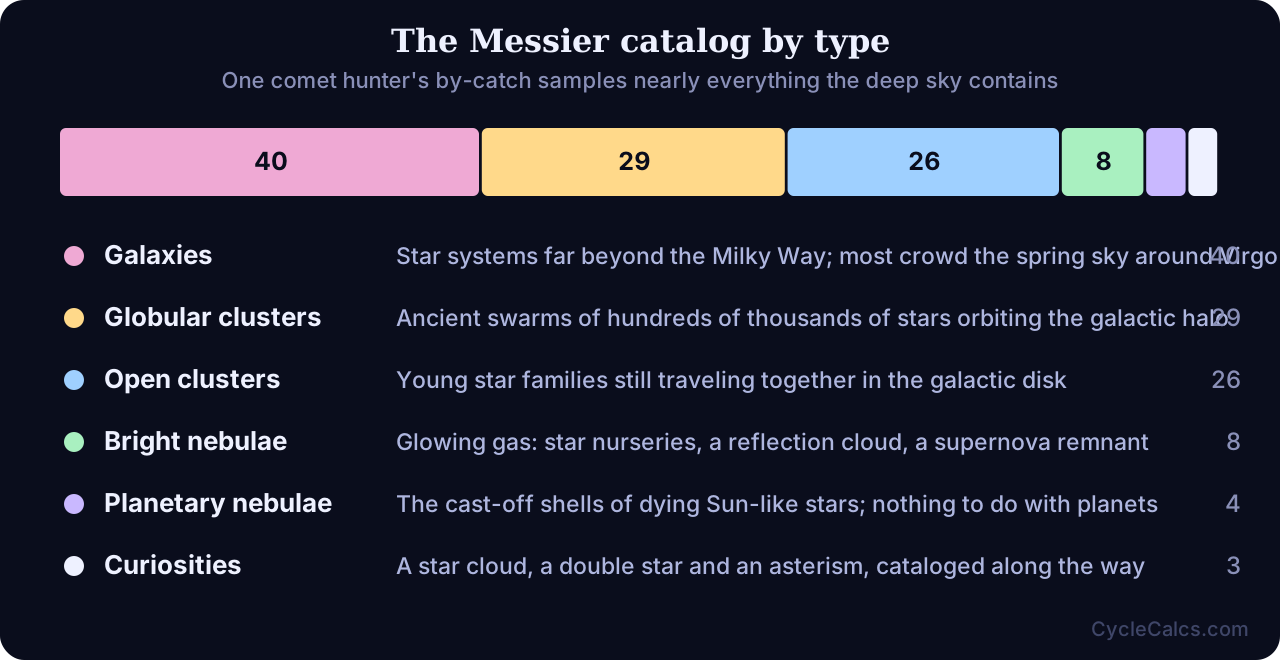
- Open clusters (26). Young families of stars, from a few dozen to a few thousand, still traveling together in the galaxy's disk after being born from one cloud. Most will drift apart within a few hundred million years. They range from naked-eye spectacles like the Pleiades to rich telescopic fields like M37.
- Globular clusters (29). Ancient spherical swarms of hundreds of thousands of stars orbiting the Milky Way's halo, most of them 11 to 13 billion years old, older than the galaxy's disk itself. In the eyepiece they grow from a fuzzy ball to a sugar-spill of resolved stars as aperture increases.
- Bright nebulae (8). Clouds of gas and dust: some glowing with their own light where new stars ionize them (Orion, the Lagoon), one shining only by reflected starlight (M78), and one, the Crab, the debris of an exploded star. The catalog's single supernova remnant is also its first entry.
- Planetary nebulae (4). The cast-off outer layers of dying Sun-like stars, glowing for a few tens of thousands of years while the exposed core fades to a white dwarf. The name is an 18th-century accident: in early telescopes their small disks resembled planets. They have nothing to do with planets.
- Galaxies (40). Entire star systems far beyond the Milky Way, from our neighbor Andromeda at 2.5 million light-years to M109 at roughly 84 million. The catalog's galaxies crowd the spring sky, where the Virgo Cluster pours across the border into Coma Berenices.
- The curiosities (3). One naked-eye window through the Milky Way's dust (the M24 star cloud), one double star cataloged by mistake (M40), and one four-star asterism (M73). The debated entry M102 is counted with the galaxies and discussed below.
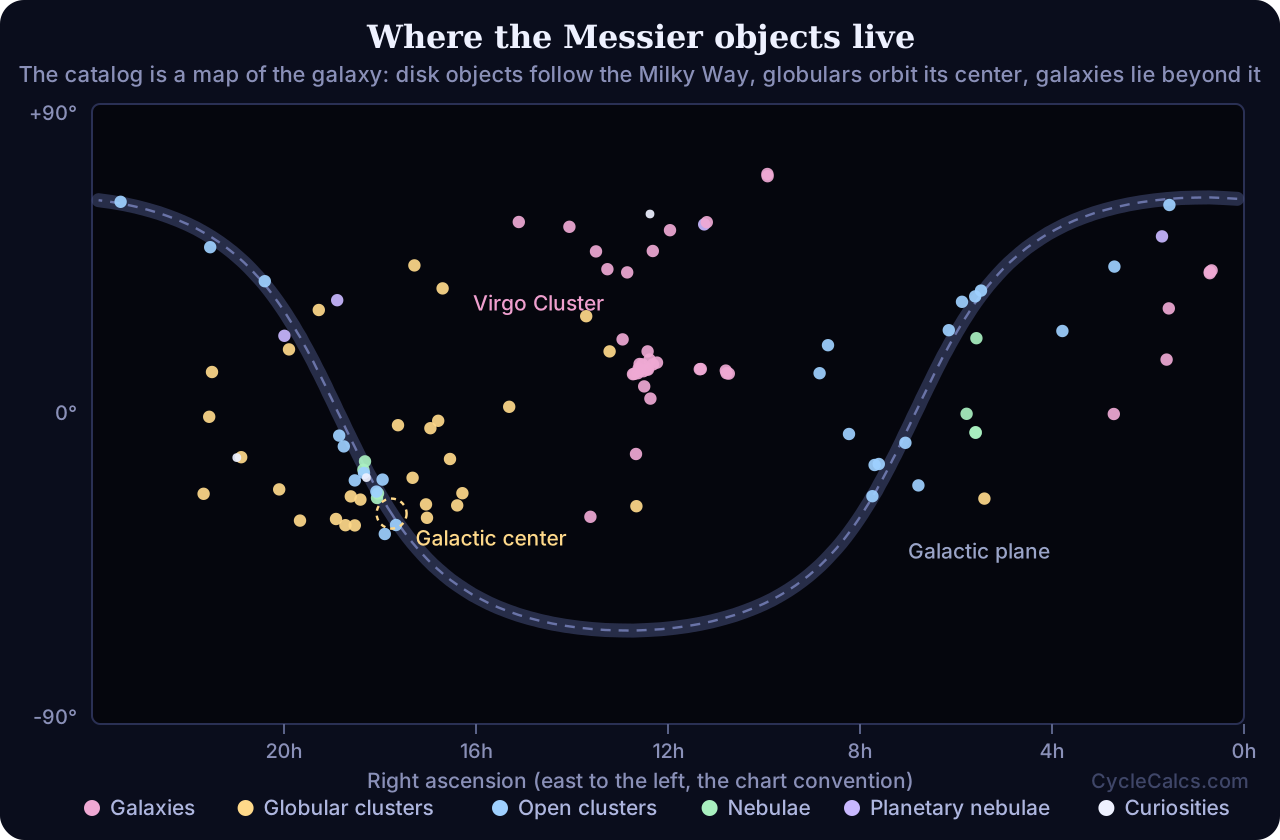
The catalog also has a geography. Globular clusters swarm the summer sky toward Sagittarius, Scorpius and Ophiuchus, because that is the direction of the galactic center they orbit. Open clusters and nebulae ride the winter and summer Milky Way, because they live in the galaxy's star-forming disk. And the galaxies fill the spring sky, where we look up and out of our own galaxy's dusty plane into clear intergalactic space. Learn that pattern and the catalog stops being a list and becomes a map of how the galaxy is put together.
The Messier marathon
Around the March new moon, and only then, the geometry of the sky allows a determined observer at the right latitude to see every Messier object in a single night. The Sun sits in Pisces and Aquarius, the one stretch of sky nearly empty of Messier objects, so everything else parades through the darkness between dusk and dawn. That all-night pursuit is the Messier marathon.
The race has a brutal start and finish. At dusk you have minutes to catch M74 and M77, low in the west in fading twilight, two of the hardest objects in the catalog at the worst possible moment. The night then unrolls eastward: the autumn objects, the winter showpieces, the spring galaxies (most marathoners hit the Virgo Cluster after midnight), the summer globulars in the small hours, and finally a dawn scramble for M30, rising just ahead of the Sun. Miss the window at either end and a perfect score is gone.
Honesty about the conditions: a full 110-object marathon is realistic only between about latitude 20 and 40 degrees north; farther north, the southernmost objects barely rise, and farther south, the dusk and dawn brackets fail. It also demands a dark site with clean horizons, and it is a sport, not an observing program. Nobody appreciates the Ring Nebula in the 40 seconds a marathon schedule allows. Most observers get more from a half marathon, or from taking a season's objects at a comfortable pace with the month column in the table above.
Mistakes, gaps and the M102 debate
A catalog assembled by hand over 23 years, from a Paris rooftop, carries scars, and they are part of its charm. The site treats them honestly rather than smoothing them over:
- M40 is a double star. Messier went looking for a nebula Hevelius had reported near Megrez, found nothing but a faint pair of stars, and cataloged the pair anyway. Modern measurements show the two stars are unrelated, a chance alignment.
- M73 is four unrelated stars. A tiny Y-shaped knot that Messier described as a cluster containing nebulosity. Precise distances have since shown the four stars lie at different depths; there is no cluster and no nebulosity.
- M47 and M48 were lost for centuries. Sign errors and a 5-degree slip in Messier's recorded positions meant no object existed at either cataloged spot. The true identities (NGC 2422 and NGC 2548) were only pinned down in the 20th century, both puzzles fully settled in 1959. M91 stayed lost even longer, until a 1969 analysis showed Messier had measured it from the wrong reference galaxy.
- M102 may be a duplicate. Mechain reported it, then wrote a letter saying it had been a re-observation of M101. But Messier's handwritten position and description fit the Spindle Galaxy, NGC 5866, remarkably well. The literature has argued both ways for two centuries. This page follows the common modern practice of treating NGC 5866 as M102, and says so rather than pretending the question is closed.
- M45 has no NGC number. The Pleiades were too obviously a star cluster to make the New General Catalog, so one of the sky's most famous objects has no NGC or IC number at all; Melotte 22 is its main alternate designation.
Object-by-object guides
Every object below gets the same honest treatment: what it is, who found it, the accepted distance, and how to find and see it, including the minimum equipment and the brightest sky (its Bortle class) in which it stays an easy catch. The star-hop directions assume you can point at the bright stars of the season; the constellation guides cover that first step. Photographs are NASA imagery; the eyepiece always shows less color and less nebulosity than any photo, and the guides say what you will actually see.
M1 Crab NebulaSupernova remnant in Taurus
- ID
- NGC 1952
- Distance
- about 4,900 to 8,100 light-years
- Magnitude
- 8.4
- Size
- 6x4 arcmin
- Best month
- February
- Gear
- Telescope, 80 mm and up
- Sky
- Dark skies (Bortle 4 or better) to be easy
- Discovery
- John Bevis, 1731; the object that prompted Messier to start his catalog in 1758
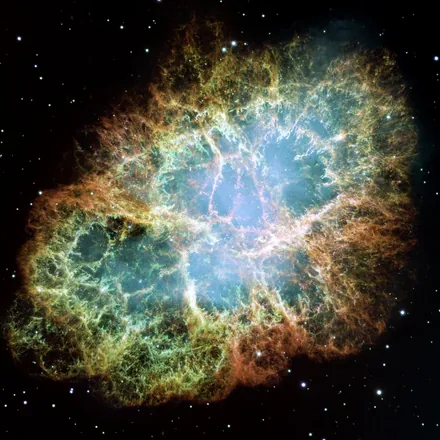
The Crab Nebula is the expanding wreckage of a supernova that Chinese astronomers recorded in 1054, bright enough at its peak to be seen in daylight. At its heart sits a pulsar, a city-sized neutron star spinning about 30 times per second.
Finding it: Look 1 degree northwest of Zeta Tauri, the star at the tip of the Bull's southern horn.
M2Globular cluster in Aquarius
- ID
- NGC 7089
- Distance
- about 33,000 light-years
- Magnitude
- 6.5
- Size
- 13 arcmin
- Best month
- October
- Gear
- Binoculars
- Sky
- Suburban skies or darker (Bortle 5) to stay easy
- Discovery
- Jean-Dominique Maraldi, 1746
One of the oldest globular clusters known, M2 packs roughly 150,000 stars into a ball about 175 light-years across, with an estimated age near 13 billion years.
Finding it: Sweep about 5 degrees north of Beta Aquarii; the cluster forms a near right angle with Alpha and Beta Aquarii.
M3Globular cluster in Canes Venatici
- ID
- NGC 5272
- Distance
- about 33,900 light-years
- Magnitude
- 6.4
- Size
- 16 arcmin
- Best month
- June
- Gear
- Binoculars
- Sky
- Suburban skies or darker (Bortle 5) to stay easy
- Discovery
- Charles Messier, 1764; the first object he discovered himself
M3 contains about half a million stars and more known variable stars than any other globular cluster, over 270 of them, most of the RR Lyrae type pulsing on cycles of hours.
Finding it: Look roughly halfway along the line from Arcturus to Cor Caroli.
M4Globular cluster in Scorpius
- ID
- NGC 6121
- Distance
- about 7,200 light-years
- Magnitude
- 5.9
- Size
- 26 arcmin
- Best month
- July
- Gear
- Binoculars
- Sky
- Suburban skies or darker (Bortle 6) to stay easy
- Discovery
- Philippe Loys de Cheseaux, 1746
At about 7,000 light-years, M4 is the nearest globular cluster to Earth, close enough that a modest telescope resolves its outer stars. A distinctive bar of 11th-magnitude stars runs straight through its center.
Finding it: Just over 1 degree west of Antares; the two share a binocular field.
M5Globular cluster in Serpens
- ID
- NGC 5904
- Distance
- about 24,500 light-years
- Magnitude
- 5.8
- Size
- 17 arcmin
- Best month
- July
- Gear
- Binoculars
- Sky
- Suburban skies or darker (Bortle 6) to stay easy
- Discovery
- Gottfried Kirch, 1702
Rivaling M13 for the title of the northern sky's finest globular, M5 spans some 165 light-years and may be one of the oldest clusters in the galaxy at close to 13 billion years.
Finding it: About 8 degrees southwest of Unukalhai, the brightest star of Serpens, right next to the 5th-magnitude star 5 Serpentis.
M6 Butterfly ClusterOpen cluster in Scorpius
- ID
- NGC 6405
- Distance
- about 1,600 light-years
- Magnitude
- 4.2
- Size
- 15 arcmin
- Best month
- August
- Gear
- Binoculars
- Sky
- Suburban skies or darker (Bortle 6) to stay easy
- Discovery
- Giovanni Battista Hodierna, before 1654
The Butterfly Cluster's brighter stars trace two open wings. Its brightest member, the orange giant BM Scorpii, varies noticeably and gives the blue cluster a single warm-colored eye.
Finding it: About 5 degrees north of the Scorpion's stinger star Shaula, in the same binocular field as M7.
M7 Ptolemy's ClusterOpen cluster in Scorpius
- ID
- NGC 6475
- Distance
- about 650 to 1,310 light-years
- Magnitude
- 3.3
- Size
- 80 arcmin
- Best month
- August
- Gear
- Naked eye
- Sky
- Fine under bright suburban skies (Bortle 7)
- Discovery
- Recorded by Ptolemy about 130 AD, one of the earliest written records of any deep-sky object
Ptolemy's Cluster is the southernmost Messier object and an easy naked-eye glow from dark sites, 80 stars scattered across a patch wider than two full Moons.
Finding it: About 4.5 degrees northeast of Shaula, between the Scorpion's stinger and the Teapot's spout.
M8 Lagoon NebulaNebula in Sagittarius
- ID
- NGC 6523
- Distance
- about 4,100 light-years
- Magnitude
- 5.8
- Size
- 90x40 arcmin
- Best month
- August
- Gear
- Binoculars
- Sky
- Dark skies (Bortle 4 or better) to be easy
- Discovery
- Giovanni Battista Hodierna, before 1654
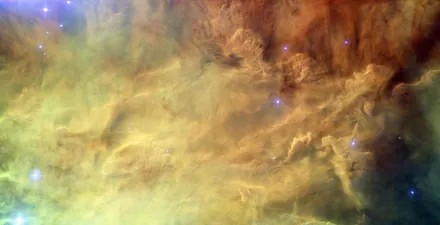
The Lagoon Nebula is a stellar nursery 4,000 light-years away, bright enough to glimpse with the naked eye from a dark site. A dark dust channel, the lagoon itself, splits the glow beside the young cluster NGC 6530.
Finding it: Above and right of the Teapot's spout in Sagittarius; under dark skies it is a naked-eye brightening of the Milky Way.
M9Globular cluster in Ophiuchus
- ID
- NGC 6333
- Distance
- about 25,800 light-years
- Magnitude
- 7.9
- Size
- 9 arcmin
- Best month
- August
- Gear
- Telescope, 50 mm and up
- Sky
- Suburban skies or darker (Bortle 5) to stay easy
- Discovery
- Charles Messier, 1764
M9 orbits unusually close to the galactic center, about 5,500 light-years from it, and its light is visibly dimmed and reddened by dust in the foreground.
Finding it: About 3.5 degrees southeast of Sabik (Eta Ophiuchi).
M10Globular cluster in Ophiuchus
- ID
- NGC 6254
- Distance
- about 14,300 light-years
- Magnitude
- 6.6
- Size
- 15 arcmin
- Best month
- August
- Gear
- Binoculars
- Sky
- Suburban skies or darker (Bortle 6) to stay easy
- Discovery
- Charles Messier, 1764
M10 and its neighbor M12 make one of the sky's best globular pairs, close enough to compare in one low-power sweep: M10 is the slightly brighter and more concentrated of the two.
Finding it: Near the center of Ophiuchus, about 1 degree west of the 5th-magnitude star 30 Ophiuchi.
M11 Wild Duck ClusterOpen cluster in Scutum
- ID
- NGC 6705
- Distance
- about 6,200 light-years
- Magnitude
- 5.8
- Size
- 14 arcmin
- Best month
- September
- Gear
- Binoculars
- Sky
- Suburban skies or darker (Bortle 5) to stay easy
- Discovery
- Gottfried Kirch, 1681
The Wild Duck Cluster is the densest open cluster in the Messier catalog, close to 3,000 stars in a wedge that early observers likened to a flight of ducks. In a small telescope it can pass for a loose globular.
Finding it: Follow the tail of Aquila from Altair through Lambda Aquilae into the Scutum star cloud; M11 sits at the cloud's northern edge.
M12Globular cluster in Ophiuchus
- ID
- NGC 6218
- Distance
- about 15,700 light-years
- Magnitude
- 6.6
- Size
- 14 arcmin
- Best month
- August
- Gear
- Binoculars
- Sky
- Suburban skies or darker (Bortle 6) to stay easy
- Discovery
- Charles Messier, 1764
M12 is a noticeably loose globular; its relaxed grip appears to have cost it dearly, with studies suggesting the galaxy's tides have stripped away as many as a million of its low-mass stars.
Finding it: About 3 degrees northwest of M10, in the middle of Ophiuchus.
M13 Great Hercules ClusterGlobular cluster in Hercules
- ID
- NGC 6205
- Distance
- about 22,200 light-years
- Magnitude
- 5.9
- Size
- 17 arcmin
- Best month
- August
- Gear
- Binoculars
- Sky
- Suburban skies or darker (Bortle 5) to stay easy
- Discovery
- Edmond Halley, 1714
The Great Hercules Cluster holds several hundred thousand stars and is the showpiece globular of northern skies. In 1974 the Arecibo radio telescope beamed humanity's first deliberate interstellar message toward it.
Finding it: On the western edge of the Keystone of Hercules, two-thirds of the way from Zeta to Eta Herculis.
M14Globular cluster in Ophiuchus
- ID
- NGC 6402
- Distance
- about 30,300 light-years
- Magnitude
- 7.6
- Size
- 12 arcmin
- Best month
- August
- Gear
- Binoculars
- Sky
- Suburban skies or darker (Bortle 5) to stay easy
- Discovery
- Charles Messier, 1764
M14 hides a rarity: a nova erupted inside it in 1938, but nobody noticed until the photographic plates were re-examined in 1964, making it one of only a few novae ever found in a globular cluster.
Finding it: In the sparse eastern half of Ophiuchus, about 8 degrees south of Cebalrai (Beta Ophiuchi).
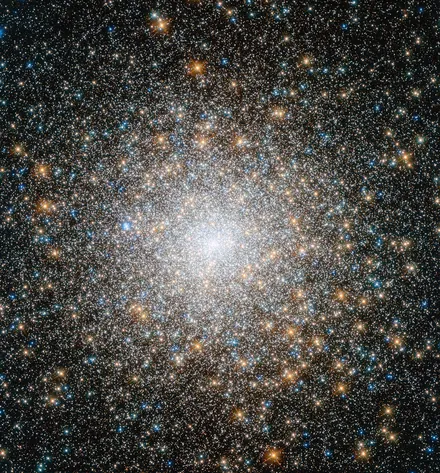
M15Globular cluster in Pegasus
- ID
- NGC 7078
- Distance
- about 33,000 light-years
- Magnitude
- 6.4
- Size
- 12 arcmin
- Best month
- October
- Gear
- Binoculars
- Sky
- Suburban skies or darker (Bortle 5) to stay easy
- Discovery
- Jean-Dominique Maraldi, 1746
M15 has one of the densest cores of any globular, the textbook example of core collapse, and it was the first globular found to contain a planetary nebula, the tiny Pease 1.
Finding it: Extend the line from Theta Pegasi through Enif about 4 degrees farther; the cluster sits beside a 6th-magnitude star.
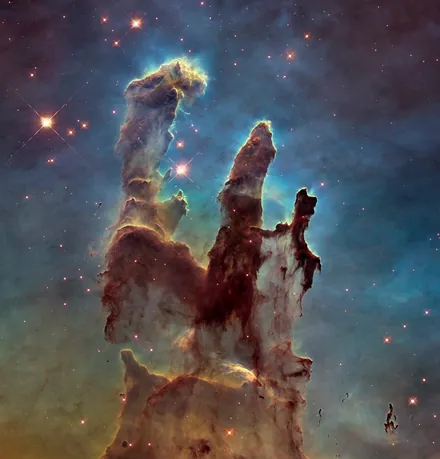
M16 Eagle NebulaNebula in Serpens
- ID
- NGC 6611
- Distance
- about 7,000 light-years
- Magnitude
- 6.0
- Size
- 7 arcmin
- Best month
- August
- Gear
- Binoculars
- Sky
- Suburban skies or darker (Bortle 6) to stay easy
- Discovery
- Philippe Loys de Cheseaux, 1746
The Eagle Nebula surrounds the young cluster de Cheseaux actually discovered; the gas itself became world famous in 1995 when Hubble imaged the towering Pillars of Creation forming stars inside it.
Finding it: About 2.5 degrees west of Gamma Scuti, one binocular field north of M17.
M17 Omega NebulaNebula in Sagittarius
- ID
- NGC 6618
- Distance
- about 5,000 to 6,000 light-years
- Magnitude
- 7.0
- Size
- 46x37 arcmin
- Best month
- August
- Gear
- Binoculars
- Sky
- Suburban skies or darker (Bortle 5) to stay easy
- Discovery
- Philippe Loys de Cheseaux, 1746
Called the Omega, Swan, or Horseshoe Nebula, M17 shows a bright bar with a curved neck that really does look like a swan gliding on water. It is one of the Milky Way's most active star factories.
Finding it: Just north of the M24 star cloud in northern Sagittarius, about 2.5 degrees south of M16.
M18Open cluster in Sagittarius
- ID
- NGC 6613
- Distance
- about 4,900 light-years
- Magnitude
- 6.9
- Size
- 9 arcmin
- Best month
- August
- Gear
- Binoculars
- Sky
- Suburban skies or darker (Bortle 5) to stay easy
- Discovery
- Charles Messier, 1764
M18 is a modest scatter of a few dozen young stars, easy to overlook precisely because it sits between two showpieces; it makes a natural rest stop on the sweep from M17 down to M24.
Finding it: About 1 degree south of M17.
M19Globular cluster in Ophiuchus
- ID
- NGC 6273
- Distance
- about 28,700 light-years
- Magnitude
- 7.2
- Size
- 14 arcmin
- Best month
- August
- Gear
- Binoculars
- Sky
- Suburban skies or darker (Bortle 5) to stay easy
- Discovery
- Charles Messier, 1764
M19 is one of the most flattened-looking globulars known. Part of the squashed appearance turns out to be an artifact of uneven foreground dust, with tides from the galactic center, only about 6,500 light-years away, likely contributing the rest.
Finding it: About 7.5 degrees due east of Antares.
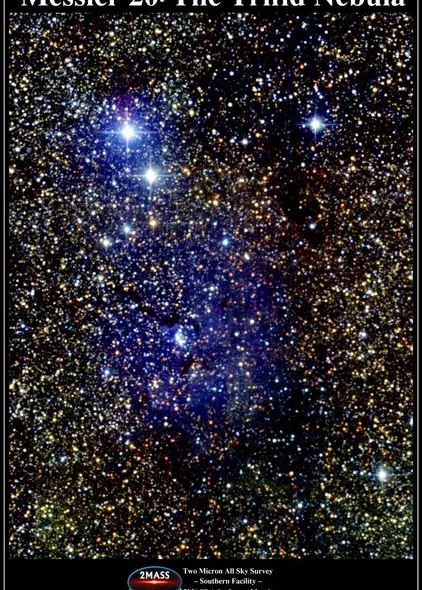
M20 Trifid NebulaNebula in Sagittarius
- ID
- NGC 6514
- Distance
- about 5,200 light-years
- Magnitude
- 6.3
- Size
- 29x27 arcmin
- Best month
- August
- Gear
- Binoculars
- Sky
- Dark skies (Bortle 4 or better) to be easy
- Discovery
- Charles Messier, 1764
The Trifid Nebula's three dark dust lanes divide its pink emission glow into the lobes that give it its name, with a contrasting blue reflection nebula hanging just to the north.
Finding it: About 1.5 degrees northwest of the Lagoon Nebula M8; the pair share a binocular field.
M21Open cluster in Sagittarius
- ID
- NGC 6531
- Distance
- about 4,300 light-years
- Magnitude
- 5.9
- Size
- 13 arcmin
- Best month
- August
- Gear
- Binoculars
- Sky
- Suburban skies or darker (Bortle 6) to stay easy
- Discovery
- Charles Messier, 1764
M21 is a compact knot of stars only about 4 to 8 million years old, so young that its heaviest members are still blazing blue giants.
Finding it: Less than 1 degree northeast of the Trifid Nebula M20.
M22Globular cluster in Sagittarius
- ID
- NGC 6656
- Distance
- about 9,600 to 11,600 light-years
- Magnitude
- 5.1
- Size
- 24 arcmin
- Best month
- September
- Gear
- Binoculars
- Sky
- Suburban skies or darker (Bortle 5) to stay easy
- Discovery
- Abraham Ihle, 1665; the first globular cluster ever discovered
M22 outshines both M13 and M5 and would be the northern sky's finest globular if it rode higher; from mid-northern latitudes it stays low, where haze and thick air always tax it. In 2012 astronomers reported two stellar-mass black hole candidates inside it.
Finding it: About 2.5 degrees northeast of Kaus Borealis, the star at the top of the Teapot's lid.
M23Open cluster in Sagittarius
- ID
- NGC 6494
- Distance
- about 2,200 light-years
- Magnitude
- 5.5
- Size
- 27 arcmin
- Best month
- August
- Gear
- Binoculars
- Sky
- Suburban skies or darker (Bortle 6) to stay easy
- Discovery
- Charles Messier, 1764
M23 scatters about 150 stars across a Moon-sized field, and it stands far enough from the densest Milky Way that binoculars show it as a distinct island of stars.
Finding it: About 4.5 degrees northwest of Mu Sagittarii, the star just above the Teapot's lid.
M24 Small Sagittarius Star CloudStar cloud in Sagittarius
- ID
- IC 4715
- Distance
- about 10,000 light-years
- Magnitude
- 4.5
- Size
- 90 arcmin
- Best month
- August
- Gear
- Naked eye
- Sky
- Dark skies (Bortle 4 or better) to be easy
- Discovery
- Charles Messier, 1764
M24 is not a cluster at all but a window: a gap in the foreground dust that lets you see 10,000 light-years deep into an inner spiral arm. Binoculars show more stars here than almost anywhere else in the sky.
Finding it: A naked-eye cloud of Milky Way north of the Teapot, about 7 degrees north of Kaus Borealis.
M25Open cluster in Sagittarius
- ID
- IC 4725
- Distance
- about 2,000 light-years
- Magnitude
- 4.6
- Size
- 32 arcmin
- Best month
- September
- Gear
- Binoculars
- Sky
- Fine under bright suburban skies (Bortle 7)
- Discovery
- Philippe Loys de Cheseaux, 1746
M25 contains the Cepheid variable U Sagittarii, a pulsating yardstick star that brightens and fades on a 6.7-day cycle; clusters that host Cepheids helped calibrate the cosmic distance scale.
Finding it: About 3.5 degrees east of the M24 star cloud.
M26Open cluster in Scutum
- ID
- NGC 6694
- Distance
- about 5,000 light-years
- Magnitude
- 8.0
- Size
- 15 arcmin
- Best month
- September
- Gear
- Telescope, 50 mm and up
- Sky
- Dark skies (Bortle 4 or better) to be easy
- Discovery
- Charles Messier, 1764
M26 shows a curious dip in star density right at its core; whether foreground dust or a real gap in the cluster causes it is still not settled.
Finding it: About 1 degree southeast of Delta Scuti, the star that lends its name to a whole class of variables.
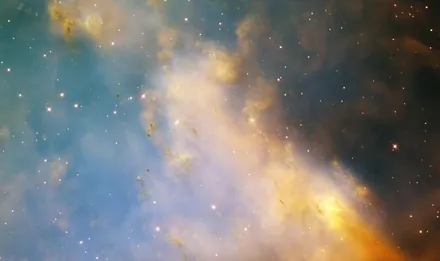
M27 Dumbbell NebulaPlanetary nebula in Vulpecula
- ID
- NGC 6853
- Distance
- about 1,150 to 1,520 light-years
- Magnitude
- 8.1
- Size
- 8x4 arcmin
- Best month
- September
- Gear
- Binoculars
- Sky
- Suburban skies or darker (Bortle 5) to stay easy
- Discovery
- Charles Messier, 1764; the first planetary nebula ever discovered
The Dumbbell Nebula is the puffed-off outer atmosphere of a dying Sun-like star, and it is the easiest planetary nebula in the sky: binoculars show it, and any telescope reveals the apple-core shape.
Finding it: About 3 degrees north of Gamma Sagittae, the point of the Arrow.
M28Globular cluster in Sagittarius
- ID
- NGC 6626
- Distance
- about 17,900 light-years
- Magnitude
- 6.9
- Size
- 11 arcmin
- Best month
- August
- Gear
- Binoculars
- Sky
- Suburban skies or darker (Bortle 5) to stay easy
- Discovery
- Charles Messier, 1764
M28 was the first globular cluster found to contain a millisecond pulsar, a recycled neutron star spun up to about 300 rotations per second by material stolen from a companion.
Finding it: About 1 degree northwest of Kaus Borealis at the top of the Teapot's lid.
M29Open cluster in Cygnus
- ID
- NGC 6913
- Distance
- about 7,200 light-years
- Magnitude
- 6.6
- Size
- 7 arcmin
- Best month
- September
- Gear
- Binoculars
- Sky
- Suburban skies or darker (Bortle 6) to stay easy
- Discovery
- Charles Messier, 1764
M29's brightest stars form a tiny dipper shape, and every one of them is a hot blue giant thousands of times more luminous than the Sun; heavy foreground dust dims the whole group several magnitudes.
Finding it: About 1.7 degrees south of Sadr, the central star of the Northern Cross.
M30Globular cluster in Capricornus
- ID
- NGC 7099
- Distance
- about 27,800 to 31,000 light-years
- Magnitude
- 7.5
- Size
- 11 arcmin
- Best month
- October
- Gear
- Binoculars
- Sky
- Suburban skies or darker (Bortle 5) to stay easy
- Discovery
- Charles Messier, 1764
M30 orbits the galaxy backward relative to the disk's rotation, a strong hint it was captured from a devoured dwarf galaxy, and its core has undergone gravitational collapse into an extremely dense knot.
Finding it: About 3.5 degrees east-southeast of Zeta Capricorni, beside the 5th-magnitude star 41 Capricorni.
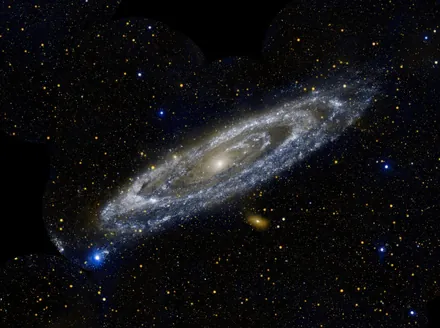
M31 Andromeda GalaxyGalaxy in Andromeda
- ID
- NGC 224
- Distance
- about 2.4 million to 2.6 million light-years
- Magnitude
- 3.4
- Size
- 190x60 arcmin
- Best month
- December
- Gear
- Naked eye
- Sky
- Suburban skies or darker (Bortle 6) to stay easy
- Discovery
- Known since antiquity; first described in writing by al-Sufi in 964
The Andromeda Galaxy is the nearest large galaxy and the most distant thing most people will ever see unaided, its light 2.5 million years old on arrival. It and the Milky Way are closing at about 70 miles per second and may merge in roughly 4.5 billion years, though newer studies make the collision less than certain.
Finding it: From Mirach, hop northwest through Mu Andromedae and continue the same distance again; under dark skies it is an obvious elongated smudge.
M32Galaxy in Andromeda
- ID
- NGC 221
- Distance
- about 2.4 million to 2.6 million light-years
- Magnitude
- 8.2
- Size
- 9x7 arcmin
- Best month
- December
- Gear
- Telescope, 80 mm and up
- Sky
- Dark skies (Bortle 4 or better) to be easy
- Discovery
- Guillaume Le Gentil, 1749
M32 is a compact elliptical galaxy, a rare, dense type that may be the stripped core of a once-larger galaxy that strayed too close to Andromeda.
Finding it: A small round glow 22 arcminutes south of M31's core, inside the same low-power field.
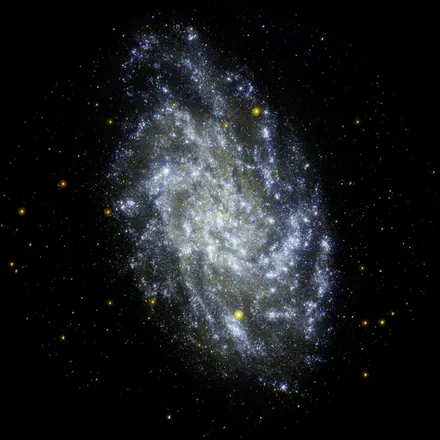
M33 Triangulum GalaxyGalaxy in Triangulum
- ID
- NGC 598
- Distance
- about 2.4 million to 3.1 million light-years
- Magnitude
- 5.7
- Size
- 71x42 arcmin
- Best month
- December
- Gear
- Binoculars
- Sky
- Dark skies (Bortle 3 or better) to be easy
- Discovery
- Giovanni Battista Hodierna, before 1654
The Triangulum Galaxy is the third-largest member of our Local Group and, for sharp-eyed observers under truly dark skies, the most distant object visible to the naked eye. Its light is spread so thin that high magnification actually makes it vanish.
Finding it: Make the same hop from Mirach as for M31, but in the opposite direction, about 7 degrees to the southeast.
M34Open cluster in Perseus
- ID
- NGC 1039
- Distance
- about 1,500 light-years
- Magnitude
- 5.2
- Size
- 35 arcmin
- Best month
- January
- Gear
- Binoculars
- Sky
- Fine under bright suburban skies (Bortle 7)
- Discovery
- Giovanni Battista Hodierna, before 1654
M34's stars are around 200 to 250 million years old, and studies of their spins helped calibrate gyrochronology, the technique of reading a star's age from how fast it rotates.
Finding it: Roughly midway between Algol and Almach, slightly north of the connecting line.
M35Open cluster in Gemini
- ID
- NGC 2168
- Distance
- about 2,800 light-years
- Magnitude
- 5.1
- Size
- 28 arcmin
- Best month
- February
- Gear
- Binoculars
- Sky
- Fine under bright suburban skies (Bortle 7)
- Discovery
- Philippe Loys de Cheseaux, 1746
M35 fills a Moon-sized field with several hundred stars, and a small telescope shows a bonus in the same view: the far older, five-times-more-distant cluster NGC 2158 huddled at its southwest edge.
Finding it: About 2.5 degrees northwest of Propus, the star at Castor's leading foot in Gemini.
M36Open cluster in Auriga
- ID
- NGC 1960
- Distance
- about 4,100 light-years
- Magnitude
- 6.0
- Size
- 12 arcmin
- Best month
- February
- Gear
- Binoculars
- Sky
- Suburban skies or darker (Bortle 6) to stay easy
- Discovery
- Giovanni Battista Hodierna, before 1654
The youngest of Auriga's three Messier clusters at about 25 million years, M36 is dominated by hot blue stars and contains no red giants at all yet.
Finding it: Inside the Auriga pentagon, roughly midway between Theta Aurigae and Elnath.
M37Open cluster in Auriga
- ID
- NGC 2099
- Distance
- about 4,500 light-years
- Magnitude
- 5.6
- Size
- 24 arcmin
- Best month
- February
- Gear
- Binoculars
- Sky
- Suburban skies or darker (Bortle 6) to stay easy
- Discovery
- Giovanni Battista Hodierna, before 1654
The richest and finest of Auriga's trio, M37 spreads some 500 stars across the field with a bright orange giant glowing near center, a favorite winter target many observers rank among the best open clusters in the north.
Finding it: Just outside the Auriga pentagon's southeastern edge, about 5 degrees south-southwest of Theta Aurigae.
M38Open cluster in Auriga
- ID
- NGC 1912
- Distance
- about 4,200 light-years
- Magnitude
- 6.4
- Size
- 21 arcmin
- Best month
- February
- Gear
- Binoculars
- Sky
- Suburban skies or darker (Bortle 6) to stay easy
- Discovery
- Giovanni Battista Hodierna, before 1654
M38's brighter stars trace a rough Greek letter pi, and the small cluster NGC 1907 sits half a degree south, a chance alignment of two unrelated groups passing in the night.
Finding it: Inside the Auriga pentagon, about 2.5 degrees northwest of M36.
M39Open cluster in Cygnus
- ID
- NGC 7092
- Distance
- about 820 light-years
- Magnitude
- 4.6
- Size
- 32 arcmin
- Best month
- October
- Gear
- Binoculars
- Sky
- Fine under bright suburban skies (Bortle 7)
- Discovery
- Guillaume Le Gentil, about 1750; cataloged by Messier in 1764
M39 is one of the nearest open clusters, a bit over 800 light-years away, and so loose and large that binoculars frame its triangle of two dozen bright stars better than any telescope can.
Finding it: About 9 degrees east-northeast of Deneb.
M40Double star in Ursa Major
- ID
- Winnecke 4
- Magnitude
- 8.0
- Best month
- May
- Gear
- Binoculars
- Sky
- Any; magnification matters more than darkness
- Discovery
- Charles Messier, 1764
M40 is the catalog's famous mistake: chasing a nebula Hevelius had reported, Messier found only this faint double star, cataloged it anyway, and moved on. The pair, Winnecke 4, is a chance alignment rather than a true binary.
Finding it: Just over 1 degree northeast of Megrez, the star joining the Big Dipper's bowl to its handle.
M41Open cluster in Canis Major
- ID
- NGC 2287
- Distance
- about 2,300 light-years
- Magnitude
- 4.5
- Size
- 38 arcmin
- Best month
- March
- Gear
- Naked eye
- Sky
- Fine under bright suburban skies (Bortle 7)
- Discovery
- Giovanni Battista Hodierna, before 1654; Aristotle may have noted it around 325 BC
M41 may be the faintest object recorded in classical antiquity: Aristotle described a cloudy patch in this spot around 325 BC. Binoculars resolve it easily, with a warm orange giant near the center.
Finding it: About 4 degrees due south of Sirius.
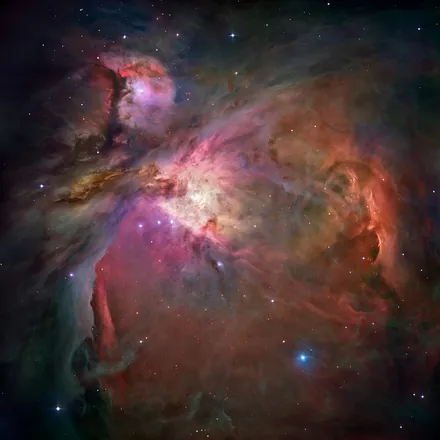
M42 Orion NebulaNebula in Orion
- ID
- NGC 1976
- Distance
- about 1,320 to 1,360 light-years
- Magnitude
- 4.0
- Size
- 66x60 arcmin
- Best month
- February
- Gear
- Naked eye
- Sky
- Fine under bright suburban skies (Bortle 7)
- Discovery
- Nicolas-Claude Fabri de Peiresc, 1610
The Orion Nebula is the nearest massive star-forming region to Earth and among the most studied objects in the sky. At its core the four Trapezium stars, young suns just unwrapped from their birth cloud, light the gas from within.
Finding it: The middle 'star' of Orion's Sword, hanging below the Belt; even small binoculars show it is not a star.
M43Nebula in Orion
- ID
- NGC 1982
- Distance
- about 1,300 light-years
- Magnitude
- 9.0
- Size
- 20x15 arcmin
- Best month
- February
- Gear
- Telescope, 100 mm and up
- Sky
- Dark skies (Bortle 3 or better) to be easy
- Discovery
- Jean-Jacques Dortous de Mairan, about 1731
M43 is really a bay of the same cloud as the Orion Nebula, split off by a dark dust lane and lit by its own young star; it earned a separate number because de Mairan spotted it before telescopes revealed the connection.
Finding it: Immediately northeast of M42, across a narrow dark lane.
M44 PraesepeOpen cluster in Cancer
- ID
- NGC 2632
- Distance
- about 580 light-years
- Magnitude
- 3.1
- Size
- 95 arcmin
- Best month
- April
- Gear
- Naked eye
- Sky
- Suburban skies or darker (Bortle 6) to stay easy
- Discovery
- Known since antiquity; Galileo first resolved it into stars in 1609
The Beehive was a weather beacon for the Greeks and Romans, who watched for its naked-eye glow to fade as a sign of coming rain. Galileo's small telescope shattered the 'little cloud' into dozens of stars, and planets have since been found orbiting its members.
Finding it: The misty patch at the center of Cancer, between the two 'donkey' stars Asellus Borealis and Asellus Australis.
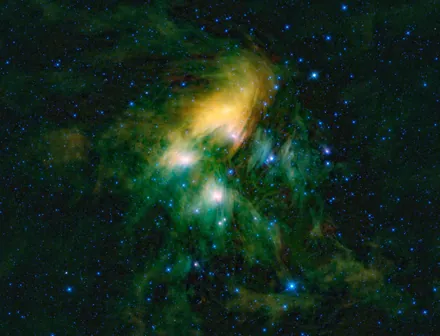
M45 PleiadesOpen cluster in Taurus
- ID
- Melotte 22
- Distance
- about 390 to 460 light-years
- Magnitude
- 1.6
- Size
- 110 arcmin
- Best month
- January
- Gear
- Naked eye
- Sky
- Fine under bright suburban skies (Bortle 8)
- Discovery
- Known since prehistory; among the oldest star names in any culture
The Pleiades appear in the Iliad, the Bible, and star lore on every inhabited continent. The blue mist in photographs is not leftover birth gas: the cluster is simply drifting through an unrelated interstellar cloud.
Finding it: The unmistakable little dipper of stars northwest of Aldebaran; most people count six, keen eyes catch more.
M46Open cluster in Puppis
- ID
- NGC 2437
- Distance
- about 5,400 light-years
- Magnitude
- 6.1
- Size
- 27 arcmin
- Best month
- March
- Gear
- Binoculars
- Sky
- Suburban skies or darker (Bortle 6) to stay easy
- Discovery
- Charles Messier, 1771; the first entry after his original catalog was published
M46 comes with a built-in illusion: the planetary nebula NGC 2438 appears embedded near its northern edge but is actually a foreground object thousands of light-years closer, photobombing the cluster.
Finding it: About 13 degrees east of Sirius; the brighter, coarser cluster M47 sits just 1.3 degrees to its west.
M47Open cluster in Puppis
- ID
- NGC 2422
- Distance
- about 1,600 light-years
- Magnitude
- 4.4
- Size
- 30 arcmin
- Best month
- March
- Gear
- Naked eye
- Sky
- Fine under bright suburban skies (Bortle 7)
- Discovery
- Giovanni Battista Hodierna, before 1654
M47 was 'lost' for nearly two centuries because Messier logged its position with reversed sign errors; the puzzle was only untangled in 1959. It is bright enough to glimpse with the naked eye from a dark site.
Finding it: About 12 degrees east-northeast of Sirius, in the same binocular field as M46.
M48Open cluster in Hydra
- ID
- NGC 2548
- Distance
- about 1,500 light-years
- Magnitude
- 5.8
- Size
- 54 arcmin
- Best month
- March
- Gear
- Binoculars
- Sky
- Suburban skies or darker (Bortle 6) to stay easy
- Discovery
- Charles Messier, 1771
Another of the 'missing' Messier objects: the cataloged position lies about 5 degrees too far north, a slip first untangled in 1934 and finally settled in 1959. The real cluster is a fine binocular object with a triangular heart.
Finding it: About 14 degrees southeast of Procyon, just over the Monoceros border in Hydra.
M49Galaxy in Virgo
- ID
- NGC 4472
- Distance
- about 54 million to 58 million light-years
- Magnitude
- 8.4
- Size
- 10x8 arcmin
- Best month
- May
- Gear
- Telescope, 80 mm and up
- Sky
- Dark skies (Bortle 4 or better) to be easy
- Discovery
- Charles Messier, 1771; the first member of the Virgo Cluster ever found
This giant elliptical was the first galaxy discovered in the Virgo Cluster, and it slightly outshines even M87. Its halo holds several thousand globular clusters of its own.
Finding it: About 5 degrees due south of the midpoint of the Vindemiatrix-Denebola line.
M50Open cluster in Monoceros
- ID
- NGC 2323
- Distance
- about 3,200 light-years
- Magnitude
- 5.9
- Size
- 16 arcmin
- Best month
- March
- Gear
- Binoculars
- Sky
- Suburban skies or darker (Bortle 6) to stay easy
- Discovery
- Giovanni Domenico Cassini, before 1711
M50 sits in the winter Milky Way between the two brightest dog stars, a heart-shaped scatter of about 80 stars with a lone red giant standing out against its blue members.
Finding it: About a third of the way along the line from Sirius to Procyon.
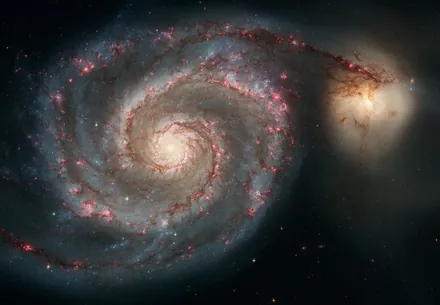
M51 WhirlpoolGalaxy in Canes Venatici
- ID
- NGC 5194/5
- Distance
- about 19 million to 27 million light-years
- Magnitude
- 8.1
- Size
- 11x8 arcmin
- Best month
- June
- Gear
- Telescope, 150 mm and up
- Sky
- Dark skies (Bortle 3 or better) to be easy
- Discovery
- Charles Messier, 1773
The Whirlpool was the first object in which spiral structure was ever seen, sketched by Lord Rosse at his giant telescope in 1845, decades before anyone knew such spirals were separate galaxies. Its companion NGC 5195 is tugging the spiral into shape.
Finding it: About 3.5 degrees southwest of Alkaid, the last star of the Big Dipper's handle.
M52Open cluster in Cassiopeia
- ID
- NGC 7654
- Distance
- about 5,000 light-years
- Magnitude
- 6.9
- Size
- 13 arcmin
- Best month
- November
- Gear
- Binoculars
- Sky
- Suburban skies or darker (Bortle 5) to stay easy
- Discovery
- Charles Messier, 1774
M52 is a rich, young cluster sitting in a heavily obscured stretch of the Milky Way, and the photogenic Bubble Nebula lies just half a degree away in the same telescopic field.
Finding it: Extend the line from Schedar through Caph in Cassiopeia the same distance again.
M53Globular cluster in Coma Berenices
- ID
- NGC 5024
- Distance
- about 58,000 light-years
- Magnitude
- 7.7
- Size
- 13 arcmin
- Best month
- June
- Gear
- Binoculars
- Sky
- Suburban skies or darker (Bortle 5) to stay easy
- Discovery
- Johann Elert Bode, 1775
M53 is one of the most far-flung globulars in the catalog, orbiting some 60,000 light-years from the galactic center out in the halo, unusually poor in heavy elements even by globular standards.
Finding it: About 1 degree northeast of Diadem, Alpha Comae Berenices.
M54Globular cluster in Sagittarius
- ID
- NGC 6715
- Distance
- about 87,400 light-years
- Magnitude
- 7.7
- Size
- 9 arcmin
- Best month
- September
- Gear
- Binoculars
- Sky
- Suburban skies or darker (Bortle 5) to stay easy
- Discovery
- Charles Messier, 1778
For two centuries M54 passed as an ordinary globular; in 1994 astronomers realized it belongs to the Sagittarius Dwarf galaxy currently being devoured by the Milky Way. It is the catalog's one object that poses as a Milky Way globular while actually belonging to another galaxy.
Finding it: About 1.7 degrees west-southwest of Ascella, the Teapot's bottom-left handle star.
M55Globular cluster in Sagittarius
- ID
- NGC 6809
- Distance
- about 17,600 light-years
- Magnitude
- 7.0
- Size
- 19 arcmin
- Best month
- September
- Gear
- Binoculars
- Sky
- Suburban skies or darker (Bortle 5) to stay easy
- Discovery
- Nicolas-Louis de Lacaille, 1752, from South Africa
M55 is big, close, and loose, a globular so spread out that a small telescope begins resolving it edge to edge; northern observers just need a clear southern horizon to enjoy it.
Finding it: About 8 degrees east of Ascella, in the sparse region trailing the Teapot.
M56Globular cluster in Lyra
- ID
- NGC 6779
- Distance
- about 32,900 light-years
- Magnitude
- 8.2
- Size
- 7 arcmin
- Best month
- September
- Gear
- Telescope, 80 mm and up
- Sky
- Dark skies (Bortle 4 or better) to be easy
- Discovery
- Charles Messier, 1779
M56 sits in a gorgeously rich Milky Way field, and like M30 it travels a retrograde orbit, evidence it likely arrived with a dwarf galaxy the Milky Way swallowed long ago.
Finding it: Roughly midway between Albireo and Sulafat, Gamma Lyrae.
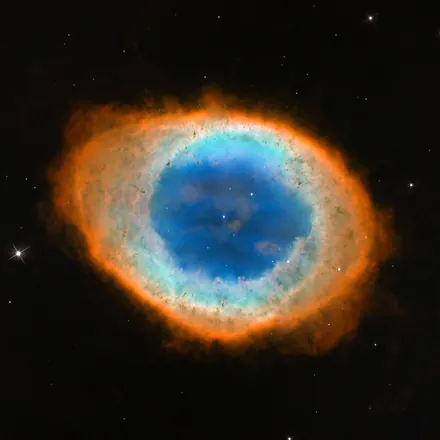
M57 Ring NebulaPlanetary nebula in Lyra
- ID
- NGC 6720
- Distance
- about 1,600 to 3,800 light-years
- Magnitude
- 9.0
- Size
- 1 arcmin
- Best month
- September
- Gear
- Telescope, 80 mm and up
- Sky
- Suburban skies or darker (Bortle 5) to stay easy
- Discovery
- Antoine Darquier de Pellepoix, 1779
The Ring Nebula is the sky's most famous smoke ring: the cast-off atmosphere of a dying star, lit by the white-hot core left at its center. That central star, a white dwarf in the making, is a challenge object needing large apertures.
Finding it: Between Sheliak and Sulafat, the two stars at the southern end of Lyra's parallelogram.
M58Galaxy in Virgo
- ID
- NGC 4579
- Distance
- about 63 million light-years
- Magnitude
- 9.8
- Size
- 6x5 arcmin
- Best month
- June
- Gear
- Telescope, 120 mm and up
- Sky
- Dark skies (Bortle 3 or better) to be easy
- Discovery
- Charles Messier, 1779
M58 is one of the brightest barred spirals in the Virgo Cluster, and when Messier logged it in 1779 it was among the most distant objects any human had ever cataloged, though he could not have known it.
Finding it: In the heart of the Virgo Cluster, about 2 degrees east of M87 along the line toward Vindemiatrix.
M59Galaxy in Virgo
- ID
- NGC 4621
- Distance
- about 55 million to 65 million light-years
- Magnitude
- 9.8
- Size
- 5x4 arcmin
- Best month
- June
- Gear
- Telescope, 120 mm and up
- Sky
- Dark skies (Bortle 3 or better) to be easy
- Discovery
- Johann Gottfried Koehler, 1779
M59 is a bright elliptical whose core rotates opposite to its outskirts, the fingerprint of an ancient merger; Koehler caught it while following the comet of 1779 through Virgo.
Finding it: In the Virgo Cluster, about 25 arcminutes west of M60; the pair fit in one medium-power field.
M60Galaxy in Virgo
- ID
- NGC 4649
- Distance
- about 51 million to 59 million light-years
- Magnitude
- 8.8
- Size
- 7x6 arcmin
- Best month
- June
- Gear
- Telescope, 80 mm and up
- Sky
- Dark skies (Bortle 4 or better) to be easy
- Discovery
- Johann Gottfried Koehler, 1779
M60 anchors the eastern end of the Virgo Cluster and harbors one of the best-measured supermassive black holes, weighing in around 4.5 billion Suns. A close spiral companion, NGC 4647, overlaps it in photographs.
Finding it: The easternmost bright galaxy of the Virgo swarm, about 4.5 degrees west and a shade north of Vindemiatrix.
M61Galaxy in Virgo
- ID
- NGC 4303
- Distance
- about 50 million to 55 million light-years
- Magnitude
- 9.7
- Size
- 7x6 arcmin
- Best month
- May
- Gear
- Telescope, 120 mm and up
- Sky
- Dark skies (Bortle 3 or better) to be easy
- Discovery
- Barnaba Oriani, 1779
M61 is one of the Virgo Cluster's liveliest members, a barred spiral bursting with star formation that has produced at least eight observed supernovae, among the highest counts of any Messier galaxy.
Finding it: In the southern outskirts of the Virgo Cluster, about 8 degrees northwest of Porrima.
M62Globular cluster in Ophiuchus
- ID
- NGC 6266
- Distance
- about 22,200 light-years
- Magnitude
- 6.6
- Size
- 14 arcmin
- Best month
- August
- Gear
- Binoculars
- Sky
- Suburban skies or darker (Bortle 6) to stay easy
- Discovery
- Charles Messier, 1771
M62 is visibly lopsided for a globular, its core displaced by the relentless tides of the nearby galactic center, and it teems with exotic remnants: pulsars, X-ray binaries, and black hole candidates.
Finding it: About 7.5 degrees southeast of Antares, low between Scorpius and Ophiuchus.
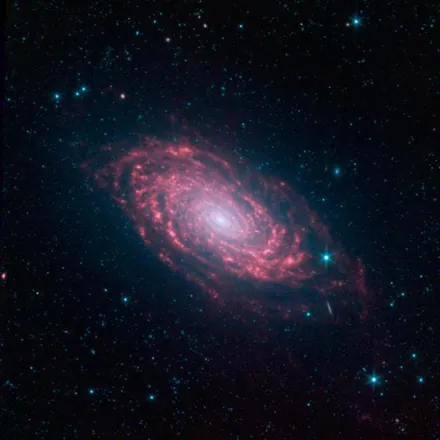
M63 Sunflower GalaxyGalaxy in Canes Venatici
- ID
- NGC 5055
- Distance
- about 37 million light-years
- Magnitude
- 8.6
- Size
- 13x7 arcmin
- Best month
- June
- Gear
- Telescope, 120 mm and up
- Sky
- Dark skies (Bortle 3 or better) to be easy
- Discovery
- Pierre Mechain, 1779; his first discovery
The Sunflower Galaxy is the archetype of a flocculent spiral: instead of two grand arms it displays hundreds of short, fleecy segments, like petals. A faint giant arc around it records a dwarf galaxy it tore apart.
Finding it: About 5 degrees northeast of Cor Caroli, along the line toward Alkaid.
M64 Black Eye GalaxyGalaxy in Coma Berenices
- ID
- NGC 4826
- Distance
- about 16 million to 19 million light-years
- Magnitude
- 8.5
- Size
- 10x5 arcmin
- Best month
- June
- Gear
- Telescope, 100 mm and up
- Sky
- Dark skies (Bortle 4 or better) to be easy
- Discovery
- Edward Pigott, 1779, twelve days before Bode found it independently
The Black Eye Galaxy hides real drama: its outer gas disk rotates in the opposite direction to the inner one, almost certainly the remains of a swallowed companion, and the collision zone glows with new stars beneath the famous dark dust arc.
Finding it: About 5 degrees northwest of Diadem, beside the 5th-magnitude star 35 Comae Berenices.
M65Galaxy in Leo
- ID
- NGC 3623
- Distance
- about 41 million to 42 million light-years
- Magnitude
- 9.3
- Size
- 10x3 arcmin
- Best month
- May
- Gear
- Telescope, 100 mm and up
- Sky
- Dark skies (Bortle 4 or better) to be easy
- Discovery
- Charles Messier, 1780
M65 is the tidier member of the Leo Triplet, a dusty spiral seen at a steep slant that has so far escaped the distortions rearranging its two neighbors.
Finding it: Midway between Chertan and Iota Leonis, below the Lion's hindquarters; M66 sits in the same field.
M66Galaxy in Leo
- ID
- NGC 3627
- Distance
- about 31 million to 41 million light-years
- Magnitude
- 9.0
- Size
- 9x4 arcmin
- Best month
- May
- Gear
- Telescope, 100 mm and up
- Sky
- Dark skies (Bortle 4 or better) to be easy
- Discovery
- Charles Messier, 1780
M66's arms are visibly askew, thrown out of symmetry by a close pass from its neighbor NGC 3628; together with M65 they form the Leo Triplet, one of the sky's best galaxy groups for small telescopes.
Finding it: About 20 arcminutes east of M65, between Chertan and Iota Leonis.
M67Open cluster in Cancer
- ID
- NGC 2682
- Distance
- about 2,600 to 2,900 light-years
- Magnitude
- 6.9
- Size
- 30 arcmin
- Best month
- April
- Gear
- Binoculars
- Sky
- Suburban skies or darker (Bortle 5) to stay easy
- Discovery
- Johann Gottfried Koehler, before 1779
At roughly 4 billion years old, M67 is one of the most ancient open clusters known, nearly the Sun's age, and it has become the standard laboratory for testing how Sun-like stars evolve.
Finding it: Just under 2 degrees west of Acubens, Alpha Cancri.
M68Globular cluster in Hydra
- ID
- NGC 4590
- Distance
- about 33,600 light-years
- Magnitude
- 8.2
- Size
- 12 arcmin
- Best month
- June
- Gear
- Telescope, 80 mm and up
- Sky
- Dark skies (Bortle 4 or better) to be easy
- Discovery
- Charles Messier, 1780
M68 is a metal-poor globular swinging through the halo on a wildly inclined orbit, another suspected souvenir of a dwarf galaxy the Milky Way consumed.
Finding it: About 3.5 degrees south-southeast of Kraz, Beta Corvi, below the Crow's sail.
M69Globular cluster in Sagittarius
- ID
- NGC 6637
- Distance
- about 29,700 light-years
- Magnitude
- 7.7
- Size
- 7 arcmin
- Best month
- September
- Gear
- Binoculars
- Sky
- Suburban skies or darker (Bortle 5) to stay easy
- Discovery
- Charles Messier, 1780
M69 is one of the most metal-rich globulars known, its stars comparatively seasoned with heavy elements, a signature of forming close to the galaxy's dense center where enrichment ran fastest.
Finding it: Inside the Teapot, about 2.5 degrees northeast of Kaus Australis.
M70Globular cluster in Sagittarius
- ID
- NGC 6681
- Distance
- about 29,400 light-years
- Magnitude
- 8.1
- Size
- 8 arcmin
- Best month
- September
- Gear
- Telescope, 50 mm and up
- Sky
- Dark skies (Bortle 4 or better) to be easy
- Discovery
- Charles Messier, 1780
M70 earned modern fame by accident: comet Hale-Bopp was discovered in July 1995 by two observers who happened to be pointed at this small globular at the same moment.
Finding it: Almost exactly midway between Kaus Australis and Ascella, along the Teapot's bottom.
M71Globular cluster in Sagitta
- ID
- NGC 6838
- Distance
- about 13,000 light-years
- Magnitude
- 8.3
- Size
- 7 arcmin
- Best month
- September
- Gear
- Telescope, 80 mm and up
- Sky
- Dark skies (Bortle 4 or better) to be easy
- Discovery
- Philippe Loys de Cheseaux, 1746
For most of a century astronomers argued over whether M71 was a dense open cluster or a loose globular; the verdict, settled by its stars' compositions, is a genuinely loose globular caught drifting through the Milky Way's plane.
Finding it: Midway between Gamma and Delta Sagittae, inside the Arrow's shaft.
M72Globular cluster in Aquarius
- ID
- NGC 6981
- Distance
- about 53,400 to 55,700 light-years
- Magnitude
- 9.4
- Size
- 6 arcmin
- Best month
- October
- Gear
- Telescope, 100 mm and up
- Sky
- Dark skies (Bortle 3 or better) to be easy
- Discovery
- Pierre Mechain, 1780
M72 is one of the faintest and most distant globulars in the catalog, about 55,000 light-years away; even in a mid-size telescope it stays a soft, grainy glow, which is exactly why finishing it feels earned.
Finding it: About 3 degrees south-southeast of Albali, Epsilon Aquarii.
M73Asterism in Aquarius
- ID
- NGC 6994
- Magnitude
- 10.0
- Best month
- October
- Gear
- Telescope, 120 mm and up
- Sky
- Any; magnification matters more than darkness
- Discovery
- Charles Messier, 1780
M73 is four unrelated stars in a chance Y-shaped huddle. Whether it was a real cluster stayed genuinely open until the 2000s, when precise distances proved the stars are strangers passing at different depths.
Finding it: About 1.5 degrees east of M72.
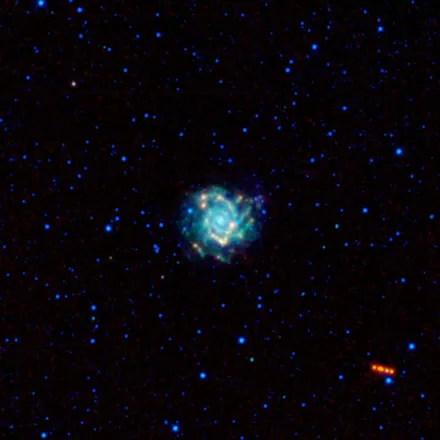
M74Galaxy in Pisces
- ID
- NGC 628
- Distance
- about 24 million to 36 million light-years
- Magnitude
- 9.2
- Size
- 11x10 arcmin
- Best month
- December
- Gear
- Telescope, 200 mm and up
- Sky
- Dark skies (Bortle 3 or better) to be easy
- Discovery
- Pierre Mechain, 1780
M74 is the classic 'Phantom Galaxy,' widely considered the hardest Messier object because its light spreads across a face-on disk of very low surface brightness. It is also a supernova factory, with three seen since 2002.
Finding it: About 1.3 degrees east-northeast of Eta Piscium; use low power and a dark sky.
M75Globular cluster in Sagittarius
- ID
- NGC 6864
- Distance
- about 67,500 light-years
- Magnitude
- 8.6
- Size
- 6 arcmin
- Best month
- September
- Gear
- Telescope, 80 mm and up
- Sky
- Dark skies (Bortle 4 or better) to be easy
- Discovery
- Pierre Mechain, 1780
M75 is the most concentrated globular in the Messier catalog, class I on the compactness scale, and at about 67,000 light-years it is also one of the most remote, glowing from the far side of the galactic center.
Finding it: In the barren zone between Sagittarius and Capricornus, about 8 degrees southwest of Dabih, Beta Capricorni.
M76 Little Dumbbell NebulaPlanetary nebula in Perseus
- ID
- NGC 650/1
- Distance
- about 2,500 light-years
- Magnitude
- 10.1
- Size
- 2x1 arcmin
- Best month
- December
- Gear
- Telescope, 120 mm and up
- Sky
- Dark skies (Bortle 3 or better) to be easy
- Discovery
- Pierre Mechain, 1780
The Little Dumbbell is traditionally called the faintest Messier object, though M74 and M98 contest the title in practice. Its bright bar is the waist of a tiny hourglass that higher power teases out on steady nights.
Finding it: About 1 degree north-northwest of Phi Persei, near the Andromeda border.
M77 Cetus AGalaxy in Cetus
- ID
- NGC 1068
- Distance
- about 47 million light-years
- Magnitude
- 8.8
- Size
- 7x6 arcmin
- Best month
- January
- Gear
- Telescope, 80 mm and up
- Sky
- Dark skies (Bortle 4 or better) to be easy
- Discovery
- Pierre Mechain, 1780
M77 is the brightest Seyfert galaxy and one of the closest, a spiral whose compact core blazes with energy from a feeding supermassive black hole; it became a founding member of the class when Carl Seyfert singled it out in 1943.
Finding it: About 1 degree east-southeast of Delta Ceti.
M78Nebula in Orion
- ID
- NGC 2068
- Distance
- about 1,600 light-years
- Magnitude
- 8.0
- Size
- 8x6 arcmin
- Best month
- February
- Gear
- Telescope, 100 mm and up
- Sky
- Dark skies (Bortle 3 or better) to be easy
- Discovery
- Pierre Mechain, 1780
M78 is the brightest reflection nebula in the sky, starlight bouncing off dust rather than gas glowing on its own; in the eyepiece it looks like a small comet with two faint stars for a nucleus.
Finding it: About 2.5 degrees north-northeast of Alnitak, the eastern Belt star of Orion.
M79Globular cluster in Lepus
- ID
- NGC 1904
- Distance
- about 41,000 light-years
- Magnitude
- 8.0
- Size
- 9 arcmin
- Best month
- February
- Gear
- Telescope, 50 mm and up
- Sky
- Dark skies (Bortle 4 or better) to be easy
- Discovery
- Pierre Mechain, 1780
M79 is a rarity: a globular in the winter sky, on the side of the heavens facing away from the galactic center where few globulars live. Its origin is still debated, with some studies tying it to debris from an accreted dwarf galaxy.
Finding it: Extend the line from Arneb through Nihal in Lepus about 3.5 degrees farther south.
M80Globular cluster in Scorpius
- ID
- NGC 6093
- Distance
- about 32,600 light-years
- Magnitude
- 7.2
- Size
- 9 arcmin
- Best month
- July
- Gear
- Binoculars
- Sky
- Suburban skies or darker (Bortle 5) to stay easy
- Discovery
- Charles Messier, 1781
M80 is one of the densest globulars in the galaxy, and in 1860 a nova inside it briefly outshone the entire cluster of hundreds of thousands of stars, one of very few such eruptions ever seen in a globular.
Finding it: Almost exactly midway between Antares and Acrab, Beta Scorpii.
M81 Bode's GalaxyGalaxy in Ursa Major
- ID
- NGC 3031
- Distance
- about 11 million to 12 million light-years
- Magnitude
- 6.8
- Size
- 27x14 arcmin
- Best month
- April
- Gear
- Telescope, 100 mm and up
- Sky
- Dark skies (Bortle 4 or better) to be easy
- Discovery
- Johann Elert Bode, 1774
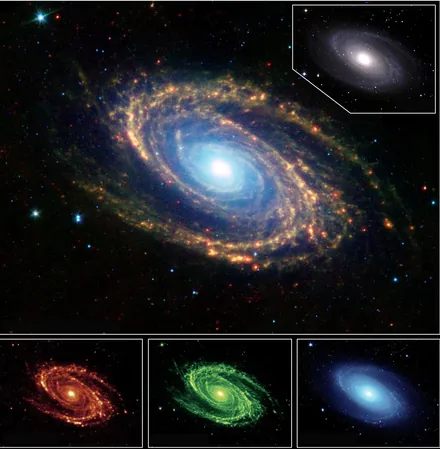
Bode's Galaxy is the nearest grand-design spiral to the Milky Way and the anchor of one of the closest galaxy groups to our own. It is bright enough that binoculars catch it from a dark site, 12 million light-years out.
Finding it: Extend the Big Dipper's bowl diagonal from Phecda through Dubhe the same distance again.
M82 Cigar GalaxyGalaxy in Ursa Major
- ID
- NGC 3034
- Distance
- about 11 million to 12 million light-years
- Magnitude
- 8.4
- Size
- 11x4 arcmin
- Best month
- April
- Gear
- Telescope, 80 mm and up
- Sky
- Dark skies (Bortle 4 or better) to be easy
- Discovery
- Johann Elert Bode, 1774
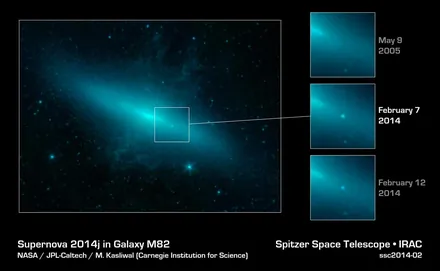
The Cigar Galaxy is the prototype starburst: a close pass by M81 crushed its gas into a frenzy of star birth, blowing towers of glowing hydrogen out of its disk. In 2014 it hosted SN 2014J, the nearest type Ia supernova in decades.
Finding it: In the same low-power field as M81, about half a degree to its north.
M83 Southern PinwheelGalaxy in Hydra
- ID
- NGC 5236
- Distance
- about 15 million light-years
- Magnitude
- 7.6
- Size
- 13x12 arcmin
- Best month
- June
- Gear
- Binoculars
- Sky
- Suburban skies or darker (Bortle 5) to stay easy
- Discovery
- Nicolas-Louis de Lacaille, 1752, from South Africa
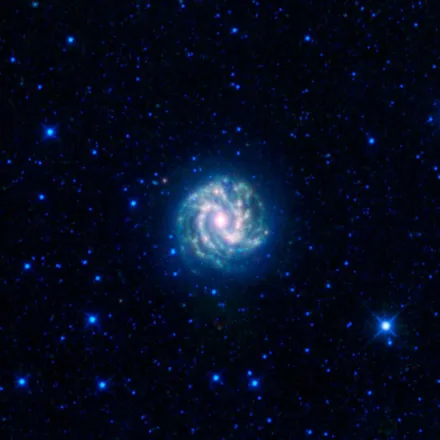
The Southern Pinwheel was the first galaxy discovered beyond the Local Group, and it is one of the most supernova-productive galaxies known, with six recorded since 1923.
Finding it: About 7 degrees southeast of Gamma Hydrae; northern observers should catch it at its highest, low in the south.
M84Galaxy in Virgo
- ID
- NGC 4374
- Distance
- about 57 million to 63 million light-years
- Magnitude
- 9.3
- Size
- 7x6 arcmin
- Best month
- May
- Gear
- Telescope, 100 mm and up
- Sky
- Dark skies (Bortle 3 or better) to be easy
- Discovery
- Charles Messier, 1781
M84 marks the western gateway of Markarian's Chain, the graceful arc of galaxies curving through the Virgo Cluster's heart; a jet-launching supermassive black hole hides in its core.
Finding it: Near the midpoint of the Vindemiatrix-Denebola line, in the same field as M86.
M85Galaxy in Coma Berenices
- ID
- NGC 4382
- Distance
- about 56 million to 64 million light-years
- Magnitude
- 9.2
- Size
- 7x5 arcmin
- Best month
- May
- Gear
- Telescope, 100 mm and up
- Sky
- Dark skies (Bortle 4 or better) to be easy
- Discovery
- Pierre Mechain, 1781
M85 is the Virgo Cluster's northern outpost, a lenticular galaxy whose faint shells and ripples record a merger within the last few billion years. It is strangely quiet at its center, with little sign of the usual supermassive black hole activity.
Finding it: Just over 1 degree east-northeast of the magnitude-4.7 star 11 Comae Berenices.
M86Galaxy in Virgo
- ID
- NGC 4406
- Distance
- about 49 million to 55 million light-years
- Magnitude
- 9.2
- Size
- 9x6 arcmin
- Best month
- May
- Gear
- Telescope, 100 mm and up
- Sky
- Dark skies (Bortle 3 or better) to be easy
- Discovery
- Charles Messier, 1781
M86 plows through the Virgo Cluster's heart at about 875 miles per second relative to the cluster, fast enough that the hot intracluster gas is stripping its interstellar medium away in a visible wake. It also shows the strongest blueshift in the catalog, approaching us at about 150 miles per second.
Finding it: Beside M84 near the midpoint of the Vindemiatrix-Denebola line; the pair anchor Markarian's Chain.
M87 Virgo AGalaxy in Virgo
- ID
- NGC 4486
- Distance
- about 52 million to 55 million light-years
- Magnitude
- 8.6
- Size
- 8x7 arcmin
- Best month
- June
- Gear
- Telescope, 80 mm and up
- Sky
- Dark skies (Bortle 4 or better) to be easy
- Discovery
- Charles Messier, 1781
M87 is the Virgo Cluster's central giant, wrapped in over 10,000 globular clusters, firing a plasma jet first noticed in 1918. Its central black hole, 6.5 billion solar masses, became the first ever photographed, by the Event Horizon Telescope in 2019.
Finding it: Just south of the midpoint of the line from Vindemiatrix to Denebola.
M88Galaxy in Coma Berenices
- ID
- NGC 4501
- Distance
- about 39 million to 56 million light-years
- Magnitude
- 9.5
- Size
- 7x4 arcmin
- Best month
- June
- Gear
- Telescope, 120 mm and up
- Sky
- Dark skies (Bortle 3 or better) to be easy
- Discovery
- Charles Messier, 1781
M88 is one of the Virgo Cluster's most elegant spirals, its tightly wound arms unusually regular for a galaxy plowing through a crowded cluster; it is racing away from M86 at well over 1,000 miles per second of relative speed.
Finding it: About 2 degrees north of M87, on the Coma Berenices side of the cluster.
M89Galaxy in Virgo
- ID
- NGC 4552
- Distance
- about 47 million to 53 million light-years
- Magnitude
- 9.8
- Size
- 5 arcmin
- Best month
- June
- Gear
- Telescope, 120 mm and up
- Sky
- Dark skies (Bortle 3 or better) to be easy
- Discovery
- Charles Messier, 1781
M89 looks almost perfectly circular on the sky, rare even among ellipticals; whether it truly is nearly spherical or just a flattened system seen end-on remains unknowable from our single vantage point.
Finding it: About 1 degree east of M87, toward Vindemiatrix.
M90Galaxy in Virgo
- ID
- NGC 4569
- Distance
- about 56 million to 62 million light-years
- Magnitude
- 9.5
- Size
- 10x5 arcmin
- Best month
- June
- Gear
- Telescope, 120 mm and up
- Sky
- Dark skies (Bortle 3 or better) to be easy
- Discovery
- Charles Messier, 1781
M90 is one of the few galaxies approaching us: its orbit through the Virgo Cluster more than cancels the cosmic expansion. Its gas has been so thoroughly stripped by the cluster that its star formation is quietly shutting down.
Finding it: About 1.5 degrees northeast of M87.
M91Galaxy in Coma Berenices
- ID
- NGC 4548
- Distance
- about 47 million to 79 million light-years
- Magnitude
- 10.2
- Size
- 5x4 arcmin
- Best month
- June
- Gear
- Telescope, 150 mm and up
- Sky
- Dark skies (Bortle 3 or better) to be easy
- Discovery
- Charles Messier, 1781
M91 was a 'missing' Messier object for nearly two centuries, the victim of a bookkeeping slip; in 1969 an amateur astronomer, William C. Williams, worked out that Messier had measured its position from the wrong reference galaxy.
Finding it: About 1 degree east of M88, in the Coma Berenices section of the Virgo Cluster.
M92Globular cluster in Hercules
- ID
- NGC 6341
- Distance
- about 26,700 light-years
- Magnitude
- 6.5
- Size
- 11 arcmin
- Best month
- August
- Gear
- Binoculars
- Sky
- Suburban skies or darker (Bortle 6) to stay easy
- Discovery
- Johann Elert Bode, 1777
M92 would headline any constellation that did not already contain M13; it is nearly as bright, slightly more compact, and among the most metal-poor and oldest globulars known, with age estimates brushing the age of the universe itself.
Finding it: About 6 degrees north of Pi Herculis, the Keystone's northeastern corner star.
M93Open cluster in Puppis
- ID
- NGC 2447
- Distance
- about 3,600 light-years
- Magnitude
- 6.2
- Size
- 22 arcmin
- Best month
- March
- Gear
- Binoculars
- Sky
- Suburban skies or darker (Bortle 6) to stay easy
- Discovery
- Charles Messier, 1781
M93 is a compact wedge of about 80 stars whose brightest members trace an arrowhead or butterfly; it was the last open cluster Messier himself discovered.
Finding it: About 1.5 degrees northwest of Azmidi, Xi Puppis.
M94 Cat's Eye GalaxyGalaxy in Canes Venatici
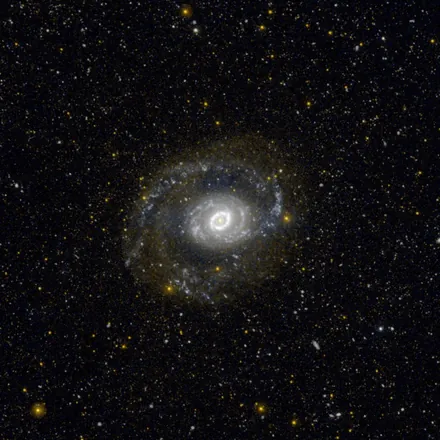
- ID
- NGC 4736
- Distance
- about 15 million to 17 million light-years
- Magnitude
- 8.1
- Size
- 11x9 arcmin
- Best month
- June
- Gear
- Telescope, 50 mm and up
- Sky
- Dark skies (Bortle 4 or better) to be easy
- Discovery
- Pierre Mechain, 1781
M94 is the double-ring galaxy: an inner ring of furious star formation circles its bright core, and studies of its rotation suggest it contains surprisingly little dark matter, a genuine puzzle.
Finding it: About 3 degrees north-northwest of Cor Caroli, forming a shallow triangle with Cor Caroli and Chara.
M95Galaxy in Leo
- ID
- NGC 3351
- Distance
- about 31 million to 34 million light-years
- Magnitude
- 9.7
- Size
- 3 arcmin
- Best month
- May
- Gear
- Telescope, 120 mm and up
- Sky
- Dark skies (Bortle 3 or better) to be easy
- Discovery
- Pierre Mechain, 1781
M95 is a textbook ringed barred spiral, its arms springing from a near-perfect circle of star formation around the bar, and it served as one of the calibration galaxies for measuring the universe's expansion rate.
Finding it: Roughly midway between Regulus and Chertan, about 2 degrees south of the connecting line; M96 shares the field.
M96Galaxy in Leo
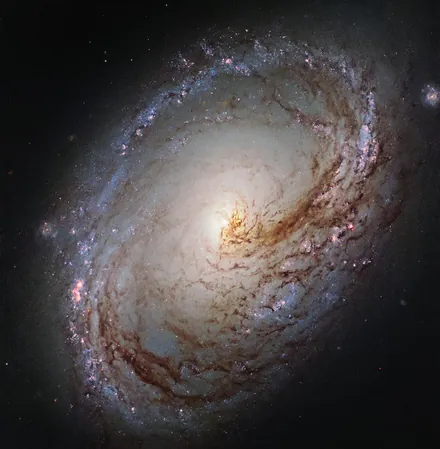
- ID
- NGC 3368
- Distance
- about 28 million to 34 million light-years
- Magnitude
- 9.2
- Size
- 8x5 arcmin
- Best month
- May
- Gear
- Telescope, 100 mm and up
- Sky
- Dark skies (Bortle 4 or better) to be easy
- Discovery
- Pierre Mechain, 1781
M96 is the namesake of one of the nearest groups to pair bright spirals with a giant elliptical; the group is wrapped in an enormous ring of hydrogen gas, the Leo Ring, whose origin is still argued over.
Finding it: About three quarters of a degree east of M95, midway between Regulus and Chertan.
M97 Owl NebulaPlanetary nebula in Ursa Major
- ID
- NGC 3587
- Distance
- about 2,000 light-years
- Magnitude
- 9.9
- Size
- 3 arcmin
- Best month
- May
- Gear
- Telescope, 100 mm and up
- Sky
- Dark skies (Bortle 4 or better) to be easy
- Discovery
- Pierre Mechain, 1781
The Owl Nebula gets its face from two darker cavities in a nearly spherical shell of gas shed by a dying star about 8,000 years ago; the owl's 'eyes' emerge with a nebula filter on dark nights.
Finding it: About 2.5 degrees southeast of Merak, the Big Dipper's southwestern bowl star; M108 lies in the same field.
M98Galaxy in Coma Berenices
- ID
- NGC 4192
- Distance
- about 44 million light-years
- Magnitude
- 10.1
- Size
- 10x3 arcmin
- Best month
- May
- Gear
- Telescope, 150 mm and up
- Sky
- Dark skies (Bortle 3 or better) to be easy
- Discovery
- Pierre Mechain, 1781
M98 is a nearly edge-on spiral diving toward us at about 90 miles per second, one of the very few blueshifted galaxies in the sky, and its elongated low-contrast glow makes it one of the tougher Messier targets.
Finding it: About half a degree west of the 5th-magnitude star 6 Comae Berenices.
M99Galaxy in Coma Berenices
- ID
- NGC 4254
- Distance
- about 45 million to 56 million light-years
- Magnitude
- 9.8
- Size
- 5 arcmin
- Best month
- May
- Gear
- Telescope, 120 mm and up
- Sky
- Dark skies (Bortle 3 or better) to be easy
- Discovery
- Pierre Mechain, 1781
M99 spins visibly off balance, one arm flung wide by a recent gravitational encounter, and it was the second galaxy ever to have its spiral form recognized, again by Lord Rosse's great telescope in the 1840s.
Finding it: About 0.7 degree southeast of 6 Comae Berenices.
M100Galaxy in Coma Berenices
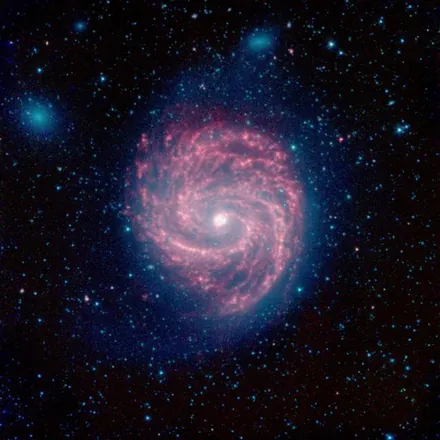
- ID
- NGC 4321
- Distance
- about 55 million light-years
- Magnitude
- 9.4
- Size
- 7x6 arcmin
- Best month
- May
- Gear
- Telescope, 120 mm and up
- Sky
- Dark skies (Bortle 3 or better) to be easy
- Discovery
- Pierre Mechain, 1781
M100 is the Virgo Cluster's grandest spiral, and its Cepheid variable stars, measured by the Hubble Space Telescope in the 1990s, provided one of the key rungs in pinning down the scale and age of the universe.
Finding it: About 2 degrees northeast of 6 Comae Berenices.
M101 PinwheelGalaxy in Ursa Major
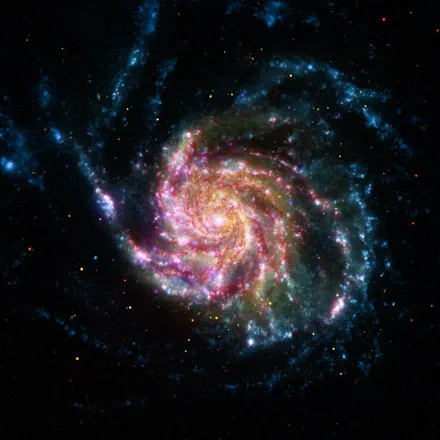
- ID
- NGC 5457
- Distance
- about 19 million to 22 million light-years
- Magnitude
- 7.7
- Size
- 29x27 arcmin
- Best month
- June
- Gear
- Telescope, 200 mm and up
- Sky
- Dark skies (Bortle 2 or better) to be easy
- Discovery
- Pierre Mechain, 1781
The Pinwheel Galaxy is a giant, nearly twice the Milky Way's diameter at about 170,000 light-years, but its light is spread so thin that it demands dark skies. In 2023 it hosted SN 2023ixf, the closest bright supernova since 2014.
Finding it: Forms a near-equilateral triangle with Mizar and Alkaid, on the east side of the Big Dipper's handle.
M102 SpindleGalaxy in Draco
- ID
- NGC 5866
- Distance
- about 50 million light-years
- Magnitude
- 9.9
- Size
- 5x2 arcmin
- Best month
- July
- Gear
- Telescope, 120 mm and up
- Sky
- Dark skies (Bortle 3 or better) to be easy
- Discovery
- Pierre Mechain, 1781; its identity was debated for two centuries
M102 is the catalog's great identity puzzle: Mechain later claimed it was a duplicate of M101, but the recorded description and position fit the Spindle Galaxy, NGC 5866, a lens-shaped galaxy bisected by a knife-edge dust lane, and that is the object shown here.
Finding it: About 4 degrees southwest of Edasich, Iota Draconis.
M103Open cluster in Cassiopeia
- ID
- NGC 581
- Distance
- about 10,000 light-years
- Magnitude
- 7.4
- Size
- 6 arcmin
- Best month
- December
- Gear
- Binoculars
- Sky
- Suburban skies or darker (Bortle 5) to stay easy
- Discovery
- Pierre Mechain, 1781
M103 was the final entry of the original published catalog, added on Mechain's word before Messier ever observed it. It is a young cluster shaped like a slender arrowhead, with a red giant glinting near the middle of the shaft.
Finding it: About 1 degree east of Ruchbah, Delta Cassiopeiae.
M104 SombreroGalaxy in Virgo
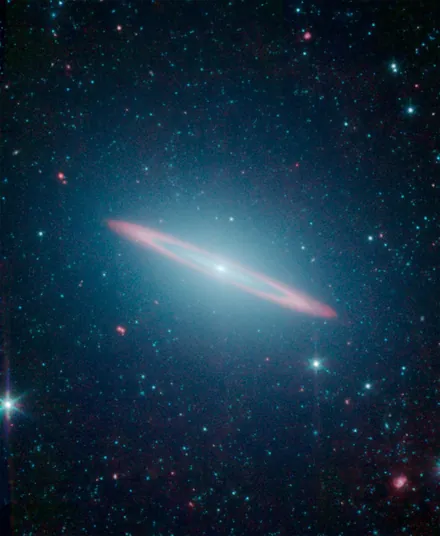
- ID
- NGC 4594
- Distance
- about 29 million to 31 million light-years
- Magnitude
- 8.3
- Size
- 9x4 arcmin
- Best month
- June
- Gear
- Telescope, 150 mm and up
- Sky
- Dark skies (Bortle 3 or better) to be easy
- Discovery
- Pierre Mechain, 1781
The Sombrero Galaxy made scientific history: in 1912 Vesto Slipher measured its enormous recession speed, the first hint that the 'spiral nebulae' were rushing apart, years before anyone framed an expanding universe. Its brim is a crisp dark dust lane.
Finding it: About 5 degrees northeast of Eta Corvi, at the end of a chain of faint stars pointing from Corvus toward Spica.
M105Galaxy in Leo
- ID
- NGC 3379
- Distance
- about 30 million to 34 million light-years
- Magnitude
- 9.3
- Size
- 5 arcmin
- Best month
- May
- Gear
- Telescope, 100 mm and up
- Sky
- Dark skies (Bortle 4 or better) to be easy
- Discovery
- Pierre Mechain, 1781; added to the modern catalog in 1947
M105 is the standard elliptical galaxy: so smooth and symmetric that astronomers use it as the textbook baseline against which other ellipticals are compared. It was one of three objects restored to the catalog by Helen Sawyer Hogg in 1947.
Finding it: About 1 degree northeast of M96, in the Leo I group between Regulus and Chertan.
M106Galaxy in Canes Venatici
- ID
- NGC 4258
- Distance
- about 22 million to 25 million light-years
- Magnitude
- 8.3
- Size
- 19x7 arcmin
- Best month
- May
- Gear
- Telescope, 80 mm and up
- Sky
- Dark skies (Bortle 4 or better) to be easy
- Discovery
- Pierre Mechain, 1781; added to the modern catalog in 1947
M106 has a pair of ghostly 'anomalous arms' made of glowing gas heated by jets from its central black hole, and water masers orbiting that black hole give one of the most precise direct distance measurements to any galaxy.
Finding it: Roughly midway between Chara, Beta Canum Venaticorum, and Phecda in the Big Dipper's bowl.
M107Globular cluster in Ophiuchus
- ID
- NGC 6171
- Distance
- about 20,900 light-years
- Magnitude
- 8.1
- Size
- 10 arcmin
- Best month
- August
- Gear
- Telescope, 50 mm and up
- Sky
- Dark skies (Bortle 4 or better) to be easy
- Discovery
- Pierre Mechain, 1782; the last object Mechain discovered, added to the catalog in 1947
M107 is an unusually open, loose globular with curious dark patches across its face, and it was the very last of the 110 objects to be discovered, though not the last added to the list.
Finding it: About 2.5 degrees south-southwest of Zeta Ophiuchi.
M108Galaxy in Ursa Major
- ID
- NGC 3556
- Distance
- about 46 million light-years
- Magnitude
- 10.0
- Size
- 9x2 arcmin
- Best month
- May
- Gear
- Telescope, 120 mm and up
- Sky
- Dark skies (Bortle 3 or better) to be easy
- Discovery
- Pierre Mechain, 1781; added to the modern catalog in 1953
M108 is a nearly edge-on spiral with almost no central bulge, a chaotic streak of dust and star clouds that observers have nicknamed the Surfboard; it shares a low-power field with the Owl Nebula in a memorable odd-couple pairing.
Finding it: About 1.5 degrees southeast of Merak, just before the Owl Nebula M97.
M109Galaxy in Ursa Major
- ID
- NGC 3992
- Distance
- about 60 million to 108 million light-years
- Magnitude
- 9.8
- Size
- 8x5 arcmin
- Best month
- May
- Gear
- Telescope, 120 mm and up
- Sky
- Dark skies (Bortle 3 or better) to be easy
- Discovery
- Pierre Mechain, 1781; added to the modern catalog in 1953
M109 is likely the most distant object in the Messier catalog at roughly 84 million light-years, a barred spiral whose bar and loose arms show in mid-size amateur telescopes on dark nights.
Finding it: About 0.7 degree southeast of Phecda, the Big Dipper's southeastern bowl star.
M110Galaxy in Andromeda
- ID
- NGC 205
- Distance
- about 2.6 million to 2.8 million light-years
- Magnitude
- 8.0
- Size
- 22x11 arcmin
- Best month
- December
- Gear
- Telescope, 80 mm and up
- Sky
- Dark skies (Bortle 4 or better) to be easy
- Discovery
- Charles Messier, 1773; not added to the catalog until 1966
Messier spotted this companion of Andromeda in 1773 and included it in his later engraving of the Great Nebula's field, but never gave it a number; it finally became M110 in 1966, the catalog's last addition. It is a dwarf elliptical being slowly kneaded by Andromeda's tides.
Finding it: About 35 arcminutes northwest of M31's core, on the opposite side from M32.
Common questions
What is the Messier catalog?
A list of 110 deep-sky objects compiled by the French comet hunter Charles Messier between 1758 and 1781, with seven historical additions completed in 1966. Messier recorded the fuzzy objects that could be mistaken for comets so he could ignore them, and his list of distractions turned out to be a nearly complete inventory of the northern sky's finest clusters, nebulae and galaxies.
How many Messier objects are there?
There are 110. Messier's final 1781 publication listed 103; historians later restored seven more objects (M104 through M110) that Messier and his collaborator Pierre Mechain had observed but never numbered, the last of them in 1966.
Can you see Messier objects without a telescope?
Yes. Eight of the 110 are routine naked-eye objects from a dark site, including the Pleiades, the Beehive Cluster, the Andromeda Galaxy and the Orion Nebula, and a few more, led by the Lagoon Nebula and the Triangulum Galaxy, are naked-eye stretch targets under excellent skies. Another 48 need nothing beyond ordinary binoculars; the rest require a telescope, though most are within reach of a small one.
What is the easiest Messier object to see?
The Pleiades (M45), an unmistakable naked-eye star cluster even from bright suburbs. After it, the Orion Nebula (M42), the Beehive (M44), the Andromeda Galaxy (M31) and the Hercules Cluster (M13) are the classic first deep-sky targets, and all five reward any instrument from binoculars up.
What is the hardest Messier object to see?
By common consent M74, a face-on spiral galaxy whose light is spread so thin that it vanishes in any light pollution or moonlight. The Little Dumbbell Nebula (M76) and the galaxy M98 are the other usual nominees. All three reward a genuinely dark sky and patience at low power.
What is a Messier marathon?
An attempt to observe all 110 objects in a single night. It is possible only around the March new moon, when the Sun sits in the one stretch of sky nearly empty of Messier objects, and a complete run is realistic only between about 20 and 40 degrees north latitude, under dark skies with clean horizons.
Why are there no far-southern objects in the catalog?
Messier observed from Paris, at 49 degrees north, so nothing in his catalog lies south of about declination -35. The great southern showpieces such as Omega Centauri and the Carina Nebula belong to later lists, chiefly the 109-object Caldwell catalog.
What is the difference between M numbers and NGC numbers?
M numbers are the catalog's 110 entries. NGC numbers come from the New General Catalog of 1888, which lists 7,840 objects; most Messier objects also carry one. The exceptions: M24 and M25 have Index Catalog numbers instead (IC 4715 and IC 4725), while M40, a double star, and M45, the Pleiades, have neither.
Are the Messier objects numbered in order across the sky?
No. The numbers follow the order in which Messier logged the objects over 23 years, so consecutive numbers can sit on opposite sides of the sky. That is also why marathon observers work from a custom sequence rather than counting from M1 to M110.
Keep exploring
Live Sky Map
Every Messier object plotted over your horizon right now; tap any symbol to identify it.
ReferenceThe 88 Constellations
The complete constellation catalog: the finder skills every star-hop in this page builds on.
SkyToday in the Sky
Tonight's Moon, the planets' places and the next sky events from your location.
CalculatorTelescope & Eyepiece
Magnification, exit pupil and true field, plus the sky-quality and limiting-magnitude panel.
Cite this page
CycleCalcs, "The Messier Catalog: All 110 Objects & Guides", CycleCalcs LLC, https://www.cyclecalcs.com/messier.html (add your access date).
The computed values on this page (positions, rise and set times, visibility) are public domain under CC0, stated here. The identifications and names derive from public astronomical catalogs whose terms travel with them; the register is on the engine and sources.