Press room
You are probably here on a deadline, with an eclipse or a supermoon to file on. This page exists so you can get the numbers right, grab an image you are allowed to publish, and reach a human who will answer.
Need a number we do not have on the site? Email info@cyclecalcs.com and say what you need and by when. We will compute contact times, altitudes, obscuration, rise and set, or phase for any location on Earth and any date from 1700 to 2200, and send it back with the conventions stated so you can quote it safely.
No charge, no strings, and no requirement to credit us. Getting the sky right in print is the point.
What CycleCalcs is
A free astronomy site that computes where things are and when they happen, and explains the cycles behind them. It covers tonight's sky, the Moon's phases and distances, eclipses, equinoxes and solstices, planetary positions and retrogrades, meteor showers, and the long rhythms underneath, from the 29.53-day synodic month to the 25,920-year precession of the equinoxes (the traditional round figure; the modern measured value is about 25,772 years).
The distinguishing feature, for your purposes, is that nothing on the site is a lookup table. Every figure is computed at request time by the open-source Astronomy Engine, and the same engine backs the website, the public API and the published datasets. Those three can disagree with each other only if the engine disagrees with itself.
Strictly positional astronomy. No astrology, no horoscopes, and no claim that anything in the sky affects events on Earth.
Fact sheet
| Name | CycleCalcs. Published by CycleCalcs LLC, a Virginia limited liability company. |
|---|---|
| Site | www.cyclecalcs.com, free and requiring no account. |
| Engine | Astronomy Engine 2.1.19 (MIT), by Don Cross. Vendored and hash-verified, not fetched at runtime. |
| Accuracy | Arcminute class for the Sun, Moon and planets, over roughly 1700 to 2200. Measured residuals are published at /api/accuracy.html. |
| API | 30 read-only endpoints at /api.html. Free tier needs no key and no signup. |
| Open data | 55,909 computed events, 1700 to 2200, public domain. DOI 10.5281/zenodo.21905241. |
| Contact | info@cyclecalcs.com |
Using our numbers
You may quote any computed value from this site freely, with no attribution and no permission. Positions, phases, rise and set times, eclipse circumstances, conjunctions, seasons and every other calculated quantity are facts about the physical universe, and our license dedicates them to the public domain under CC0 1.0. That includes commercial use.
A link back is welcome and never required.
Three things worth getting right
These trip up eclipse and moon coverage every single cycle, and a reporter who gets them right stands out:
- Greatest eclipse is not greatest duration. Greatest eclipse is the moment the Moon's shadow axis passes closest to Earth's center. The place where totality lasts longest is a different point, usually a few seconds longer. Most coverage quotes the first and calls it the second. For the 2 August 2027 eclipse the NASA canon gives greatest duration 6 min 23.2 sec at 26.81N 31.13E, and greatest eclipse 6 min 22.6 sec. Durations computed on this site run about about three seconds longer than the canon's, because of the lunar radius each adopts for totality; we state that wherever we publish one.
- "Supermoon" has no official definition. It was coined by an astrologer in 1979 and every publication draws the line somewhere different, which is exactly why supermoon counts disagree between outlets. We use 360,000 km measured at the instant of the full moon, and we always publish the actual distance so you can apply whatever rule your style guide prefers.
- 99 percent is not "almost totality". It is a different phenomenon. The corona does not appear, the sky does not go dark, and eye protection must stay on. Aswan sits at 99.85 percent for the 2027 eclipse and sees nothing of what Luxor sees, 15 km outside the path.
Logos and brand assets
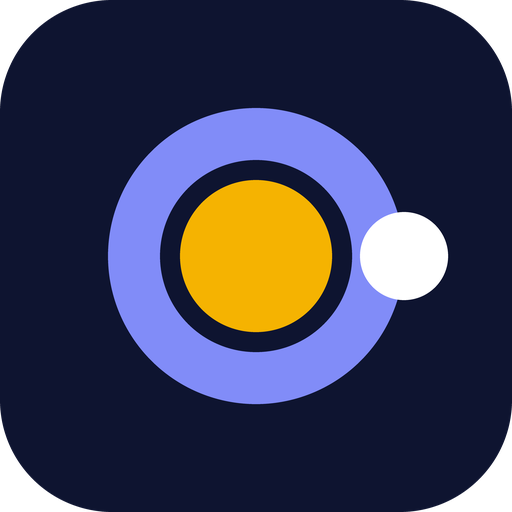
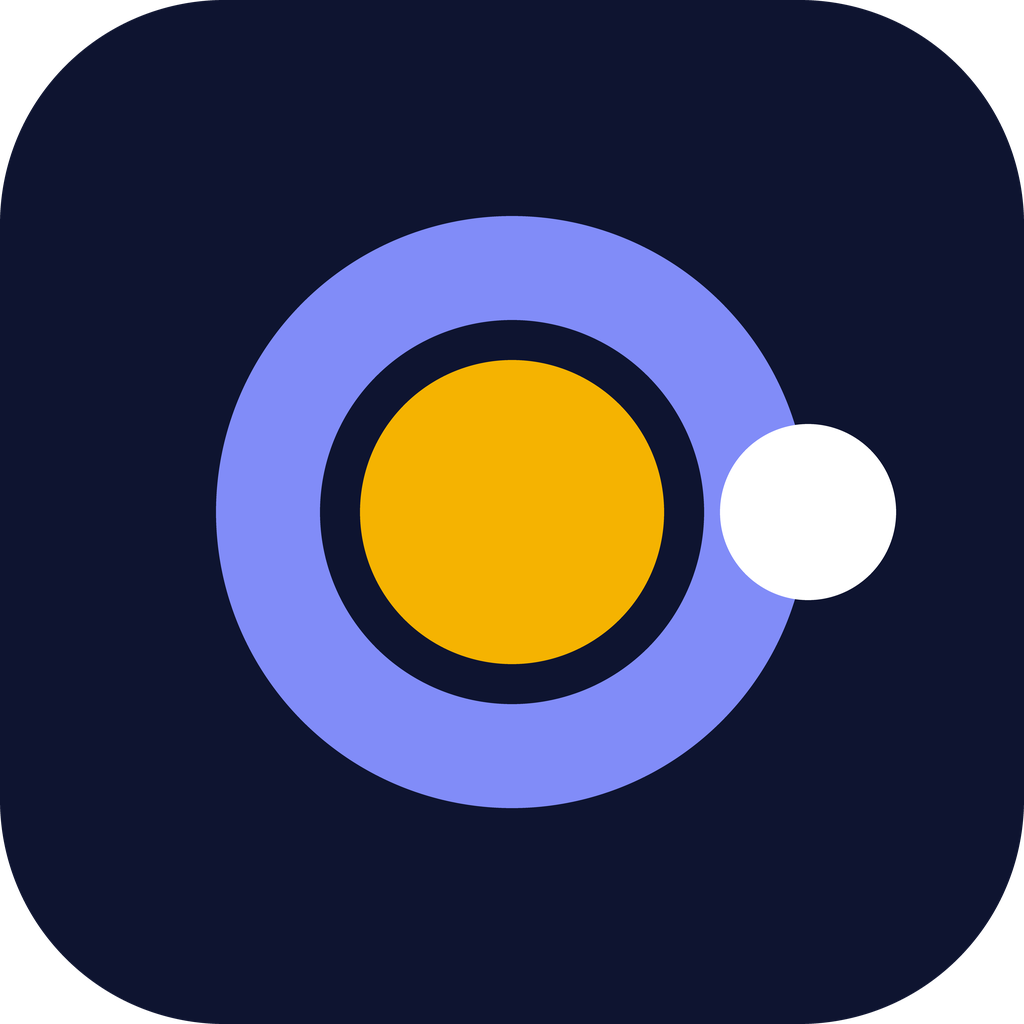
Free to use when reporting on or referring to CycleCalcs. Please do not stretch, recolor or redraw the mark, place it on a busy background, or use it in a way that implies we endorse a product. The mark is a gold body inside an indigo orbital ring with a white satellite sitting on the ring: a sun with a planet, or a planet with a moon, either way a cycle.




Palette
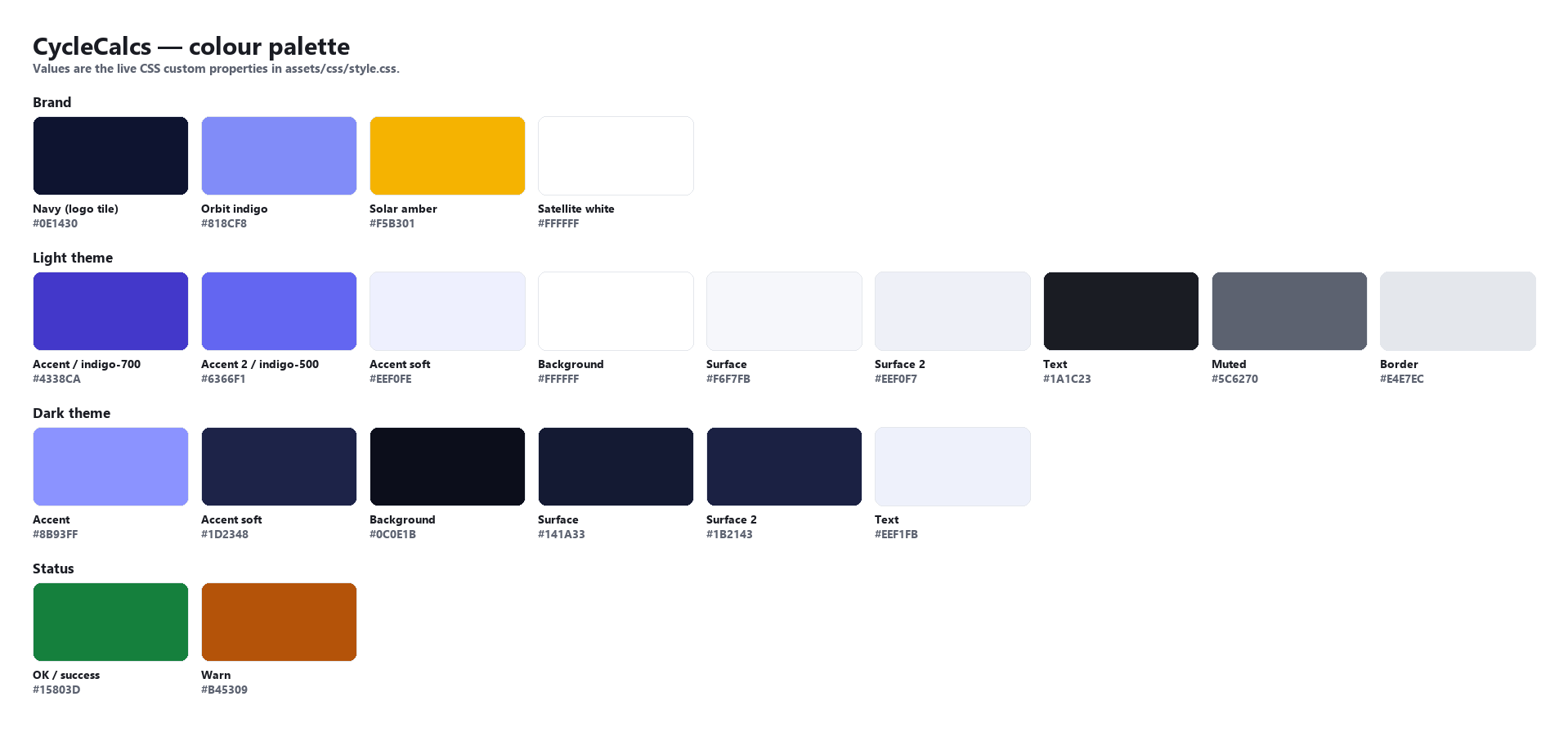
Navy #0E1430, orbit indigo #818CF8, solar amber #F5B301, satellite white #FFFFFF.
Diagrams and figures
The site carries 80 standalone explanatory diagrams: why eclipses only happen near the lunar nodes, how the equation of time splits the earliest sunset from the shortest day, what the analemma is, why the Moon rises later each night. They are SVG, so they scale to a full newspaper page without going soft, and every one carries a small CycleCalcs.com watermark in the bottom-right corner.
You may republish any figure from this site in news coverage, in print or online, free of charge. Two conditions, both easy: leave the watermark intact, and do not redraw or relabel the diagram so it says something we did not. Cropping, rescaling and placing it in your own layout are all fine, and because the credit is baked into the image you do not need a separate caption line for us.
If you need a variant we do not have, ask. We will draw the same diagram for a specific date, a specific latitude, or your publication's column width, and send it back as SVG and PNG. That offer is genuine and it is free.
Browse them in context on the Learn pages, or email and describe what you are trying to show.
Data and citation
If you need the underlying numbers rather than a page, there are three ways in, all free:
- The API: 30 endpoints, JSON, no key required. Every response names its reference frame, epoch, time scale and refraction model.
- Calendar feeds: subscribable iCalendar for moon phases, eclipses and seasons.
- Bulk datasets: 55,909 events from 1700 to 2200 as CSV, archived on Zenodo with a permanent DOI and a byte-reproducible build.
To cite the data:
CycleCalcs LLC (2026). CycleCalcs Astronomy Data: moon phases, apsides, node crossings, seasons and eclipses, 1700-2200. Zenodo. https://doi.org/10.5281/zenodo.21905241
What is coming that you may want to cover
The one worth planning for now is the total solar eclipse of 2 August 2027, which crosses southern Spain, Gibraltar, Morocco, Algeria, Tunisia, Libya, Egypt and Saudi Arabia. Totality runs over six minutes along the Nile, longer than any land totality since 1991, and August in Upper Egypt is about as close to a guaranteed clear sky as eclipse chasing gets.
We publish it town by town, with totality timed to the second and contact times in each town's own clock, including the near misses that will catch travelers out. If you are writing a "where should I go" piece, that page has the gradient: Malaga is inside the path by about 9 km and gets 1 min 51 sec, while Tarifa, about 130 km away in a straight line (nearer 160 by the coast road), gets 4 min 41 sec. The Spanish towns have editions in Spanish.
The data pack. Every catalog town's circumstances in one file, ready to republish: towns.csv or towns.json, with contact times to the second in UTC, totality durations, Sun altitudes and each town's local maximum. The computed values are public domain (CC0, stated here): republish them in a table, a graphic or an app without asking. Credit as "CycleCalcs" is appreciated, never required; place names and coordinates come from GeoNames under CC BY 4.0, and that credit travels with them.
Any town, usually within a day. Name a town on or near the path and we will compute its full local circumstances, checked and quotable, free: info@cyclecalcs.com. The engine is validated against JPL Horizons and every residual from that study is published in full (the measured accuracy, with the raw comparison in the data repository), so every figure you print can be traced.
For everything else, the eclipse calendar, equinoxes and solstices, meteor showers and full moon calendar run years ahead.
The club kit: for astronomy clubs, observatories and planetariums
Everything below is free, needs no account, and may be reprinted: the computed values are public domain (CC0). A link from your resources page is appreciated, never a condition.
- Calendar feeds for your events page. The subscribable feeds carry every full moon, eclipse and season (plus one combined sky feed), computed by the engine behind this site. Stable URLs; your calendar software refreshes them on its own.
- Widgets for your homepage. Tonight's moon, the next-eclipse countdown, the planet parade and three more, each one paste-and-done from the embed page; there is also a WordPress plugin and npm package for sites built that way.
- The 2027 eclipse, computed for your observing site. Send your site's coordinates to info@cyclecalcs.com and we will run the same per-coordinate computation the town pages carry, free: contact times to the second, totality duration, Sun altitude, and the margin to the edge of the path.
- A newsletter item, ready to reprint. The paragraph below is CC0: paste it into your club newsletter as-is, or edit it freely.
The total solar eclipse of 2 August 2027 is the longest total solar eclipse on easily accessible land this century: 6 minutes 23 seconds at greatest duration, over six minutes along the Nile, and more than four and a half minutes at Tarifa on Europe's southern tip. CycleCalcs publishes it town by town, with contact times to the second in each town's own clock and the near misses spelled out, free: cyclecalcs.com/eclipses/2027-08-02/. The same engine computes any coordinates on request.
What we will not tell you
We will not give you an astrological angle, a claim that a planetary alignment affects earthquakes, tides beyond the Moon's real and well understood contribution, or human behavior. If a story needs one of those, we are the wrong source, and we will say so rather than hedge.
We will also tell you when a number is less certain than it looks: contact times here are mean-limb figures, and the Moon's mountainous edge shifts them a second or two either way.
The 2027 eclipse, town by town
Totality to the second for fourteen towns on the path, with the near misses that will catch travelers out.
DataThe API
30 endpoints, no key, every response stating its frame, epoch and time scale.
MethodMethodology
How every figure on this site is computed, and where each cited value comes from.
AboutAbout CycleCalcs
Who publishes this, what it is for, and what it deliberately refuses to do.