The Sun
The Sun is the engine behind every cycle this site tracks. It is a G2 main-sequence star, a yellow dwarf about 4.5 billion years old, and it holds more than 99.8 percent of the solar system's mass: it would take about 333,000 Earths to balance it on a scale. Every sunrise, every season, and every eclipse comes down to how Earth and the Moon move around this one star, roughly 150 million kilometers away.
The live panel below shows what the Sun is doing today from your location: when it rises and sets, how long daylight lasts, and where it sits among the stars right now. Everything is computed in your browser; if you tap Use my location, your city is named from a place index served with this page.
On this page
The Sun's next milestone is the December solstice on December 21, 2026 (Universal Time), and the next solar eclipse anywhere on Earth is an annular eclipse on February 6, 2027.
Sunrise, sunset, twilight and day length for your location are in the live panel below; the season table lists every equinox and solstice for the next two years.
The Sun has no single day length, because it is not solid. Its glowing gas turns about once every 25 days at the equator and takes up to 36 days near the poles, a pattern called differential rotation. That uneven spin winds up the Sun's magnetic field and helps drive the 11-year sunspot cycle.
The Sun today from your location
Enter coordinates
This panel computes today's sunrise, sunset and day length for the Sun in your browser, and it needs JavaScript to run. The rest of this page, including the calendars and event dates below, is fully readable without it. For a live all-sky view, open the Sky Map or Today in the Sky.
Everything is computed on your device. Tapping "Use my location" names your city from a place index served with this page. Times appear in your device's time zone.
The Sun at a glance
| Distance from Earth | 147.1 to 152.1 million km over the year (light takes about 8.3 minutes) |
|---|---|
| Diameter (mean) | about 1,391,400 km (109 × Earth's) |
| Mass | 1.989 × 10³⁰ kg (about 333,000 Earths; 99.8% of the solar system) |
| Surface gravity | 274 m/s² (28 × Earth's) |
| Escape velocity | 617.6 km/s |
| Rotation | about 25 days at the equator, up to 36 days near the poles (it is not solid) |
| Effective surface temperature | 5,772 K (about 5,500 °C) |
| Core temperature | about 15 million °C |
| Composition (photosphere) | about 91% hydrogen and 9% helium atoms |
| Luminosity | 3.828 × 10²⁶ watts |
| Total solar irradiance | 1,361 W/m² at 1 AU: the luminosity above spread over a sphere 1 AU in radius |
| Spectral type | G2 V, a yellow dwarf main-sequence star |
| Age | about 4.5 billion years |
| Tilt of spin axis to the ecliptic | 7.25° |
| One orbit of the Milky Way | about 230 million years |
| Apparent magnitude | −26.7 |
Physical data: NASA NSSDCA Sun Fact Sheet and NASA Science. Total solar irradiance: derived here from the luminosity, L / 4π(1 AU)2.
Equinoxes, solstices and Earth's orbit
The seasons turn on four instants a year: two equinoxes, when the Sun crosses Earth's equator, and two solstices, when it reaches its farthest point north or south. Separately, Earth's slightly elliptical orbit brings us closest to the Sun in early January and farthest in early July, a rhythm that does not cause the seasons but does fine-tune their lengths. Dates are in Universal Time.
| Date | Event |
|---|---|
| Dec 21, 2026 | December solstice |
| Jan 3, 2027 | Perihelion: Earth at its closest to the Sun, 0.9833 AU |
| Mar 20, 2027 | March equinox |
| Jun 21, 2027 | June solstice |
| Jul 5, 2027 | Aphelion: Earth at its farthest from the Sun, 1.0167 AU |
| Sep 23, 2027 | September equinox |
| Dec 22, 2027 | December solstice |
| Mar 20, 2028 | March equinox |
| Jun 20, 2028 | June solstice |
| Sep 22, 2028 | September equinox |
How much sunlight reaches Earth
Sunlight arriving at Earth follows that distance: about 1,408 W/m² at perihelion (0.9833 AU) and 1,317 at aphelion (1.0167 AU), 6.9 percent more in January than in July. The sunspot cycle moves it far less, about 0.1 percent: NASA's TSIS-1 radiometer measured yearly means of 1,361.5 W/m² at 1 AU in 2019, near the minimum, and 1,362.6 in 2024, the maximum year.
How to see the Sun
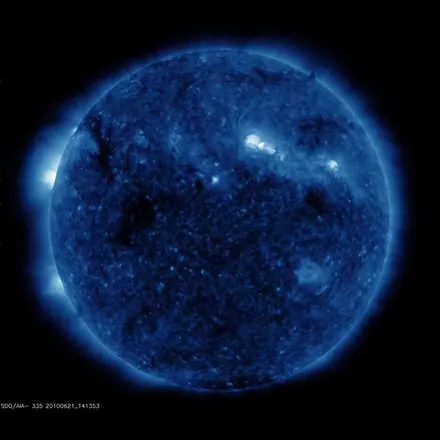
Safety comes before everything else with this target: never look directly at the Sun. It can injure the retina in moments, and because the retina has no pain receptors, the damage arrives without warning. There are only three safe ways to observe it: certified eclipse glasses meeting the ISO 12312-2 standard, a purpose-made solar filter fitted over the front of a telescope or binoculars, or projection, described below. Never look through any optics pointed at the Sun unless a certified filter covers the front; ordinary sunglasses, smoked glass, and filters that screw into the eyepiece are all unsafe.
Projection is the free method. Make a small, clean hole in a piece of card, stand with your back to the Sun, and let sunlight pass through the hole onto a second card a few feet away: the bright circle it forms is a true image of the Sun's disk. A kitchen colander throws dozens of these images at once, and during a partial eclipse every one of them becomes a tiny crescent.
Telescope projection is also how to watch sunspots, and it is the one arrangement where a telescope is aimed at the Sun without a filter: the image falls on a card, and no eye ever goes anywhere near the eyepiece. Cap or remove the finder scope first, point a small telescope at the Sun by minimizing its shadow (never sight along the tube), and project the eyepiece image onto white card; a simple refractor works best for projection, and never leave the setup unattended where a child could put an eye to it. The other route is a proper white-light filter over the front aperture, which makes looking through the eyepiece safe. Either way you can follow dark spots drifting across the disk as the Sun rotates, multiplying and fading with the roughly 11-year solar cycle. A small telescope used this way shows a pale, quiet disk carrying a few dark spots, far short of the seething detail in the spacecraft image on this page. Prominences and flares need specialized hydrogen-alpha telescopes, which isolate a single deep-red wavelength of hydrogen light.
The Sun's cycles
Watched from Earth, the Sun sets the rhythm of the day and the year. Because Earth's axis is tilted, the Sun rides high in summer and low in winter, and its rising and setting points sweep along the horizon through the year; the seasons lesson shows why the tilt, not distance, does the work (Earth is actually closest to the Sun, about 147 million kilometers, during northern winter). The Sunrise and Sunset Calculator charts the whole yearly swing for your location, and the equation of time lesson explains the subtler rhythm that makes sundial noon and clock noon drift apart and back over the year.
The Sun also keeps a cycle of its own. It does not rotate as a solid body: the equator turns in about 25 days while regions near the poles take up to 36. That uneven spin winds up the solar magnetic field, which erupts through the surface as sunspots, and their numbers rise and fall over a cycle averaging roughly 11 years. The sunspot cycle lesson lets you explore centuries of real sunspot counts and see the rhythm for yourself.
Solar Cycle 25 began at the minimum of December 2019. Its 13-month smoothed sunspot number peaked in October 2024. NOAA's Space Weather Prediction Center forecasts the smoothed count still falling at the end of 2030, so the next minimum is expected around 2030 or later. The count itself is Rudolf Wolf's sunspot number, R = k(10g + s): ten for each group of spots g, one for each individual spot s, and a factor k that scales each observer's count to the standard.
Eclipses depend on a coincidence of scale. The Sun's disk spans about half a degree of sky, so close to the Moon's apparent size that the Moon can only just cover it. The Eclipse Explorer maps every upcoming solar eclipse and shows where each one is visible.
The slowest rhythms dwarf human history. Over tens of thousands of years, gradual shifts in Earth's orbit and tilt redistribute sunlight and pace the ice ages, the Milankovitch cycles. And the Sun is itself a traveler, carrying the whole solar system around the Milky Way at about 720,000 kilometers per hour: one galactic year takes roughly 230 million years.
To see where these periods fit among everything else that repeats overhead, read the full the sunspot cycle profile, or find it sorted by length in the complete cycles list. Its activity keeps a longer beat as well, the 22-year Hale magnetic cycle, two sunspot cycles with a polarity reversal between them.
What's next for the Sun
The Sun's headline events are eclipses, the only times the solar disk itself puts on a show for the naked eye (through proper eclipse glasses, always). The Eclipse Explorer maps where each one is visible. Dates are in Universal Time.
| Date | Event |
|---|---|
| Feb 6, 2027 | Annular solar eclipse |
| Aug 2, 2027 | Total solar eclipse |
| Jan 26, 2028 | Annular solar eclipse |
Frequently asked questions
Why is it dangerous to look at the Sun during an eclipse?
Because even a thin sliver of the exposed Sun is intense enough to burn the retina, and the retina feels no pain, so the damage happens without warning. A partial eclipse is especially risky: the sky dims, your pupils open wider, and staring feels easier than usual. Certified eclipse glasses meeting ISO 12312-2, a purpose-made solar filter over the front of a telescope or binoculars, or projection are the only safe options. Naked-eye viewing is safe only during the brief total phase of a total eclipse, while the Moon completely covers the Sun's disk.
How long does sunlight take to reach Earth?
About 8 minutes. The Sun is on average 149.6 million kilometers away, and light crossing that gulf takes a little over eight minutes, so you always see the Sun as it was roughly eight minutes ago. The distance varies through the year, between about 147 and 152 million kilometers, which changes the travel time by about eight seconds either way.
Does the Sun orbit anything?
Yes. The Sun orbits the center of the Milky Way galaxy, carrying the planets along with it at about 720,000 kilometers per hour. One full lap, sometimes called a galactic year, takes about 230 million years. Since the Sun is roughly 4.5 billion years old, it has completed only about 20 of these laps in its entire lifetime.
What is the solar cycle?
The solar cycle is the rise and fall of the Sun's magnetic activity over a period averaging a little over 11 years. At solar maximum the disk carries many sunspots and the Sun produces more flares and eruptions, which is when auroras are most frequent on Earth; at solar minimum the disk can be nearly spotless for weeks. Individual cycles run somewhat shorter or longer than the average.
What is the Sun made of?
Mostly hydrogen and helium. In the photosphere, the Sun's visible surface layer, about 91 percent of its atoms are hydrogen and about 9 percent are helium, with only traces of heavier elements such as oxygen, carbon and iron. The Sun is not burning in the ordinary sense: its core, at about 15 million degrees Celsius, fuses hydrogen into helium, converting more than four million tons of matter into pure energy every second.
How long is a day on the Sun?
The Sun does not turn as a single body, because it is a ball of gas rather than a solid world. Tracking sunspots shows the equator coming back around in about 25 days while features near the poles take up to 36, so there is no one figure to give. Astronomers often quote the roughly 27-day rotation seen from Earth for the mid-latitudes where most sunspots appear.
When is the next solar eclipse?
The next solar eclipse anywhere on Earth is an annular eclipse on February 6, 2027 (Universal Time), followed by a total eclipse on August 2, 2027. Each eclipse is only visible from a limited region; the Eclipse Explorer on this site maps every path.
When is the next equinox or solstice?
The next is the December solstice on December 21, 2026 (Universal Time). The full table on this page lists every equinox and solstice for the next two years, with Earth's perihelion and aphelion dates alongside.
Keep exploring
- Sunrise and Sunset Calculator: today's sun times, twilight and day length for your location, all year
- Sunspot Cycle lesson: explore centuries of real sunspot counts behind the 11-year rhythm
- Eclipse Explorer: every upcoming solar eclipse and where its shadow falls
- Seasons lesson: why Earth's tilt, not its distance, makes summer and winter
- Equation of Time lesson: why sundial noon and clock noon disagree through the year
Cite this page
CycleCalcs, "The Sun: Sunrise Today, Facts and the Solar Cycle", CycleCalcs LLC, https://www.cyclecalcs.com/the-sun.html (add your access date).
Every computed value on this page is public domain: CycleCalcs asserts no copyright in calculated astronomical facts and dedicates any such right to CC0, stated here. Quote the numbers freely, with or without credit. Conventions and sources: the engine and sources.