Retrograde Motion: Why the Planets Loop Backward
Night after night the planets creep slowly eastward through the stars. Then, for a few weeks, one of them seems to stop, reverse, and drift backward before turning around again. This is apparent retrograde motion, and nothing about the planet has actually changed. We are watching from Earth, which is itself racing around the Sun, and the backward loop is an illusion of our own moving viewpoint.
On this page
Pick a planet below and play the two views: on the left, Earth overtaking it from the inside lane; on the right, the loop that overtaking draws across our sky.
A backward loop that is not really backward
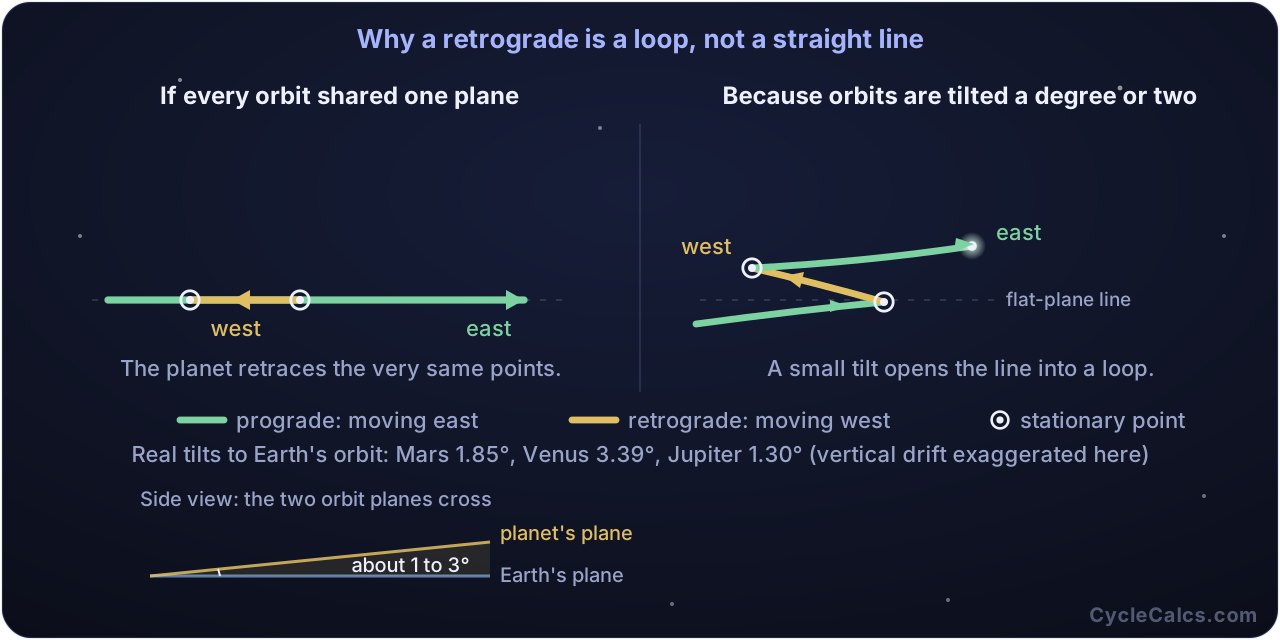
The word retrograde simply means moving the wrong way. Almost all the time the planets travel prograde, also called direct: slowly eastward against the fixed stars, the same direction the Sun and Moon drift. A retrograde is the brief spell when a planet appears to halt, back up to the west, halt again, and then carry on east. The two moments of apparent standstill are called the stationary points, marked on the sky view.
Think of overtaking a slower car on the highway. As you pull alongside and pass it, the other car seems to slide backward against the distant scenery, even though it is still rolling forward. The instant you draw level is when it appears to move backward fastest.
Retrograde motion is exactly this, played out between two worlds circling the Sun. The planet keeps moving forward the whole time; it only looks like it reverses because our line of sight to it swings around as we pass.
Outer planets: the loop at opposition
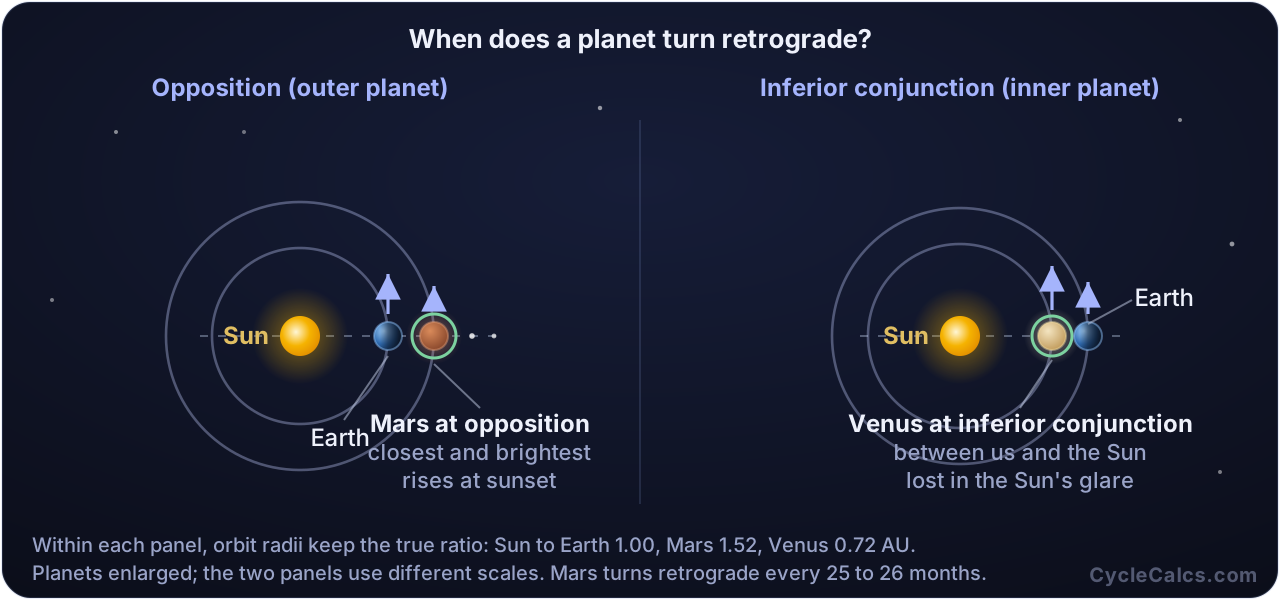
Earth is closer to the Sun than Mars, Jupiter, or Saturn, so it travels faster and on a shorter track. Every so often Earth catches one of these outer planets and overtakes it on the inside.
That catch-up moment is opposition, when the planet sits directly opposite the Sun in our sky: it rises at sunset, stands highest at midnight, and is at its closest and brightest of the year. It is precisely then that the planet appears to loop backward, because we are sweeping past it.
Mars reaches opposition and goes retrograde about every 25 to 26 months, set by its synodic period of roughly 780 days, and the backward loop lasts a little over two months. The more distant and slower the planet, the more often Earth laps it, and the closer its synodic period comes to a year. Jupiter turns retrograde every 13 months (its 398.9-day synodic period) and stays retrograde about four months each time, tracing a tighter loop, so about one calendar year in twelve has no new retrograde station. 2027 is one: Jupiter stations retrograde on 13 December 2026 and next on 12 January 2028, though it is still retrograde early in 2027, until 13 April (dates in UT, from /v2/retrogrades).
Inner planets: the loop at inferior conjunction
The inner planets, Venus and Mercury, are faster than Earth, so they do the overtaking. Each turns retrograde near inferior conjunction, the moment it sweeps between Earth and the Sun, passing us on the inside lane. The geometry is the same overtaking illusion, just with the roles reversed. The catch is that this happens close to the Sun in our sky, so the backward loop is mostly lost in the glare and far harder to watch than a Mars or Jupiter loop riding high in a midnight sky.
Why a loop, and not just a back-and-forth
If all the planets orbited in exactly the same flat plane, a retrograde would be a simple back-and-forth along a line, the planet retracing its own steps. In reality each orbit is tilted by a degree or two from Earth’s, so as the planet backs up it also drifts a little north or south.
That sideways nudge opens the back-and-forth into the graceful loop or S-shape you see on the right. The exact figure depends on how high above or below our orbital plane the planet sits during the pass. (The up-and-down scale on the sky view is stretched so this gentle drift is easy to see; in the real sky the loop is long and shallow.)
The puzzle that broke the Earth-centered sky
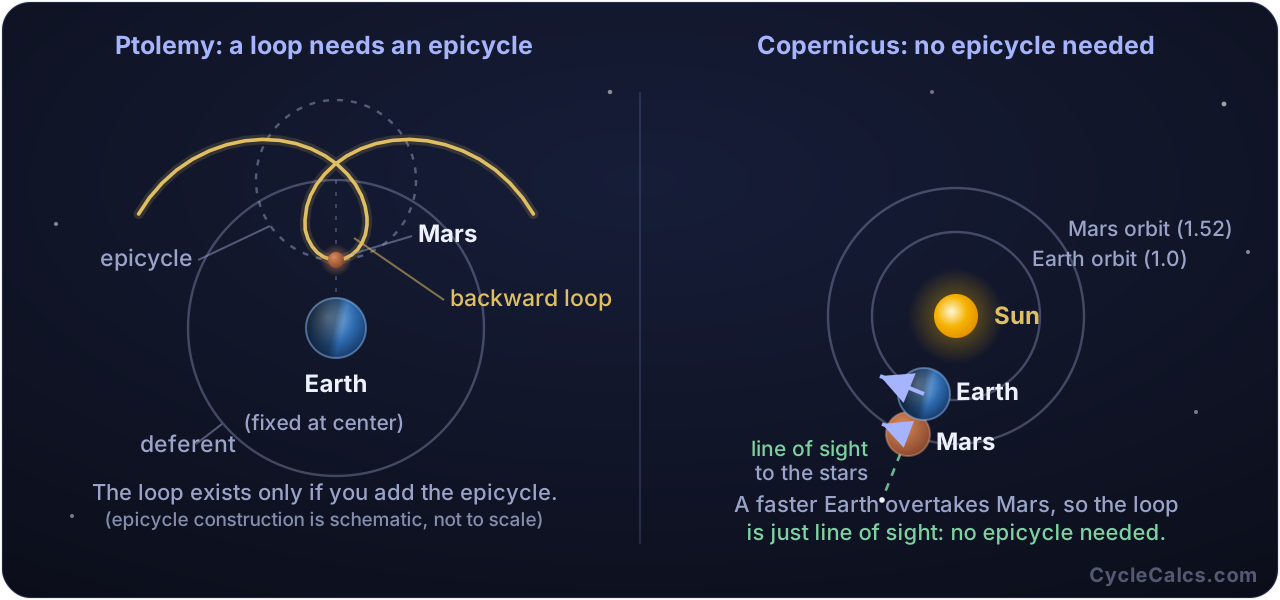
Retrograde motion is one of the oldest puzzles in astronomy. Babylonian skywatchers recorded the stations and loops of the planets thousands of years ago. In the Earth-centered model of Ptolemy, each planet had to ride a small circle, an epicycle, turning on top of its main orbit, an ingenious but awkward fix invented purely to reproduce the loops.
When Copernicus placed the Sun at the center and let Earth move, the epicycles fell away. Retrograde motion was no longer a thing the planets did; it was a thing we see because we move. That quiet simplification was one of the strongest arguments for the Sun-centered solar system.
You can trace these loops yourself for any date in the Live Orrery by switching on the trails, and reproduce the synodic periods that set their timing with the Synodic-Period Calculator or among the cycles by length. For today's answer, which planets are retrograde right now keeps a live board with every station date, and Mercury retrograde dates lists every upcoming window with exact times.
Mercury retrograde: real motion, no effect
You may have heard that “Mercury is in retrograde” and that it stirs up trouble on Earth. The motion itself is perfectly real: Mercury does appear to loop backward three or four times a year, for the geometric reason above. But it is only an appearance, a trick of perspective, and a planet sliding past us sends out no force, no influence, and no signal of any kind.
The claim that a retrograde tangles travel plans or technology belongs to astrology, not astronomy. What is genuinely worth catching is the sight itself: an outer planet near opposition, blazing at its brightest, slowly drawing its loop among the stars over a couple of months.
Frequently asked questions
Why do planets appear to move backward?
Most of the time a planet drifts slowly eastward against the background stars, the direction called prograde or direct motion. Apparent retrograde motion is the few weeks when it seems to stop, reverse to the west, then stop and resume going east. Nothing about the planet actually changes. We watch from Earth, which is itself moving, and the backward loop is the result of our viewpoint sliding past the planet, the way a faster car on the highway makes a slower one seem to drift backward.
When does Mars go into retrograde?
An outer planet such as Mars turns retrograde around opposition, the time it sits opposite the Sun in our sky and is closest and brightest. That is when the faster Earth, on its inner orbit, catches up to and overtakes it. Mars does this about every 25 to 26 months, the spacing set by its synodic period of roughly 780 days, and each retrograde lasts a little over two months.
Is Mercury retrograde real, and does it affect anything?
The motion is real geometry, but it has no physical effect on Earth or on people. Mercury and Venus turn retrograde near inferior conjunction, when they overtake Earth on the inside and pass between us and the Sun. It is the same overtaking illusion as for the outer planets. The planet sends out no force during this time, and the idea that a retrograde changes events on Earth is astrology, not astronomy.
Sources & further reading
- NASA GSFC StarChild: What does it mean for Mercury to be in retrograde?: a plain-language explanation that retrograde is an apparent motion, not a real reversal.
- Penn State ASTRO 801, Planetary Motion: a university course lesson on how geocentric and heliocentric models account for the loops.
- Ohio State University: Ptolemy to Copernicus: how epicycles were replaced once Earth was allowed to move.
- NASA JPL Solar System Dynamics: Approximate Positions of the Planets: the orbital elements and formulae used to compute where each planet sits.
- Jean Meeus, Astronomical Algorithms (Willmann-Bell): the standard reference for planetary position calculations.
See how these figures are computed on the methodology and sources page.
Keep exploring
Retrograde Right Now
The live status board: which planets are retrograde at this moment, with exact station dates for every planet.
LiveMars
The textbook retrograde planet: where Mars is tonight, month by month, and its next opposition.
InteractiveSynodic vs Sidereal Periods
The lapping rhythm that sets how often Earth overtakes a planet, and how often retrograde returns.
InteractiveVenus 8-Year Cycle
Venus laps us five times in eight years, tracing a rose of inferior conjunctions and retrograde loops.
InteractiveThe Live Orrery
Turn on trails for any date and watch the real retrograde loops draw themselves from above.
InteractiveKepler’s Three Laws
The two orbits whose geometry creates the retrograde illusion are both Keplerian ellipses; meet the rules they obey.