Mercury retrograde dates, 2025 to 2031
On this page
Mercury is not retrograde right now. The next Mercury retrograde runs October 24 to November 13.
Station instants are computed to the minute with the same open-source ephemeris that runs this site's live tools; the table converts every one to your time zone. For the live status of all seven planets, see which planets are retrograde right now.
Every Mercury retrograde, 2025 to 2031
| Stations retrograde | Stations direct | Length | Inferior conjunction |
|---|---|---|---|
| March 15, 2025, 06:48 UTC | April 7, 2025, 11:06 UTC | 23 days | March 24, 2025 |
| July 18, 2025, 04:39 UTC | August 11, 2025, 07:33 UTC | 24 days | July 31, 2025 |
| November 9, 2025, 19:01 UTC | November 29, 2025, 17:39 UTC | 20 days | November 20, 2025 |
| February 26, 2026, 06:47 UTC | March 20, 2026, 19:35 UTC | 23 days | March 7, 2026 |
| June 29, 2026, 17:37 UTC | July 23, 2026, 22:57 UTC | 24 days | July 13, 2026 |
| October 24, 2026, 07:16 UTC | November 13, 2026, 15:52 UTC | 20 days | November 4, 2026 |
| February 9, 2027, 17:36 UTC | March 3, 2027, 12:35 UTC | 22 days | February 18, 2027 |
| June 10, 2027, 18:19 UTC | July 4, 2027, 19:41 UTC | 24 days | June 23, 2027 |
| October 7, 2027, 14:40 UTC | October 28, 2027, 14:10 UTC | 21 days | October 19, 2027 |
| January 24, 2028, 11:04 UTC | February 14, 2028, 12:39 UTC | 21 days | February 2, 2028 |
| May 21, 2028, 08:39 UTC | June 14, 2028, 06:07 UTC | 24 days | June 2, 2028 |
| September 19, 2028, 16:31 UTC | October 11, 2028, 10:30 UTC | 22 days | October 2, 2028 |
| January 7, 2029, 07:58 UTC | January 27, 2029, 18:37 UTC | 20 days | January 16, 2029 |
| May 1, 2029, 23:10 UTC | May 25, 2029, 19:16 UTC | 24 days | May 12, 2029 |
| September 2, 2029, 12:15 UTC | September 25, 2029, 02:03 UTC | 23 days | September 15, 2029 |
| December 22, 2029, 05:51 UTC | January 11, 2030, 05:43 UTC | 20 days | December 31, 2029 |
| April 13, 2030, 02:27 UTC | May 6, 2030, 20:18 UTC | 24 days | April 23, 2030 |
| August 16, 2030, 01:23 UTC | September 8, 2030, 09:23 UTC | 23 days | August 29, 2030 |
| December 6, 2030, 02:46 UTC | December 25, 2030, 21:17 UTC | 20 days | December 15, 2030 |
| March 26, 2031, 00:47 UTC | April 18, 2031, 11:15 UTC | 23 days | April 4, 2031 |
| July 29, 2031, 06:48 UTC | August 22, 2031, 04:27 UTC | 24 days | August 12, 2031 |
| November 19, 2031, 21:14 UTC | December 9, 2031, 16:25 UTC | 20 days | November 30, 2031 |
Times shown in your local time zone.
The two station columns are the moments Mercury's apparent motion against the stars reverses: eastward drift stops at the first station, runs westward for about three weeks, and stops again at the second before resuming eastward. The inferior conjunction near the middle of each window is the day Mercury passes almost directly between Earth and the Sun, the geometric heart of the whole event; our Mercury page tracks the apparitions around each conjunction in detail.
The 115.88-day rhythm
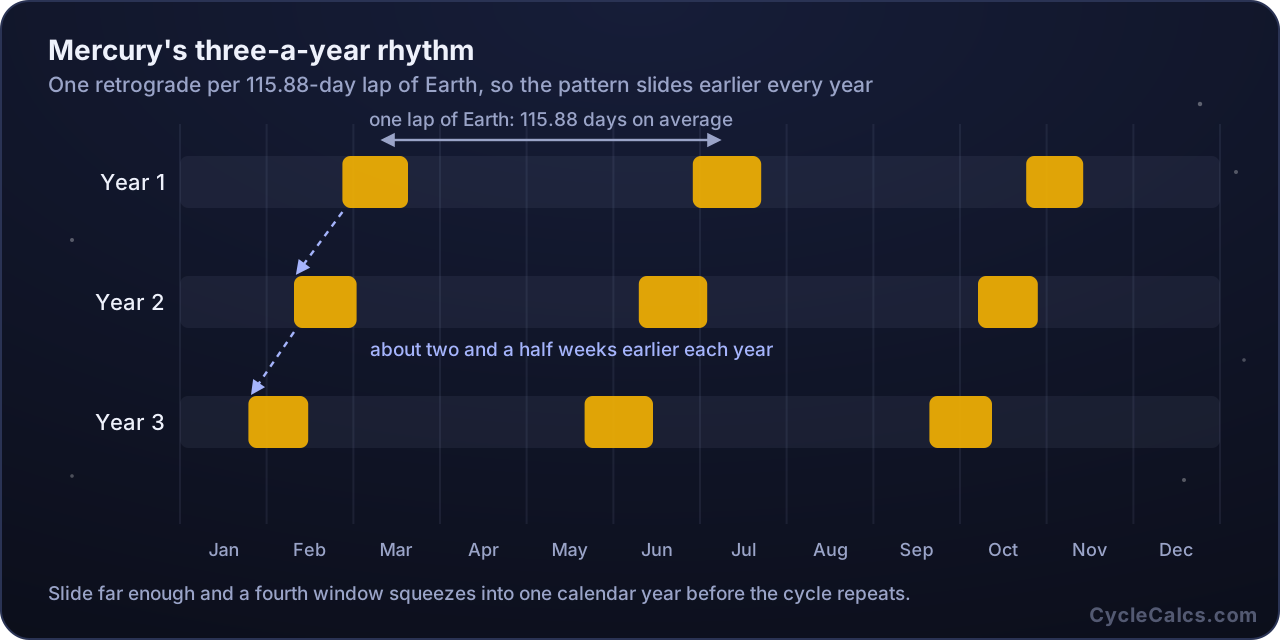
Mercury retrogrades run on one of the most dependable schedules in the sky. Mercury laps Earth every 115.88 days on average (the synodic period), and every lap produces one retrograde window as Mercury overtakes us on the inside. Three laps come to just under 348 days, about 18 days short of a full year, so most years hold three retrogrades and the whole pattern slides about 18 days earlier each year. Slide far enough and a fourth window opens inside a single calendar year, as happens in 2029. The window lengths vary too, from 20 to 24 days in this table, because Mercury's orbit is markedly elliptical and the overtaking geometry differs from lap to lap.
Why the dates you read elsewhere differ by a day
A station is one instant, the same everywhere on Earth; the calendar date it lands on depends on where you stand. Take the station of December 22, 2029, at 05:51 UTC: in London that is December 22, but on the US West Coast (UTC-8 in winter) the clock still reads the evening of December 21. Lists that publish bare dates have quietly rounded in some time zone, usually US Eastern, which is why two accurate sources can disagree by a day. The table above sidesteps the problem: it shows the exact instants and your browser converts them to your own clock.
What Mercury is actually doing (and what you can see)
Every Mercury retrograde tells the same three-act story. As the window opens, Mercury is ending an evening apparition: it hangs very low in twilight after sunset, sinking closer to the Sun each night. Near the middle of the window it passes inferior conjunction, crossing nearly between Earth and the Sun, invisible in the glare, and switching sides. By the second station it has re-emerged as a morning object, climbing a little higher before dawn each day. The retrograde loop and the evening-to-morning flip are the same event seen two ways: both happen because Mercury is overtaking Earth on the inside track.
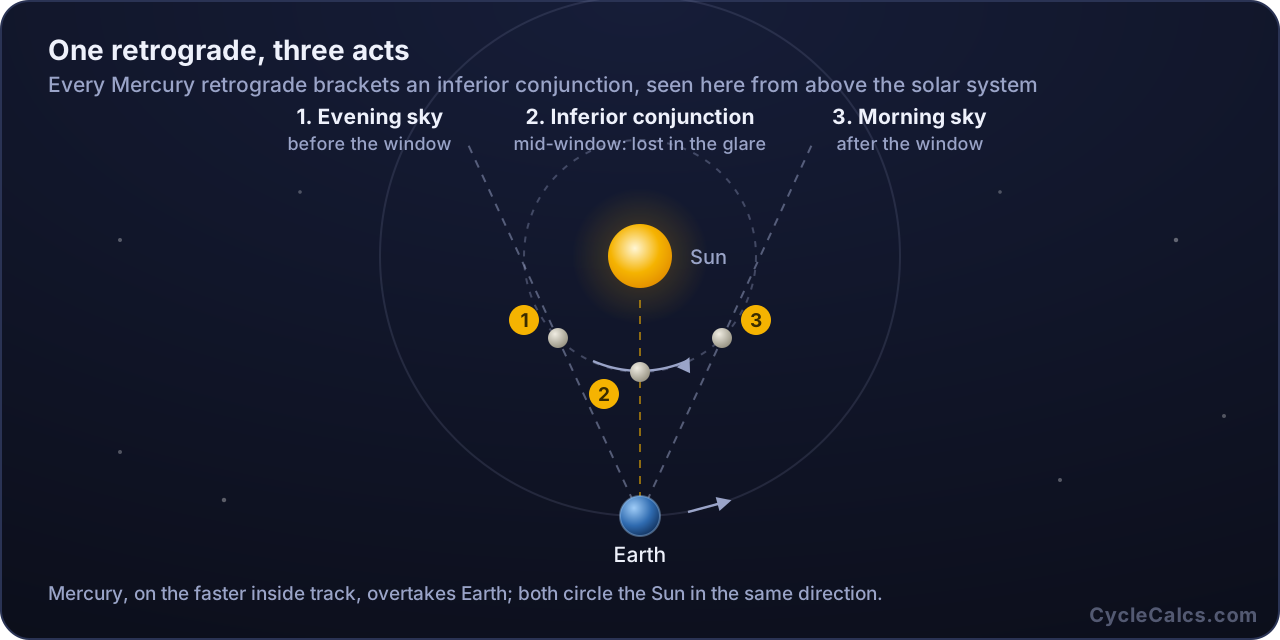
For actually spotting the planet, the retrograde weeks are the worst time to try: Mercury spends most of them inside the Sun's glare. The rewarding views come near greatest elongation, several weeks before or after each inferior conjunction, when Mercury stands farthest from the Sun in twilight. The Mercury page lists each upcoming apparition with dates and altitudes, and Today in the Sky says whether Mercury is observable from your location tonight.
Real motion, no effect
It is worth being precise about what a Mercury retrograde is, because so much is claimed for it. The planet never stops or reverses; it runs its 88-day orbit exactly as it always has, at all times at least about 77 million kilometers from Earth. What reverses is the apparent drift of a dot of light against background stars, an artifact of viewing one moving planet from another. The drift's direction has no physical channel to electronics, contracts, or travel plans, and careful checks find no correlation. Astronomy can tell you, to the minute, when the illusion begins and ends; what it cannot do is make the illusion mean something. The retrograde motion lesson shows the geometry interactively, sightline by sightline.
Frequently asked questions
How often is Mercury retrograde?
On average every 115.88 days, the time Mercury takes to lap Earth. That puts three retrogrades in most calendar years and occasionally four (2029 opens four windows), more often than any other planet.
How long does Mercury retrograde last?
About three weeks. Across the table on this page the windows run from 20 to 24 days, station to station. The variation comes from Mercury's markedly elliptical orbit: the loops differ depending on where along its orbit Mercury overtakes Earth.
When is the next Mercury retrograde?
Mercury is retrograde October 24, 2026 to November 13, 2026, and then February 9, 2027 to March 3, 2027, station to station. The table above has every window with exact instants in your time zone and highlights whichever is under way.
Why do Mercury retrograde dates differ by a day between sources?
Each station is a single instant, and calendars disagree about which date that instant belongs to. A station at 06:47 UTC falls on that date in Europe but on the previous evening in the western United States. Published lists rarely say which time zone they rounded in; this page shows the exact instants and converts them to yours.
Can I see Mercury during its retrograde?
At the edges of the window, yes: as the retrograde begins Mercury is usually very low in evening twilight, and by the end it has re-emerged low in the morning sky. Around the middle it passes inferior conjunction, nearly between Earth and the Sun, and is lost in the glare entirely. The comfortable views come near greatest elongation, a few weeks before or after the inferior conjunction at the window's middle.
Does Mercury retrograde affect technology or daily life?
No. Mercury never stops, never reverses, and never comes closer than about 77 million kilometers; the backward drift is a sightline effect of a faster inner planet overtaking Earth. There is no physical mechanism by which the apparent direction of a planet's drift could influence electronics or communication, and no statistical evidence that it does. The belief belongs to astrology, not astronomy.
Keep exploring: which planets are retrograde right now, the retrograde motion lesson for the geometry, Mercury's apparitions and cycles, and the synodic rhythm that sets the 115.88-day beat.
Cite this page
CycleCalcs, "Mercury Retrograde Dates 2025-2031: Exact Times", CycleCalcs LLC, https://www.cyclecalcs.com/mercury-retrograde.html (add your access date).
Every computed value on this page is public domain: CycleCalcs asserts no copyright in calculated astronomical facts and dedicates any such right to CC0, stated here. Quote the numbers freely, with or without credit. Conventions and sources: the engine and sources.