Mercury
Mercury is the smallest of the eight planets, just 4,879 km across, and the innermost, circling the Sun every 88 days at an average distance of 58 million km. That inside track is exactly what makes it elusive: seen from Earth, Mercury never wanders far from the Sun's glare, so it only ever shows itself low in twilight, shortly after sunset or shortly before sunrise. Of the five planets visible without equipment, it is the one most people have never knowingly seen, which makes finally spotting it feel like a genuine accomplishment.
Mercury returns to view several times a year, alternating between the evening and morning sky. The live panel below shows where it stands right now from your location, and the tables list its upcoming apparitions and greatest elongations; everything is computed in your browser.
On this page
Mercury is the evening star until its conjunction on November 4, 2026, visible low in the west after sunset. Its next greatest elongation, the widest and best-placed point of this apparition, comes on October 12, 2026 (25° from the Sun, evening sky).
Exact rise and set times for your location are in the live panel below; the apparition table maps every morning-star and evening-star window for the next few years.
A day on Mercury is a study in extremes. The planet turns once every 58.6 Earth days, locked in a 3:2 rhythm with its orbit, yet the time from one sunrise to the next stretches to about 176 Earth days, two full Mercury years. That gap between the spin and the sunrises is the difference between a sidereal and a solar day.
Mercury tonight from your location
Enter coordinates
This panel computes tonight's position and rise and set times for Mercury in your browser, and it needs JavaScript to run. The rest of this page, including the calendars and event dates below, is fully readable without it. For a live all-sky view, open the Sky Map or Today in the Sky.
Everything is computed on your device. Tapping "Use my location" names your city from a place index served with this page. Times appear in your device's time zone.
Mercury at a glance
| Mean distance from the Sun | 57.9 million km (0.39 AU) |
|---|---|
| Distance from Earth | 77.3 to 221.9 million km |
| Equatorial diameter | 4,879 km (0.38 of Earth's, the smallest planet) |
| Mass | 3.30 × 10²³ kg (0.055 of Earth's) |
| Surface gravity | 3.70 m/s² (0.38 of Earth's) |
| Escape velocity | 4.3 km/s |
| Rotation period (sidereal) | 58.6 days, locked 3:2 with its orbit |
| Day length (sunrise to sunrise) | 176 Earth days, two Mercury years |
| Orbital period | 88.0 days |
| Synodic period (Earth laps it) | 115.9 days |
| Axial tilt | 0.03° (essentially none) |
| Surface temperature | about −180 °C at night to +430 °C in daytime |
| Atmosphere | a vanishingly thin exosphere (oxygen, sodium, hydrogen, helium, potassium) |
| Moons | none |
| Rings | none |
| Brightest apparent magnitude | −2.4 |
Physical data: NASA NSSDCA Mercury Fact Sheet (temperature extremes from NASA Science). Orbital period: the mean sidereal value from Meeus, Astronomical Algorithms, ch. 31.
Morning star or evening star?
Because Mercury orbits closer to the Sun than Earth does, it never strays far from the Sun in our sky. It swings from one side of the Sun to the other, appearing as an evening star in the west after sunset, then as a morning star in the east before dawn. Each switch happens at a conjunction, when it passes nearly in front of or behind the Sun, and for a stretch around every conjunction date Mercury is too close to the Sun to see at all. Dates are in Universal Time.
| Appears as | From | Until |
|---|---|---|
| Evening star (west, after sunset) | Now | Nov 4, 2026 |
| Morning star (east, before sunrise) | Nov 4, 2026 | Jan 1, 2027 |
| Evening star (west, after sunset) | Jan 1, 2027 | Feb 18, 2027 |
| Morning star (east, before sunrise) | Feb 18, 2027 | Apr 28, 2027 |
| Evening star (west, after sunset) | Apr 28, 2027 | Jun 23, 2027 |
| Morning star (east, before sunrise) | Jun 23, 2027 | Aug 11, 2027 |
| Evening star (west, after sunset) | Aug 11, 2027 | Oct 19, 2027 |
| Morning star (east, before sunrise) | Oct 19, 2027 | Dec 11, 2027 |
| Evening star (west, after sunset) | Dec 11, 2027 | Feb 2, 2028 |
| Morning star (east, before sunrise) | Feb 2, 2028 | Apr 11, 2028 |
| Evening star (west, after sunset) | Apr 11, 2028 | Jun 2, 2028 |
| Morning star (east, before sunrise) | Jun 2, 2028 | Jul 25, 2028 |
| Evening star (west, after sunset) | Jul 25, 2028 | Oct 2, 2028 |
| Morning star (east, before sunrise) | Oct 2, 2028 | Nov 20, 2028 |
| Evening star (west, after sunset) | Nov 20, 2028 | Jan 16, 2029 |
| Morning star (east, before sunrise) | Jan 16, 2029 | Mar 26, 2029 |
| Evening star (west, after sunset) | Mar 26, 2029 | May 12, 2029 |
| Morning star (east, before sunrise) | May 12, 2029 | Jul 9, 2029 |
| Evening star (west, after sunset) | Jul 9, 2029 | Sep 15, 2029 |
| Morning star (east, before sunrise) | Sep 15, 2029 | Oct 30, 2029 |
| Evening star (west, after sunset) | Oct 30, 2029 | Dec 31, 2029 |
| Morning star (east, before sunrise) | Dec 31, 2029 | Mar 9, 2030 |
| Evening star (west, after sunset) | Mar 9, 2030 | Apr 23, 2030 |
| Morning star (east, before sunrise) | Apr 23, 2030 | Jun 24, 2030 |
| Evening star (west, after sunset) | Jun 24, 2030 | Aug 29, 2030 |
| Morning star (east, before sunrise) | Aug 29, 2030 | Oct 11, 2030 |
| Evening star (west, after sunset) | Oct 11, 2030 | Dec 15, 2030 |
| Morning star (east, before sunrise) | Dec 15, 2030 | Feb 20, 2031 |
| Evening star (west, after sunset) | Feb 20, 2031 | Apr 4, 2031 |
| Morning star (east, before sunrise) | Apr 4, 2031 | Jun 8, 2031 |
| Evening star (west, after sunset) | Jun 8, 2031 | Aug 12, 2031 |
| Morning star (east, before sunrise) | Aug 12, 2031 | Sep 24, 2031 |
| Evening star (west, after sunset) | Sep 24, 2031 | Nov 30, 2031 |
| Morning star (east, before sunrise) | Nov 30, 2031 | Feb 2, 2032 |
| Evening star (west, after sunset) | Feb 2, 2032 | Mar 17, 2032 |
| Morning star (east, before sunrise) | Mar 17, 2032 | May 23, 2032 |
| Evening star (west, after sunset) | May 23, 2032 | Jul 23, 2032 |
| Morning star (east, before sunrise) | Jul 23, 2032 | Sep 5, 2032 |
| Evening star (west, after sunset) | Sep 5, 2032 | beyond this table |
How to see Mercury
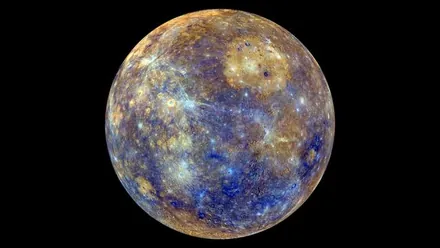
Mercury only ever appears in twilight, and the viewing windows are the greatest elongations in the table above. An elongation is the angle between a planet and the Sun in our sky; because Mercury orbits inside Earth's orbit, that angle tops out between roughly 18 and 28 degrees, set by where the planet sits on its stretched path. At an evening elongation, look low above the western horizon as the sunset glow fades; at a morning one, low in the east before dawn. For northern observers, evening showings are best in spring and morning ones in autumn (reversed for southern observers), when the ecliptic, the line the Sun and planets follow across the sky, meets the horizon most steeply.
The single most important piece of equipment is a flat horizon: Mercury never climbs high before it sets or the sky brightens, so a treeline or bank of haze in the wrong direction hides it completely. Binoculars make the hunt far easier, provided you never raise them to sweep until the Sun is entirely below the horizon. Then scan the twilight for a single steady point of light; once found, Mercury is usually easy to hold with the naked eye.
Do not wait for a dark sky, because Mercury almost never appears in one; by the time twilight ends it has usually set, and at dawn the sky brightens around it. A small telescope shows a tiny disk, about 5 to 13 arcseconds across (tiny: the full Moon spans roughly 1,900 arcseconds), running through phases like a miniature Moon, from gibbous to a thin crescent as it swings near us. Surface detail is beyond backyard equipment, and the low altitude keeps the image churning; the photo on this page is a spacecraft view, not what the eyepiece shows.
Mercury's cycles
Mercury's synodic period of 115.88 days is the clock behind every apparition, the time it takes to lap Earth and line up with the Sun again. Mercury circles the Sun in 87.97 days, but Earth keeps moving too, so the meeting cycle runs about a month longer than the orbit itself. Our synodic vs sidereal lesson untangles the two clocks, and the Synodic Period Calculator derives the 115.88 days from the two orbits. Each lap brings one evening and one morning apparition, and at about three laps a year that means six or seven greatest elongations, more viewing windows than any other planet offers.
Mercury also holds one of the solar system's tidiest orbital locks, a true 3:2 spin-orbit resonance. It rotates once every 1,407.6 hours, about 59 days, exactly two thirds of its 88-day year, so it completes three spins for every two orbits, held in step by the Sun's tidal grip on its slightly lopsided body. A solar day on Mercury, sunrise to sunrise, therefore lasts about 176 Earth days, two full Mercury years. It is a cousin of the 1:1 lock that keeps one face of the Moon turned toward Earth, explained in our tidal locking lesson.
The same overtaking cycle makes Mercury the sky's most frequent backtracker. Around each inferior conjunction, the moment it passes between Earth and the Sun, Mercury appears to slide backward against the stars for a few weeks, so it turns retrograde three times in most years and occasionally four, more often than any other planet. Nothing about its orbit changes; it is pure perspective, and the retrograde lesson shows the geometry in motion. To find Mercury tonight, start with Today's Sky, or plot it over your own horizon with the Sky Map.
To see where these periods fit among everything else that repeats overhead, read the full the Mercury synodic period profile, or find it sorted by length in the complete cycles list.
What's next for Mercury
These are the dates that shape each apparition: greatest elongations (the best viewing), and the conjunctions when Mercury switches between the morning and evening sky. Dates are in Universal Time.
| Date | Event |
|---|---|
| Oct 12, 2026 | Greatest evening elongation: 25° from the Sun, the best evening view of this apparition |
| Nov 4, 2026 | Inferior conjunction: passes between Earth and the Sun, leaving the evening sky for the morning sky |
| Nov 20, 2026 | Greatest morning elongation: 20° from the Sun, the best pre-dawn view of this apparition |
| Jan 1, 2027 | Superior conjunction: passes behind the Sun, leaving the morning sky for the evening sky |
| Feb 3, 2027 | Greatest evening elongation: 18° from the Sun, the best evening view of this apparition |
| Feb 18, 2027 | Inferior conjunction: passes between Earth and the Sun, leaving the evening sky for the morning sky |
| Mar 17, 2027 | Greatest morning elongation: 28° from the Sun, the best pre-dawn view of this apparition |
| Apr 28, 2027 | Superior conjunction: passes behind the Sun, leaving the morning sky for the evening sky |
| May 28, 2027 | Greatest evening elongation: 23° from the Sun, the best evening view of this apparition |
| Jun 23, 2027 | Inferior conjunction: passes between Earth and the Sun, leaving the evening sky for the morning sky |
| Jul 15, 2027 | Greatest morning elongation: 21° from the Sun, the best pre-dawn view of this apparition |
| Aug 11, 2027 | Superior conjunction: passes behind the Sun, leaving the morning sky for the evening sky |
Frequently asked questions
Why is Mercury so hard to see?
Mercury orbits inside Earth's orbit, only about 58 million km from the Sun on average, so from our vantage point it never appears more than about 28 degrees from the Sun in the sky. That keeps it trapped in twilight: it sets soon after the Sun in the evening, or rises only shortly before it in the morning, and it always sits low over the horizon, where haze and obstructions are worst. Brightness is not the problem; the challenge is timing and a clear horizon.
How long is a day on Mercury?
It depends which day you mean. Mercury rotates once on its axis every 1,407.6 hours, about 59 Earth days. But a solar day, noon to noon for someone standing on the surface, lasts about 176 Earth days, because the slow spin is locked in a 3:2 resonance with the fast 88-day orbit: three rotations for every two trips around the Sun. One Mercury solar day therefore spans two complete Mercury years.
Is Mercury the hottest planet?
No. Mercury's daytime side reaches roughly 430 degrees Celsius, but with almost no atmosphere to hold the heat, the night side plunges to about minus 180 degrees Celsius. Venus, wrapped in a thick carbon dioxide atmosphere, stays hotter than Mercury's daytime peak across its whole surface, day and night. Mercury's real record is the largest temperature swing of any planet in the solar system.
Does Mercury have any moons or rings?
No. Mercury has zero moons and no rings. It orbits deep in the Sun's gravity, where the zone in which a moon could circle Mercury stably is very small; anything wandering there tends to be pulled away by the Sun or lost. Of the eight planets, only Mercury and Venus travel with no moon at all.
How often is Mercury in retrograde?
About three times a year, and occasionally four. Every 115.88 days Mercury laps Earth on its faster inside orbit, and for a few weeks around that pass it appears to drift backward against the background stars before resuming its normal eastward march. It is a line-of-sight effect of the faster planet sweeping past us; Mercury itself never stops or reverses.
Is Mercury a morning star or an evening star right now?
Mercury is currently an evening star, low in the west after sunset, and it stays on that side of the Sun until its conjunction on November 4, 2026, when it switches to the morning sky. The apparition table on this page lists every switch for the next few years.
Keep exploring
- Mercury Morning Star Tracker: is Mercury visible right now, live, with the whole 116-day cycle on a dial
- Sky Map: plot Mercury over your own horizon during a twilight window
- Mercury Retrograde Dates: every upcoming window with exact station times
- Retrograde Motion lesson: why Mercury backs up more often than any other planet
- Synodic vs Sidereal lesson: the 88-day orbit and the 116-day sky cycle, untangled
- Synodic Period Calculator: derive the Mercury-Earth meeting cycle yourself
- Venus: the other inside planet, and a far easier twilight target