The Metonic Cycle: 19 Years, 235 Months, One Repeating Sky
Nineteen years is a strangely lucky number for the Moon. In that span the Moon completes almost exactly 235 of its phase cycles, so a full moon that falls on your birthday this year will fall on your birthday again 19 years from now. The ancient Greeks noticed this, the Hebrew calendar is built on it, and the date of Easter still leans on it. Below, watch 235 months and 19 years race down the same timeline and land together.
On this page
The Metonic cycle is the near-coincidence that 19 tropical years (6,939.60 days) almost exactly equal 235 synodic months (6,939.69 days). Because the two clocks so nearly agree, the Moon's phases fall on almost the same calendar dates every 19 years. The 235 months split as 12 x 12 + 7 x 13, twelve ordinary years plus seven with a leap month. The match is off by only about 2 hours per cycle, so the dates slip by a day roughly every 219 years.
Nineteen years, two hundred thirty-five months
The problem the Metonic cycle solves is an old and awkward one: the month and the year do not fit together. One synodic month, from new moon to new moon, is 29.53 days. One tropical year, from spring equinox to spring equinox, is 365.24 days. Divide one into the other and you get about 12.37 months in a year. That leftover 0.37 of a month is the whole trouble. It means the Moon's phases cannot line up with the calendar year, because a year is not a whole number of months. Each year, a given phase falls about 11 days earlier than the year before.
Meton of Athens, working around 432 BC, found the elegant escape. Wait not one year but nineteen, and the leftovers add up. Nineteen years hold 19 times 12.37, which comes to 235 months, a whole number at last. Line up 235 synodic months and 19 tropical years and they end within a couple of hours of each other, so the Moon returns to the same phase on the same date it started.

You can see the same thing on the calendar view above. Every full moon of 19 years is plotted by its date across the year and by which year it falls in. The full moons drift steadily to the left, about 11 days earlier each year, until they wrap around, and after 235 of them the chosen full moon has arrived back on the very date it began.
Seven leap months and the Golden Number
There is a beautiful piece of arithmetic hidden inside the number 235. If every year had 12 months, 19 years would hold only 228 months, seven short of 235. So seven of the nineteen years must carry a thirteenth month, a leap month, to make up the difference. The bookkeeping is exact: 12 x 12 + 7 x 13 = 235. Twelve ordinary years of twelve months, seven leap years of thirteen.
This is not just a curiosity. It is the engine of the Hebrew calendar, which is a true lunar-and-solar calendar: it counts months by the Moon but keeps Passover in spring by the Sun. To do both, it inserts a leap month (a second Adar) in exactly seven years out of every nineteen, on the Metonic schedule. Without those seven leap months, the lunar months would slide backward through the seasons, the way the months of the purely lunar Islamic calendar do.
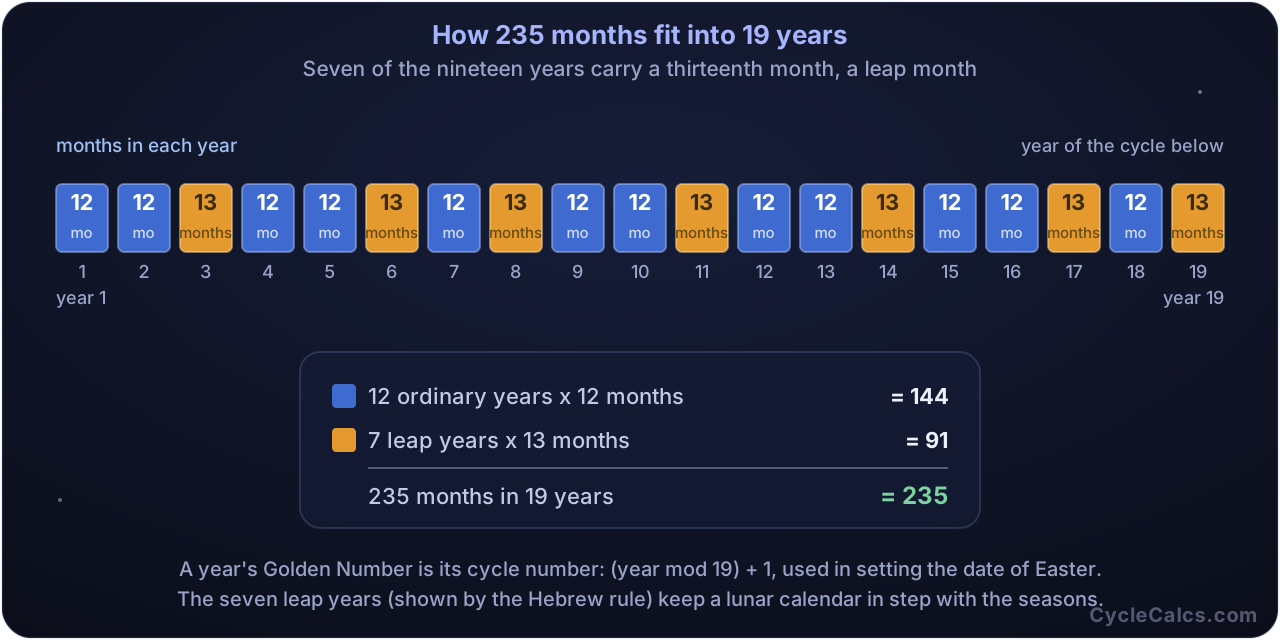
A year's place in the cycle, numbered 1 through 19, is called its Golden Number. You find it by dividing the year by 19 and adding 1 to the remainder: the Golden Number is (year mod 19) + 1. For the year 2026, 2026 divided by 19 leaves a remainder of 12, so the Golden Number is 13. Because the Moon repeats on the Metonic cycle, medieval calendar-makers used the Golden Number to look up the phase of the Moon for any year, and the 19-year cycle it marks still underlies the computus, the rule that fixes Easter as the first Sunday after the ecclesiastical full moon of spring, a calendar approximation of the real one.
Close, but not exact
The Metonic match is wonderful, but it is not perfect, and honesty about the gap is part of understanding it. Nineteen tropical years come to 6,939.60 days; 235 synodic months come to 6,939.69 days. The difference is 0.09 of a day, about 2 hours. So each time the cycle turns, the Moon's phases arrive about 2 hours later than exactly 19 years before.
Two hours is tiny, but it accumulates. It takes roughly 219 years, about 11 or 12 cycles, for those 2-hour slips to add up to a full day, and after many centuries the phase dates drift noticeably. This slow error is why the simple 19-year rule built into the older Julian Easter gradually fell out of step with the real Moon, and why the Gregorian reform of 1582 added small corrections to the computus to nudge it back. The Metonic cycle is a superb approximation, not an eternal law.
The Metonic cycle is not the Saros
It is easy to confuse the Metonic cycle with the other famous lunar cycle, the Saros, but they are different lengths and they do different jobs. The Metonic cycle is 235 synodic months, about 19 years, and it returns the Moon's phases to the same calendar dates. The Saros is 223 synodic months, about 18 years and 11 days, and it returns eclipses, because 223 months also happen to equal a whole number of the other two lunar rhythms, the return to the same node and the same distance. Same phase alone gives you the Metonic cycle; same phase plus same node plus same distance gives you the Saros.
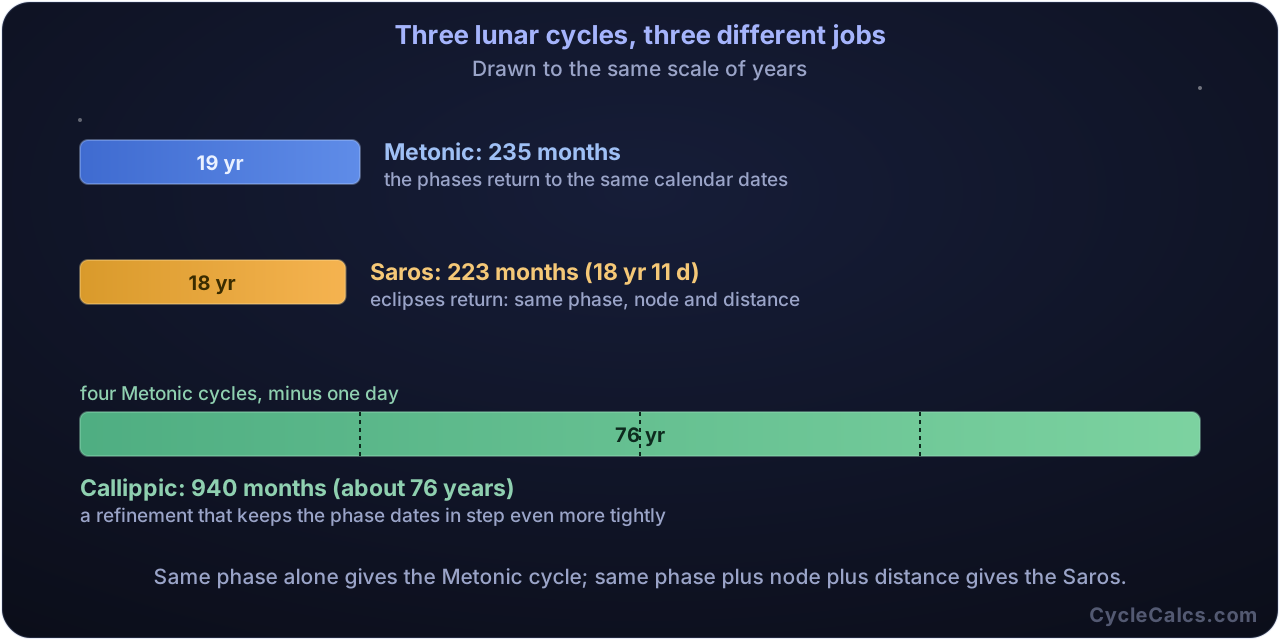
There is also a refinement of the Metonic cycle worth knowing. The 19-year Metonic calendar was reckoned in practice as a round 6,940 days, which runs a little long against the Sun. About a century after Meton, the astronomer Callippus grouped four of these cycles into 76 years and dropped a single day, giving a mean year of exactly 365.25 days and holding the Moon's phases to the calendar even more tightly. This Callippic cycle of 940 months became the backbone of Greek astronomical timekeeping. You can compare all of these on the cycles by length page.
Frequently asked questions
What is the Metonic cycle?
The Metonic cycle is the near-coincidence that 19 tropical years, about 6,939.60 days, almost exactly equal 235 synodic months, about 6,939.69 days. Because those two clocks so nearly agree, the Moon's phases fall on almost the same calendar dates every 19 years. It is named for the Greek astronomer Meton of Athens, who described it around 432 BC.
Why do the Moon's phases repeat every 19 years?
Because 235 synodic months add up to almost exactly 19 years. A single year holds about 12.37 lunar months, which does not divide evenly, so phases drift across the calendar from one year to the next. But over 19 years the fractional months build back up to a whole number, 235, so the pattern of phases lands back on nearly the same dates it started on.
What is the Golden Number?
The Golden Number is a year's position within the 19-year Metonic cycle, calculated as the year divided by 19 with 1 added to the remainder, that is (year modulo 19) plus 1. It runs from 1 to 19. Because the Moon repeats on the cycle, the Golden Number was used for centuries to find the approximate dates of new and full moons, and the 19-year cycle it belongs to still underlies the calculation of the date of Easter.
Is the Metonic cycle the same as the Saros cycle?
No. The Metonic cycle is 235 synodic months, about 19 years, and it makes the Moon's phases recur on the same calendar dates. The Saros cycle is 223 synodic months, about 18 years and 11 days, and it makes eclipses recur because it also brings the Moon back to the same node and the same distance. They are different lengths and describe different things: phases on the calendar versus the return of eclipses.
Sources & further reading
- timeanddate: The Metonic Cycle: a plain-language overview of the 19-year cycle and its uses.
- NASA Eclipse Web Site: Saros: the eclipse cycle, for contrast with the Metonic.
- NASA: Earth's Moon: the synodic month and the Moon's motion.
- Jean Meeus, Astronomical Algorithms (Willmann-Bell): the standard reference for the lunar months and calendar cycles.
See how these figures are computed on the methodology and sources page.
Keep exploring
The Moon
A 12-month phase calendar to watch the 19-year rhythm play out, plus tonight’s phase.
InteractiveSynodic vs Sidereal Periods
Where the 29.53-day synodic month comes from, the building block of the 235-month cycle.
InteractiveEclipses & the Saros
The Metonic cycle's cousin: 223 months that bring eclipses, not just phases, back around.
InteractiveMoon Phases
The 29.5-day phase cycle whose 235 repeats are what the Metonic cycle counts.
ReferenceCycles by Length
The Metonic, Saros and Callippic cycles alongside every other rhythm of the sky.
ReferenceThe numbers and where we stand: the Metonic cycle
The exact 6,939.69-day figure, where the current cycle stands, and the dates the phases next repeat.
ReferenceThe numbers and where we stand: the Callippic cycle
Four Metonic cycles minus one day: 27,758.75 days, 940 synodic months, and where we sit in the current 76-year run.