The Galactic Year: One Orbit of the Milky Way
The Sun does not sit still. Carrying the Earth and every other planet with it, it orbits the center of the Milky Way once every 230 million years or so. That single trip is the galactic year. Drag the slider or press Play to ride one lap and see where the Sun was when life on Earth looked very different.
One galactic year, the time the Sun takes to orbit the center of the Milky Way once, is about 225 to 250 million years (commonly rounded to 230 million). The Sun lies roughly 26,000 light-years from the center and moves at about 230 kilometers per second. In its 4.6-billion-year life it has made roughly 20 laps; one lap ago, the first dinosaurs were appearing.
What the galactic year is
Just as the Earth circles the Sun once a year, the Sun circles the heart of the Milky Way once a galactic year. Our galaxy is a flat, spinning disk of a few hundred billion stars, more than a hundred thousand light-years across, with a bright bulge at its center hiding a supermassive black hole. The Sun lives out toward the suburbs, about 26,000 light-years from the middle, on the inner edge of a spiral feature called the Orion Arm.
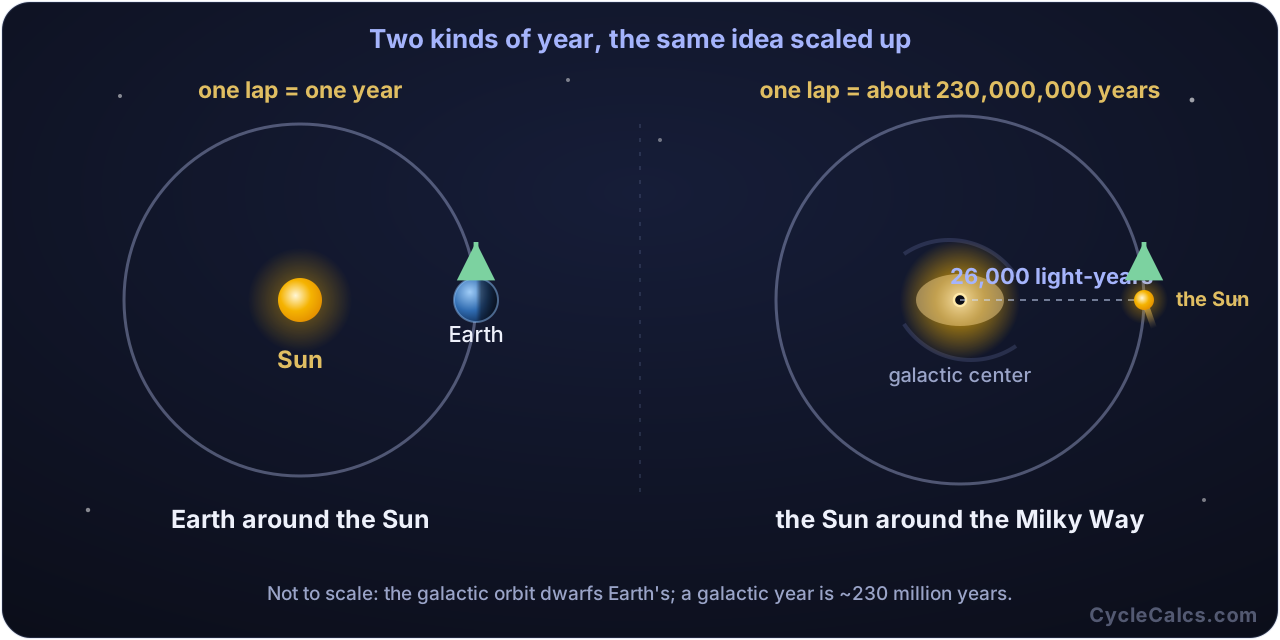
Out there the Sun sweeps along at roughly 230 kilometers a second, fast enough to cross the United States in under twenty seconds. Yet the circle it has to complete is so vast that a single lap takes somewhere around 230 million years. That whole journey is one galactic year, the longest cycle on this site, longer than the entire age of the dinosaurs.
The last galactic year on Earth
Because the lap is so long, the whole sweep of life as we tend to picture it fits inside the most recent one. Set the slider to the start, one galactic year ago, and the Earth is in the Late Triassic: the first dinosaurs and the first true mammals are appearing, and every continent is fused into the supercontinent Pangaea. As the Sun rounds the galaxy, Pangaea breaks apart, the great dinosaurs rise and then vanish in the asteroid impact 66 million years ago, mammals spread, primates emerge, and only in the final fraction of the lap do humans appear. The Sun has now completed one full trip around the galaxy since those first dinosaurs walked, having seen all of that go by just once. Because the orbit is not a tidy closing circle, it comes back to roughly the same distance from the center rather than to the very same point in the galaxy.
About twenty laps in a lifetime
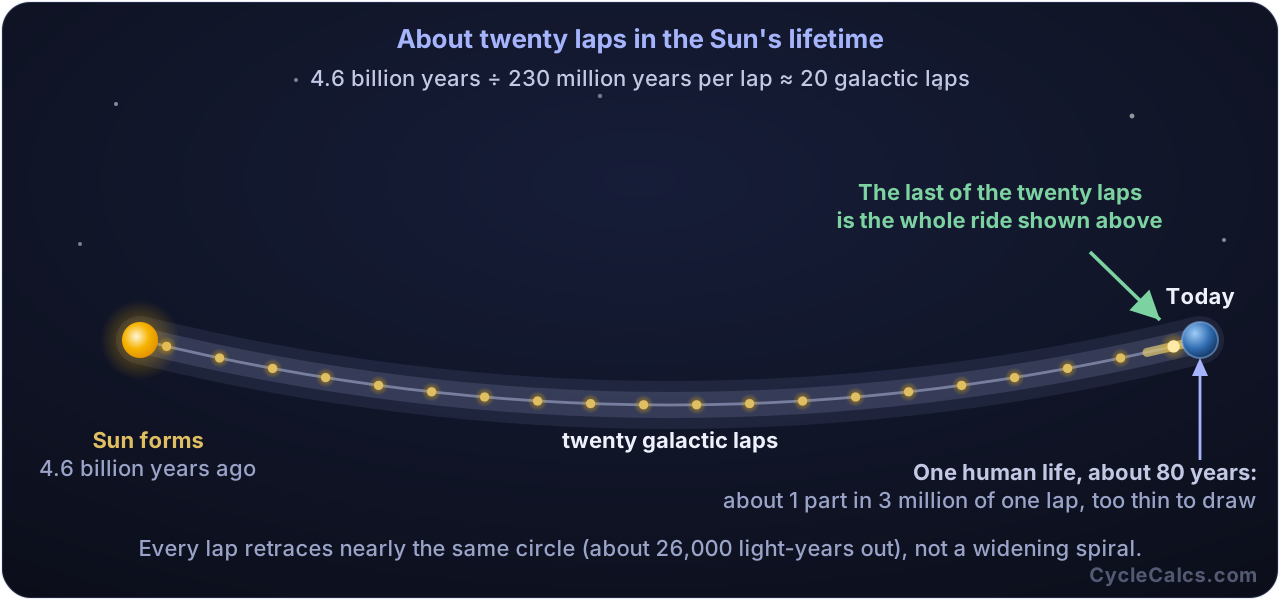
The Sun and its planets are about 4.6 billion years old. Divide that by a 230-million-year lap and you get roughly 20 galactic years: the Sun has circled the Milky Way about twenty times since it first lit up. A comfortable human life of 80 years, by comparison, is around a third of a millionth of a single lap. You can see this longest of cycles set beside all the others, from the 24-hour day on up, on the Astronomical Cycles page, and find today's position in each on the live cosmic clock.
How well do we know it?
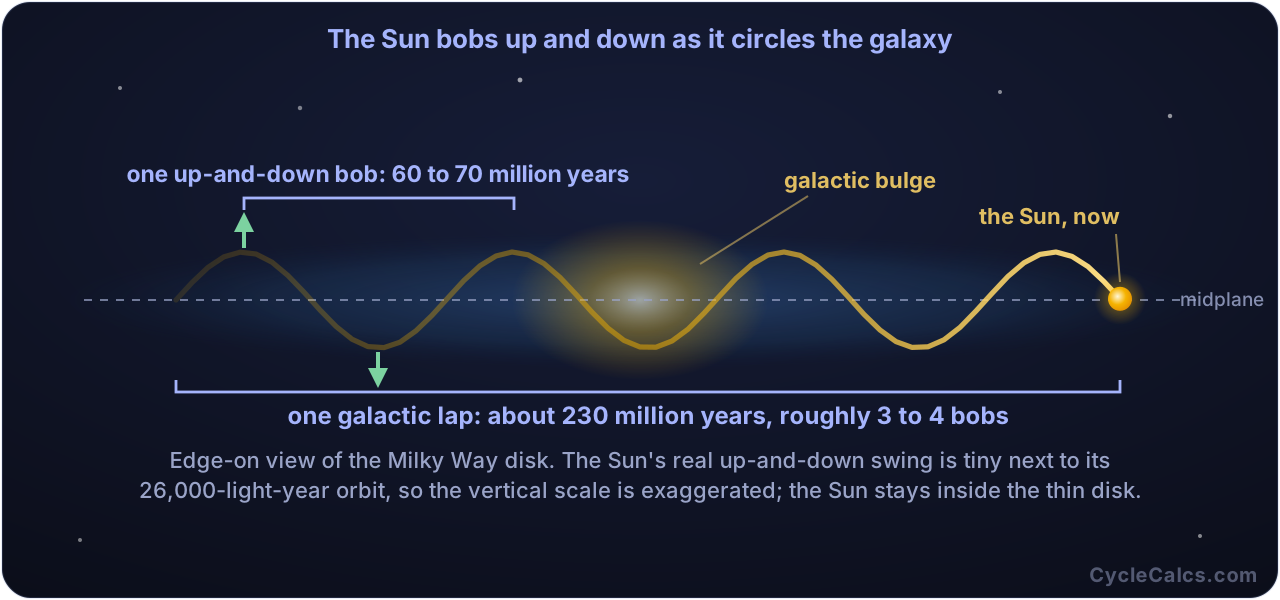
The galactic year is not a precise number. Estimates run from about 225 to 250 million years, because the exact distance to the galactic center is hard to measure and the Sun's path is not a tidy closed circle. As it orbits, the Sun also bobs gently up and down through the disk, rising above the midplane and sinking back roughly every 60 to 70 million years, like a horse on a very slow carousel. So the figure of 230 million years is a good round average for a real, if slightly wandering, journey, not a clock that ticks to the second.
Frequently asked questions
How long is a galactic year?
A galactic year is the time the Sun takes to orbit the center of the Milky Way once, about 225 to 250 million years, commonly rounded to 230 million. The Sun lies roughly 26,000 light-years from the center and travels at about 230 kilometers per second. The exact figure is uncertain because the center is hard to pin down and the Sun's path is not a perfect circle.
How many times has the Sun orbited the galaxy?
About 20 times. The Sun and the Earth are roughly 4.6 billion years old, and at one lap every 230 million years that comes to roughly 20 galactic years since they formed. Each lap is so long that the most recent one began when the first dinosaurs were appearing.
What was happening on Earth one galactic year ago?
One galactic year ago, about 230 million years in the past, the Earth was in the Late Triassic. The first dinosaurs and the first true mammals were just appearing, and all the land was joined in the single supercontinent Pangaea. Everything from the rise and fall of the dinosaurs to the appearance of humans has happened within this one trip around the galaxy.
Sources & further reading
- NASA, Solar System Exploration: notes the solar system takes about 230 million years to orbit the galactic center.
- NASA Goddard, Imagine the Universe: The Milky Way Galaxy: the Sun's trip around the galactic center and our place in the disk.
- NASA Goddard, Imagine the Universe: The Milky Way: the galaxy's structure and the Sun's roughly 8-kiloparsec distance from the center.
- ESA, Gaia mission: the survey mapping stellar positions and motions across the Milky Way.
- Jean Meeus, Astronomical Algorithms: the standard reference for the positional-astronomy calculations behind this site.
See how these figures are computed on the methodology and sources page.
Keep exploring
Where Are We Now
Today's position in every cycle, from the turning day to this galactic year.
ReferenceAstronomical Cycles
Every major cycle from a day to a galactic year, on one zoomable timeline.
InteractiveGrand-Cycle Timeline
The long rhythms of the sky laid out across deep time.
InteractivePrecession
The roughly 25,800-year wobble of Earth's axis, the Great Year.