What Is That in the Sky?
You saw a light in the sky and want to know what it was. Tell the tool which direction you were facing, roughly how high above the horizon it stood, and when. It works out where every bright planet, the Moon and the brightest stars actually were in your sky at that moment, ranks the ones that fit what you describe, and explains each in plain language. It answers for tonight and for a night last week, which is the one thing a point-your-phone app cannot do.
On this page
Describe what you saw
Tell us more (optional): color, twinkle and brightness
Everything is computed in your browser. Naming your city and searching for one are both answered from a place index served with this page. Until you set a location the tool uses a default near 40°N and says so, because the direction and height of everything depend on where you stand.
The short version, for the most common sightings: a dazzling, steady point low in the west after sunset, or low in the east before dawn, is almost always the planet Venus. A bright, steady point higher up in the evening is usually Jupiter. A steady reddish point is Mars or one of the red stars Antares, Betelgeuse and Aldebaran. A light that drifts silently across the sky in a minute or two is a satellite or the International Space Station; one that blinks or shows colored lights is an aircraft. A point that streaked and vanished within a second was a meteor.
How the identifier works
For the models, accuracy and data behind these figures, see the methodology and sources page.
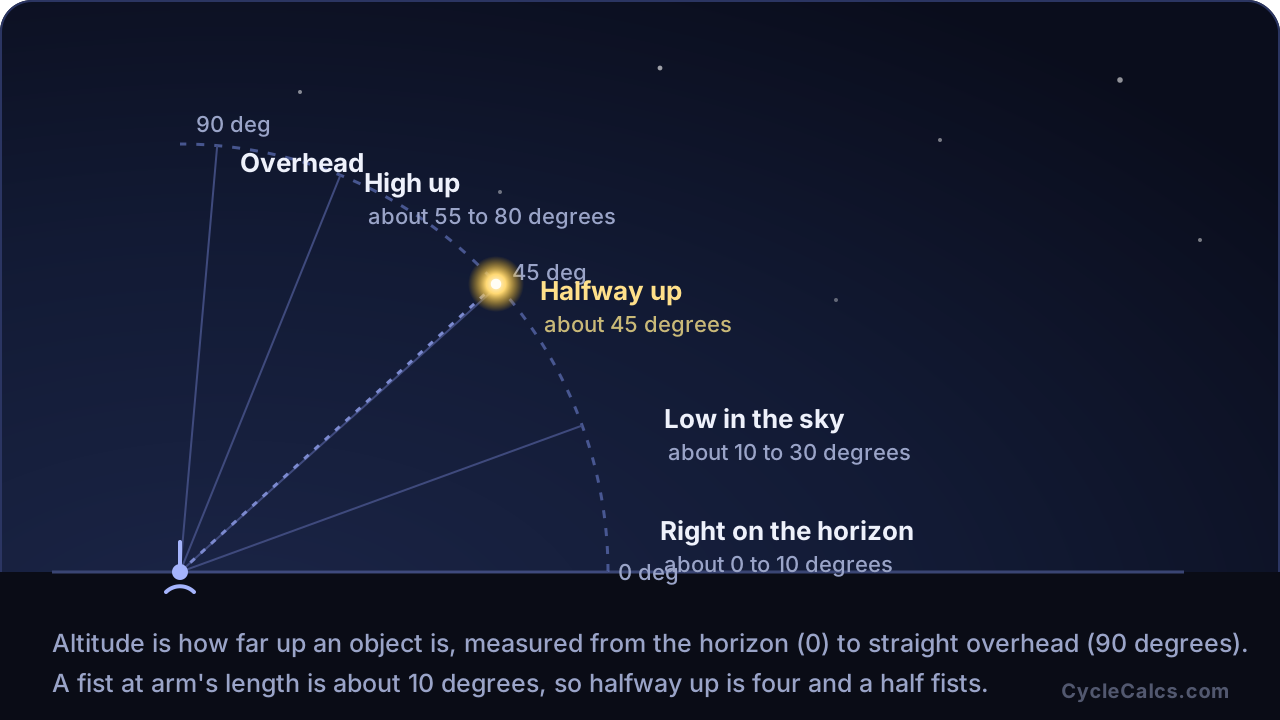
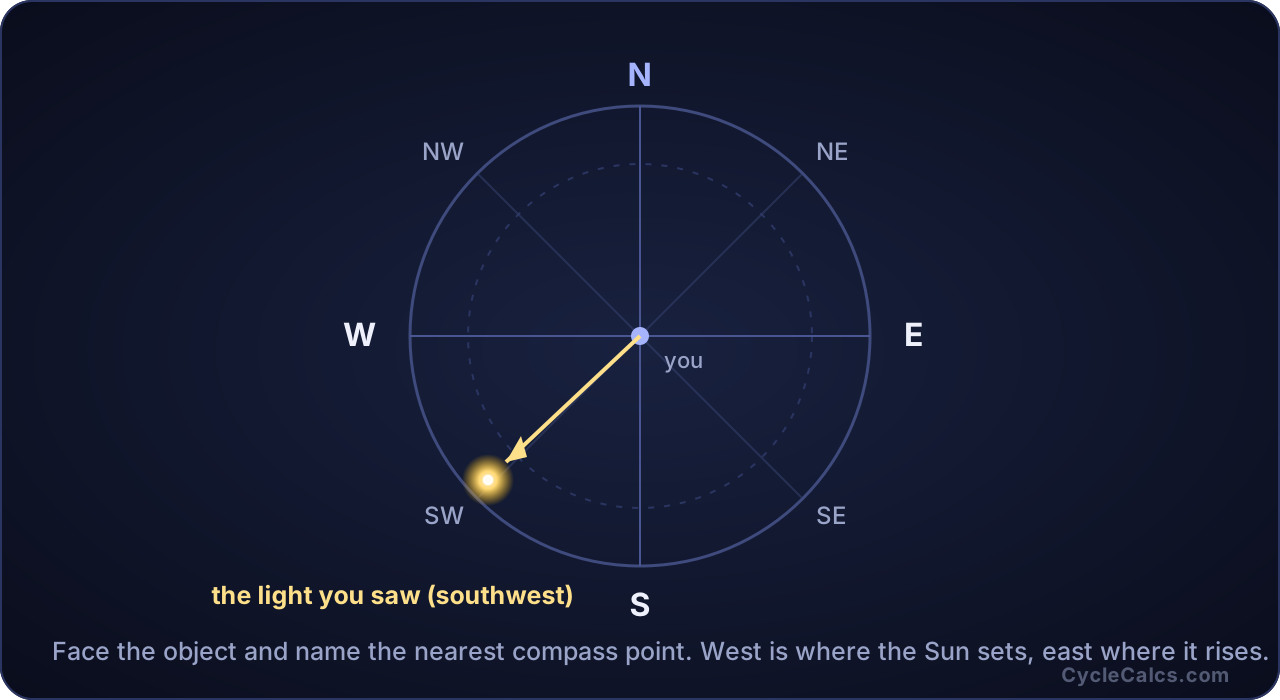
Every star and planet stands in a definite place in your sky at any given instant, set by two numbers: its altitude, the height above the horizon from 0 to 90 degrees, and its azimuth, the compass direction measured around from north. Both depend on where you are on Earth and on the exact time, which is why the tool asks for your location and the moment you looked. For that instant it computes the altitude, azimuth and brightness of the Moon, the five naked-eye planets and two dozen of the brightest stars with the same astronomy engine the rest of the site uses, then throws out everything that was below your horizon.
What remains is scored against your description. An object earns a high score when its computed direction and height match what you reported, and the match is weighted by how bright the object is, so a brilliant planet outranks a faint star that happened to sit in the same patch of sky. Any extra detail you give sharpens the ranking further: whether the light twinkled, its color, and how bright it looked. The result is a shortlist, brightest and best-placed first, with the reasoning shown for each.
Twinkling, color and the steady giveaway
The single most useful clue is whether the light twinkled. Stars are so distant that each is a true point of light, and pockets of moving air bend that point into the rapid shimmer we call twinkling, or scintillation. A planet is close enough to show a small disk, and its light averages across the turbulence and holds steady. So a steady light is more likely a planet, and a hard-twinkling one more likely a star, though anything low near the horizon shimmers more because you are looking through a longer, thicker slice of atmosphere. Color helps too: a warm orange or red points to Mars or to a red-giant star like Antares or Betelgeuse, while a cold blue-white points to Sirius, Vega or Rigel.
Satellites, planes and meteors
Three of the most common sightings are not fixed objects at all, and the site does not track individual satellites, so the tool reasons about them from how the light behaved rather than from a computed position. A steady point that drifts silently across the sky over a minute or two, often fading as it slips into the shadow of Earth, is a satellite or the International Space Station, seen mainly in the couple of hours after dusk and before dawn when the ground is dark but they are still in sunlight. A light that blinks, especially in more than one color, is an aircraft carrying navigation lights and a strobe. A point that streaked across the sky and vanished within a second was a meteor. For exact satellite and ISS pass times over your spot, the tool links you to a dedicated pass predictor.
The usual suspects
A handful of objects account for the great majority of "what was that?" sightings. Knowing their habits makes the answer obvious more often than not.
- Venus is the brightest thing in the sky after the Sun and Moon, bright enough to cast a faint shadow and to be mistaken for a landing aircraft. It never strays far from the Sun, so it appears only in the west after sunset or the east before sunrise, low down, as the "evening star" or "morning star." It shines with a steady white light.
- Jupiter is the next brightest and, unlike Venus, can ride high across the whole night, climbing well up in the south. Also steady and white.
- Mars is unmistakably orange when it is well placed, and its brightness varies enormously from one year to the next as its distance changes. It keeps to the ecliptic and does not twinkle.
- Saturn is a modest yellowish point, easy to overlook next to the brighter planets, again holding to the ecliptic.
- The bright stars. Sirius, blue-white and low in the south on winter evenings, twinkles so fiercely that people report it changing color and flashing. Arcturus and Capella are golden; Betelgeuse, Antares and Aldebaran are orange-red; Vega, Rigel and Spica are blue-white. Polaris, the North Star, is only moderately bright and sits almost due north at a height equal to your latitude.
- The International Space Station and satellites move, steadily and silently, which no star or planet does.
Two safe rules cover most cases. First, planets shine steadily and stars twinkle. Second, a light that moves is a satellite, a plane or a meteor, never a star or planet. Everything else the tool sorts out by working the geometry for your exact place and time.
Frequently asked questions
How can I tell a planet from a star?
Planets shine with a steady light while stars twinkle. A star is so far away it is a true point of light, so turbulence in the air breaks it up into a flicker; a planet shows a tiny disk that averages the turbulence out and holds steady. Planets also keep to a narrow band across the sky, the ecliptic, the same path the Sun and Moon follow. Twinkling is strongest low near the horizon, where you look through the most air, so even a planet can shimmer a little there.
What is the very bright star in the west after sunset?
Almost always the planet Venus, the brightest point of light in the sky after the Sun and Moon. Because Venus orbits closer to the Sun than Earth does, it only ever appears low in the west after sunset or low in the east before sunrise, and is never seen near midnight. A bright, steady point higher up or in the south or east on an evening is more often the planet Jupiter.
I saw a bright reddish star. What was it?
The usual reddish culprits are the planet Mars and three orange-red stars: Antares in Scorpius, Betelgeuse in Orion, and Aldebaran in Taurus. Mars shifts position from month to month and shines steadily; the stars hold fixed places and twinkle. Enter the direction, height and time above and this tool will tell you which of them was actually in that part of your sky.
I saw a light moving slowly across the sky with no sound or blinking. What was it?
Most likely a satellite or the International Space Station catching sunlight. They look like steady stars that glide from one side of the sky toward the other over a minute or two, then often fade out as they cross into the shadow of Earth. They are seen mainly in the couple of hours after dusk and the couple before dawn, when the ground is dark but they are still lit. For the exact passes over your location, use a pass predictor such as heavens-above.com.
It blinked or flashed in different colors. Was it something unusual?
A light that blinks, especially in red, green or white, is almost certainly an aircraft; planes carry blinking navigation lights and a white strobe. This tool deals in positional astronomy, the Sun, Moon, planets, stars and satellites, not in unidentified objects. The simple rule is that a steadily moving, non-blinking light is a satellite, while a blinking one, or one showing more than one color, is a plane.
Can it identify something I saw on an earlier night?
Yes. Enter the date and the rough time you saw it along with the direction and height, and the tool recomputes the whole sky for that past moment. That is the one thing a point-your-phone star app cannot do, because it only shows the sky as it is right now, not as it was when you were actually looking.
Why does it need my location and the time?
Because the same star or planet sits in a completely different direction and height depending on where you stand and when you look. One object can be low in the east at one hour and high in the south a few hours later, and two observers far apart see it in different parts of their skies at the same instant. Without a place and a time there is no way to say what was where you were looking.
Keep exploring
Live Sky Map
Once you know what it was, see it in place: a full-screen planetarium of your sky right now or on any night, with tap-to-identify labels.
TonightToday in the Sky
Which planets are up tonight from your location, where the Moon sits, and a ranked list of the best things to look at.
StarsThe 88 Constellations
A whole-sky map and a finder guide for every constellation, to place the bright star you spotted in its pattern.
StarsStar Names
The official IAU star names with their meanings and magnitudes, from Sirius and Vega to Aldebaran and Antares.
TonightMercury Morning Star Tracker
The commonest answer to a bright point low in twilight, after Venus: whether Mercury is in the morning or evening sky right now, and how long the window lasts.