The Sunspot Cycle
The Sun is not steady. The number of dark sunspots on its face climbs and falls over roughly 11 years, and the spots' magnetic polarity flips every cycle, so the full magnetic rhythm lasts about 22 years. Scrub through one 22-year span below: watch the Sun's face freckle and clear (left), while the spots trace out the famous butterfly pattern over time (right).
On this page
How long is the solar cycle? About 11 years from one sunspot minimum to the next (the Schwabe cycle), or 22 years counting the Sun's full magnetic reversal (the Hale cycle). Individual cycles run from 9 to 14 years. Solar Cycle 25 peaked in 2024 to 2025 and is now declining toward the next minimum around 2030.
What sunspots are
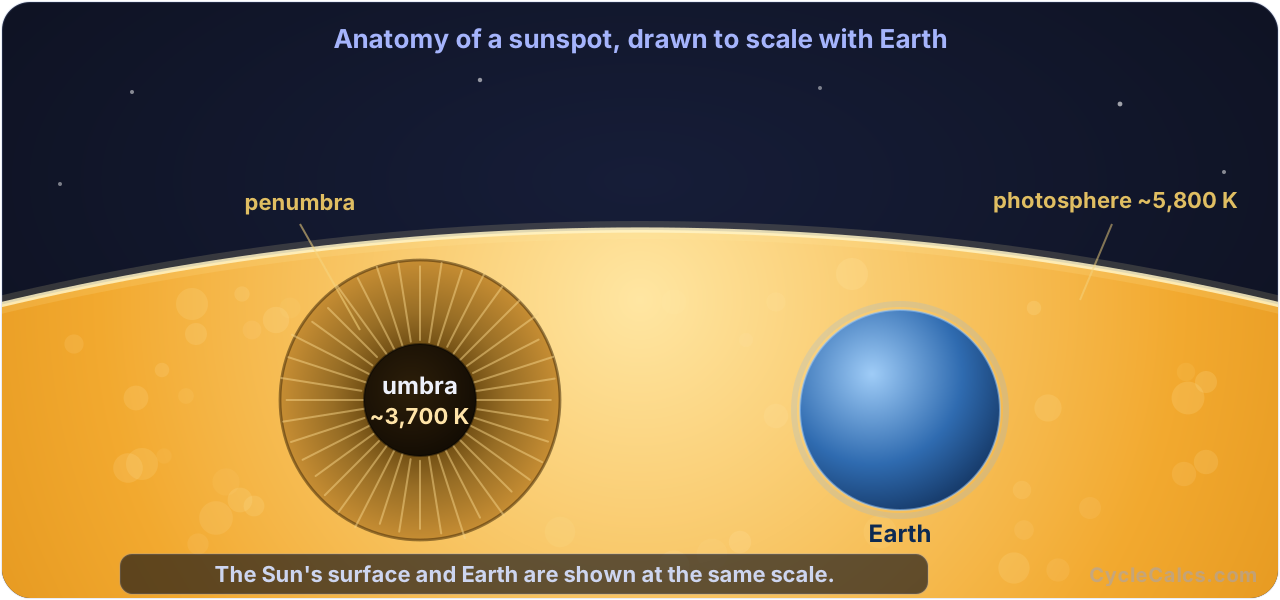
A sunspot is a patch of the Sun's surface where its magnetic field is so concentrated that it suppresses the churning convection that normally carries heat up from below. Starved of that heat, the patch cools to about 3,700 degrees, against roughly 5,800 degrees for the surface around it.
It is still searingly hot and bright, but because our eyes judge brightness by contrast, the cooler patch looks like a dark blot. The darkest core is the umbra, ringed by a lighter, feathery penumbra. A big sunspot group can be larger than the whole Earth.
The 11-year rhythm: the Schwabe cycle
If you count the spots month after month, the total rises and falls in a slow swell that repeats, on average, every 11 years (anywhere from about 9 to 14). At solar maximum the Sun's face is freckled with dozens of spots and frequent storms; at solar minimum it can go days at a time with a clean, blank disk.
The German astronomer Heinrich Schwabe stumbled on this pattern in 1843, after seventeen years of patiently sketching the Sun while hunting for a planet inside Mercury's orbit that he never found. Today the rise and fall is tracked continuously; you can follow the current cycle on the United States Space Weather Prediction Center.
The 22-year magnetic cycle: the Hale cycle
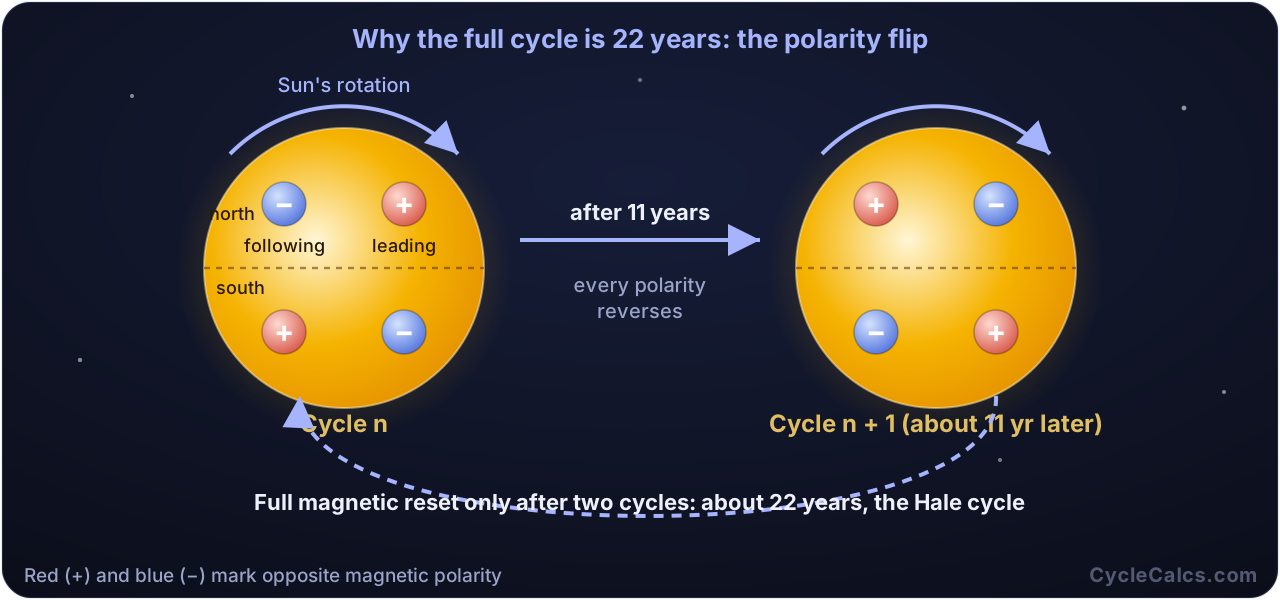
There is a deeper rhythm hiding underneath the count. Early in the 20th century George Ellery Hale showed that sunspots are intensely magnetic, and that they come in pairs with opposite magnetic poles, a leading spot and a following one. Here is the surprising part: the polarity of those pairs is reversed in the northern and southern hemispheres, and it flips from one 11-year cycle to the next.
So the Sun's magnetism only truly returns to its starting state after two sunspot cycles. That full magnetic cycle, about 22 years, is the Hale cycle. In the view above, the spots are tinted by polarity, as a magnetogram would show them, and you can watch the colors swap when the next cycle begins.
The butterfly diagram and Spörer's law
The spots do not appear just anywhere. At the start of a cycle they break out at middle latitudes, around 30 to 35 degrees north and south of the solar equator. As the cycle runs on, fresh spots emerge closer and closer to the equator, reaching about 8 degrees by the time the cycle fades. This steady equatorward march is called Spörer's law.
Plot the latitude of every spot against time, year after year, and the two drifting bands trace a shape like a pair of butterfly wings, which is why it is known as the butterfly diagram (the right-hand view draws it as you scrub).
Why it matters: space weather
An active Sun is a stormy one. Near solar maximum, tangled magnetic fields snap and release solar flares and coronal mass ejections, huge clouds of charged particles. When these sweep past Earth they light up the auroras, but they can also disturb radio communication, knock satellites off course, and, in the strongest cases, strain power grids.
The Sun's mood even has a long memory: during the Maunder Minimum, from about 1645 to 1715, sunspots all but vanished for seventy years, a lull that overlapped the coldest stretch of Europe's "Little Ice Age," although how much the quiet Sun contributed is still debated.
We are now in Solar Cycle 25 (counted from 1755), which began in December 2019 and reached its maximum around 2024. You can find the solar cycle alongside every other rhythm on the cycles by length page.
Do the planets pace the sunspot cycle?
For as long as people have charted the Sun, some have wondered whether the planets set its rhythm. The idea has a stubborn appeal, because of a genuine coincidence: several planetary periods land surprisingly close to the Sun's 11-year beat.
Jupiter circles the Sun every 11.86 years. Venus, Earth, and Jupiter return to the same tidal alignment every 11.07 years. Jupiter and Saturn line up to tug on the Sun from the same direction every 9.93 years (half of their 19.86-year meeting cycle, because a tide bulges toward both the near body and the far one). Each of these falls within a year of the roughly 11-year sunspot cycle.
Is that a clue, or a coincidence? The chart below lets you test it yourself: lay a rigid planetary clock over the real 200-year sunspot record and see how long it can keep step.
Claims versus evidence: how to weigh an idea like this
An idea about nature earns its place only if it can pass three tests, in order. First it needs a believable mechanism: a real physical way for the cause to produce the effect. Second it has to survive the numbers: the proposed force must actually be strong enough to do the job. Third it must match the data in phase: the predicted timing has to keep step with what we observe, not just for a cycle or two but across the whole record.
The planetary idea has been argued at three very different levels of seriousness, and these three tests sort them out cleanly.
A cautionary tale: Tice's "Jovial cycle"
In the 1870s an American weather forecaster named John H. Tice claimed that Jupiter, on reaching certain points in its orbit, set off an electrical disturbance across the solar system that triggered sunspots, storms, and even earthquakes on a roughly twelve-year "Jovial cycle." It failed every test.
There was no real mechanism, only an assumed one; the system-wide electrical forces he imagined do not exist; and when his predictions missed, he explained them away by appealing to a planet, Vulcan, that turned out not to exist. Reviewers of his own day dismissed the theory as built on a groundless assumption. Tice is the textbook example of how a tidy-looking cycle can be pure coincidence dressed up as a law.
A serious modern question
A small number of present-day scientists, publishing in peer-reviewed journals, ask a far more careful version of the question. They notice the 11.07-year Venus-Earth-Jupiter beat and Jupiter's 11.86-year orbit, and they wonder whether the planets might gently synchronize the Sun's internal clock, the way a faint but regular push can keep a child's swing going in time. This is not astrology, and it is not Tice.
It passes the first test, because a plausible mechanism has been proposed: a slight nudging of waves deep inside the Sun. But it stumbles on the second. The tidal bulge the planets raise on the Sun is less than a millimeter high, and Jupiter's tug at the depth where the Sun's magnetism is generated is about ten thousand times weaker than the churning gas motions already at work there.
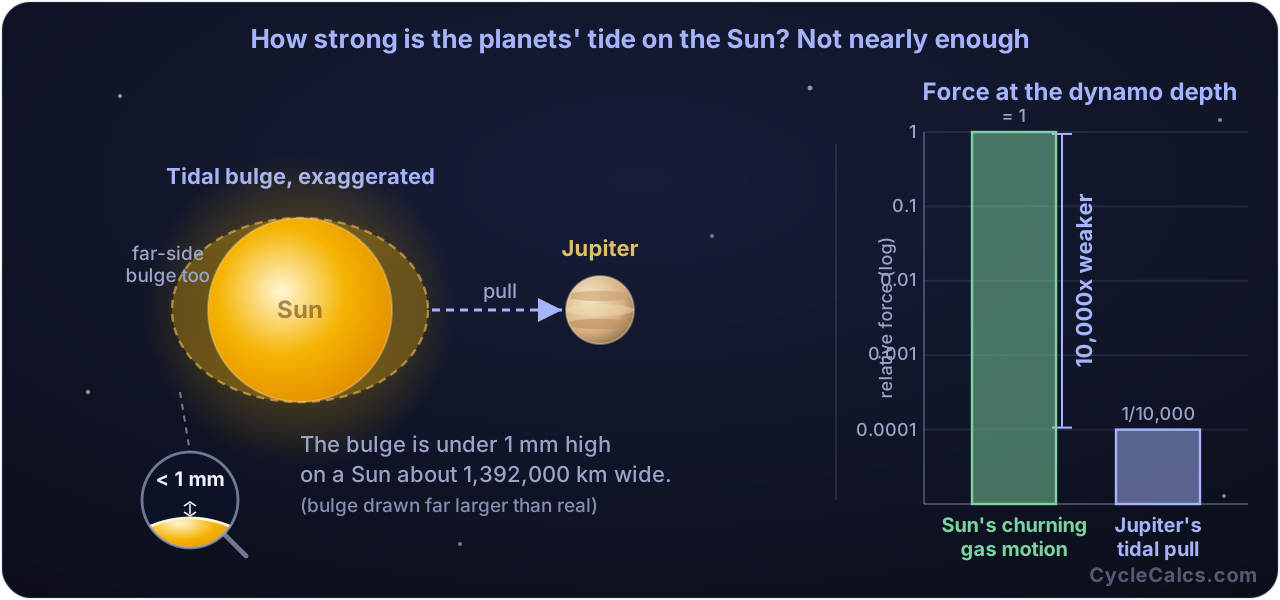
To rescue the idea, its supporters have to assume the Sun hugely amplifies that tiny push, a step most solar physicists do not accept. It also struggles with the third test: critics have shown that the supposed 11.07-year signal does not actually stand out in the planetary tides, and a rigid planetary clock drifts away from the real cycle within a few decades, exactly as the chart above shows.
What the evidence actually supports
The mainstream explanation needs no planets at all.
The Sun generates its own magnetism through a dynamo: its churning, electrically charged gas, wound up by the Sun's own rotation, builds and then sheds magnetic field on its own schedule. The mainstream Babcock-Leighton dynamo model reproduces both the 11-year Schwabe cycle and the 22-year Hale flip directly from the physics of the Sun, and it remains the model that best fits the observations.
So the honest summary is this: the planets almost certainly do not cause the sunspot cycle. Whether they very slightly influence its timing is a genuine open question that a few researchers continue to test, and the burden of proof, rightly, still rests with them. That is the difference between a coincidence, a hypothesis, and an established explanation, and it is worth keeping in mind whenever any cycle is said to drive another.
Frequently asked questions
What is the sunspot cycle?
The number of sunspots on the Sun rises and falls over a period of about 11 years, on average, called the Schwabe cycle. At solar maximum the Sun is freckled with spots and storms; at solar minimum it can go days with none. The spots mark places where the Sun's magnetic field is especially strong.
Why is the full solar cycle 22 years?
The magnetic polarity of the sunspot groups reverses from one 11-year cycle to the next, and it is opposite in the northern and southern hemispheres. Only after two 11-year cycles does the magnetic pattern return to where it started, so the complete magnetic cycle, called the Hale cycle, is about 22 years long.
What is the butterfly diagram?
A plot of the latitude of sunspots over time. Each cycle, spots first appear around 30 to 35 degrees north and south of the solar equator and then drift toward the equator, reaching about 8 degrees by the cycle's end. Plotted year after year, the two bands look like the wings of a butterfly. The equatorward drift is known as Spörer's law.
Do planets cause sunspots?
No. The Sun makes its own cycle through an internal magnetic dynamo, and the mainstream Babcock-Leighton model reproduces the 11-year rhythm with no help from the planets. There is a real coincidence that keeps the question alive: three planetary periods, the 11.07-year Venus-Earth-Jupiter alignment beat, Jupiter's 11.86-year orbit, and the 9.93-year Jupiter-Saturn tidal cycle, all sit close to 11 years. But the tides the planets raise on the Sun are less than a millimeter high, thousands of times too weak to drive the dynamo, and a rigid planetary clock soon drifts out of step with a cycle that itself varies between about 9 and 14 years. A serious minority of scientists still studies whether the planets gently nudge, or synchronize, the timing, but no one has shown that they cause the cycle.
Sources & further reading
- NOAA Space Weather Prediction Center, solar cycle progression: the observed solar cycle indices, and the source of the yearly sunspot numbers plotted on this page.
- NOAA Space Weather Prediction Center: solar cycle progression: the observed solar cycle indices, monthly and smoothed sunspot numbers, published as a United States Government work.
- NASA Marshall Space Flight Center, The Sunspot Cycle: the 11-year rhythm, the butterfly diagram, and cycle predictions.
- European Space Agency, The Sun: an overview of solar activity and the missions that watch it.
- Solar cycle (Wikipedia): a broad, well-referenced survey of the cycle, the dynamo, and its history.
- Jean Meeus, Astronomical Algorithms (2nd ed., Willmann-Bell): the standard reference for the underlying positional calculations.
See how these figures are computed on the methodology and sources page.
Keep exploring
The Sun
Today’s sunrise and day length for your location, the next eclipses, and the Sun’s vital facts.
ReferenceCycles by length
The 11-year sunspot cycle sits among every other natural rhythm, shortest to longest.
InteractiveSun's Declination & Seasons
The other great solar rhythm: how the Sun's height drives the year.
InteractiveEclipses
A total eclipse briefly reveals the Sun's corona, where space weather is born.
ReferenceThe numbers and where we stand: the sunspot cycle
The 10.7-year measured average, minimum to minimum, and where the current cycle stands right now.
ReferenceThe numbers and where we stand: the Hale cycle
The Sun's full magnetic cycle: about 22 years, two sunspot cycles, with where the current one stands.