The sunspot cycle
Where does the 11-year sunspot cycle stand right now?
The sunspot cycle is the roughly 11-year rise and fall in the number of dark spots on the Sun's surface, the visible sign of the star's changing magnetic field. This is the Schwabe cycle, named for the amateur astronomer who first noticed the pattern in the 1840s. Its length is not fixed: individual cycles have run anywhere from about 9 to nearly 14 years, and the 24 completed cycles since 1755 average about 11.0 years, minimum to minimum.
Unlike the tropical year or axial precession, this is not a clockwork orbital period you can compute from geometry. It is a data-driven cycle, read off the observed Sun and reconstructed from centuries of counts. Every value here is a measurement with real uncertainty, not an exact ephemeris quantity, and forecasts of the next minimum carry error bars for that reason.
How it works, in plain language: The sunspot cycle. This page carries the numbers.
On this page
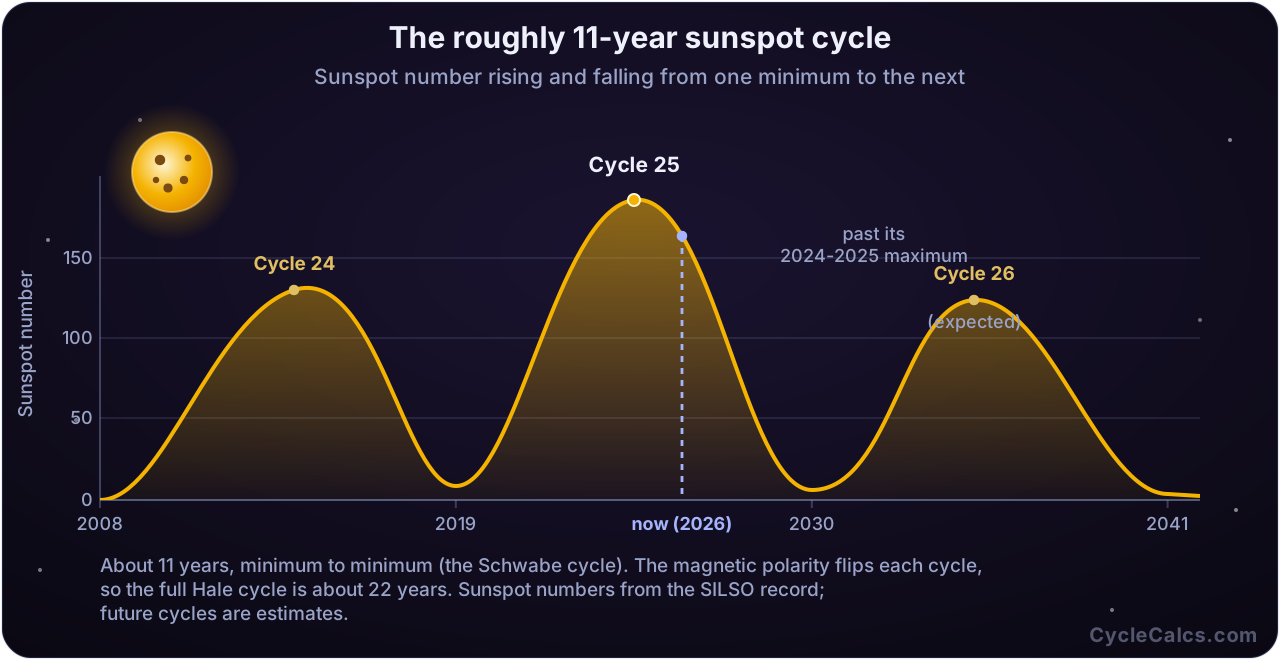
We are in Solar Cycle 25, which began around December 2019 and passed its maximum in October 2024 (13-month smoothed) according to the NOAA sunspot record. The next minimum is expected around 2030.
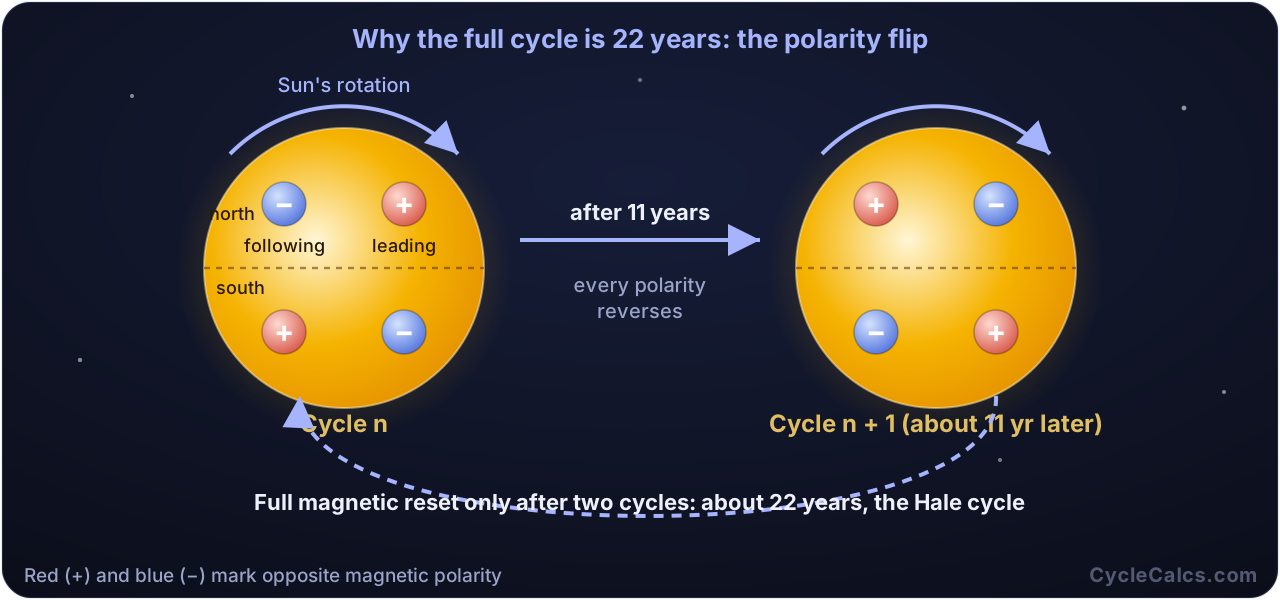
The count of sunspots rises and falls on a roughly 11-year rhythm, the Schwabe cycle; the Sun's magnetic polarity flips each cycle, so the full magnetic Hale cycle is about 22 years.
Where we are in the sunspot cycle right nowobserved data
The current cycle is Solar Cycle 25, past its October 2024 maximum (NOAA SWPC; 13-month smoothed) and heading toward a minimum around 2030. This is an observed, data-driven rhythm, so its timing is an estimate. The milestones below come from the NOAA record and forecasts.
The sunspot and Hale cycles are tracked from the NOAA sunspot-number record, not an ephemeris, so the figures here are observed data and estimates. See every cycle together on the cosmic clock.
The sunspot cycle at a glance
| Mean period | about 11 years (the Schwabe cycle) |
|---|---|
| Range of individual cycles | about 9 to nearly 14 years |
| Average of the 24 completed cycles since 1755 | about 11.0 years, minimum to minimum |
| Full magnetic cycle (Hale) | about 22 years |
| Type | observed, data-driven; not an orbital period |
| Current cycle (NOAA SWPC) | Solar Cycle 25, began around December 2019 |
| Cycle 25 maximum (NOAA SWPC) | October 2024 (13-month smoothed) |
| Next minimum (NOAA SWPC estimate) | around 2030 |
| Measured from | the NOAA sunspot-number record |
Sources: NOAA Space Weather Prediction Center, observed solar cycle indices.
The sunspot cycle in every unit
Because the sunspot cycle is measured rather than computed, its length is best expressed as a range and an average, alongside the longer magnetic cycle it belongs to.
| Mean period | about 11 years |
|---|---|
| Mean period in days | about 11 x 365.25 d = about 4,018 d |
| 24 completed cycles, 1755 to 2019 | about 264.8 yr / 24 = about 11.03 yr = about 4,029 d |
| Shortest to longest observed | about 9 to nearly 14 years |
| Two Schwabe cycles | about 2 x 11 yr = the full magnetic Hale cycle, about 22 years |
| Solar Cycle 25 so far (NOAA SWPC) | began around December 2019, maximum October 2024 (13-month smoothed) |
| Cycle 25 length to next minimum (NOAA SWPC estimate) | about 2019 to about 2030 = roughly 11 years |
Values are measurements from the NOAA sunspot-number record, not derived constants; the day figures are approximate and depend on which minima are chosen. Current-cycle timing is an estimate and carries real uncertainty.
What the sunspot cycle is and how it arises
Sunspots are regions where intense magnetic fields, thousands of times stronger than the surrounding surface, punch through the Sun's outer layers. The field chokes off the upward flow of hot gas from below, so a spot is cooler and darker than the surrounding photosphere. Their number tracks how tangled and active the Sun's overall magnetic field is at a given time.
The cycle arises from a dynamo deep inside the Sun. The Sun does not rotate as a solid body: its equator turns faster than its poles, and this differential rotation, working with churning convection, winds up and amplifies the magnetic field over years. As the field grows twisted, more spots appear, activity climbs to a maximum, and then the field reorganizes and decays toward minimum.
The magnetic polarity of the Sun flips from one 11-year cycle to the next. The north and south magnetic poles trade places, and the leading spots in each hemisphere reverse their magnetic sign. Only after two Schwabe cycles does the field return to its original polarity, which is why the full magnetic cycle, the Hale cycle, runs about 22 years.
The math
There is no formula for the sunspot cycle in the way there is for an orbit. You cannot plug in masses and distances and get 11 years out. Instead the period is measured from the sunspot-number record, which this site takes from the observed solar cycle indices published by the NOAA Space Weather Prediction Center. The record has yearly means from 1700, sparse before 1749, monthly means from 1749 and daily counts from 1818, and the whole series was recalibrated in 2015. Cycle length is taken from one minimum to the next.
Over the 24 completed cycles since 1755 that spacing averages about 11.0 years, but it is not stable: individual cycles span from about 9 to nearly 14 years, and their peak amplitude varies just as much. Because it is an empirical average of a noisy, physically variable process, any single number for the period is a summary, not a constant, and forecasts of the coming minimum or maximum are stated with genuine uncertainty.
For where the Sun sits today in this rhythm, alongside every other cycle's current position, see the live board on Where Are We Now; the period itself is listed with its siblings in the cycles catalog.
Where the sunspot cycle stands
| Date | Milestone (observed or estimated) |
|---|---|
| December 2019 | Cycle 24 minimum; Cycle 25 begins |
| October 2024 | Cycle 25 maximum, 13-month smoothed (NOAA SWPC) |
| around 2030 | Cycle 25 minimum (expected) |
| around 2035 | Cycle 26 maximum (expected) |
How the sunspot cycle relates to other cycles
The sunspot cycle sits apart from its siblings on this site precisely because it is measured, not computed. The tropical year and axial precession are geometric periods you can predict to the second or the year; the sunspot cycle is a statistical average of a physical process that refuses to keep exact time. Reading the two kinds of cycle side by side is a good way to see what "period" really means in astronomy.
For the underlying physics of spots, the dynamo, and the polarity flip, see the Learn lesson on the sunspot cycle, and the Sun object page for the star that drives it all.
Frequently asked questions
How long is the sunspot cycle?
On average about 11 years, measured from one minimum in sunspot number to the next. This is the Schwabe cycle. Individual cycles are not identical: the 24 completed cycles since 1755 have run anywhere from about 9 to nearly 14 years, and their average spacing, minimum to minimum, is about 11.0 years. It is an observed rhythm, not a fixed clock, so the length varies from cycle to cycle.
Why is the full solar magnetic cycle 22 years, not 11?
The Sun's magnetic polarity flips at each sunspot maximum. After one roughly 11-year Schwabe cycle the north and south magnetic poles have swapped, and the magnetic signs of spots have reversed. It takes a second cycle for the field to return to its original polarity. That full magnetic cycle, called the Hale cycle, is about 22 years, or two sunspot cycles back to back.
What solar cycle are we in now?
According to the NOAA Space Weather Prediction Center, we are in Solar Cycle 25. It began around December 2019 and reached its maximum in October 2024, measured by the 13-month smoothed sunspot number. Activity is now expected to decline toward the next minimum around 2030, which would mark the start of Solar Cycle 26. These dates are estimates and carry real uncertainty, since the timing of a cycle can only be pinned down clearly after it has passed.
Is the sunspot cycle an exact, predictable period?
No. Unlike an orbital period, the sunspot cycle cannot be computed from physics in advance. It is measured after the fact from the NOAA sunspot-number record. Both the length, roughly 9 to 14 years, and the peak strength vary from one cycle to the next in ways that are not fully predictable. Forecasts of the next maximum or minimum are always given with error bars rather than exact dates.
What causes sunspots and the cycle?
Sunspots are regions of concentrated magnetic field that block hot gas from below, making them cooler and darker than the surrounding surface. The cycle comes from a dynamo inside the Sun: because the equator rotates faster than the poles, the magnetic field is steadily wound up, driving activity to a maximum; the field then reorganizes and decays to a minimum, a decline that takes about 6.7 years on average, and minima fall about 11 years apart.
When will Solar Cycle 25 end?
Solar Cycle 25 is expected to reach its minimum, handing over to Cycle 26, around 2030, but the exact timing is uncertain because cycles run anywhere from about 9 to nearly 14 years. This is an estimate from the NOAA sunspot record and forecasts, not a fixed date.
Keep exploring
- Learn: the sunspot cycle: the dynamo and the polarity flip
- The Sun: the star that drives the cycle
- The tropical year: a computed period, for contrast
- Axial precession: the roughly 25,800-year Great Year
- All astronomical cycles: where this sits among the rest