The Venus pentagram
Why does Venus trace a five-petaled rose over eight years?
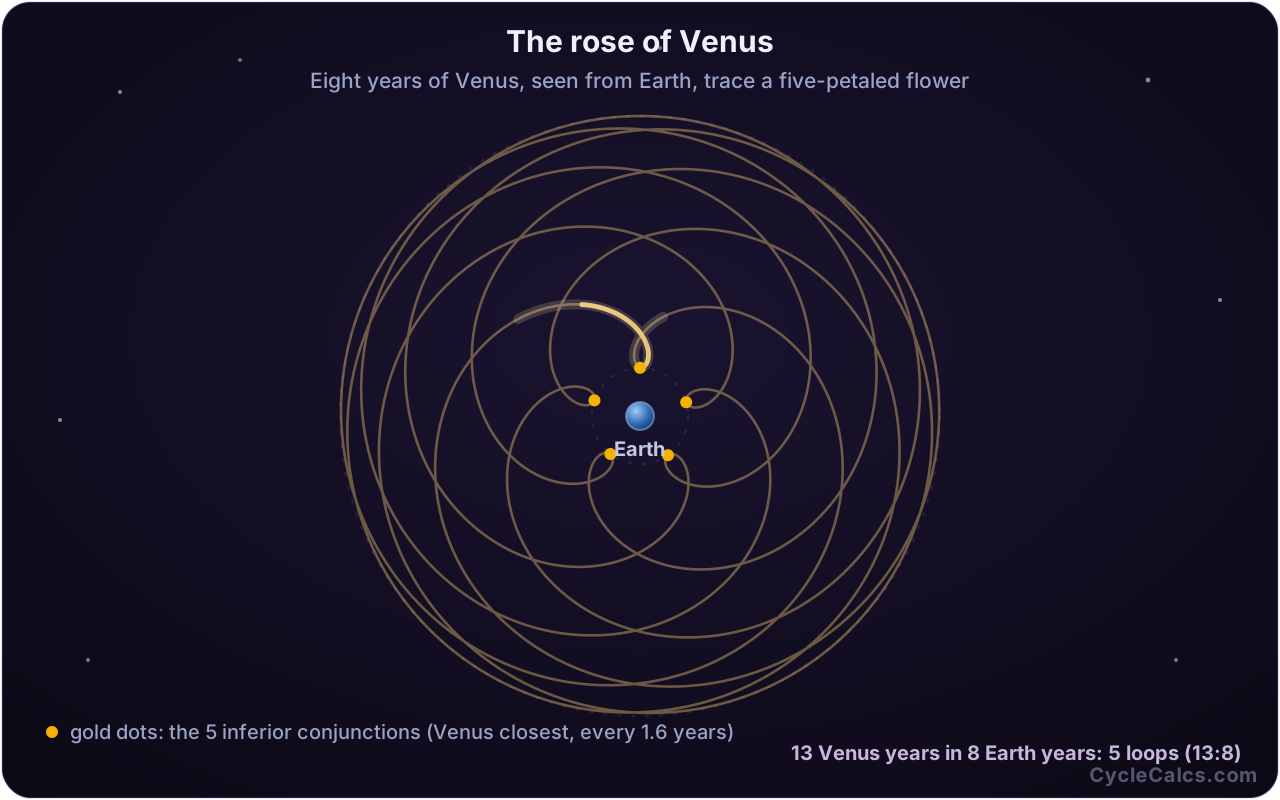
The Venus pentagram is the eight-year pattern in which Venus, seen from Earth, keeps returning to the same handful of places in the sky. One full pattern runs 2,919.6 days, close to 8 years, and is made of five synodic periods of Venus of 583.92 days each. Over that span Venus passes between Earth and the Sun five times, and those five inferior conjunctions fall about 72 degrees apart around the ecliptic, so joining them in order draws a five-pointed star, a pentagram or rose, across the background stars.
The pattern exists because 13 orbits of Venus and 8 orbits of Earth take almost the same time. That 13:8 relationship is a near-commensurability, not a resonance: nothing locks the two planets together, the match is simply close. This page is about the repeating pattern, not tonight's planet; for where Venus actually sits this evening and its current apparition as a morning or evening star, see the Venus page.
How it works, in plain language: Venus's 8-year cycle. This page carries the numbers.
On this page
Venus reaches its next inferior conjunction, passing between Earth and the Sun, on October 24, 2026. Five of these over eight years, spaced 72 degrees apart, trace the pentagram.
The full pattern, 2,919.6 days (about 8 years), is a near-commensurability: 13 Venus orbits in almost exactly 8 Earth years.
Where we are in the Venus pentagram right nowcomputed live
Venus's next inferior conjunction is October 24, 2026. Five successive ones draw the eight-year pentagram. With JavaScript on, this panel counts down to it.
Computed live in your browser from the open-source Astronomy Engine. See every cycle together on the cosmic clock.
The Venus pentagram at a glance
| Full pattern | 2,919.6 days (about 8 years) |
|---|---|
| In tropical years | about 7.994 years |
| Synodic period of Venus | 583.92 days |
| Synodic periods per pattern | 5 |
| Orbit count | 13 Venus orbits to 8 Earth orbits (13:8 near-commensurability, not a resonance) |
| Conjunctions per pattern | 5 inferior conjunctions, spaced about 72 degrees apart |
| Shape traced | a five-pointed star, the pentagram or rose of Venus |
| Drift | about 2.4 days short of 8 years each cycle; the star slowly rotates |
Sources: NASA NSSDCA, Venus Fact Sheet (synodic period 583.92 d, orbital period 224.701 d).
The Venus pentagram in every unit
The pattern is not a round number of anything; it is where five synodic periods of Venus and 13 of its orbits nearly meet eight years of Earth.
| In days | 2,919.6 days |
|---|---|
| In tropical years | about 7.994 years |
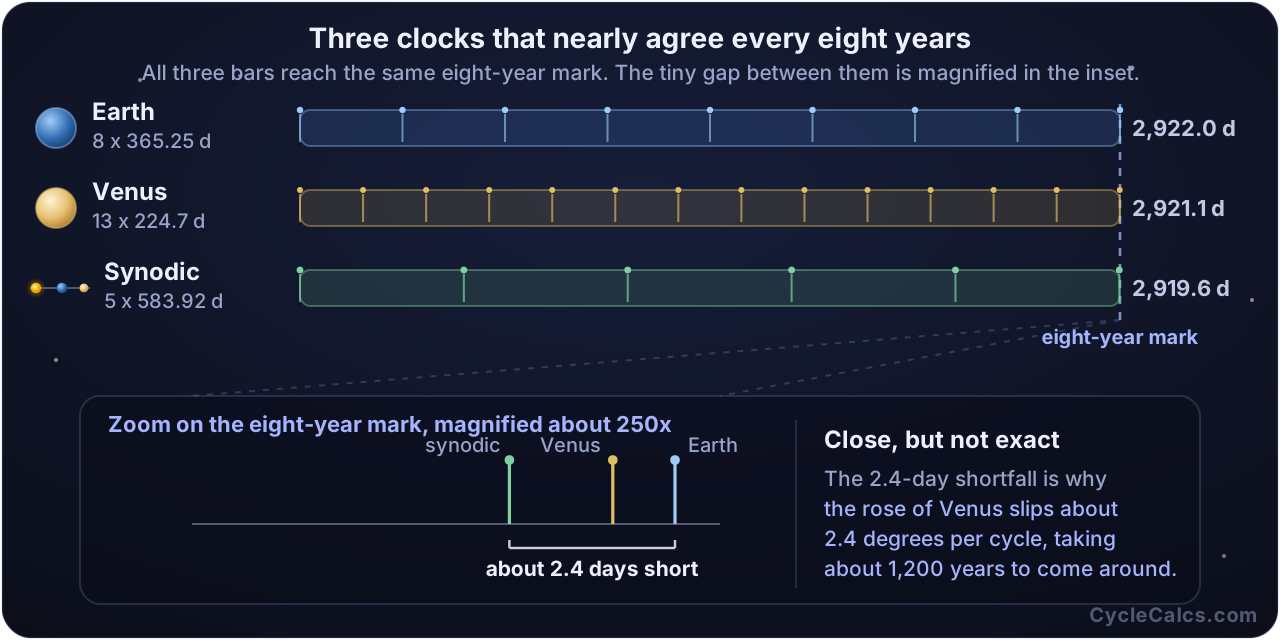
| Synodic periods of Venus | 5 x 583.92 d = 2,919.6 d |
| Venus orbits of the Sun | 13 x 224.701 d = 2,921.1 d |
| Earth orbits of the Sun | 8 x 365.25 d = 2,922.0 d |
| Inferior conjunctions | 5, spaced about 72 degrees apart (5 x 72 = 360 degrees) |
| Shortfall against 8 years | about 2.4 days per cycle, so the star drifts and rotates |
Periods from the NASA NSSDCA Venus Fact Sheet and Jean Meeus, Astronomical Algorithms. The three totals disagree by only a day or two, which is why the pattern nearly repeats; the small residual is why it slowly drifts and the star turns over the centuries rather than closing exactly.
What the Venus pentagram is and how it arises
Venus orbits closer to the Sun than Earth, so it laps us. The time between one lap and the next, from one inferior conjunction (Venus passing between Earth and the Sun) to the next, is the synodic period of Venus, 583.92 days. That is a little over nineteen months, and it does not divide evenly into a year, so each conjunction happens at a different point along the ecliptic than the one before.
Five synodic periods add up to 2,919.6 days, just under eight years. In that time the five inferior conjunctions land at five spots roughly 72 degrees apart around the sky. Plot them in the order they occur and the lines between them skip across the circle in a five-point step, drawing the familiar five-pointed star. The same span is 13 orbits of Venus against 8 of Earth, and because those counts are so nearly whole the whole figure very nearly repeats after eight years.
It does not repeat exactly. Five synodic periods fall about 2.4 days short of a full eight years, so each new pentagram is drawn a little earlier and shifted slightly against the stars. Over a human lifetime the star appears to rotate slowly; over long spans the near-match between 13 and 8 is close but not perfect, which is exactly what near-commensurability means. There is no dynamical lock holding Venus and Earth in this ratio.
The math
The synodic period comes from how fast Venus laps Earth. Using orbital periods in years, 1/T = 1/T_Venus - 1/T_Earth = 1/0.61521 - 1/1, which gives T = about 1.599 years, or 583.92 days. That is the interval between successive inferior conjunctions.
Five of those periods total 5 x 583.92 d = 2,919.6 days, which is 7.994 tropical years. Compared against Venus's own year, 13 orbits come to 13 x 224.701 d = 2,921.1 days, so the 13:8 match holds to within about a day and a half per cycle. Eight Earth years run 2,922.0 days, leaving the same small gap of roughly 2.4 days that makes the pattern creep.
Every period on the site is laid out by length on the full cycles list, where you can compare this eight-year figure against the other lapping patterns that shape the sky.
The next inferior conjunctions of Venus
| Inferior conjunction | Zodiac longitude | Interval |
|---|---|---|
| Oct 24, 2026 | Scorpio 0° | next |
| Jun 1, 2028 | Gemini 11° | 586 days later |
| Jan 6, 2030 | Capricorn 16° | 584 days later |
| Aug 11, 2031 | Leo 18° | 582 days later |
| Mar 20, 2033 | Aries 0° | 587 days later |
| Oct 21, 2034 | Libra 28° | 580 days later |
How the Venus pentagram relates to other cycles
The pentagram is a synodic pattern, so it is a close cousin of the synodic month, which is the Moon's own lapping period against the Sun; both measure how long it takes one body to catch the same alignment again. It also rhymes with the great conjunction of Jupiter and Saturn, another slow synodic pattern whose repeats trace a rotating figure on the sky, though that pair sits far outside Earth's orbit rather than inside it.
For the mechanism worked through step by step, with the star drawn out conjunction by conjunction, see the Venus 8-year cycle lesson. For the planet itself, its current elongation, brightness, and whether it is a morning or evening star, the Venus page tracks tonight's sky.
Frequently asked questions
How long is the Venus pentagram cycle?
One full pentagram runs 2,919.6 days, which is about 8 years, or more precisely 7.994 tropical years. It is made of five synodic periods of Venus, each 583.92 days, the interval between successive passes of Venus between Earth and the Sun. After that span the five conjunction points nearly, but not exactly, repeat, so the pattern slowly drifts and turns rather than closing perfectly.
Why does Venus trace a five-pointed star?
Venus passes between Earth and the Sun five times in about eight years, and those five inferior conjunctions fall roughly 72 degrees apart around the ecliptic. Because 72 degrees is one fifth of a circle, joining the points in the order they occur steps across the sky and draws a five-pointed star, often called the pentagram or rose of Venus. The five arms come from five conjunctions in one cycle.
Is the Venus 13:8 relationship a resonance?
No. In eight years Venus completes about 13 orbits while Earth completes 8, a very close 13:8 match, but nothing locks the two planets to that ratio. It is a near-commensurability, not a resonance. True orbital resonances, like Neptune and Pluto or the Galilean moons, are held in place by gravity. The Venus figure is simply a close numerical coincidence that slowly drifts.
Does the Venus pentagram repeat exactly?
Not exactly. Five synodic periods of Venus fall about 2.4 days short of a full eight years, so each new pentagram is drawn slightly earlier and shifted against the background stars. Over decades the whole star appears to rotate slowly. The pattern is close enough to look the same across a few cycles but does not close perfectly, which is why it is called a near-commensurability.
How is the pentagram different from tonight's Venus?
The pentagram is the repeating eight-year pattern of where Venus meets the Sun, not the planet's position on any given night. To see where Venus actually is this evening, whether it is a morning or evening star, its elongation from the Sun and its brightness, use the Venus morning star tracker. This page explains the long-term geometry behind those appearances.
When is the next inferior conjunction of Venus?
Venus's next inferior conjunction, when it passes between Earth and the Sun, is October 24, 2026. They recur every 583.92 days, and five of them over eight years trace the pentagram of Venus.
Keep exploring
- Is Venus the morning star right now?: tonight's position, elongation and brightness, live
- Venus: the facts, the phases and the physical data
- The Venus 8-year cycle: the pentagram drawn step by step
- The synodic month: the Moon's own lapping period
- The great conjunction: a slow synodic pattern of Jupiter and Saturn
- All cycles by length: every period laid out end to end