The synodic month
Why do the Moon's phases take 29.5 days to repeat?
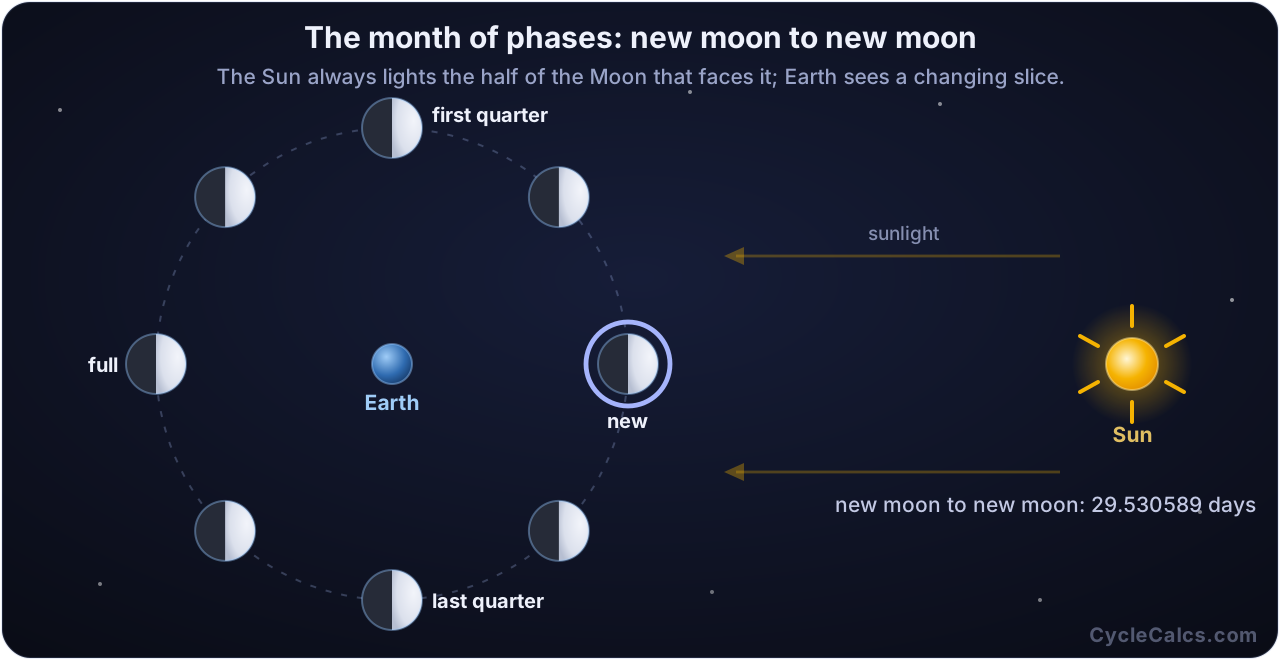
The synodic month is the month of phases, the time it takes the Moon to return to the same phase, new moon to new moon. It runs 29.530589 days, or 29 d 12 h 44 min 3 s. This is the month your eye actually follows, the one the cycle of phases traces out across a lunation, and the one every lunar and lunisolar calendar is built on.
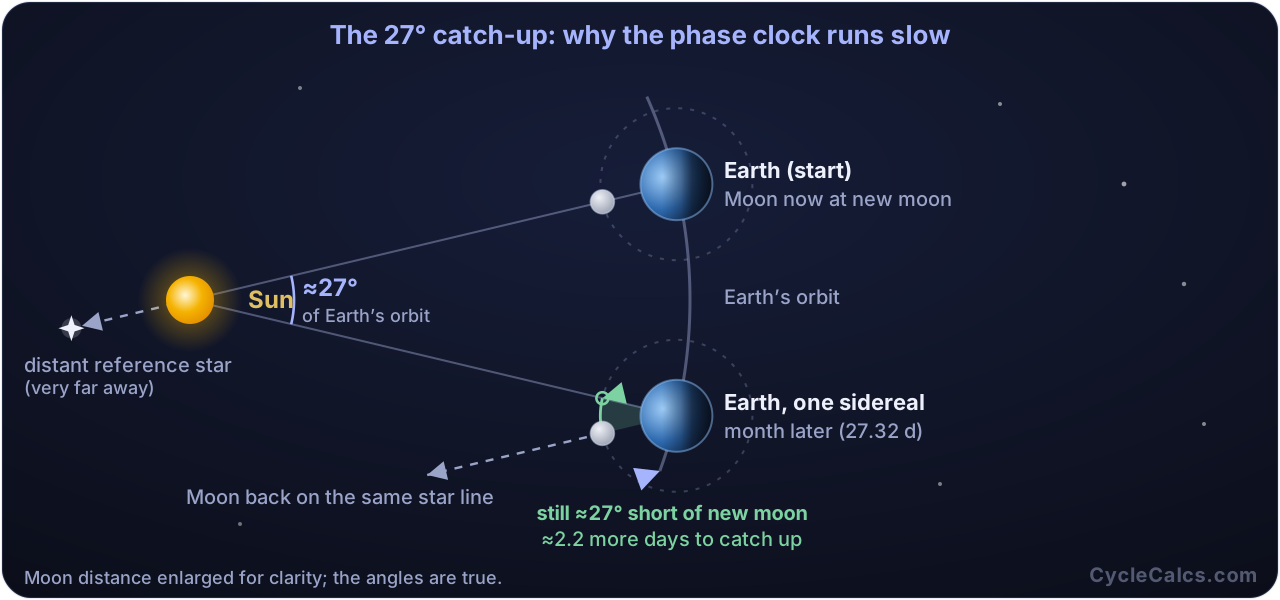
It is notably longer than the true orbital period. The Moon circles the Earth against the stars in 27.321661 days, but by the time it has done so the Earth has carried on around the Sun, so the Moon must travel about two extra days to catch the Sun's new direction and line up as a new moon again. That gap between the star-referenced orbit and the Sun-referenced phase is the whole reason the synodic month stands apart from its siblings.
How it works, in plain language: Moon phases. This page carries the numbers.
On this page
Right now the Moon is new. The next new moon, which opens the next synodic month, is November 9, 2026; the next full moon is October 26, 2026.
New moon to new moon runs 29.530589 days (29 d 12 h 44 min), about two days longer than the Moon's orbit against the stars.
Where we are in the synodic month right nowcomputed live
The current lunation runs toward the next new moon on November 9, 2026, with the next full moon on October 26, 2026. With JavaScript on, this panel shows today's phase and how far through the month we are.
Computed live in your browser from the open-source Astronomy Engine. See every cycle together on the cosmic clock.
The synodic month at a glance
| Period | 29.530589 days |
|---|---|
| Calendar time | 29 d 12 h 44 min 3 s |
| What it measures | one full cycle of phases, new moon to new moon |
| Compared with the sidereal month | about 2.2 days longer than 27.321661 days |
| Per tropical year | 12.368 synodic months |
| Why blue moons happen | the extra 0.368 month means some years hold 13 full moons |
| Basis of | lunar and lunisolar calendars |
| Also called | the lunation, or the lunar month of phases |
Sources: U.S. Naval Observatory and Jean Meeus, Astronomical Algorithms.
The synodic month in every unit
The synodic month is short, but its whole-number multiples are the frame on which the longer lunar cycles are built.
| In days | 29.530589 days |
|---|---|
| In calendar time | 29 d 12 h 44 min 3 s |
| Longer than the sidereal month by | 29.530589 - 27.321661 = 2.208928 d, about 2.2 days |
| Synodic months per tropical year | 365.24219 / 29.530589 = 12.368 |
| A 12-month lunar year | 12 x 29.530589 d = 354.37 d |
| One Metonic cycle | 235 x 29.530589 d = 6,939.69 d, about 19 years |
| One Saros | 223 x 29.530589 d = 6,585.32 d, about 18 years 11 days |
Period from the USNO and Jean Meeus, Astronomical Algorithms. The mean synodic month drifts by a small fraction of a second over centuries, and a single lunation runs anywhere from about 29.27 to 29.83 days, so the multiples above are mean values.
What the synodic month is and how it arises
An eclipse or a phase is about the angle between the Moon and the Sun as seen from Earth, not about where the Moon sits among the stars. The synodic month tracks that Sun-to-Moon angle. It starts at new moon, when the Moon and Sun share the same direction in the sky, runs through first quarter, full, and last quarter, and closes when the Moon overtakes the Sun's direction once more.
The reason it is longer than the sidereal month is pure geometry of two motions at once. In the roughly 27.3 days the Moon needs to complete one loop against the stars, the Earth moves about 27 degrees along its own orbit, dragging the direction to the Sun with it. The Moon has to cover that extra ground before it is once again lined up with the Sun. Adding the days needed to close that gap turns the 27.32-day orbit into the 29.53-day cycle of phases.
Because a tropical year holds 12.368 of these months rather than a clean 12, the phases slip against the calendar. Twelve lunations fall about 11 days short of a solar year, which is why purely lunar calendars drift through the seasons and lunisolar calendars must insert a leap month. That same leftover 0.368 of a month is what occasionally packs a second full moon into a single calendar month, the event people call a blue moon.
The math
The synodic month follows directly from two other periods, the sidereal month and the length of the year. Their reciprocal rates subtract, because the phase cycle is the Moon lapping the Sun's slowly moving direction: 1/T_syn = 1/T_sid - 1/T_year.
Put the real numbers in and the result falls out. Using the sidereal month of 27.321661 days and the year of 365.256 days, 1 / (1/27.321661 - 1/365.256) = 29.5306 days, matching the observed 29.530589 days. The same relation governs the synodic period of any two orbiting bodies, so if you want to run it for the Moon, a planet, or any pair, the synodic period calculator does the arithmetic for you.
The next new moons
| New moon (opens a synodic month) | Interval |
|---|---|
| Nov 9, 2026 | next |
| Dec 9, 2026 | 30 days later |
| Jan 7, 2027 | 29 days later |
| Feb 6, 2027 | 30 days later |
| Mar 8, 2027 | 30 days later |
| Apr 6, 2027 | 29 days later |
| May 6, 2027 | 30 days later |
| Jun 4, 2027 | 29 days later |
How the synodic month relates to other cycles
The synodic month is best understood next to its two siblings. The sidereal month of 27.321661 days is the Moon's true orbit against the stars, and the difference between the two, roughly 2.2 days, is set entirely by the Earth's motion around the Sun; the synodic versus sidereal lesson works that gap in detail. The anomalistic month, the perigee-to-perigee distance cycle, is a third, separate clock, and it is only when phase, node, and distance beat together that eclipses recur.
Its whole-number multiples are the backbone of the long lunar cycles. Stack 235 synodic months and you get the Metonic cycle that snaps the phases back to the same calendar dates; stack 223 and you get the Saros that makes eclipses repeat. To watch the phases run in real time, the moon phase calendar steps through one synodic month at a glance.
Frequently asked questions
How long is a synodic month?
A synodic month is 29.530589 days, or 29 days, 12 hours, 44 minutes, and 3 seconds. It is the time from one new moon to the next, a full cycle of the Moon's phases. A single lunation runs from about 29.27 to 29.83 days, up to about 6 hours shorter or 7 hours longer than the mean, because both the Moon's orbit and Earth's are elliptical; the lunation that begins with the new moon of 15 June 2026 (UT) lasts 29 days 6 hours 49 minutes.
Why is the synodic month longer than the sidereal month?
The sidereal month, 27.321661 days, is the time the Moon takes to circle the Earth against the background stars. During that loop the Earth moves along its own orbit, so the direction to the Sun shifts by about 27 degrees. The Moon needs roughly 2.2 more days to catch that new direction and become a new moon again, which makes the synodic month about 29.53 days.
How many synodic months are in a year?
A tropical year holds 12.368 synodic months. Twelve full lunations add up to about 354 days, some 11 days short of a solar year. That leftover 0.368 of a month is why lunar calendars drift through the seasons, why lunisolar calendars insert a leap month, and why a second full moon sometimes lands in one calendar month, the so-called blue moon.
What is the difference between the synodic and anomalistic month?
The synodic month, 29.530589 days, tracks the Moon's phases, its angle relative to the Sun. The anomalistic month tracks the Moon's distance, running from one perigee, its closest approach, to the next. They measure different things: one is about lighting and phase, the other about how near or far the Moon is. Both must line up, along with the node cycle, for eclipses to repeat.
Is the synodic month the basis of the calendar?
Yes, for lunar and lunisolar calendars. The month as a unit comes from the synodic month, the cycle of the Moon's phases. Islamic months follow it directly, while Hebrew and Chinese calendars keep months tied to the phases but add leap months to stay aligned with the solar year. The modern Gregorian month has since drifted free of the Moon.
When is the next new moon?
The next new moon is on November 9, 2026, and the next full moon is on October 26, 2026. Each new moon opens a fresh synodic month of 29.53 days. These dates are computed from Astronomy Engine.
Keep exploring
- The sidereal month: the true orbit against the stars
- Synodic vs sidereal: why the two months differ
- Moon phase calendar: watch one lunation unfold
- The Saros: 223 synodic months, and eclipses repeat
- The Moon: tonight's phase and distance