The Saros
Why do eclipses repeat every 18 years and 11 days?
The Saros is the rhythm that makes eclipses repeat. After one Saros of 6,585.32 days, roughly 18 years and 11 days, the Sun, the Moon and a lunar node return to almost exactly the same alignment, so a near-twin of the earlier eclipse takes place. Track a single eclipse forward one Saros at a time and you follow a numbered family, a Saros series, that is born at one pole of the Earth, marches across the globe over more than a thousand years, and dies at the other.
This page gives the exact length, the three lunar months that beat together to produce it, and the live reading below shows which Saros series the next solar and lunar eclipses belong to, computed in your browser from the same engine that drives the Eclipse and Saros Explorer.
How it works, in plain language: Why eclipses happen. This page carries the numbers.
On this page
The next solar eclipse falls on February 6, 2027 and belongs to Saros series 131; the next lunar eclipse falls on February 20, 2027, in Saros series 143.
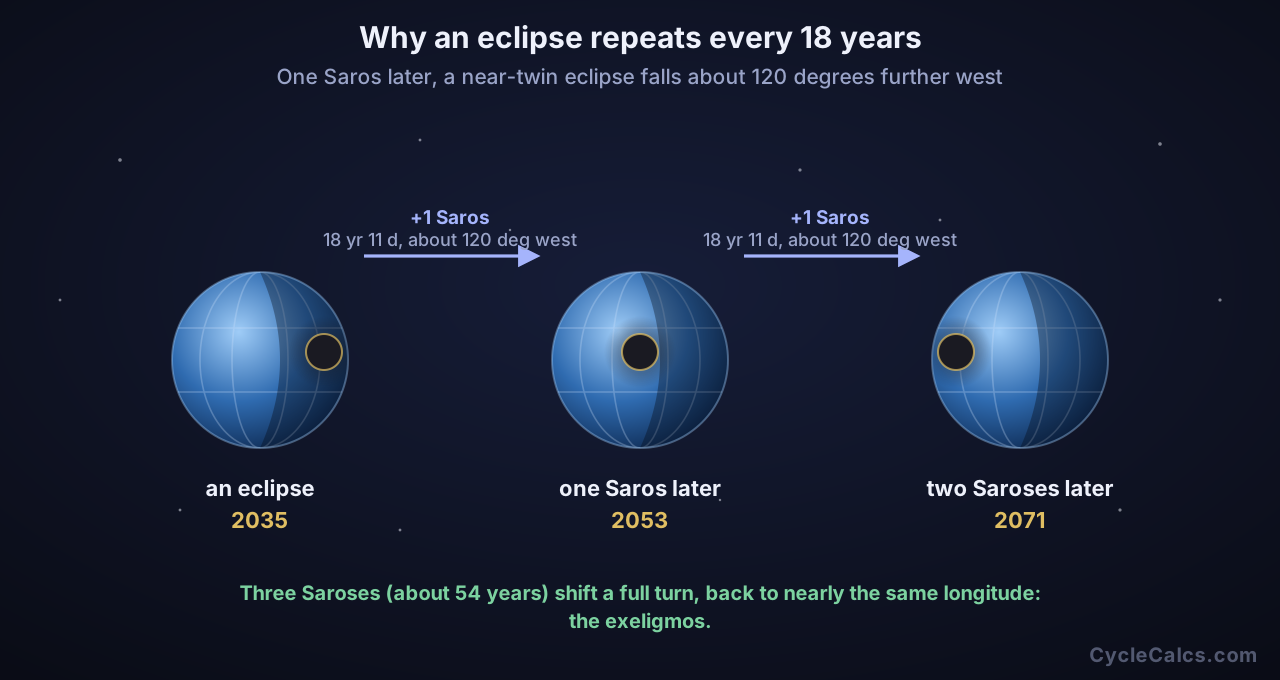
Step either series forward one Saros, about 18 years 11 days (18.03 years), and a near-identical eclipse returns, shifted about a third of the way around the globe to the west.
Where we are in the Saros right nowcomputed live
The sky is always working through several overlapping Saros series at once. The next solar eclipse belongs to series 131 (February 6, 2027) and the next lunar eclipse to series 143 (February 20, 2027). With JavaScript enabled this panel names the current series and counts down to each eclipse.
Computed live in your browser from the open-source Astronomy Engine. See every cycle together on the cosmic clock.
The Saros at a glance
| Length | 6,585.3213 days (about 18 years 11 days 8 hours) |
|---|---|
| Whole lunar months | 223 synodic months |
| Also close to | 242 draconic months and 239 anomalistic months |
| Eclipse years spanned | about 19 (346.62 days each) |
| Westward shift each cycle | about 120° of longitude, from the extra one-third day |
| Triple Saros (exeligmos) | 3 Saroses, about 54 years 33 days, returns an eclipse to nearly the same longitude |
| Length of a Saros series | roughly 1,200 to 1,550 years |
| Eclipses in a series | about 69 to 87 |
| First described | Babylonian astronomers; the name was revived by Edmond Halley in 1691 |
Sources: NASA Eclipse Web Site (Espenak and Meeus).
The Saros in every unit
A Saros is not a round number of anything; it is the interval over which three different lunar months come back into step at once, which is exactly why it works.
| In days | 6,585.3213 days |
|---|---|
| In calendar time | 18 years 11 days 8 hours (18 years 10 days if five leap years fall in the span) |
| In tropical years | about 18.03 years |
| Synodic months (new moon to new moon) | 223 exactly (× 29.530589 d = 6,585.32 d) |
| Draconic months (node to node) | 242 (× 27.212221 d = 6,585.36 d) |
| Anomalistic months (perigee to perigee) | 239 (× 27.554550 d = 6,585.54 d) |
| Eclipse years | about 19 (× 346.620 d = 6,585.78 d) |
Periods from the USNO and Jean Meeus, Astronomical Algorithms. The three lunar-month totals agree to within a fraction of a day, which is the whole secret of the Saros; the small residuals are why each series slowly drifts and eventually ends.
What the Saros is and how it arises
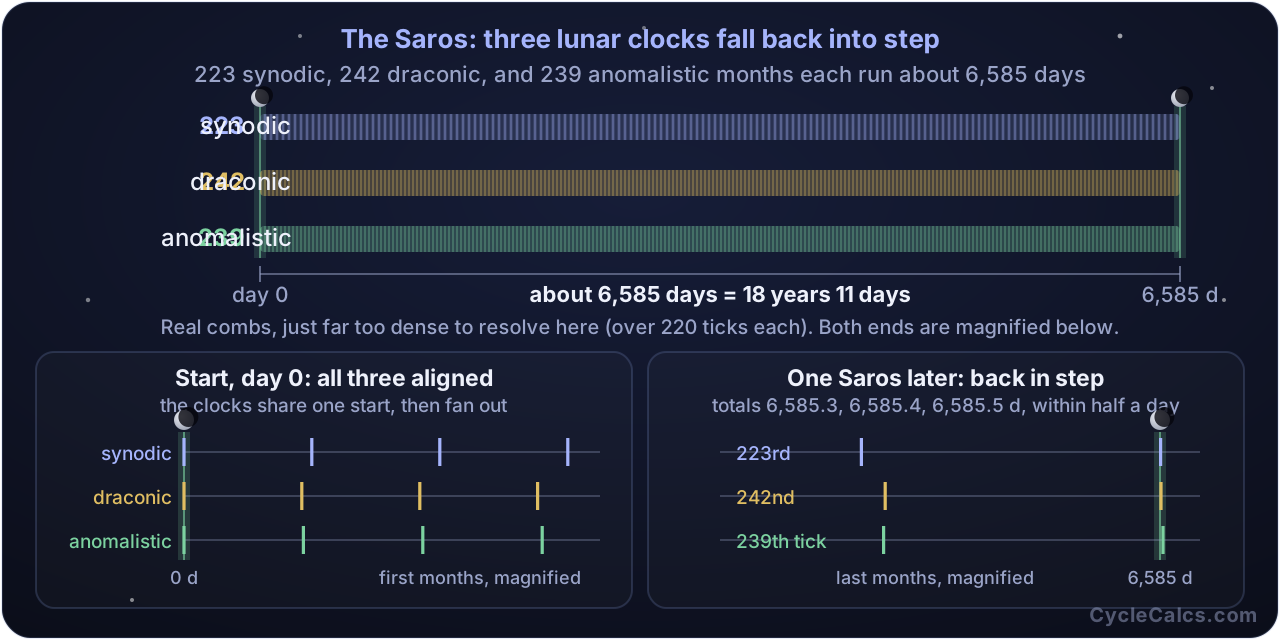
An eclipse needs three things to line up: the Moon must be new (for a solar eclipse) or full (for a lunar one), it must be near one of the two lunar nodes where its tilted orbit crosses the ecliptic, and, for the eclipse to look the same, it should be at a similar distance from Earth. Those three conditions are governed by three different clocks: the synodic month of phases, the draconic month of node crossings, and the anomalistic month of the Moon's changing distance.
The Saros is the shortest interval over which all three clocks strike together. In 6,585.32 days the Moon completes 223 whole cycles of phase, very nearly 242 whole cycles of node crossing, and very nearly 239 whole cycles of distance. Because those numbers are all close to whole, the geometry very nearly repeats, and so does the eclipse.
The catch is that one-third of a day. A Saros runs about 8 hours past a whole number of days, so the Earth has turned an extra third of a rotation when the next eclipse in the series arrives. Each eclipse therefore lands roughly 120° of longitude to the west of the one before. Wait three Saroses, an interval the Greeks called the exeligmos, and those thirds add up to a whole day, bringing the eclipse back over nearly the same part of the world.
The math
The Saros is a triple commensurability. Write the three lunar months alongside the count that nearly fills a Saros, and the totals line up:
223 synodic months × 29.530589 d = 6,585.3213 d. 242 draconic months × 27.212221 d = 6,585.3575 d. 239 anomalistic months × 27.554550 d = 6,585.5375 d.
The synodic and draconic totals differ by only about 0.04 days and the anomalistic total by about 0.22 days. Those tiny mismatches are why a Saros series is not eternal: the node alignment creeps a little each cycle, so eclipses in a series start partial, deepen to central over centuries, and fade back to partial before the family ends. To watch a single series member by member, open the Eclipse and Saros Explorer.
The next eclipses and their Saros series
| Date | Eclipse | Type | Saros series |
|---|---|---|---|
| Feb 6, 2027 | Solar | Annular | Series 131 |
| Feb 20, 2027 | Lunar | Penumbral | Series 143 |
| Jul 18, 2027 | Lunar | Penumbral | Series 110 |
| Aug 2, 2027 | Solar | Total | Series 136 |
| Aug 17, 2027 | Lunar | Penumbral | Series 148 |
| Jan 12, 2028 | Lunar | Partial | Series 115 |
| Jan 26, 2028 | Solar | Annular | Series 141 |
| Jul 6, 2028 | Lunar | Partial | Series 120 |
How the Saros relates to other cycles
The Saros is built from the synodic month, and it shares its node machinery with the eclipse year and the 18.6-year lunar nodal cycle, which slides the nodes all the way around the ecliptic. It is often confused with the Metonic cycle of 19 years, but they answer different questions: the Metonic cycle brings the phases back to the same calendar dates, while the Saros brings whole eclipses back.
The Moon is the common thread through all of these; the Moon page tracks tonight's phase and distance, and the eclipses lesson shows how the Sun, Earth and Moon have to line up. You can see every one of these periods laid out by length on the full cycles list.
Frequently asked questions
How long is one Saros cycle?
One Saros is 6,585.3213 days, which is about 18 years and 11 days, or 18 years and 10 days if five leap years fall within the span. That extra fraction of a day, about 8 hours, is important: it shifts each eclipse in a series roughly 120 degrees of longitude to the west of the one before.
Why do eclipses repeat every 18 years?
Because after 223 synodic months the Moon is back to the same phase, back near the same node, and back near the same distance from Earth, all at once. Those are the three conditions an eclipse needs, so when they realign a near-identical eclipse happens. The Saros is the shortest interval over which all three lunar months return to step together.
What is a Saros series?
A Saros series is the numbered family of eclipses you get by stepping forward one Saros at a time from a single eclipse. Each series begins with a small partial eclipse near one of Earth's poles, produces a long run of central eclipses over more than a thousand years, then fades to partial eclipses near the opposite pole before it ends. A typical series lasts 1,200 to 1,550 years and contains 69 to 87 eclipses.
What is the exeligmos or triple Saros?
The exeligmos is three Saroses, about 54 years and 33 days. Because one Saros runs about a third of a day long and shifts each eclipse about 120 degrees west, three of them add up to a whole extra day and a full 360 degrees, so the eclipse returns to nearly the same longitude on Earth as well as the same geometry in the sky.
Is the Saros the same as the Metonic cycle?
No. The Metonic cycle is 19 years and brings the phases of the Moon back to the same calendar dates, which is why it underlies lunisolar calendars. The Saros is 18 years 11 days and brings whole eclipses back. They are close in length but track different things: one follows phases, the other follows eclipses.
When is the next solar and lunar eclipse?
The next solar eclipse is on February 6, 2027, a member of Saros series 131, and the next lunar eclipse is on February 20, 2027, in Saros series 143. Both dates are computed from Astronomy Engine and are reliable between the years 1700 and 2200.
Keep exploring
- Eclipse and Saros Explorer: walk any Saros series member by member and see where each eclipse falls
- Eclipses lesson: how the Sun, Earth and Moon line up to make an eclipse
- The eclipse year: the 346-day rhythm that opens each eclipse season
- The Metonic cycle: the 19-year cousin that repeats phases, not eclipses
- The Moon: tonight's phase, distance and the cycles behind them