The eclipse year
Why do eclipses come in seasons about twice a year?
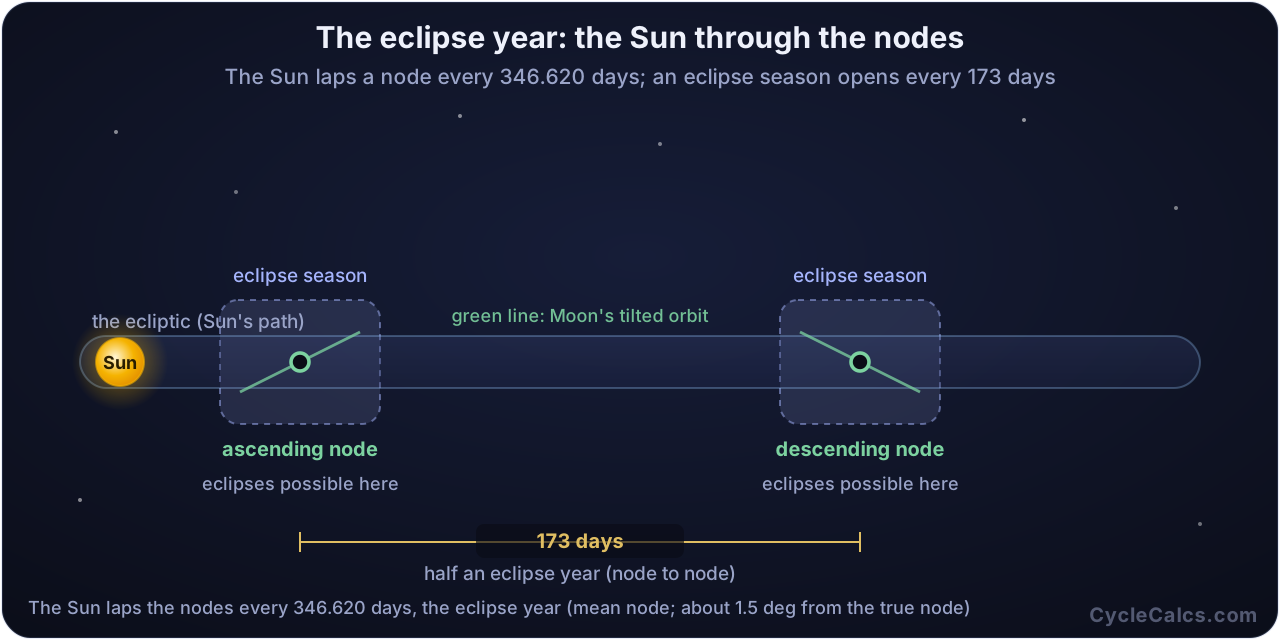
The eclipse year is 346.620 days, about 346 d 15 h, and it runs roughly 18.6 days shorter than a calendar year. It measures how long the Sun takes to travel from one crossing of a lunar node back to that same node. Eclipses can only happen when the Sun sits near a node, so this period, not the ordinary year, sets the beat of the eclipse seasons.
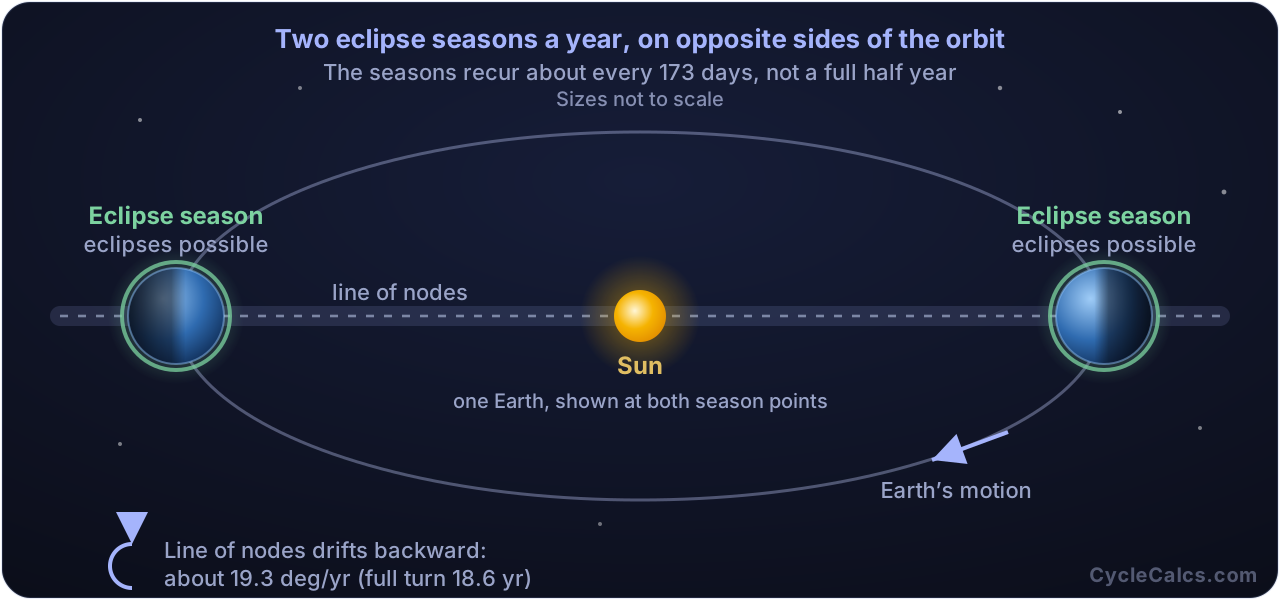
Twice per eclipse year the Sun reaches a node and an eclipse season opens, one at the ascending node and one at the descending node. Because the eclipse year is short, those seasons slide about 19 days earlier on the calendar each year. Follow that drift and you can see why eclipse dates march steadily backward through the months instead of staying fixed.
How it works, in plain language: Why eclipses happen. This page carries the numbers.
On this page
The next eclipse season is centered on February 9, 2027, when the Sun passes the Moon's ascending node. Eclipse seasons recur every 173 days, half an eclipse year of 346.620 days (about 346 d 15 h).
Only in the weeks around these node passages can the Sun, Earth and Moon line up closely enough for an eclipse.
Where we are in the eclipse year right nowcomputed live
The next eclipse season, the weeks when the Sun crosses a lunar node, is centered on February 9, 2027. Seasons come every 173 days. With JavaScript on, this panel shows how close the Sun is to a node now.
Computed live in your browser from the open-source Astronomy Engine. See every cycle together on the cosmic clock.
The eclipse year at a glance
| Eclipse year | 346.620 days (about 346 d 15 h) |
|---|---|
| Shorter than a calendar year by | about 18.6 days |
| Half eclipse year (season to season) | 173.31 days |
| Eclipse seasons per eclipse year | 2 (one at each node) |
| Seasonal calendar drift | about 19 days earlier each year |
| Node used | the mean node (about 1.5 degrees from the true node) |
| Sun's motion referenced to | the regressing lunar nodes |
| Nineteen eclipse years | almost exactly one Saros (223 synodic months) |
Sources: U.S. Naval Observatory, Astronomical Information Center.
The eclipse year in every unit
The eclipse year expressed in several forms and set against the other periods it nearly divides into.
| In days | 346.620 d |
|---|---|
| In hours | 346.620 d x 24 = 8,318.88 h (about 346 d 15 h) |
| In years | 346.620 / 365.2422 = 0.94899 yr |
| Shorter than the tropical year by | 365.2422 d - 346.620 d = 18.622 d |
| Half eclipse year | 346.620 / 2 = 173.31 d (one eclipse season interval) |
| Nineteen eclipse years | 19 x 346.620 = 6,585.78 d |
| One Saros | 223 x 29.530589 d = 6,585.32 d |
| 19 eclipse years minus 1 Saros | 6,585.78 - 6,585.32 = 0.46 d |
Node positions here are the mean node; the true node oscillates about 1.5 degrees either side of it, so real eclipse-season dates vary by roughly a day. Constants after USNO, with the synodic month taken as 29.530589 d.
What the eclipse year is and how it arises
The eclipse year exists because the two points where the Moon's tilted orbit crosses the plane of Earth's orbit, the lunar nodes, do not hold still. They creep westward along the ecliptic. Eclipses require the Sun to be near one of these crossing points, so the interval that matters for eclipses is not the Sun's return to a fixed star or to the equinox, but its return to a node that is itself sliding to meet it.
Because the node moves toward the oncoming Sun, the Sun catches up to it sooner than it would complete a full lap of the sky. That is the whole reason the eclipse year is shorter than the tropical year. The Sun needs to cover only about 346.6 degrees of relative motion, not a full 360, before it stands at the node again and the geometry for an eclipse returns.
Each eclipse year therefore contains two eclipse seasons, one when the Sun reaches the ascending node and one about 173 days later when it reaches the descending node. During each season the Sun is close enough to a node that at least one solar and often one lunar eclipse can occur. Outside the seasons, new and full Moons pass too far above or below the node for the shadows to connect.
The math
Write the eclipse year as the Sun's return to a regressing node. The Sun advances 360 degrees a year against the stars while the mean node retreats about 19.34 degrees a year in the opposite sense. The Sun meets the node once it closes that gap, which works out to 346.620 days rather than the 365.2422-day tropical year, a shortfall of 365.2422 - 346.620 = 18.622 days.
Halve the eclipse year and you get the eclipse-season spacing: 346.620 / 2 = 173.31 days from one node passage to the next. That 173.31-day step is why a season that falls in, say, early October one year opens in mid-September the next, drifting about 19 days earlier each calendar year until it laps the year entirely.
Nineteen eclipse years come to 19 x 346.620 = 6,585.78 days, within about half a day of one Saros of 223 synodic months (6,585.32 days). That near-match is what keeps whole eclipse patterns returning. To see which seasons are open now and when the next node passage falls, use the Eclipse Explorer.
The next eclipse seasons
| Approximate eclipse-season center | Node crossed |
|---|---|
| Feb 9, 2027 | Sun at the ascending node |
| Aug 4, 2027 | Sun at the descending node |
| Jan 22, 2028 | Sun at the ascending node |
| Jul 15, 2028 | Sun at the descending node |
| Jan 4, 2029 | Sun at the ascending node |
| Jun 26, 2029 | Sun at the descending node |
How the eclipse year relates to other cycles
The eclipse year is the Sun's side of the same geometry the lunar nodal cycle describes from the node's side: that 18.6-year westward regression is exactly why the Sun's return to a node takes less than a calendar year. Step nineteen eclipse years forward and you land within half a day of the Saros. The eclipse year opens the seasons, while the Saros governs whether a whole eclipse comes back inside one.
It is easy to confuse with the Metonic cycle, but they track different things: the Metonic cycle realigns the Moon's phases with the calendar over 19 years, whereas the eclipse year realigns the Sun with a node. For the underlying geometry of the crossings, see the lunar nodes lesson.
Frequently asked questions
How long is an eclipse year?
An eclipse year is 346.620 days, about 346 days and 15 hours. That is roughly 18.6 days shorter than the 365.2422-day tropical year. It measures the time the Sun takes to travel from one lunar node back to the same node. Because eclipses can only happen near a node, this period, not the calendar year, sets the rhythm of the eclipse seasons.
Why is the eclipse year shorter than a calendar year?
Because the lunar nodes do not hold still. They regress westward along the ecliptic, moving to meet the oncoming Sun. Since the node travels toward the Sun, the Sun reaches it after covering only about 346.6 degrees of relative motion instead of a full 360. That shortfall of about 18.6 days is exactly why the eclipse year comes to 346.620 days rather than 365.2422 days.
How often do eclipse seasons happen?
An eclipse season opens every half eclipse year, which is 173.31 days, one at the ascending node and one at the descending node. Because that interval is shorter than half a calendar year, the seasons drift about 19 days earlier each year. Each season lasts a few weeks and usually brings at least one solar and one lunar eclipse.
How does the eclipse year relate to the Saros?
Nineteen eclipse years come to 19 times 346.620, or 6,585.78 days, which is within about half a day of one Saros of 223 synodic months at 6,585.32 days. That close match is one reason a whole eclipse pattern returns after a Saros: the Sun, the Moon's phase, and the node all come back near step together over that span.
What node position does the eclipse year use?
The standard figure of 346.620 days is measured to the mean node, a smoothed average position. The true node oscillates about 1.5 degrees either side of the mean as the Moon's orbit wobbles, so the actual dates of node passages, and therefore eclipse seasons, can shift by roughly a day from what the mean value predicts.
When is the next eclipse season?
The next eclipse season is centered on February 9, 2027, when the Sun passes one of the Moon's nodes; eclipses cluster in the weeks either side. Seasons come every 173 days, half an eclipse year of 346.62 days. These dates use the mean node and are good to about a day.
Keep exploring
- The Saros: why whole eclipses repeat
- The Lunar Nodal Cycle: the 18.6-year node regression
- The Metonic Cycle: phases back on the calendar
- Lunar Nodes: where the crossings come from
- Eclipse Explorer: find the next eclipse season