The Metonic cycle
Why do full moons fall on the same calendar dates every 19 years?
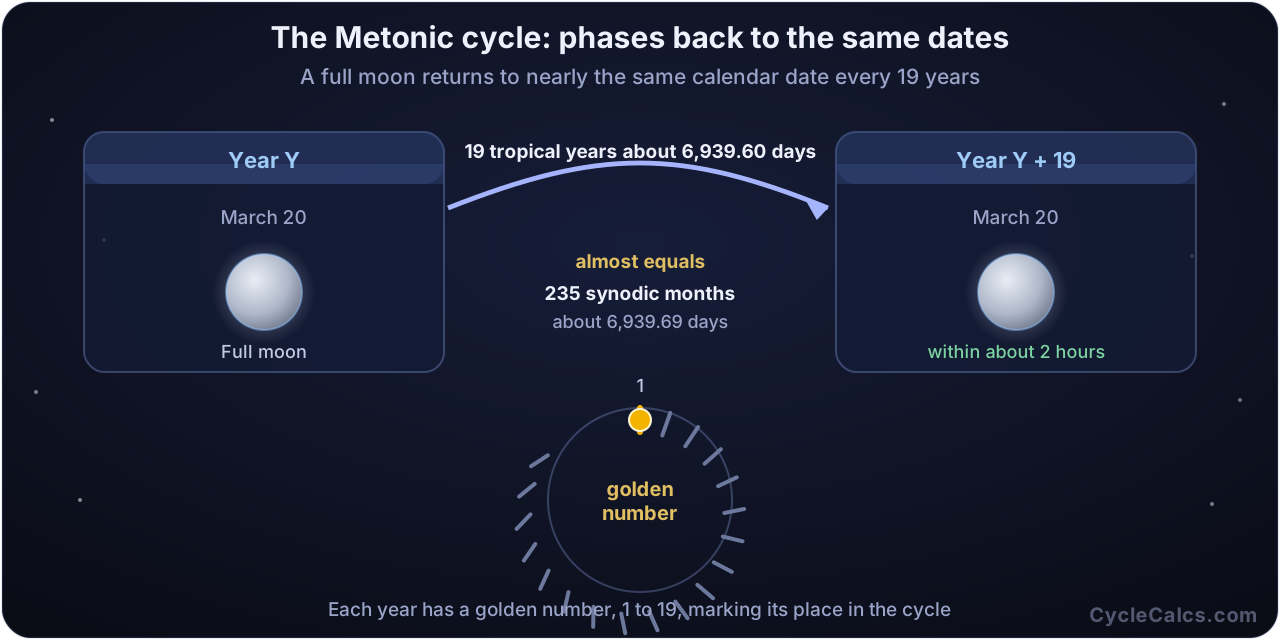
The Metonic cycle runs 6,939.69 days, about 19 years, and it exists because nineteen tropical years and 235 synodic months come out to almost exactly the same length. Nineteen tropical years measure 6,939.60 days; 235 lunar months measure 6,939.69 days. The two agree to within about two hours. Because a whole number of months fits so cleanly into a whole number of years, the Moon returns to the same phase on nearly the same calendar date every nineteen years.
This near-equality is what lets a lunar rhythm and a solar rhythm share one calendar. The Metonic cycle underlies the lunisolar calendars of the Hebrew and older Greek traditions and still governs the computus, the rule that fixes the date of Easter. Each year's place in the cycle is its golden number, computed as (year mod 19) + 1, a value that early calendar-makers wrote against the years to know when to insert a leap month.
How it works, in plain language: The Metonic cycle. This page carries the numbers.
On this page
The year 2026 carries golden number 13 in the 19-year Metonic cycle, so the Moon's phases fall on nearly the same calendar dates they held 19 years ago.
Nineteen years is almost exactly 235 lunar months, 6,939.69 days (about 19 years), which is why the phases snap back to the calendar.
Where we are in the Metonic cycle right nowcomputed live
2026 has golden number 13. The next new moon (November 9, 2026) has its Metonic echo near November 8, 2045, 19 years on. With JavaScript on, this panel shows the current golden number.
Computed live in your browser from the open-source Astronomy Engine. See every cycle together on the cosmic clock.
The Metonic cycle at a glance
| Period | 6,939.69 days (about 19 years) |
|---|---|
| In tropical years | 19 tropical years = 6,939.60 days |
| In synodic months | 235 synodic months = 6,939.69 days |
| Agreement between the two | within about 2 hours |
| What recurs | the Moon's phases on nearly the same calendar dates |
| Position marker | the golden number, (year mod 19) + 1 |
| Chief use | lunisolar calendars and the date of Easter |
| Refinement | the Callippic cycle, 4 Metonic cycles minus 1 day (76 years) |
Sources: U.S. Naval Observatory, Astronomical Information Center.
The Metonic cycle in every unit
The cycle's character comes from how a whole number of months packs into a whole number of years.
| Length in days | 6,939.69 days |
|---|---|
| Length in years | about 19 tropical years |
| 19 tropical years | 19 x 365.2422 d = 6,939.60 d |
| 235 synodic months | 235 x 29.530589 d = 6,939.69 d |
| Difference of the two totals | 6,939.69 - 6,939.60 = 0.09 d, about 2 hours |
| Months per year (average) | 235 / 19 = 12.37 synodic months |
| Leap-month years per cycle | 7 years carry a 13th month (235 - 12 x 19 = 7) |
| Callippic refinement | 4 x 6,940 whole days - 1 d = 27,759 d (76 years) |
Synodic month taken as 29.530589 days (Meeus, Astronomical Algorithms); the 235 x 29.530589 product and the 19-year total are honest to the stated decimals, and the 2-hour gap is the residual that slowly walks the cycle out of step over many centuries.

What the Metonic cycle is and how it arises
The Metonic cycle is not a physical orbit but a coincidence of two independent clocks. The tropical year is the Sun's cycle of the seasons; the synodic month is the Moon's cycle of phases, from new Moon to new Moon. Neither is a whole-number multiple of the other, so a purely lunar calendar drifts against the seasons by roughly eleven days a year. Over nineteen years that drift accumulates to almost exactly seven extra months.
Meton of Athens is credited with publicizing the relation around 432 BCE, though Babylonian astronomers had already built the same nineteen-year rule into their calendar. The practical payoff is a fixed intercalation scheme: insert a thirteenth lunar month in seven of every nineteen years and the lunar calendar stays locked to the seasons. The golden number, (year mod 19) + 1, simply names where a given year sits in that repeating pattern.
Because the fit is close but not perfect, the two-hour surplus per cycle adds up. After several centuries the phases slip a full day against the calendar, which is why the ecclesiastical rules for Easter use a fixed, idealized Metonic table rather than the true Moon.
The math
The relation is a statement that two products nearly match. Nineteen tropical years come to 19 x 365.2422 = 6,939.60 days. Two hundred thirty-five synodic months come to 235 x 29.530589 = 6,939.69 days. The difference is 0.09 days, close to two hours.
That small gap is the whole story. After nineteen years a chosen phase, say the full Moon, recurs within a couple of hours of the same clock time and on nearly the same calendar date. The month count breaks down as 235 = 12 x 19 + 7, so twelve of the nineteen years hold twelve months and seven hold thirteen. To see when a particular phase lands, or to check a golden number for any year, use the Moon phase and calendar tools on CycleCalcs.
How the phases repeat every 19 years
| Phase | Next occurrence | Its Metonic echo (19 years on) |
|---|---|---|
| New moon | Nov 9, 2026 | Nov 8, 2045 |
| Full moon | Oct 26, 2026 | Oct 25, 2045 |
How the Metonic cycle relates to other cycles
It is instructive to set the Metonic cycle beside the Saros, since both run close to nineteen years yet track different things. The Metonic cycle brings the Moon's phases back to the same calendar dates; it is a calendar cycle. The Saros brings whole eclipses back to nearly the same geometry; it is an eclipse cycle. Same rough length, different quantity tracked.
The cycle is built from two simpler periods profiled here: the synodic month supplies the 235 lunar months, and the tropical year supplies the 19 seasonal years. For the calendar history and the golden-number method worked through step by step, see the Metonic cycle lesson, or return to the cycles catalog to compare the full family.
Frequently asked questions
How long is the Metonic cycle?
The Metonic cycle is 6,939.69 days, or about 19 years. That length comes from 235 synodic months, which total 6,939.69 days. Nineteen tropical years measure 6,939.60 days, so the two agree to within about two hours. After this interval the Moon's phases fall on nearly the same calendar dates as before.
Why is 19 years special for the Moon and Sun?
Nineteen tropical years and 235 synodic months are almost exactly equal, agreeing within roughly two hours. A whole number of lunar months fits into a whole number of solar years, which no shorter interval manages so cleanly. That coincidence lets a single lunisolar calendar stay tied to both the phases of the Moon and the cycle of the seasons.
What is a golden number?
The golden number marks a year's position within the 19-year Metonic cycle. It is computed as (year mod 19) + 1, giving a value from 1 to 19. Calendar-makers wrote it against the years to know which years needed a thirteenth lunar month and to help fix the date of Easter in the ecclesiastical calendar.
How is the Metonic cycle different from the Saros?
Both are close to 19 years, but they track different things. The Metonic cycle returns the Moon's phases to the same calendar dates, so it governs calendars. The Saros returns whole eclipses to nearly the same geometry, so it governs eclipse prediction. Same rough length, but one conserves phase dates and the other conserves eclipses.
What is the Callippic cycle?
The Callippic cycle refines the Metonic cycle by taking four of them, 940 lunar months, and trimming one day from the whole-day calendar count, giving a 76-year span of 27,759 days. Removing that single day corrects most of the small surplus that the Metonic cycle accumulates, keeping the lunar and solar reckonings better aligned over the longer span.
What is the golden number this year?
In 2026 the golden number is 13. The golden number, (year mod 19) plus 1, marks a year's place in the 19-year Metonic cycle, over which the Moon's phases return to nearly the same calendar dates.
Keep exploring
- The Saros: the eclipse cousin of the same length
- The Synodic Month: the 235 months inside the cycle
- The Tropical Year: the 19 seasonal years inside it
- Learn: The Metonic Cycle: golden numbers and easter worked through
- All astronomical cycles: compare the full family