The tropical year
Why is the year of the seasons 365.2422 days long?
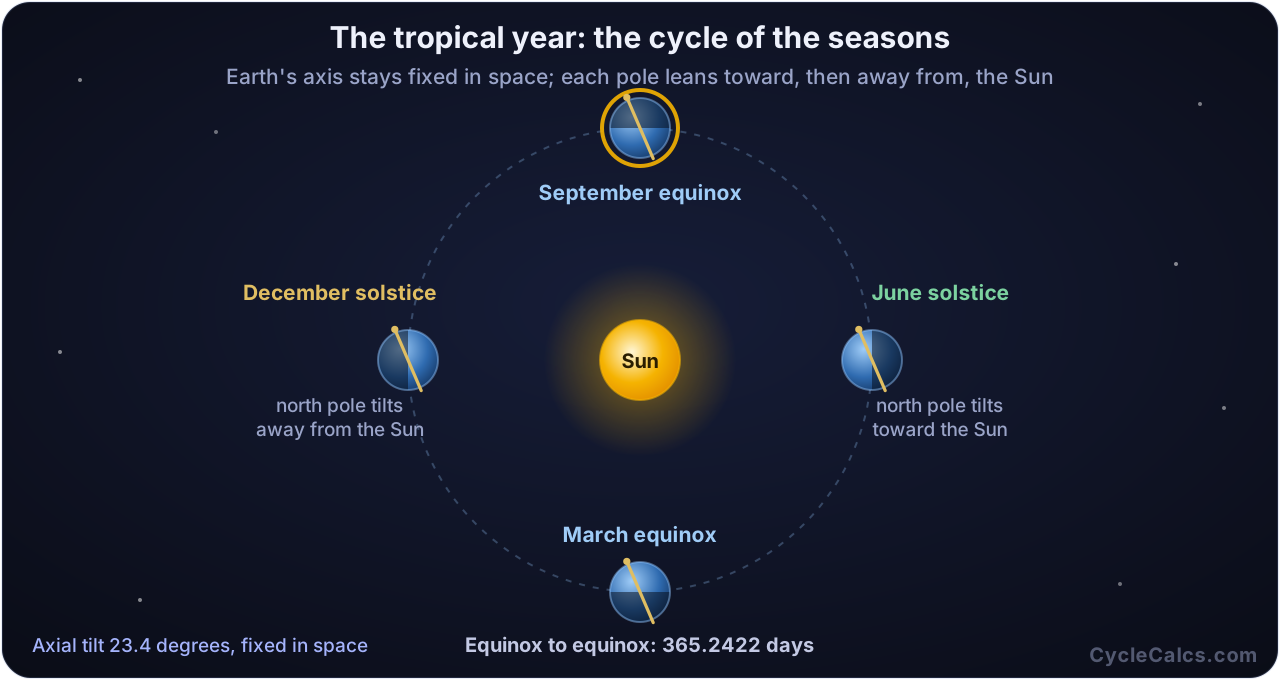
The tropical year is 365.2422 days long, or 365 days 5 hours 48 minutes 45 seconds, measured from one March equinox to the next. It is the year of the seasons: the interval over which the Sun's path across the sky returns to the same declination, bringing back the same length of day and the same solar altitude at noon. Because it is tied to the equinox rather than to the stars, it is the year a solar calendar has to track if the dates of spring and autumn are to stay put.
This is the value that keeps the seasons in step, and the target the Gregorian calendar approximates with its leap rule of 365.2425 days, from 97 leap days in every 400 years. The tropical year is about 20 minutes shorter than the sidereal year because the equinox point itself is moving: it drifts westward along the ecliptic, one full turn in about 25,800 years, the slow wheel described on the axial precession profile.
How it works, in plain language: The Sun's declination and the seasons. This page carries the numbers.
On this page
The next turn of the seasons is the December solstice on December 21, 2026. Equinox to equinox, the tropical year runs 365.2422 days (365 d 5 h 49 min).
This is the year the calendar tracks; it is about 20 minutes shorter than Earth's true orbit, because the equinox itself drifts.
Where we are in the tropical year right nowcomputed live
The next equinox or solstice is the December solstice on December 21, 2026. The seasons return every 365.2422 days. With JavaScript on, this panel counts down to it.
Computed live in your browser from the open-source Astronomy Engine. See every cycle together on the cosmic clock.
The tropical year at a glance
| Period | 365.2422 days |
|---|---|
| Full precision | 365 d 5 h 48 min 45 s |
| Reference points | March equinox to March equinox |
| What it governs | the seasons and the solar calendar |
| Gregorian approximation | 365.2425 d (97 leap days per 400 yr) |
| Difference from sidereal year | about 20 min 24 s shorter |
| Cause of the difference | westward drift of the equinox (precession) |
| Precession period | about 25,772 years (the Great Year, at the measured rate) |
Sources: U.S. Naval Observatory, Astronomical Information Center.
The tropical year in every unit
The tropical year in several forms, set beside the sidereal year and the precession cycle that separates them.
| In days | 365.2422 d |
|---|---|
| In days, hours, minutes, seconds | 365 d 5 h 48 min 45 s |
| In hours | 365.2422 x 24 = 8,765.81 h |
| Sidereal year (for comparison) | 365.25636 d |
| Tropical minus sidereal | 365.25636 - 365.2422 = 0.01416 d = about 20 min 24 s |
| Gap over one Great Year | 0.01416 d/yr x 25,772 yr = about 365 d, one year |
| Gregorian mean year | 365 + 97/400 = 365.2425 d |
| Gregorian error vs tropical | 365.2425 - 365.2422 = 0.0003 d/yr (about 1 day in 3,300 yr) |
Period constants from the USNO. The Great Year row uses the measured cycle of about 25,772 years, so the product comes to about 365 days. The one-year result is built in: the equinox laps the ecliptic once per Great Year, so over that span the tropical count gains exactly one year on the sidereal count. The tropical year varies slightly over long spans and is quoted here to fixed precision.
What the tropical year is and how it arises
A year is any interval over which the Earth-Sun geometry repeats, but more than one thing can repeat. The sidereal year is the time for the Earth to return to the same point against the background stars. The tropical year is the time for the Sun to return to the March equinox, the crossing where its path carries it from south of the celestial equator to north. The two definitions disagree because the equinox is not fixed among the stars.
The Earth's rotation axis is tilted about 23.4 degrees and slowly wheels around like a spinning top, dragged by the gravitational pull of the Sun and Moon on the planet's equatorial bulge. That wheeling carries the equinox westward along the ecliptic. So each spring the Sun reaches the equinox a little sooner than it reaches the same star, and the season-defining year comes up short of the star-defining one.
Because the seasons hang on the equinox and not on the stars, the tropical year is the one that governs daily life. Keep a calendar locked to the tropical year and the solstices and equinoxes stay near the same dates for millennia; lock it to the sidereal year instead and the calendar would slowly drift out of step with the seasons.
The math
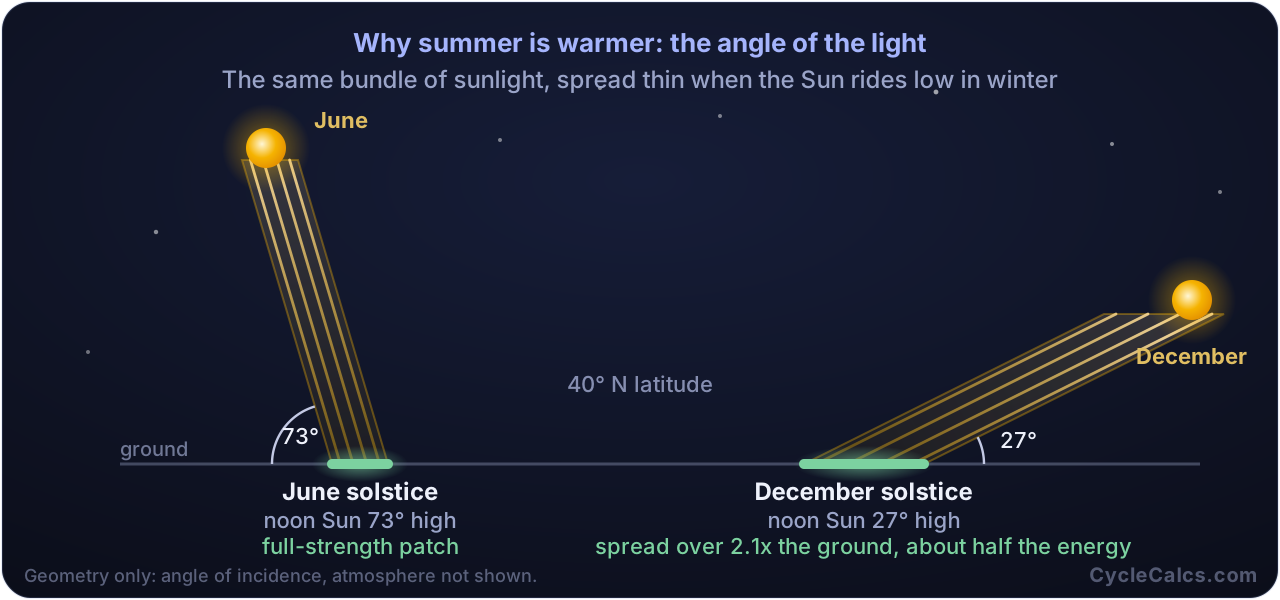
Write the two years side by side. The sidereal year is 365.25636 days; the tropical year is 365.2422 days. The difference, 0.01416 days, is about 20 minutes 24 seconds. That shortfall is exactly the time it takes the Sun to cover the small westward step the equinox has taken over the year, a step of about 50.3 arcseconds.
The link to precession is direct. The equinox moves west about 50.288 arcseconds per year (the IAU 2006 rate), and a full circle of 360 degrees is 1,296,000 arcseconds, so one complete turn takes 1,296,000 / 50.288 = about 25,772 years. Over that whole cycle the 20-minute annual gap sums to one entire year: the tropical count gains one year on the sidereal count every time the equinox laps the sky.
You can watch the equinox side of this in practice through the day-length swing across a year. To see how sunrise and sunset shift as the Sun tracks through its tropical cycle, try the sunrise and sunset calculator for your own latitude.
The next equinoxes and solstices
| Date | Equinox or solstice |
|---|---|
| Dec 21, 2026 | December solstice |
| Mar 20, 2027 | March equinox |
| Jun 21, 2027 | June solstice |
| Sep 23, 2027 | September equinox |
| Dec 22, 2027 | December solstice |
| Mar 20, 2028 | March equinox |
| Jun 20, 2028 | June solstice |
| Sep 22, 2028 | September equinox |
How the tropical year relates to other cycles
The tropical year is best understood as the equinox-referenced twin of the star-referenced sidereal year. The two are nearly identical in length, and the whole of their small difference is axial precession: subtract one year from the other and you are left with the drift of the equinox. If the sidereal year answers where the Earth is in its orbit, the tropical year answers where we are in the cycle of the seasons.
The tropical year also anchors the Metonic cycle, which reconciles 19 of these solar years with 235 lunar months to keep lunisolar calendars aligned, and it underlies the leap-year arithmetic set out in the seasons lesson. For the mechanism behind the 20-minute gap, see the precession lesson.
Frequently asked questions
How long is a tropical year?
A tropical year is 365.2422 days, or 365 days 5 hours 48 minutes 45 seconds. It is measured from one March equinox to the next, so it is the year of the seasons. This is the value the Gregorian calendar approximates with its leap rule, which averages 365.2425 days by inserting 97 leap days in every 400 years.
Why is the tropical year shorter than the sidereal year?
The tropical year is referenced to the equinox, and the equinox itself drifts westward along the ecliptic because of the precession of Earth's axis. Each spring the Sun reaches the equinox slightly before it returns to the same star, so the tropical year is about 20 minutes 24 seconds shorter than the sidereal year of 365.25636 days.
What is the difference between a tropical year and a calendar year?
The tropical year is the astronomical interval of 365.2422 days between successive March equinoxes. The calendar year is a whole number of days, either 365 or 366. The Gregorian leap rule blends them to a long-term average of 365.2425 days, which stays within about one day of the tropical year over 3,300 years.
Does the tropical year set the seasons?
Yes. The tropical year is defined by the Sun's return to the equinox, so it is the interval over which the seasons repeat. Keeping a calendar tied to the tropical year is what holds the solstices and equinoxes near the same dates over many centuries, rather than letting them slip through the calendar.
How does precession relate to the tropical year?
Precession is the reason the tropical and sidereal years differ. Earth's axis wheels around once in about 25,800 years, carrying the equinox westward about 50.3 arcseconds each year. That drift shaves roughly 20 minutes off the tropical year, and over one full precession cycle the accumulated gap adds up to about one whole year.
When is the next equinox or solstice?
The next is the December solstice on December 21, 2026. Equinoxes and solstices mark the quarters of the tropical year, which runs 365.2422 days from one March equinox to the next.
Keep exploring
- The Sidereal Year: the star-referenced twin
- Axial Precession: the drift that sets the difference
- The Metonic Cycle: 19 solar years, 235 months
- The Seasons: why the year tracks the equinox
- Sunrise and Sunset Calculator: watch day length swing