The sidereal year
How long does Earth's orbit really take, measured against the stars?
The sidereal year is 365.25636 days, or 365 d 6 h 9 min 10 s. It is the time Earth takes to return to the same position against the background stars, one full circuit of its orbit measured against a fixed frame rather than against the seasons. This is the planet's true orbital period.
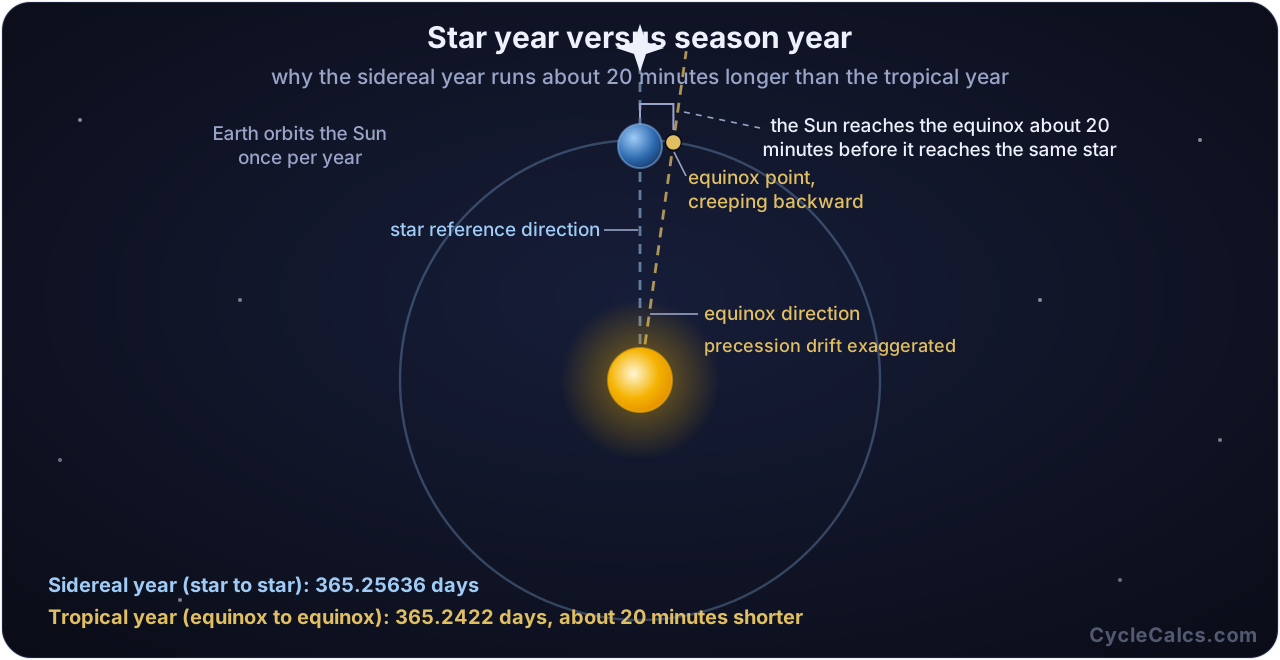
It runs about 20 minutes 24 seconds longer than the 365.2422-day tropical year that governs the seasons. That small surplus is not an accident of bookkeeping; it is the signature of precession. Because the equinox drifts westward along the ecliptic while Earth orbits, the Sun returns to the equinox slightly before it returns to the same star, and the two years part ways by exactly the precession rate.
How it works, in plain language: Precession of the equinoxes. This page carries the numbers.
On this page
Earth returns to the same point in its orbit against the fixed stars every 365.25636 days (365 d 6 h 9 min). From today's position, the next such return is October 11, 2027.
That is about 20 minutes longer than the year of the seasons; the gap is precession.
Where we are in the sidereal year right nowcomputed live
Earth completes one true orbit against the stars on October 11, 2027, one sidereal year from today's position, about 20 minutes longer than the tropical (calendar) year. With JavaScript on, this panel shows the live figure.
Computed live in your browser from the open-source Astronomy Engine. See every cycle together on the cosmic clock.
The sidereal year at a glance
| Period (days) | 365.25636 days |
|---|---|
| Period (h:m:s form) | 365 d 6 h 9 min 10 s |
| What it measures | return to the same position against the fixed stars |
| Reference frame | the stars (inertial), not the equinox |
| Longer than tropical year by | about 20 min 24 s (0.01417 d) |
| Shorter than anomalistic year by | about 4.7 minutes |
| Cause of the tropical gap | precession of the equinoxes |
| Great Year (precession cycle) | about 25,772 years at the measured rate |
Sources: U.S. Naval Observatory, Astronomical Information Center.
The sidereal year in every unit
The sidereal year written several ways, and its relationship to the neighboring definitions of the year.
| In days | 365.25636 days |
|---|---|
| In days, hours, minutes | 365 d 6 h 9 min 10 s |
| In hours | 365.25636 x 24 = 8,766.15 h |
| Sidereal minus tropical | 365.25636 - 365.24219 = 0.01417 d |
| That gap in minutes | 0.01417 d x 1440 = about 20.4 min/yr |
| Gap accumulated over the Great Year | 20.4 min/yr x 25,772 yr = about 1 full year |
| Anomalistic minus sidereal | 365.2596 - 365.25636 = about 0.0032 d (perihelion advance) |
Period constants from the U.S. Naval Observatory. The last two rows are rounded for display. The Great Year row uses the measured cycle of about 25,772 years, and the product comes to about 365 days, one full year, as it must, since the equinox laps the ecliptic exactly once per Great Year.
What the sidereal year is and how it arises
A year can be defined against different reference points, and the choice changes its length. The sidereal year uses the most physical one: the distant stars, which for this purpose form a fixed, non-rotating frame. Measured against them, Earth completes one orbit in 365.25636 days and arrives back at the same celestial longitude it started from. This is the orbital period in the strict sense, the number you would get by timing one full revolution about the Sun.
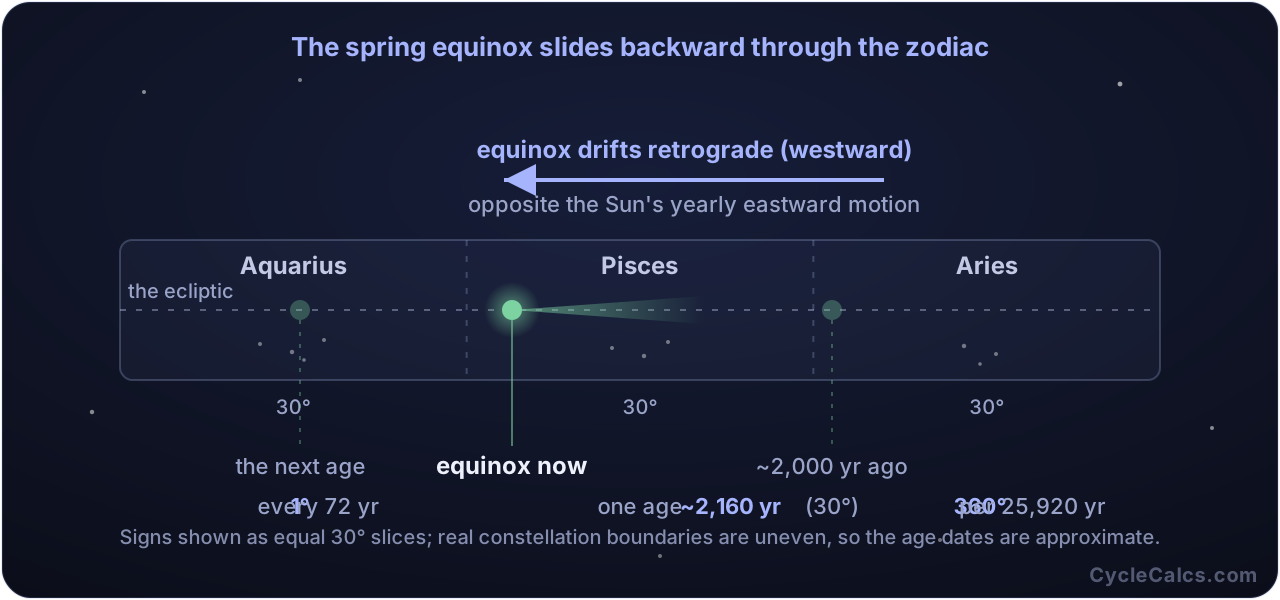
The more familiar tropical year is shorter because it is tied to the equinox rather than the stars, and the equinox does not hold still. Earth's rotation axis wobbles like a slow top, sweeping out a cone once in about 25,800 years. That motion drags the equinox point westward along the ecliptic by about 50.3 arcseconds a year, so the Sun crosses the equinox a little sooner each orbit than it returns to a given star. The seasons therefore keep a slightly shorter calendar than the orbit itself.
The sidereal year also differs from the anomalistic year, the perihelion-to-perihelion interval of 365.2596 days. Here the offset runs the other way: the anomalistic year is the longer of the two, because Earth's perihelion slowly advances along the orbit. The sidereal year sits between the tropical and the anomalistic, framed on one side by axis wobble and on the other by orbit rotation.
The math
The defining relationship is a subtraction. Take the sidereal year and remove the tropical year, and what remains is the precession of the equinoxes expressed as time: 365.25636 - 365.24219 = 0.01417 days. Multiplied by 1440 minutes in a day, that is about 20.4 minutes per year, the amount by which the Sun beats the stars back to the equinox each orbit.
That daily-looking scrap compounds. Run it forward and the equinox slides a full lap around the ecliptic in about 25,800 years, the Great Year of axial precession: 20.4 minutes per year accumulated across those years sums to about one whole year of drift. The same subtraction, done at the other end, gives the perihelion advance: the anomalistic year minus the sidereal year, 365.2596 - 365.25636, is the slow rotation of the orbit itself.
You can watch these two clocks separate on the cycles catalog, which lists the sidereal, tropical, and anomalistic years side by side so the arithmetic that connects them is visible at a glance.
The next orbital returns
| Earth back to the same star direction | Interval |
|---|---|
| Oct 11, 2027 | one sidereal year |
| Oct 10, 2028 | 365 days later |
| Oct 10, 2029 | 365 days later |
| Oct 10, 2030 | 365 days later |
| Oct 11, 2031 | 366 days later |
| Oct 10, 2032 | 365 days later |
How the sidereal year relates to other cycles
The sidereal year is best understood as one corner of a triangle with the tropical year and axial precession. Precession is not a separate phenomenon layered on top; it is precisely the difference between these two years, and the precession lesson walks through the geometry of the wobbling axis that produces the 20-minute gap.
The word 'sidereal' means the same thing here as it does for the Moon: measured against the stars rather than against a moving reference. The sidereal month is the Moon's true orbital period around Earth, defined by exactly the same star-referenced logic, and the two make a clean pair for seeing why astronomers so often prefer the fixed-star frame.
Frequently asked questions
How long is the sidereal year?
The sidereal year is 365.25636 days, which works out to 365 days, 6 hours, 9 minutes, and 10 seconds. It is Earth's true orbital period, the time the planet takes to return to the same position against the fixed background stars. This makes it the orbital period in the strict physical sense, timed against an inertial frame rather than against the seasons.
What is the difference between a sidereal year and a tropical year?
The sidereal year is measured against the fixed stars and the tropical year against the equinox. The sidereal year, 365.25636 days, runs about 20 minutes 24 seconds longer than the 365.2422-day tropical year. That gap of 0.01417 days is precession: the equinox drifts westward while Earth orbits, so the Sun returns to the equinox slightly before it returns to a given star.
Why is the sidereal year longer than the tropical year?
Because Earth's rotation axis precesses. The axis sweeps out a cone once in about 25,800 years, dragging the equinox point westward along the ecliptic by about 50.3 arcseconds each year. The Sun therefore crosses the equinox a little sooner every orbit than it returns to the same star, making the equinox-based tropical year the shorter of the two by roughly 20 minutes.
How does the sidereal year differ from the anomalistic year?
The anomalistic year, 365.2596 days, is measured from perihelion to perihelion, and it is about 4.7 minutes longer than the sidereal year. The difference comes from the slow advance of Earth's perihelion, which rotates the orbit gradually forward. So the sidereal year sits between the shorter tropical year and the longer anomalistic year.
Is the sidereal year Earth's true orbital period?
Yes. The sidereal year measures one complete revolution of Earth about the Sun relative to the fixed stars, so it is the orbital period in the physical sense. The tropical and anomalistic years are equally valid definitions, but they are tied to moving references, the equinox and the perihelion, rather than to an inertial frame.
Keep exploring
- The Tropical Year: the shorter, season-keeping year
- Axial Precession: the roughly 25,800-year wobble in the gap
- The Sidereal Month: the same star-referenced idea for the moon
- Precession Explained: the geometry behind the 20 minutes
- All Astronomical Cycles: the three years side by side