The sidereal month
How long does the Moon really take to orbit Earth?
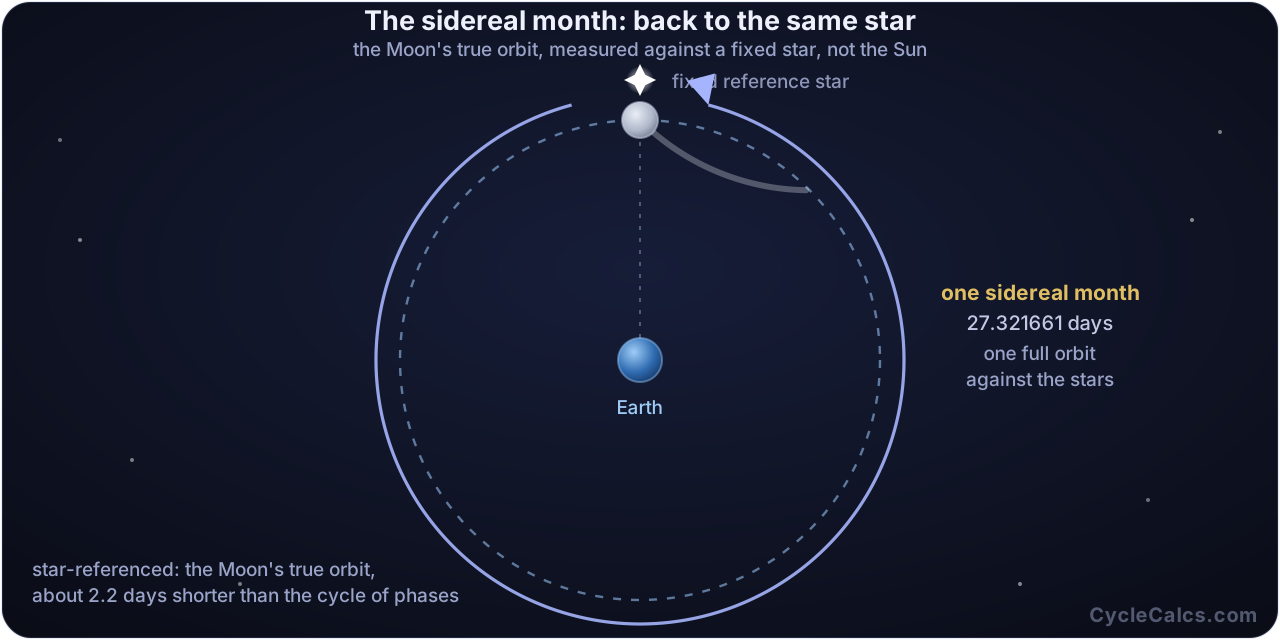
The sidereal month is 27.321661 days, or 27 days 7 hours 43 minutes. It is the time the Moon takes to return to the same position against the fixed stars, one true circuit of its orbit around Earth as seen from outside the Earth-Moon system.
This is the Moon's real orbital period, not the cycle of phases you watch in the sky. The familiar 29.530589-day synodic month is longer because Earth keeps moving along its own orbit, so the Moon must travel a little past one full circuit to line up with the Sun again. The star-referenced month strips that motion away and gives the orbit itself, which is why it runs about 2.2 days shorter.
How it works, in plain language: Synodic vs sidereal periods. This page carries the numbers.
On this page
Right now the Moon lies in Virgo. It returns to this same place among the stars every 27.321661 days (27 d 7 h 43 min), next on November 7, 2026.
That star-referenced orbit is about 2.2 days shorter than the cycle of phases you actually watch.
Where we are in the sidereal month right nowcomputed live
The Moon is currently in Virgo and returns to the same stellar longitude on November 7, 2026, one sidereal month from now. With JavaScript on, this panel names the Moon's constellation live.
Computed live in your browser from the open-source Astronomy Engine. See every cycle together on the cosmic clock.
The sidereal month at a glance
| Period | 27.321661 days |
|---|---|
| In hours and minutes | 27 d 7 h 43 min |
| What it measures | Moon's return to the same fixed star |
| Sidereal months per year | 13.368 |
| Shorter than synodic month by | about 2.2 days |
| Synodic month | 29.530589 days |
| Tropical month | 27.321582 days (about 7 s shorter) |
| Reference frame | the fixed stars, not the Sun or the equinox |
Sources: USNO, Astronomical Information Center.
The sidereal month in every unit
The sidereal month written in several forms and set against the Moon's other months and the year.
| In days | 27.321661 d |
|---|---|
| In hours | 27.321661 d x 24 = 655.72 h |
| In hours and minutes | 27 d 7 h 43 min |
| Sidereal months per year | 365.256 d / 27.321661 d = 13.368 |
| Versus synodic month | 27.321661 d vs 29.530589 d, about 2.2 d shorter |
| Versus tropical month | 27.321661 d vs 27.321582 d, about 7 s longer |
| Reconstructed from synodic + year | 1/29.530589 + 1/365.256 gives 27.3217 d |
Period constants from USNO and Jean Meeus, Astronomical Algorithms. The 13.368 figure and the reconstructed value are rounded from the exact constants above.
What the sidereal month is and how it arises
The sidereal month is the Moon's orbital period in its purest form. Pick a bright star near the ecliptic, note the Moon beside it tonight, and 27.321661 days later the Moon returns to that same star. That interval is one true revolution of the Moon around Earth, referenced to a frame that does not move: the distant stars.
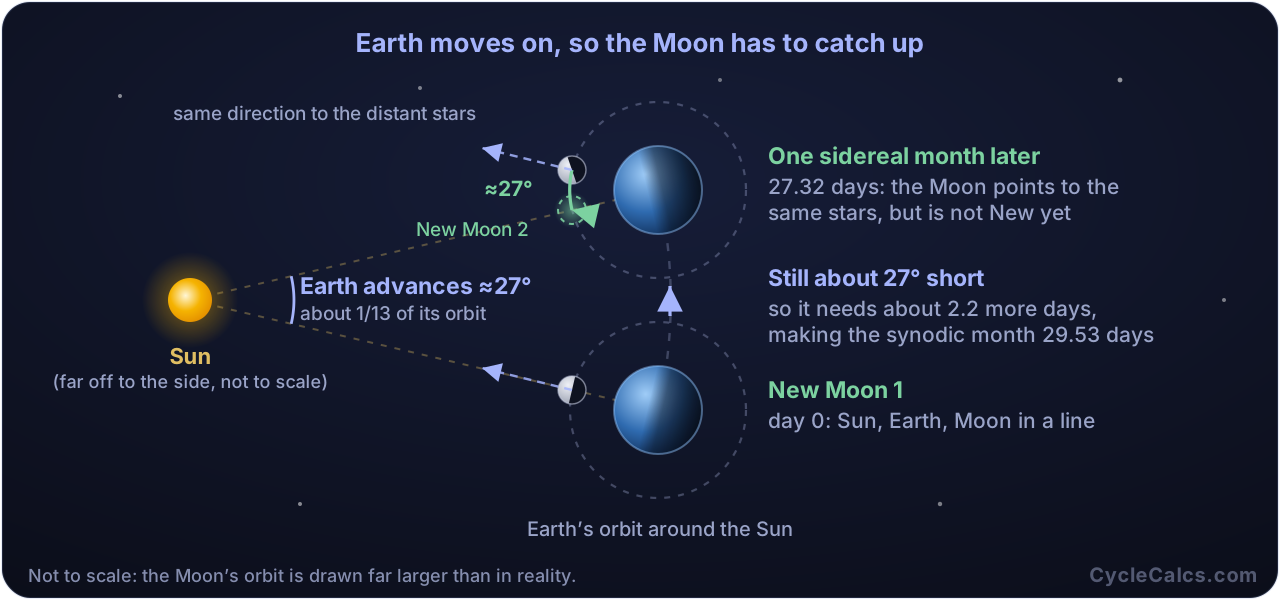
The reason it differs from the month of phases is Earth's own orbit. In one sidereal month the Earth-Moon system advances roughly 27 degrees around the Sun. The Moon has completed a full circuit against the stars, but the Sun now sits in a slightly different direction, so the Moon needs about 2.2 more days to catch up and repeat the same phase. That extra stretch turns the 27.32-day orbit into the 29.53-day synodic month.
A third, nearly identical month, the tropical month of 27.321582 days, is measured to the moving equinox rather than to a fixed star. Because the equinox drifts slowly westward through axial precession, the Moon reaches it about 7 seconds sooner than it reaches a truly fixed star, making the tropical month marginally shorter than the sidereal one.
The math
The sidereal and synodic months are tied together through Earth's motion around the Sun. Over one synodic month the Moon must make up the angle Earth has swept, which gives the relation 1/T_syn = 1/T_sid minus 1/T_year, where T_year is the length of Earth's orbit.
Rearranged to solve for the star-referenced orbit, 1/T_sid = 1/T_syn + 1/T_year = 1/29.530589 + 1/365.256, which works out to 27.3217 days. The same algebra explains the count of 13.368 sidereal months in a year against 12.37 synodic months: the orbit is faster than the phase cycle, so more of them fit.
You can watch both clocks at once, phases against stars, in the synodic versus sidereal lesson, which animates the extra 2.2 days as Earth carries the Sun-line forward.
The next returns to the same stars
| Moon back to the same star position | Interval |
|---|---|
| Nov 7, 2026 | one sidereal month |
| Dec 4, 2026 | 27 days later |
| Dec 31, 2026 | 27 days later |
| Jan 27, 2027 | 27 days later |
| Feb 24, 2027 | 28 days later |
| Mar 23, 2027 | 27 days later |
| Apr 20, 2027 | 28 days later |
| May 17, 2027 | 27 days later |
How the sidereal month relates to other cycles
The sidereal month is one of three lunar months that describe different things about the same orbit. The synodic month tracks phases against the Sun, while the anomalistic month tracks the distance cycle from perigee to perigee. Only the sidereal month gives the geometric orbit itself, the Moon's return to a fixed direction in space.
Its year-length counterpart is the sidereal year, which does for Earth's orbit what the sidereal month does for the Moon's: it measures a return to the fixed stars rather than to the Sun or the equinox. Both are the star-referenced members of their families, and both differ from their tropical cousins by the small margin that precession introduces.
Frequently asked questions
How long is a sidereal month?
A sidereal month is 27.321661 days, or 27 days 7 hours 43 minutes. It is the time the Moon takes to return to the same position against the fixed stars, one complete revolution around Earth. This is the Moon's true orbital period, and it runs about 2.2 days shorter than the 29.530589-day synodic month of phases.
What is the difference between a sidereal month and a synodic month?
A sidereal month, 27.321661 days, measures the Moon's orbit against the fixed stars. A synodic month, 29.530589 days, measures the cycle of phases against the Sun. The synodic month is about 2.2 days longer because Earth moves along its own orbit during that time, so the Moon must travel past one full circuit to line up with the Sun again.
Why is the sidereal month shorter than the month of phases?
Because Earth is orbiting the Sun. During one sidereal month the Earth-Moon system moves roughly 27 degrees around the Sun. The Moon completes its circuit against the stars in 27.32 days, but the Sun's direction has shifted, so the Moon needs about 2.2 more days to repeat the same phase. That gives the longer 29.53-day synodic month.
How many sidereal months are in a year?
There are 13.368 sidereal months in a year. Dividing the year of 365.256 days by the sidereal month of 27.321661 days gives that figure. It is more than the 12.37 synodic months in a year because the orbital period is shorter than the cycle of phases, so more true circuits fit into the same span.
What is a tropical month and how does it differ?
A tropical month is 27.321582 days, measured from the Moon's return to the equinox rather than to a fixed star. It is about 7 seconds shorter than the sidereal month because the equinox drifts slowly westward through axial precession, so the Moon reaches it a moment sooner than it reaches a truly fixed star.
Keep exploring
- Synodic month: the 29.53-day cycle of phases
- Anomalistic month: perigee to perigee, the distance cycle
- Sidereal year: earth's star-referenced orbit
- Synodic vs sidereal: two lunar clocks side by side
- The Moon: the orbiting body itself