The anomalistic month
When is the Moon closest to Earth, and why does its size change?
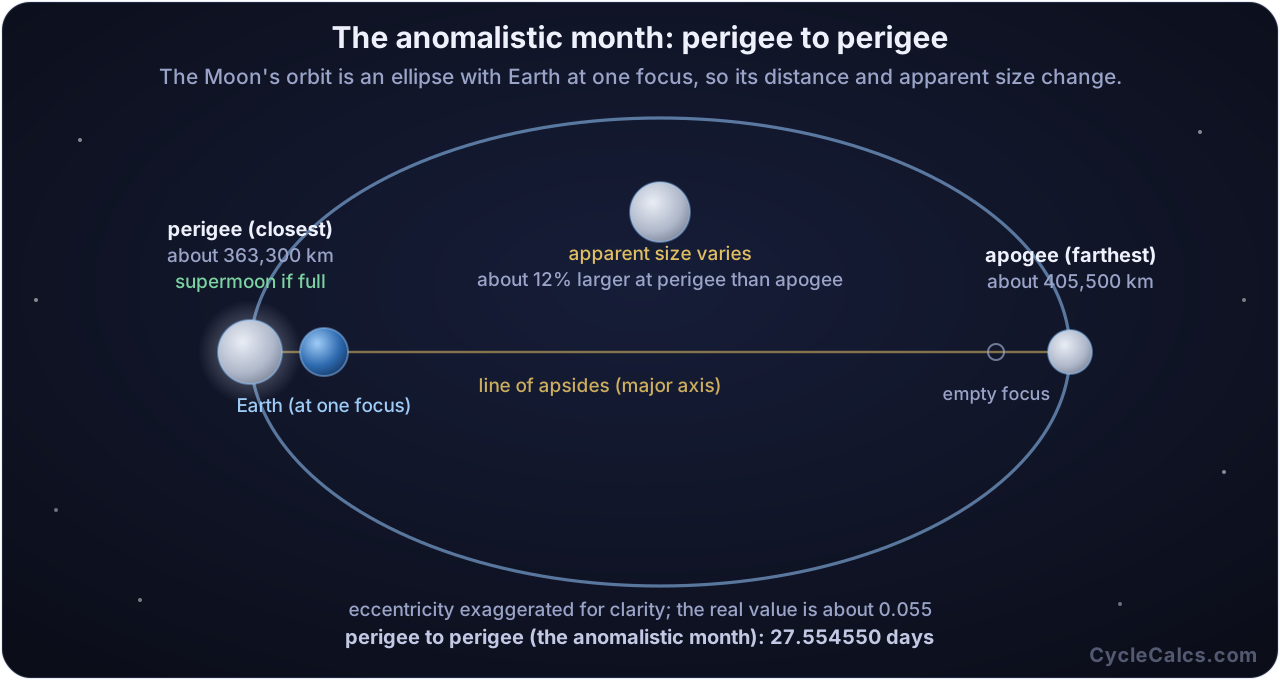
The anomalistic month is 27.554550 days, or 27 d 13 h 19 min, the time the Moon takes to return from perigee (its closest approach to Earth) to perigee again. This is the Moon's distance cycle. Over its course the Moon swings from perigee out to apogee and back, its apparent diameter growing and shrinking by roughly a seventh and its motion across the sky speeding up and slowing down in step.
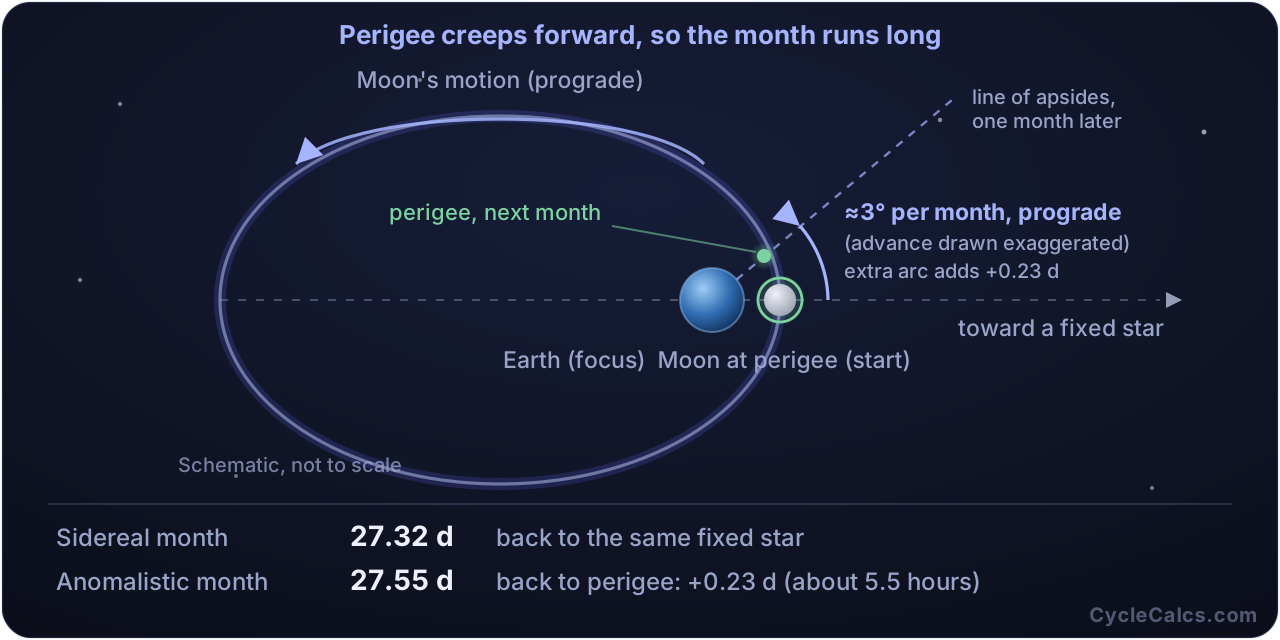
It runs a little longer than the 27.321661-day sidereal month, the time to return to the same star, because the long axis of the Moon's orbit, its line of apsides, does not hold still. The apsides creep forward, so each lap the Moon must travel slightly past a full orbit to catch perigee again. When one of those perigee passages coincides with a full Moon, the result is the large, bright disk popularly called a supermoon.
How it works, in plain language: Apsidal precession. This page carries the numbers.
On this page
The Moon next reaches perigee (closest) on October 28, 2026 at 364,397 km, and apogee (farthest) on October 16, 2026 at 404,632 km.
Perigee to perigee runs 27.554550 days (27 d 13 h 19 min), a little longer than the star-referenced orbit because the Moon's orbit slowly turns.
Where we are in the anomalistic month right nowcomputed live
The next lunar perigee is October 28, 2026 (364,397 km) and the next apogee is October 16, 2026. A perigee near a full moon gives a supermoon. With JavaScript on, this panel updates as the Moon nears each.
Computed live in your browser from the open-source Astronomy Engine. See every cycle together on the cosmic clock.
The anomalistic month at a glance
| Period | 27.554550 days |
|---|---|
| In hours and minutes | 27 d 13 h 19 min |
| Defined by | perigee to perigee |
| Governs | the Moon's apparent size and speed; supermoons |
| Longer than sidereal month by | about 0.232889 days (5 h 35 min) |
| Cause of the excess | forward precession of the line of apsides |
| Apsidal precession period | about 8.85 years |
| Anomalistic months in one Saros | 239 |
Sources: U.S. Naval Observatory, Astronomical Information Center.
The anomalistic month in every unit
The anomalistic month expressed in several units and set against the cycles it helps build.
| In days | 27.554550 d |
|---|---|
| In hours | 27.554550 d x 24 = 661.3092 h |
| In days, hours, minutes | 27 d 13 h 19 min |
| Minus the sidereal month | 27.554550 d - 27.321661 d = 0.232889 d |
| Apsidal precession, one turn | about 8.85 years, or about 40.7 deg per year |
| Anomalistic months in a Saros | 239 x 27.554550 d = 6,585.54 d |
| Compared with the Saros length | 6,585.32 d (223 synodic months) |
Period from the USNO; the 6,585.54-day figure for 239 anomalistic months is close to but not identical with the 6,585.32-day Saros, and the small gap is why perigee circumstances drift slowly across an eclipse series.
What the anomalistic month is and how it arises
The Moon's orbit is an ellipse, not a circle, so its distance from Earth is never fixed. At perigee the Moon comes closest; half a lap later, at apogee, it is farthest. The anomalistic month measures one full round of this distance cycle, perigee to perigee. Because the Moon moves fastest when nearest and slowest when farthest, following Kepler's rule that a body sweeps equal areas in equal times, the same cycle sets the rhythm of the Moon's changing speed across the sky.
If the orbit's ellipse stayed frozen in space, the anomalistic month would match the sidereal month exactly, since the Moon would reach perigee at the same point among the stars each time. It does not. The whole ellipse slowly rotates in its own plane, carried forward by the gravitational tugging of the Sun. The point of perigee therefore advances, and the Moon has to travel a little beyond one full orbit to overtake it. That extra travel is what makes the anomalistic month the longest of the Moon's orbital months, longer than the sidereal, tropical and draconic months, though still shorter than the 29.53-day synodic month of phases.
When perigee happens to land within a day or so of full Moon, the Moon appears at its largest and brightest, the familiar supermoon. There is nothing exotic in it; it is simply the near coincidence of the distance cycle with the phase cycle, two clocks of slightly different length that drift in and out of alignment.
The math
The gap between the two months comes entirely from apsidal precession. The line of apsides advances about 40.7 degrees per year, completing one full turn in about 8.85 years. In the time of one sidereal month the perigee point has moved forward a small amount, so the Moon must cover that extra arc before it is again at closest approach. Numerically the difference is 27.554550 d - 27.321661 d = 0.232889 d, about 5 hours 35 minutes per month.
The same 27.554550-day beat threads through eclipse prediction. Stack 239 anomalistic months and you get 239 x 27.554550 d = 6,585.54 d, close to the 6,585.32-day Saros of 223 synodic months. Because the two totals nearly agree, successive eclipses one Saros apart repeat with almost the same Earth-Moon distance, which is why a run of central eclipses tends to be all total or all annular for a long stretch.
To see the distance cycle in motion, and to find when the next perigee falls near a full Moon, use the supermoon and lunar-distance tools on the Moon page.
The next perigees and apogees
| Date | Apsis | Distance |
|---|---|---|
| Oct 16, 2026 | Apogee (far) | 404,632 km |
| Oct 28, 2026 | Perigee (near) | 364,397 km |
| Nov 13, 2026 | Apogee (far) | 405,608 km |
| Nov 25, 2026 | Perigee (near) | 359,335 km |
| Dec 11, 2026 | Apogee (far) | 406,407 km |
| Dec 24, 2026 | Perigee (near) | 356,641 km |
| Jan 7, 2027 | Apogee (far) | 406,597 km |
| Jan 21, 2027 | Perigee (near) | 357,273 km |
How the anomalistic month relates to other cycles
The Moon keeps several clocks at once, and they are worth holding apart. The sidereal month (27.321661 d) times the Moon's return to the same star; the synodic month (29.530589 d) times the cycle of phases; the anomalistic month (27.554550 d) times the cycle of distance. The anomalistic month is the odd one out in that its clock is set not by a fixed direction in space but by the slowly turning shape of the orbit itself, described in the Learn lesson on apsidal precession.
Its close partnership with distance also ties it to eclipses. The near match of 239 anomalistic months with the Saros is one of the three near-commensurabilities (with the synodic and draconic months) that make the Saros such a reliable eclipse predictor.
Frequently asked questions
How long is the anomalistic month?
The anomalistic month is 27.554550 days, which is 27 days 13 hours 19 minutes. It measures the time the Moon takes to return from perigee, its closest point to Earth, back to perigee. This is the longest of the Moon's orbital months, running about five and a half hours longer than the sidereal month, though the 29.53-day synodic month of phases is longer still.
Why is the anomalistic month longer than the sidereal month?
Because the Moon's orbit slowly rotates. The line of apsides, the long axis of the ellipse, advances about 40.7 degrees per year and completes one turn in about 8.85 years. Since perigee keeps moving forward, the Moon must travel a little past a full sidereal orbit to reach perigee again, adding about 0.232889 days to the month.
What causes supermoons?
A supermoon happens when the perigee passage of the anomalistic month falls close to a full Moon in the synodic month. The two cycles have slightly different lengths, 27.554550 days and 29.530589 days, so they drift in and out of step. When they nearly coincide, the full Moon sits near its closest approach and looks larger and brighter than usual.
How does the anomalistic month relate to the Saros?
The Saros eclipse cycle contains 239 anomalistic months. Multiplying gives 239 times 27.554550 days, or 6,585.54 days, close to the 6,585.32-day Saros of 223 synodic months. This near match means eclipses one Saros apart occur at nearly the same Earth-Moon distance, keeping a series of central eclipses consistently total or annular for many centuries.
Is the anomalistic month the same as the sidereal month?
No. The sidereal month, 27.321661 days, times the Moon's return to the same star. The anomalistic month, 27.554550 days, times its return to perigee, the point of closest approach. They differ because the orbit's perigee slowly precesses forward, so the anomalistic month is about 0.232889 days, roughly five and a half hours, longer.
When is the next lunar perigee?
The Moon next reaches perigee, its closest approach, on October 28, 2026 at about 364,397 kilometers. Perigees recur every anomalistic month of 27.55 days; a perigee near a full moon makes a supermoon.
Keep exploring
- The Sidereal Month: the star-return cycle, 27.321661 days
- The Synodic Month: the cycle of phases, 29.530589 days
- The Saros: 239 anomalistic months in one lap
- Apsidal Precession: why perigee slowly turns
- The Moon: distance, supermoons, and lunar tools
Cite this page
CycleCalcs, "The Anomalistic Month: Perigee to Perigee", CycleCalcs LLC, https://www.cyclecalcs.com/cycles/anomalistic-month.html (add your access date). The underlying event datasets are archived with a permanent DOI: 10.5281/zenodo.21905241, which always resolves to the newest version. Since v1.1.0 that archived record also carries the engine's accuracy study against JPL Horizons, with every raw residual and the code that reproduces it; the same files are browsable in the data repository.
Every computed value on this page is public domain: CycleCalcs asserts no copyright in calculated astronomical facts and dedicates any such right to CC0, stated here. Quote the numbers freely, with or without credit. Conventions and sources: the engine and sources.
The data behind this page. Lunar perigees and apogees 1700-2200: instants and Earth-Moon distance, free and in the public domain under CC0: CSV. The archive files are regenerated by a documented build and published with a SHA-256 manifest.