Axial precession (the Great Year)
Why does the pole star change over thousands of years?
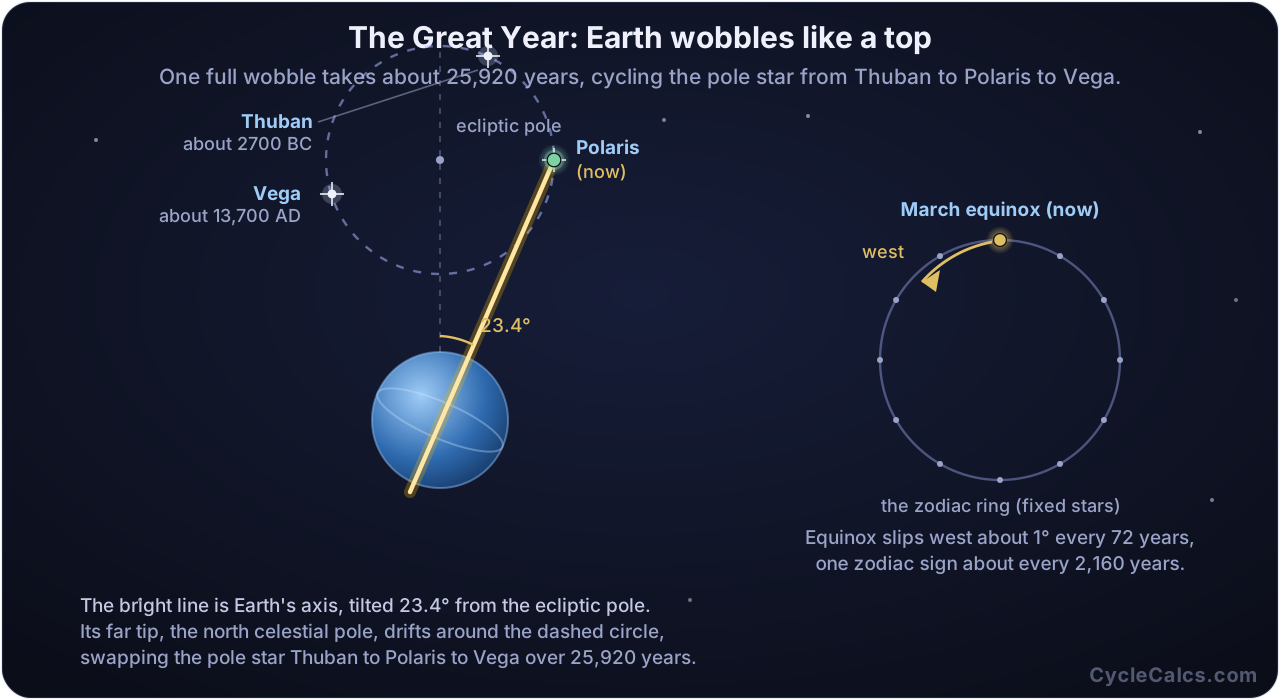
Axial precession is the slow wobble of Earth's spin axis, which sweeps out a full cone in about 25,800 years, the span known as the Great Year. Over that interval the celestial pole traces a circle around the ecliptic pole, the equinox point slides steadily westward around the sky, and the star that happens to mark true north changes from one age to the next.
This is the slowest cycle we track, a secular drift with no daily or yearly ephemeris signal to read off a clock. It is also the reason the tropical year runs shorter than the sidereal year, and the reason the zodiac signs have slid out of step with the constellations that once named them. For the physics worked through in full, see the precession lesson.
How it works, in plain language: Precession of the equinoxes. This page carries the numbers.
On this page
Earth's axis is tracing a slow cone, carrying the March equinox westward about one degree every 71.6 years. By the official constellation boundaries of the International Astronomical Union (IAU) it lies in Pisces today and will cross into Aquarius around the year 2597. Our pole star is Polaris.
Where we are in axial precession right nowcomputed live
Axial precession is a slow, steady drift, not a dated event, but it has a position: since the year 2000 the March equinox has drifted about 0.374° west along the ecliptic (measured IAU 2006 rate, mean equinox, as of 2026). The equinox point lies in Pisces by the IAU boundaries, the pole star is Polaris, and a full turn is under way. The milestones below mark the road ahead.
Computed live in your browser from the open-source Astronomy Engine. See every cycle together on the cosmic clock.
Axial precession (the Great Year) at a glance
| Period | about 25,772 years at the measured rate (IAU 2006) |
|---|---|
| Drift of the equinox | about 50.288 arcseconds per year, westward |
| One degree of drift | about 71.6 years |
| March equinox in Pisces (IAU boundaries) | since 68 BCE; crosses into Aquarius in 2597 |
| Type of motion | secular drift; no daily or yearly ephemeris signal |
| Current pole star | Polaris (Alpha Ursae Minoris) |
| Pole star around 4000 CE | Gamma Cephei (Errai) |
| Pole star around 13,700 CE | Vega |
| Cause | Sun and Moon pulling on Earth's equatorial bulge |
Sources: U.S. Naval Observatory, Astronomical Applications.
Axial precession (the Great Year) in every unit
The Great Year is not built from other lunar or planetary months; it follows from one rate, the westward drift of the equinox, and divides cleanly into degrees of that drift.
| In years | about 25,772 years (one Great Year at the measured rate) |
|---|---|
| In days | about 9,413,068 days |
| In centuries | about 258 centuries |
| Equinox drift | about 1 degree every 71.6 years; 360 degrees at that rate take about 25,772 years |
| Passage through Pisces (IAU boundaries) | 68 BCE to 2597, about 2,664 years; the passage before it, through Aries, took about 1,797 years, because the IAU constellations are unequal |
| Regression rate | about 50.288 arcseconds per year |
| Pole-star cone | the celestial pole circles once, returning near Polaris after about 25,800 years |
Day and century totals use a 365.25-day year and are approximate. The rows use the measured drift: 50.288 arcseconds per year in the IAU 2006 model (Capitaine, Wallace and Chapront 2003), about 50.29 in the U.S. Naval Observatory tables and Jean Meeus, Astronomical Algorithms. The rate itself creeps up very slowly, so any one-turn figure is approximate. The Pisces passage uses the official IAU constellation boundaries.
What axial precession is and how it arises
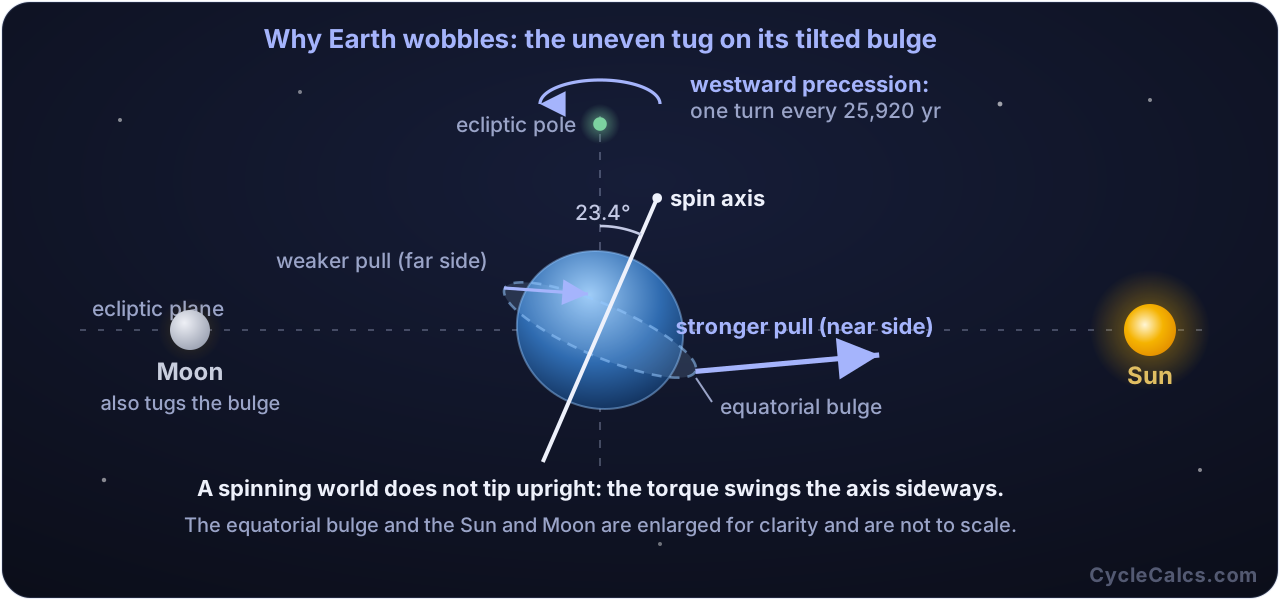
Earth is not a perfect sphere. Its spin has thrown a slight bulge around the equator, and that bulge sits tilted about 23.4 degrees to the plane of Earth's orbit. The Sun and the Moon both pull on the near side of the bulge a little harder than the far side, and the net effect is a torque that tries to lever the tilt upright. A spinning body does not tip in the direction it is pushed; it responds at right angles, so instead of straightening, the axis swings slowly around in a cone. That gyroscopic response, played out over millennia, is axial precession.
Because the axis is moving, the point on the sky it aims at moves too. Right now the north celestial pole sits close to Polaris, which is why Polaris holds still while the sky wheels around it. That is a coincidence of our era, not a permanent fact. Around the year 4000 the pole will have crept toward Gamma Cephei, the star Errai, and around the year 13,700 it will lie near brilliant Vega. After a full turn, about 25,800 years at today's rate, the pole returns close to Polaris again, around the year 27,900.
Down on the ecliptic, the Sun's yearly path across the sky, the same motion drags the equinox, the crossing point where the Sun moves from south to north of the celestial equator, steadily westward, about 1 degree every 71.6 years. By the official constellation boundaries of the International Astronomical Union it left Aries for Pisces in 68 BCE and crosses into Aquarius in 2597. This is why the tropical zodiac signs no longer overlap the constellations they were named for. The zodiac here is only a coordinate grid laid along the ecliptic; the drift is geometry, nothing more.
The math
The cleanest way to see the length is through the drift rate. The equinox creeps westward about 50.288 arcseconds per year (the IAU 2006 rate), which is about 71.6 years per degree. A full circle is 360 degrees, or 1,296,000 arcseconds, so one complete turn takes 1,296,000 / 50.288 = about 25,772 years. The rate itself creeps up very slowly, so the figure is approximate. The motion is slow enough that it took ancient observers centuries of records to notice it at all.
To find how far the sky has shifted since any reference date, take the fraction of the cycle that has elapsed and turn it into an angle: (years since epoch / 25,772) x 360 degrees, dividing by the measured length of the cycle. That is the number of degrees the equinox has slid westward along the ecliptic since the epoch, and equally the angle by which today's pole has swung around its cone.
Precession has no daily or yearly event to wait for, so the live panel above reports a position rather than a date: how far the equinox has drifted since the year 2000, which IAU constellation the equinox point occupies, and its longitude against two named sidereal zero points. Beyond that reading it is a background that reshapes every other cycle over deep time. To see where it sits alongside the faster rhythms of the sky, browse the full cycles list by length.
Milestones of the Great Year
| Approximate year | Milestone |
|---|---|
| Now (2026) | Pole star Polaris; March equinox in Pisces (since 68 BCE), 0.37° west of its year-2000 position |
| around 2597 | The March equinox crosses into Aquarius |
| around 4000 | Gamma Cephei (Errai) becomes the pole star |
| around 7500 | Alderamin nears the north celestial pole |
| around 13,700 | Vega, the brightest pole star of the whole cycle |
| around 27,900 | The pole passes closest to Polaris again, one measured Great Year (about 25,772 years) after its closest approach around 2100 |
How axial precession relates to other cycles
Precession is best understood through the two year lengths it pulls apart. The sidereal year measures Earth's orbit against the fixed stars, while the tropical year measures it against the equinox, which precession is steadily dragging westward. Since the equinox moves to meet the incoming Sun a little early each year, the tropical year finishes first; the roughly twenty-minute head start it gains every year is precession, accumulated one orbit at a time.
The axial wobble is also one strand of the longer climate rhythms in the Milankovitch cycles, where it combines with the slow turn of Earth's elliptical orbit to set the timing of the seasons relative to Earth's closest approach to the Sun. On the site, precession is the deep-time floor beneath every faster cycle, one turn of which outlasts three hundred human lifetimes.
Frequently asked questions
How long is one Great Year of axial precession?
About 25,772 years at the measured rate, 50.288 arcseconds per year (IAU 2006). That is the time Earth's spin axis takes to sweep out a full cone and return to where it started, and equally the time the equinox takes to slide all the way around the ecliptic: 1,296,000 arcseconds divided by 50.288. The rate creeps up very slowly, so the figure is approximate. Many references quote a rounder traditional figure; the precession lesson explains where it comes from.
What causes axial precession?
Earth has a bulge around its equator, and the Sun and Moon pull harder on the near side of that bulge than the far side. The result is a torque that would tip the tilt upright, but because Earth is spinning it responds sideways instead, like a leaning top. So the axis swings slowly around in a cone rather than straightening, once in about 25,800 years.
Will Polaris always be the North Star?
No. Polaris marks north only in our era. As the axis precesses, the north celestial pole drifts away from it. Around the year 4000 the pole moves toward Gamma Cephei, the star Errai, and around the year 13,700 it lies near Vega. After a full turn, about 25,800 years, the pole circles back close to Polaris again, around the year 27,900.
Why are the zodiac signs no longer aligned with the constellations?
Because precession drags the equinox westward about 1 degree every 71.6 years. The tropical signs are a coordinate grid anchored to the equinox, so as the equinox moves, the grid slides against the star patterns that once named it. By the official IAU boundaries the March equinox left Aries for Pisces in 68 BCE, so along the ecliptic of 2026 only the last 0.9 degree of the slice still called Aries reaches the constellation Aries; the rest of it runs through Pisces. It is geometry, not meaning.
How does precession make the tropical year shorter than the sidereal year?
The sidereal year is Earth's orbit measured against the fixed stars. The tropical year is measured against the equinox, which precession is moving westward to meet the Sun a little early each orbit. Because the finish line comes to the runner, the tropical year ends about twenty minutes sooner than the sidereal year. That small yearly gap is precession showing up one orbit at a time.
Does precession shift the zodiac against the constellations?
Yes. Over the Great Year the equinox slides all the way around the ecliptic, so the tropical zodiac signs, which are anchored to the equinox, gradually fall out of step with the constellations of the same name. The March equinox now lies in Pisces rather than Aries: by the official IAU boundaries it crossed from Aries into Pisces in 68 BCE.
Keep exploring
- The precession lesson: the physics, worked through
- The tropical year: the year precession shortens
- The sidereal year: the orbit against the stars
- Milankovitch cycles: precession and the ice ages
- All cycles by length: where the great year sits