The lunar nodal cycle
Why do the Moon's nodes slide backward around the sky in 18.6 years?
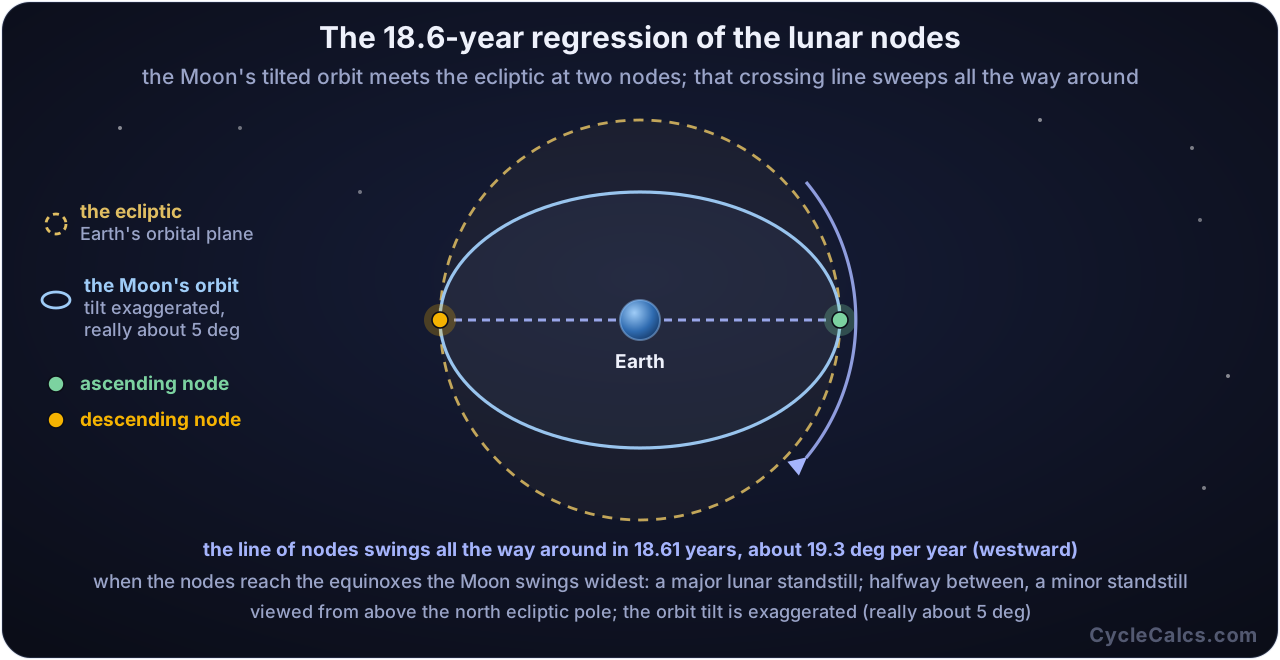
The lunar nodal cycle is the 6,798.383 days (18.61 years) it takes the Moon's ascending node to travel once all the way around the ecliptic. The node is where the Moon's tilted orbit crosses Earth's orbital plane, and it does not sit still: it drifts steadily westward, or regresses, at about 19.34 degrees per year. Run that drift for 18.61 years and the crossing point has swept through the full 360 degrees of ecliptic longitude and returned to where it began.
That slow circulation is the master clock behind several effects that look unrelated until you trace them back to the node. It tilts the Moon's monthly path higher or lower against the horizon, producing the major and minor lunar standstills that alternate roughly every 9.3 years. It nods Earth's spin axis in the 18.6-year nutation, and it modulates the tides on the same beat. To see where the node sits and how the Moon's orbit tilts, start with the lunar nodes lesson and the Moon's object page.
How it works, in plain language: The lunar nodes. This page carries the numbers.
On this page
The Moon's ascending node now sits at Aquarius 27° and regresses about 19.3 degrees a year. The next minor standstill is around May 21, 2034.
One full turn of the node, 6,798.383 days (18.61 years), swings the Moon between its widest and narrowest monthly range in the sky.
Where we are in the lunar nodal cycle right nowcomputed live
The lunar node is regressing through the zodiac; the next minor standstill falls around May 21, 2034. Standstills alternate about every 9.3 years. With JavaScript on, this panel shows the node's live position.
Computed live in your browser from the open-source Astronomy Engine. See every cycle together on the cosmic clock.
The lunar nodal cycle at a glance
| Period | 6,798.383 days |
|---|---|
| In years | 18.6129 years |
| Motion of the node | westward (regression) |
| Rate | about 19.34 degrees per year |
| Standstill spacing | major to minor about every 9.3 years |
| Node position at major standstill | ascending node near 0 degrees ecliptic longitude |
| Drives | nutation, lunar standstills, 18.6-year tidal modulation |
| Half-cycle | about 9.3 years |
Sources: U.S. Naval Observatory, Astronomical Information Center.
The lunar nodal cycle in every unit
The nodal period expressed in several units and set against the Moon's other periods, so its 18.6-year length can be checked against familiar cycles.
| In days | 6,798.383 d |
|---|---|
| In years | 6,798.383 d / 365.25 d = 18.6129 yr |
| In eclipse years | 6,798.383 d / 346.62 d = 19.61 eclipse years |
| In sidereal months | 6,798.383 d / 27.321661 d = 248.83 sidereal months |
| Node rate | 360 deg / 18.6129 yr = 19.34 deg/yr |
| Half-cycle (standstill to standstill) | 18.6129 yr / 2 = 9.31 yr |
| Degrees per day | 360 deg / 6,798.383 d = 0.05295 deg/day |
Period from USNO and standard astronomical references. The eclipse-year (346.62 d) and sidereal-month (27.321661 d) counts are ratios, not whole numbers, since these periods are not commensurate; the 19.34 deg/yr and 9.31 yr figures follow directly from the 18.6129-year period. Rates are rounded and are mean values, since the node's motion is not perfectly uniform.
What the lunar nodal cycle is and how it arises
The Moon's orbit is tilted about 5 degrees to the ecliptic, so the orbit pierces the ecliptic plane at two points: the ascending node, where the Moon crosses going north, and the descending node opposite it. If the Sun and the rest of the solar system exerted no sideways pull, those crossing points would stay fixed among the stars. They do not. The Sun's gravity tugs on the tilted lunar orbit and forces the whole orbital plane to wobble like a spinning coin settling on a table. The nodes are the visible signature of that wobble, and they slide westward around the ecliptic once every 18.61 years.
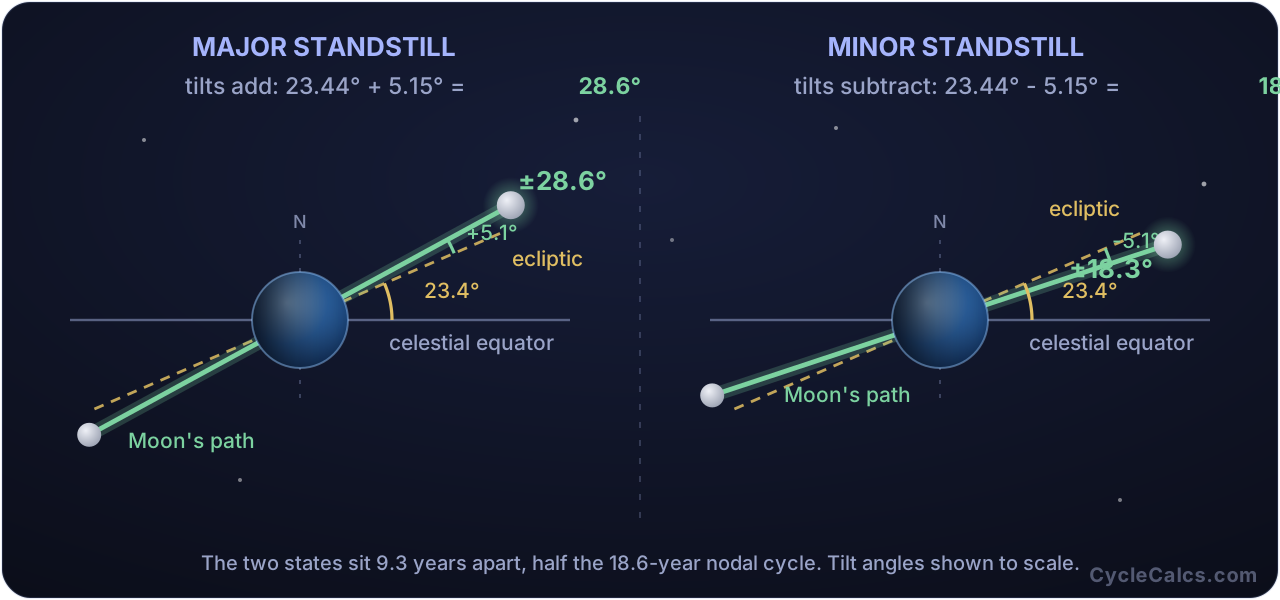
As the node circulates, it changes how the Moon's 5-degree tilt adds to or subtracts from Earth's 23.4-degree axial tilt. When the ascending node sits near 0 degrees of ecliptic longitude, the two tilts stack, and over a month the Moon swings across a declination range wider than the Sun ever reaches. That is a major lunar standstill: the Moon rises and sets at its most extreme northerly and southerly points, and its highest passes climb steeply while its lowest passes skim the horizon. About 9.3 years later the tilts partly cancel, the monthly swing shrinks, and a minor standstill occurs.
The same tug that moves the nodes also rocks Earth. The gravitational torque on Earth's equatorial bulge, modulated by the circulating lunar orbit, makes the spin axis nod with a period of 18.6 years, the principal term of nutation. On the oceans, the changing geometry shifts the balance of the tide-raising forces, adding a small 18.6-year modulation to long-term tidal ranges that shows up clearly in century-long sea-level records.
The math
The governing quantity is the rate at which the node sweeps through ecliptic longitude. One full circuit is 360 degrees and it takes 18.6129 years, so the mean regression rate is 360 degrees / 18.6129 years = 19.34 degrees per year, or equivalently 360 degrees / 6,798.383 days = 0.05295 degrees per day. Because the motion is westward, the node meets the Sun a little sooner each time, which is why the eclipse year runs shorter than the calendar year, though that is a separate cycle from the node's own circulation.
Standstills are set purely by where the node sits. A major lunar standstill occurs when the ascending node is near 0 degrees of ecliptic longitude, tilting the Moon's path to its widest declination range, roughly the 23.4-degree obliquity plus the 5-degree orbital tilt. Advance the node halfway around, 180 degrees, and the tilts subtract: that is the minor standstill, 18.6129 / 2 = 9.31 years later. To watch the node's longitude tick forward and find the next standstill window, use the Moon tracker on the Moon's object page.
The next lunar standstills
| Approximate date | Lunar standstill |
|---|---|
| May 21, 2034 | Minor standstill |
| Sep 10, 2043 | Major standstill |
| Dec 30, 2052 | Minor standstill |
| Apr 21, 2062 | Major standstill |
How the lunar nodal cycle relates to other cycles
The nodal cycle is the parent of two cycles that get more attention. Because the nodes regress, the Sun returns to a node in an eclipse year of about 346.6 days rather than a full calendar year, which is why eclipse seasons drift earlier each year. Stack the nodal motion with the returns of the new or full Moon and the Moon's varying distance and you get the eighteen-year Saros, the interval over which similar eclipses repeat. The Saros and the nodal cycle share the same eighteen-year neighborhood by an arithmetic coincidence, not because one causes the other.
The node's circulation is distinct from the swing of the Moon's distance, which is governed by the rotation of the orbit's long axis over the anomalistic month. Both are slow orbital precessions, but the nodes move westward while the line of apsides moves eastward. For the geometry of the crossing points themselves, the lunar nodes lesson works through why the orbit is tilted and how the nodes are defined, and the full family sits together on the cycles catalog.
Frequently asked questions
How long is the lunar nodal cycle?
The lunar nodal cycle lasts 6,798.383 days, which is 18.6129 years, usually rounded to 18.6 years. In that time the Moon's ascending node drifts once all the way around the ecliptic and returns to its starting longitude. Because the node moves westward, this is called nodal regression, and it runs at a mean rate of about 19.34 degrees per year.
What is a lunar standstill?
A lunar standstill is when the Moon's monthly north-south swing in declination reaches an extreme. At a major standstill the ascending node sits near 0 degrees of ecliptic longitude, so the Moon's 5-degree orbital tilt adds to Earth's axial tilt and the Moon reaches its most extreme rising and setting points. A minor standstill, with the smallest swing, follows about 9.3 years later.
Why does the Moon's node move?
The Sun's gravity pulls sideways on the Moon's tilted orbit and forces the whole orbital plane to precess, like a spinning coin wobbling as it settles. The nodes, where the orbit crosses the ecliptic, are the visible mark of that wobble. They slide westward around the ecliptic once every 18.61 years, a motion called nodal regression.
How is the nodal cycle related to nutation?
The same solar torque that moves the lunar nodes also acts on Earth's equatorial bulge, and the circulating lunar orbit modulates it. That produces the principal term of nutation, an 18.6-year nodding of Earth's spin axis. So the axis wobble and the node's circulation share exactly the same period, 18.61 years, because they trace back to the same gravitational cause.
Is the nodal cycle the same as the Saros?
No. The nodal cycle, 18.61 years, is how long the Moon's node takes to circle the ecliptic. The Saros, about 18.03 years, is how long until similar eclipses repeat. Both land near eighteen years, but that is an arithmetic coincidence, not cause. The Saros combines several lunar periods, while the nodal cycle is the node's own motion alone.
When is the next major lunar standstill?
The next major lunar standstill, when the Moon reaches its widest monthly swing in declination, is around September 10, 2043. Standstills follow the 18.6-year regression of the lunar nodes, alternating major and minor about every 9.3 years.
Keep exploring
- The Eclipse Year: how node regression shortens the year
- The Saros: the eighteen-year eclipse repeat
- The Anomalistic Month: the orbit's other slow precession
- Lunar Nodes: why the orbit is tilted
- The Moon: track the node and standstills