Venus
Venus is the brightest planet and, after the Sun and the Moon, the brightest natural object in the sky, peaking near magnitude −4.8 (on the astronomers' brightness scale, lower numbers mean brighter). Nearly Earth's twin in size but orbiting closer to the Sun, it never strays far from the Sun as seen from Earth, which is why it appears either as the famous evening star, low in the west after sunset, or as the morning star, in the east before dawn, spending roughly nine and a half months in each role before switching.
The live panel below shows which role Venus is playing right now from your location: when it rises or sets tonight, how bright it currently is, and where to look. Everything is computed in your browser as you read.
On this page
Venus is the evening star until its conjunction on October 24, 2026, visible low in the west after sunset. Its next greatest elongation, the widest and best-placed point of this apparition, comes on January 3, 2027 (47° from the Sun, morning sky).
Exact rise and set times for your location are in the live panel below; the apparition table maps every morning-star and evening-star window for the next few years.
Venus turns once every 243 Earth days, backwards, more slowly than the 225 days it takes to orbit, so on Venus a day is longer than a year. Sunrise to sunrise still comes about every 117 Earth days, because the backward spin and the forward orbit run against each other and bring the Sun back around far sooner than the slow rotation alone would; that is the solar day as opposed to the true rotation.
Venus tonight from your location
Enter coordinates
This panel computes tonight's position and rise and set times for Venus in your browser, and it needs JavaScript to run. The rest of this page, including the calendars and event dates below, is fully readable without it. For a live all-sky view, open the Sky Map or Today in the Sky.
Everything is computed on your device. Tapping "Use my location" names your city from a place index served with this page. Times appear in your device's time zone.
Venus at a glance
| Mean distance from the Sun | 108.2 million km (0.72 AU) |
|---|---|
| Distance from Earth | 38.2 to 261.0 million km (it comes closer than any other planet) |
| Equatorial diameter | 12,104 km (0.95 of Earth's) |
| Mass | 4.87 × 10²⁴ kg (0.82 of Earth's) |
| Surface gravity | 8.87 m/s² (0.90 of Earth's) |
| Escape velocity | 10.36 km/s |
| Rotation period (sidereal) | 243 days, retrograde (it spins backwards, slower than it orbits) |
| Day length (sunrise to sunrise) | 117 Earth days |
| Orbital period | 224.7 days |
| Synodic period (Earth laps it) | 583.9 days |
| Axial tilt | 177.4° (flipped nearly upside down by convention for its backwards spin) |
| Surface temperature | about 464 °C, day and night alike |
| Atmosphere | 96.5% carbon dioxide, 3.5% nitrogen, at a crushing 92 bars |
| Moons | none |
| Rings | none |
| Brightest apparent magnitude | about −4.8, the brightest of any planet |
Physical data: NASA NSSDCA Venus Fact Sheet. Orbital period: the mean sidereal value from Meeus, Astronomical Algorithms, ch. 31.
Morning star or evening star?
Because Venus orbits closer to the Sun than Earth does, it never strays far from the Sun in our sky. It swings from one side of the Sun to the other, appearing as an evening star in the west after sunset, then as a morning star in the east before dawn. Each switch happens at a conjunction, when it passes nearly in front of or behind the Sun, and for a stretch around every conjunction date Venus is too close to the Sun to see at all. Dates are in Universal Time.
| Appears as | From | Until |
|---|---|---|
| Evening star (west, after sunset) | Now | Oct 24, 2026 |
| Morning star (east, before sunrise) | Oct 24, 2026 | Aug 11, 2027 |
| Evening star (west, after sunset) | Aug 11, 2027 | Jun 1, 2028 |
| Morning star (east, before sunrise) | Jun 1, 2028 | Mar 23, 2029 |
| Evening star (west, after sunset) | Mar 23, 2029 | Jan 6, 2030 |
| Morning star (east, before sunrise) | Jan 6, 2030 | Oct 20, 2030 |
| Evening star (west, after sunset) | Oct 20, 2030 | Aug 11, 2031 |
| Morning star (east, before sunrise) | Aug 11, 2031 | Jun 2, 2032 |
| Evening star (west, after sunset) | Jun 2, 2032 | beyond this table |
How to see Venus
Venus needs no finding chart. When it is well placed, it is the first light to appear after sunset or the last to fade before sunrise, and nothing else that bright sits in the twilight glow. From a very dark site it can even cast a faint shadow. Near its brightest it is visible to a careful naked eye in full daylight, if you know exactly where to look; a daytime crescent Moon passing nearby is the classic signpost.
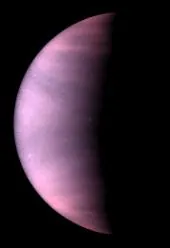
A telescope shows something first-time observers rarely expect: Venus has phases, just as the Moon does. On the far side of its orbit Venus is a small, nearly full disk about 10 arcseconds across (an arcsecond is 1/3600 of a degree); as it swings around toward Earth it grows almost sevenfold, to 66 arcseconds, while thinning to an ever-narrower crescent. Its brightest moments come when it is a broad crescent, not when it is full, because the growing disk more than makes up for the narrowing phase. Steadily braced binoculars can just show the crescent at its largest. Watching that shape change from week to week repeats Galileo's observation of 1610, the one that showed Venus must travel around the Sun rather than around Earth.
The eyepiece will not add much beyond the phase itself. The cloud tops are a dazzling, essentially featureless white, and no backyard telescope will show the surface hiding beneath them. The most comfortable views come in twilight, when the glare is gentler and Venus stands higher above the horizon's turbulent air. And never, under any circumstances, sweep for Venus with binoculars or a telescope while the Sun is above the horizon.
Venus's cycles
Nearly everything Venus does in our sky is governed by its synodic period of 583.92 days, the time from one close pass of Earth to the next. Venus circles the Sun in about 225 days to our 365, so it keeps lapping us on the inside, and each lap is one full round of apparitions: roughly nine and a half months as the evening star, then roughly nine and a half months as the morning star. Our Synodic Period Calculator shows how the 584-day rhythm falls straight out of the two orbital periods. In the weeks between the two roles, as Venus overtakes Earth, it slides backward (westward) against the stars; the retrograde motion lesson explains why.
The famous part takes five of those laps to unfold. Five synodic periods add up to about 2,920 days, just two and a half days short of eight Earth years, in which time Venus completes 13 orbits of the Sun. Because of this 13:8 near-commensurability (a coincidence of timing, not a true gravitational resonance), the planet's whole sky pattern nearly repeats on an eight-year clock: whatever Venus is doing tonight, it will do again, a couple of days earlier in the season, eight years from now, and its successive close passes trace a five-pointed figure around the sky. The Venus cycle lesson draws that pattern and walks through the arithmetic.
Venus is also the sky's matchmaker. Moving faster along the ecliptic than any planet beyond Earth's orbit, it regularly sweeps past those slower planets in close conjunctions, and its meetings with Jupiter, normally the second-brightest planet, are the most eye-catching pairings the sky offers; the Venus-Jupiter conjunction page lists them for decades ahead. To check what Venus is doing right now, and what shares the sky with it, open tonight's sky.
To see where these periods fit among everything else that repeats overhead, read the full the Venus synodic period profile, or find it sorted by length in the complete cycles list.
What's next for Venus
These are the dates that shape each apparition: greatest elongations (the best viewing), and the conjunctions when Venus switches between the morning and evening sky. Dates are in Universal Time.
| Date | Event |
|---|---|
| Oct 24, 2026 | Inferior conjunction: passes between Earth and the Sun, leaving the evening sky for the morning sky |
| Nov 27, 2026 | Greatest brilliancy: Venus at its absolute brightest, magnitude −4.9 |
| Jan 3, 2027 | Greatest morning elongation: 47° from the Sun, the best pre-dawn view of this apparition |
| Aug 11, 2027 | Superior conjunction: passes behind the Sun, leaving the morning sky for the evening sky |
| Mar 22, 2028 | Greatest evening elongation: 46° from the Sun, the best evening view of this apparition |
| Apr 27, 2028 | Greatest brilliancy: Venus at its absolute brightest, magnitude −4.7 |
| Jun 1, 2028 | Inferior conjunction: passes between Earth and the Sun, leaving the evening sky for the morning sky |
| Jul 5, 2028 | Greatest brilliancy: Venus at its absolute brightest, magnitude −4.7 |
| Aug 10, 2028 | Greatest morning elongation: 46° from the Sun, the best pre-dawn view of this apparition |
| Mar 23, 2029 | Superior conjunction: passes behind the Sun, leaving the morning sky for the evening sky |
| Oct 27, 2029 | Greatest evening elongation: 47° from the Sun, the best evening view of this apparition |
| Dec 5, 2029 | Greatest brilliancy: Venus at its absolute brightest, magnitude −4.9 |
Frequently asked questions
Why is Venus so bright?
Three things work in its favor. Venus comes closer to Earth than any other planet (about 38 million kilometers at its nearest), it is nearly Earth's size, and its unbroken cloud deck reflects about three quarters of the sunlight that hits it. Together they push Venus to magnitude -4.8, bright enough to cast faint shadows from a very dark site and to be picked out by a careful naked eye in daylight.
Why is a day on Venus longer than its year?
Venus spins extremely slowly and in the reverse direction: one rotation takes 243 Earth days, backward compared with most planets, while one orbit of the Sun takes only about 225 days, so its rotation really does outlast its year. Because the slow spin and the orbit run against each other, sunrise to sunrise on Venus takes about 117 Earth days, and the Sun rises in the west and sets in the east.
Why is Venus hotter than Mercury, even though Mercury is closer to the Sun?
Its atmosphere. Venus is wrapped in carbon dioxide (96.5 percent of the air) at 92 times Earth's sea-level pressure, a blanket that traps the Sun's heat in a runaway greenhouse effect. The surface averages about 464 degrees Celsius, day and night alike, hot enough to melt lead. Mercury sits closer to the Sun but has almost no atmosphere, so its night side radiates its heat straight back to space.
Can you see Venus during the day?
Yes. Near its brightest, Venus is the only planet you can routinely spot with the naked eye in full daylight. The trick is knowing exactly where to look: the classic method is to find a daytime crescent Moon at a moment when it stands near Venus, then search the sky beside it. Never sweep for Venus with binoculars or a telescope while the Sun is up, because accidentally catching the Sun can injure your eyes instantly.
Is Venus a morning star or an evening star right now?
Venus is currently an evening star, low in the west after sunset, and it stays on that side of the Sun until its conjunction on October 24, 2026, when it switches to the morning sky. The apparition table on this page lists every switch for the next few years.
Keep exploring
- Venus Morning Star Tracker: is Venus the morning star right now, live, with the whole 584-day cycle on a dial
- Venus Cycle lesson: the 13:8 pattern that repeats the evening star every eight years
- Venus-Jupiter conjunctions: usually the sky's two brightest planets, with every upcoming meeting
- Synodic Period Calculator: derive the 584-day Venus rhythm from any two orbits
- Retrograde Motion lesson: why Venus backs up against the stars as it overtakes Earth
- Tonight's Sky: check whether Venus is up right now from your location