Tides: Two Bulges, Two High Tides & the Spring-Neap Rhythm
Twice a day the sea climbs the beach and slides back out, and the schedule drifts about 50 minutes later every day. Both facts come straight from the Moon. Its gravity stretches the ocean into two bulges, one facing the Moon and one facing away, and the spinning Earth carries every coastline through both of them each lunar day. Sweep the Moon through a month below and watch the Sun join in: when the two line up the tides spring higher, and when they pull at right angles the tides go neap.
On this page
Tides happen because the Moon’s gravity pulls the near side of Earth harder than the far side, stretching the ocean into two bulges. Earth rotates through both, so most coasts get two high tides every 24 hours 50 minutes (the lunar day), each arriving about 50 minutes later than the day before. The Sun raises its own tide at about 46 percent of the Moon’s strength: aligned at new and full moon it makes large spring tides, and at right angles during the quarter moons it makes small neap tides.
Why the ocean has two bulges
Gravity weakens with distance. The ocean on the side of Earth facing the Moon is about 6,400 kilometers closer to the Moon than Earth’s center is, and the ocean on the far side is about 6,400 kilometers farther. Small as those differences are next to the Moon’s 384,400-kilometer distance, they matter: the near-side water feels a pull roughly 7 percent stronger than the far-side water does.
Here is the key move. Earth as a whole is falling freely around the Earth-Moon system’s common center of mass, so the average pull is already accounted for; nobody feels it, just as astronauts do not feel the gravity that holds their station in orbit. What the ocean responds to is only the difference from that average, which physicists call the tidal force or differential gravity. Subtract the average pull everywhere and a clear pattern is left over: the near side is tugged toward the Moon, the far side is left behind and effectively pushed away, and the sides are squeezed gently inward.
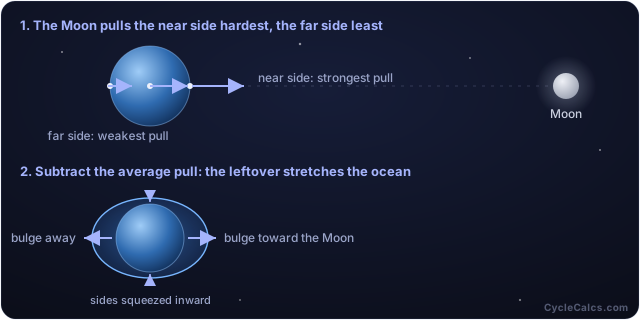
That is why there are two bulges, not one. Water heaps up under the Moon because it is pulled hardest, and it also heaps up on the opposite side of the planet because the solid Earth is pulled out from under it, leaving the far-side water behind. If the far-side bulge feels wrong, hold on to this picture: the Moon pulls Earth’s body away from the far-side ocean slightly faster than it pulls the far-side ocean itself.
One more consequence hides in the subtraction. Because the tidal force is a difference between nearly equal pulls, it falls off with the cube of distance rather than the square. That single fact decides who rules the tides. The Sun’s raw gravitational pull on Earth is about 180 times stronger than the Moon’s, but a pull that strong and that uniform barely varies across Earth’s width, which is a tiny fraction of 150 million kilometers. Run the numbers and the Sun’s tidal force comes out at only 46 percent of the Moon’s; equivalently, the Moon’s tide is about 2.2 times the Sun’s. The nearby Moon wins because tides reward closeness far more than mass.
Two high tides every lunar day
The bulges stay lined up with the Moon while Earth rotates underneath them. In one turn of the planet, your stretch of coast sweeps through a bulge (high tide), a trough (low tide), the second bulge (high tide again), and the second trough. Two highs and two lows, which is exactly the rhythm most of the world’s coasts keep.
But the cycle is not 24 hours, because the Moon does not stand still. While Earth spins once, the Moon travels about 13 degrees farther along its orbit, and Earth needs roughly 50 extra minutes of rotation to bring the Moon back over the same spot. That interval, 24 hours 50 minutes, is the lunar day (also called the tidal day), and it is the same reason the Moon rises about 50 minutes later each night on the moon calendar.
With two high tides per lunar day, successive highs come about 12 hours 25 minutes apart, and the whole schedule slides about 50 minutes later from one day to the next. Anyone who fishes, surfs, or walks mudflats knows this drift by heart; now you know it is simply the Moon’s orbital motion written into the sea. Both rhythms, the tidal day and the fortnightly spring-neap alternation below, have their own entries in the cycles by length catalog.
Spring and neap tides
The Sun raises its own pair of bulges, at that 46 percent strength. What the ocean actually does is add the two patterns together, and the sum depends on the angle between the Sun and the Moon, which is exactly what the phase of the Moon tracks.
At new moon the Moon sits between Earth and the Sun, so both tide-raisers pull along the same line and their bulges stack: high tides run higher, low tides run lower. These are spring tides. At full moon the Moon is on the opposite side of Earth from the Sun, and here is the part that surprises people: the tides spring just as high. It works because each body raises two bulges on opposite sides of the planet. The bulge pattern is a symmetric stretch along a line, not a heap on one side, so it makes no difference whether the Sun and Moon share a side or face each other across the Earth. Alignment is alignment.
At the quarter moons the Sun and Moon pull at right angles. The Sun’s high water lands on the Moon’s low water and partly fills it in, so the range shrinks to its smallest: neap tides. The Moon still wins (its tide is 2.2 times as strong), so the tides never cancel, they just flatten. Drag the slider through a month above and watch the dashed solar bulge swing from reinforcing the lunar bulge to fighting it.
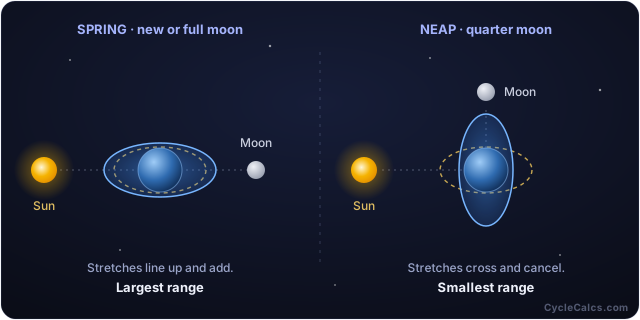
The names are Old English, not seasonal: spring tides spring up, and “neap” probably comes from a word meaning lacking or without power. Since the alignment repeats at every new and full moon, the spring-neap cycle takes 14.77 days, half of the 29.5-day synodic month.
One refinement worth knowing: the Moon’s orbit is an ellipse, so its distance varies through the month. At perigee, its closest point, the Moon is about 6 percent closer than average, and because tidal force grows with the cube of closeness, its tide runs nearly 20 percent stronger. When a perigee happens to coincide with a new or full moon, the result is a perigean spring tide, the “king tides” that make coastal news. The same geometry makes a full moon at perigee look larger, the popular supermoon, and the slow turning of the perigee point itself is the subject of the apsidal precession lesson.
The tides are reshaping the Earth-Moon system
Tides do more than move water; they carry momentum between the Earth and the Moon. Earth spins much faster than the Moon orbits, and friction with the ocean floor drags the tidal bulge slightly ahead of the Moon’s position. That off-axis heap of water has gravity of its own, and it pulls the Moon gently forward along its orbit, feeding it energy. The Moon responds by spiraling slowly outward: lunar laser ranging, bouncing light off reflectors the Apollo crews left on the surface, measures the Moon receding at about 3.8 centimeters per year.
Earth pays for it with spin. Tidal friction lengthens the day by roughly 2 milliseconds per century, which sounds like nothing until geology adds it up. Fossil corals laid down daily growth bands, and counting bands per yearly layer shows that around 400 million years ago the year held about 400 days, each about 22 hours long. The sea has been braking the planet for eons.
The Moon itself already finished this story. Earth raises far larger tides on the Moon than the Moon raises here, and long ago that friction slowed the Moon’s spin until it matched its orbit, a state called tidal locking. That is why the Moon always shows us the same face: the same physics you are watching above, run to completion.
What the real ocean does
Honesty requires a caveat: the two neat bulges above are the equilibrium tide, the shape the ocean would take if water could respond instantly and no continents stood in the way. The real ocean cannot do that. Continents block the bulges from simply gliding around the globe, so each ocean basin sloshes in its own way, and the tide actually travels as long, slow waves that rotate around points of nearly zero tide called amphidromic points. The idealized picture explains the rhythms beautifully, the 12 h 25 m beat and the spring-neap cycle, but each coastline sets its own volume and timing.
The local differences are dramatic. High tide at most ports does not arrive when the Moon is overhead but hours later, by a lag that is a fixed personality trait of each harbor (its lunitidal interval, which old sailing directions called the establishment of the port). The spring-neap rhythm lags too: at many coasts the biggest tides of the month arrive a day or two after the new or full moon, a delay called the age of the tide, because the ocean needs time to respond. Funnel-shaped bays can resonate with the tidal push the way a bathtub sloshes in time with your hand: the Bay of Fundy in Canada amplifies its tides to as much as 16 meters, while the nearly enclosed Mediterranean manages only a few tens of centimeters. The two daily highs are often unequal as well: when the Moon stands far north or south of Earth’s equator, a given shore passes closer to the heart of one bulge than the other, so one high tide runs higher than the next (the diurnal inequality). Some coasts, including parts of the Gulf of Mexico, go further and get just one high tide a day, because the basin’s geometry nearly mutes the twice-daily component and lets a once-daily one dominate. This is why real tide tables are built from each port’s measured record rather than from raw astronomy, and why the gauge chart above is labeled an idealized shore: in this simple model the neap range drops to about a third of the spring range, while at typical coasts the swing is gentler, roughly 20 percent either side of average.
Planets, earthquakes and the air
Every body in the Solar System raises a tide on Earth, and the cube of distance decides which ones matter. The table gives the tidal acceleration each one produces at Earth's surface, 2GMR/d3, against the Moon's at its mean distance. Planetary alignments do not flood coasts or trigger earthquakes through their tides: the arithmetic is not there, the same standard this site applies to claims about planets and the sunspot cycle.
| Tide raiser | Distance | m/s2 | Times the Moon's mean |
|---|---|---|---|
| The Moon, at its mean distance | 384,400 km | 1.10 × 10⁻⁶ | 1.00 |
| The Moon, at the closest perigee of 2026 | 356,641 km, 24 December | 1.38 × 10⁻⁶ | 1.25 |
| The Sun, at 1 au | 149.6 million km | 5.05 × 10⁻⁷ | 0.459 |
| Venus, at its closest | 38.2 million km | 7.43 × 10⁻¹¹ | 6.75 × 10⁻⁵ |
| Jupiter, at its closest | 588.5 million km | 7.92 × 10⁻¹² | 7.20 × 10⁻⁶ |
| All seven planets, each at its closest, at once | never together | 8.64 × 10⁻¹¹ | 7.86 × 10⁻⁵ |
GM for each body from JPL's planetary ephemeris DE440; R is Earth's mean radius, 6,371 km. The last column gives each tide as a multiple of the Moon's at its mean distance. The perigee is the vendored Astronomy Engine's. Each planet's distance is the smaller of the closest distance its page gives (the NASA fact-sheet minimum) and its closest approach between 1700 and 2200 in the same engine, so every planet row is an upper bound for those five centuries. The last row adds all seven planets' tides as if each stood at its closest on one line at once, which never happens.
Earthquakes. The Moon and Sun stress every fault a little, in step with the tides of the solid Earth. That stress is tiny beside the stress an earthquake releases, so at most it can nudge a fault that is already close to failing, and the effect shows only in statistics. In a global catalog of 442,412 earthquakes, slightly more struck while the solid tide was lifting the ground, about 0.5 to 1 percent more likely at its peak (Métivier et al. 2009). On shallow thrust faults the earthquake rate varies by up to a factor of three with the tidal stress, a link that appears with the strongest tides (Cochran et al. 2004). Great earthquakes, magnitude 8 and above, show no preferred day of the calendar year or of the lunar cycle (Hough 2018). And the planets, whose combined tide is more than ten thousand times weaker than the Moon's, show nothing at all: on 78 percent of days, at least one set of three bodies among the Sun and the eight planets, Earth included, lies on a line to within 3 degrees, and 79 percent of the 813 earthquakes of magnitude 7 or more from 1950 to 2018 struck on such days, no more than chance (Romanet 2023).
The air and the rock. The atmosphere has tides as well, a twice-daily swing in pressure that a barometer shows plainly in the tropics, but it is driven mostly by the Sun's daily heating, and the Moon's gravitational air tide is far smaller. The genuinely measurable gravitational tides hide in plain sight: the solid rock beneath you flexes by roughly 30 centimeters twice a day (the body tide).
The 18.6-year swing. Tidal ranges also rise and fall by a few percent over the 18.61-year lunar nodal cycle, as the tilt of the Moon's orbit to Earth's equator changes: the main twice-daily lunar tide varies by about 3.7 percent either way, which is why official tide datums are averaged over a 19-year epoch.
Frequently asked questions
Why are there two high tides a day?
The Moon's gravity pulls the ocean on the near side of Earth harder than it pulls Earth's center, and the center harder than the ocean on the far side. Relative to Earth as a whole, the near-side water is pulled toward the Moon and the far-side water is left behind, so the ocean stretches into two bulges on opposite sides of the planet. As Earth rotates through both bulges, most coasts see a high tide about every 12 hours and 25 minutes.
Why is high tide about 50 minutes later each day?
The tides follow the lunar day, the 24-hour-50-minute interval between one pass of the Moon over your meridian and the next. While Earth spins once, the Moon moves ahead along its orbit, so Earth needs about 50 extra minutes to face it again. Two high tides fit into each lunar day, which is also why the Moon itself rises about 50 minutes later each night.
What are spring tides and neap tides?
Spring tides are the larger tides near new moon and full moon, when the Sun, Earth, and Moon line up and the solar tide adds to the lunar tide. The name comes from the tide springing up, not from the season. Neap tides are the smaller tides near the quarter moons, when the Sun pulls at right angles to the Moon and partly fills in the lunar low points. The cycle from spring to neap and back takes about 14.77 days, half a synodic month.
Do the planets raise tides on Earth?
Yes, but far too weakly to matter. Tidal force falls with the cube of distance, so even Venus at its closest raises a tide about 14,800 times weaker than the Moon's, and Jupiter's is more than 100,000 times weaker. The Sun and Moon are the only bodies whose tides matter on Earth, and claims that planetary alignments drive floods or earthquakes through their tidal pull do not survive the arithmetic.
Sources & further reading
- NOAA Ocean Service: Tides and Water Levels tutorial: the standard plain-language reference on tidal forces, constituents, and real-world tide types.
- NOAA: What are spring and neap tides?: the syzygy and quadrature geometry in brief.
- NASA Science: Earth’s Moon: the Moon’s orbit, distance, and its slow recession measured by laser ranging.
- Paul Schureman, Manual of Harmonic Analysis and Prediction of Tides (U.S. Coast and Geodetic Survey): the classic text behind modern tide prediction, including the 18.61-year nodal factor of the lunar tide.
- JPL Solar System Dynamics: astrodynamic parameters: the GM of the Sun, the Moon and each planet from the planetary ephemeris DE440, used in the tide table.
- L. Métivier, O. de Viron, C. P. Conrad, S. Renault, M. Diament and G. Patau, Evidence of earthquake triggering by the solid earth tides, Earth and Planetary Science Letters 278, 370-375 (2009).
- E. S. Cochran, J. E. Vidale and S. Tanaka, Earth tides can trigger shallow thrust fault earthquakes, Science 306, 1164-1166 (2004).
- S. E. Hough, Do large (magnitude ≥8) global earthquakes occur on preferred days of the calendar year or lunar cycle?, Seismological Research Letters 89, 577-581 (2018).
- P. Romanet, Could planet/sun conjunctions be used to predict large (moment magnitude ≥ 7) earthquakes?, Seismica 2 (2023).
See how the site’s figures are computed on the methodology and sources page.
Keep exploring
The Moon
The world that raises the tides: tonight’s phase, its distance right now, and the next perigee.
InteractiveTidal Locking & Libration
The same tidal friction that raises the seas locked the Moon's spin to its orbit, so it shows us one face.
InteractiveMoon Phases
The Sun-Moon angle that sets spring and neap tides is the same angle that makes the Moon wax and wane.
InteractiveSynodic vs Sidereal
Why the phase month is 29.5 days: the lapping rhythm behind the 14.77-day spring-neap cycle.
InteractiveMoon Phase Calendar
Tonight’s phase and the month’s new, quarter, and full moons: your spring-and-neap forecast.
ReferenceCycles by Length
The tidal day (24 h 50 m) and the spring-neap cycle (14.77 d) in the full catalog of sky rhythms.