Venus: the Morning Star, the Evening Star & the Pentagram
Venus travels around the Sun on a smaller orbit than Earth's, always closer to the Sun than we are. Because of that, Venus can never appear far from the Sun in our sky. It is only ever a brilliant morning star low in the east before sunrise, or an evening star in the west after sunset. Follow it for eight years below. The Sun-centered view on the left and Venus's path across our sky on the right move together, and Venus's five close passes by Earth slowly trace a five-petaled rose.
On this page
Venus orbits inside Earth's orbit, so it never strays more than about 47 degrees from the Sun and shows only as a morning star before sunrise or an evening star after sunset. Every eight years its pattern nearly repeats: 13 orbits of Venus fall in almost exactly 8 Earth years, a 13-to-8 near-commensurability that puts five Venus-Earth conjunctions around the sky and traces the five-petaled rose of Venus.
Earth’s inner neighbor
Venus circles the Sun once every 224.7 days at a distance of about 0.72 AU, roughly 72 percent of the Earth’s distance from the Sun. Its orbit therefore sits entirely inside Earth’s larger orbit. (Venus is not somehow inside the planet Earth. Both worlds orbit the Sun, and Venus simply keeps to the smaller, inner track.)
Because Venus is always nearer the Sun than we are, the Sun and Venus can never sit on opposite sides of our sky. A planet farther out, such as Mars or Jupiter, can ride high overhead at midnight, directly opposite the Sun, but Venus never can. From our moving viewpoint on Earth it stays tethered close to the Sun, swinging out to one side of it and then back to the other.
Morning star and evening star
When Venus sits to the west of the Sun, it rises a little before the Sun does, so we catch it low in the east in the hour before dawn. That is the morning star. When Venus sits to the east of the Sun, it sets a little after the Sun, so it shines in the west in the hour after sunset. That is the evening star.
We never see both at once, because Venus can only ever be on one side of the Sun at a time. The ancient Greeks did not realize this at first. They named the dawn apparition Phosphorus, the light-bringer, and the dusk apparition Hesperus, the evening one, and understood only later that the two were a single world.
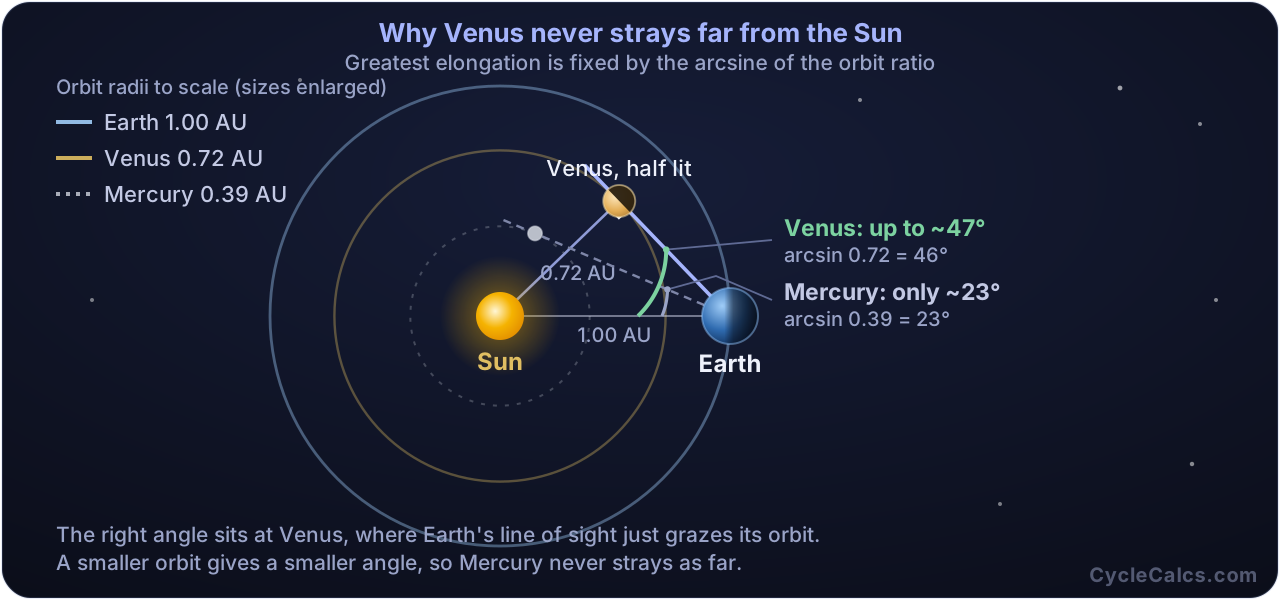
How far from the Sun can Venus stray? At most about 47°, a separation astronomers call its greatest elongation. (It varies between roughly 45.4° and 47.1° as the two orbits carry the planets nearer and farther apart.) There is a simple reason for the limit.
Picture the line of sight from Earth that just grazes the edge of Venus’s orbit. The angle that line makes with the direction of the Sun depends only on the size of Venus’s orbit, and it works out to the arcsine of 0.72, or about 46°. A planet on an even smaller orbit is held even tighter to the Sun, which is exactly why Mercury, the innermost planet, is harder to glimpse than Venus.
The eight-year rhythm and the pentagram
Because Venus is closer to the Sun, it moves faster than Earth and repeatedly laps us, the way a runner on an inner lane overtakes one on an outer lane. The time from one lap to the next, measured by when the Sun, Earth, and Venus return to the same alignment, is the synodic period. For Venus it is 583.92 days, a little over a year and seven months.
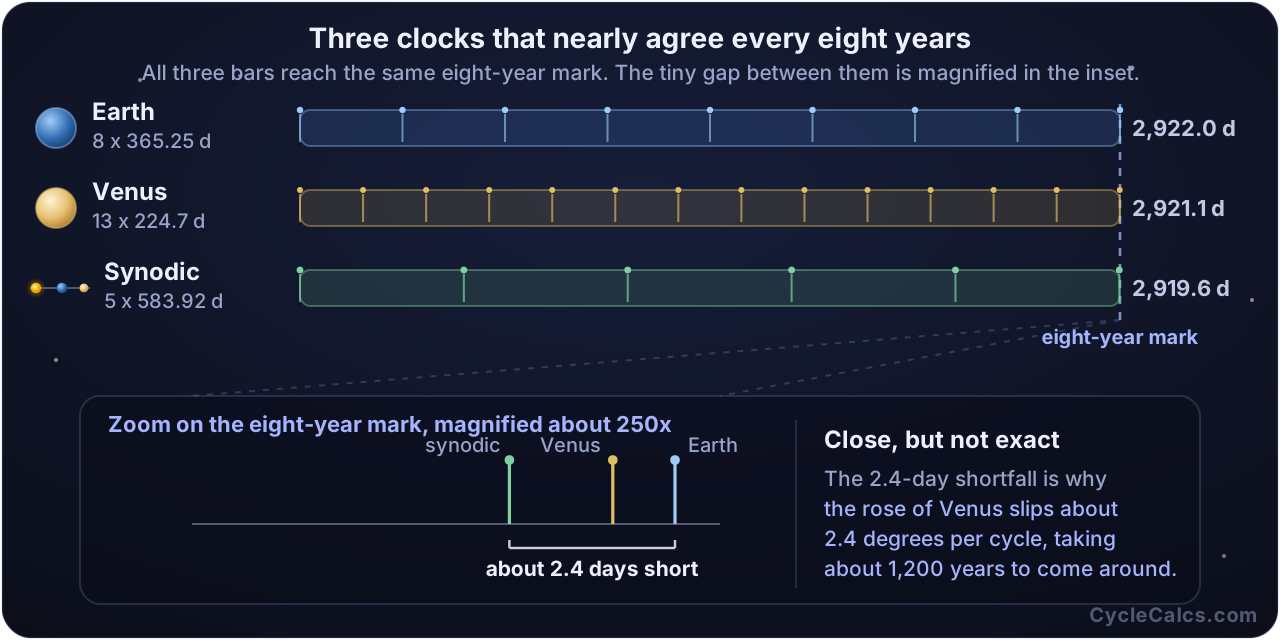
Now for the remarkable part. Five of those synodic periods add up to 2,919.6 days, which is almost exactly eight Earth years (2,922 days), and almost exactly thirteen Venus years as well. Because these three separate clocks so nearly agree, the entire Sun, Earth, and Venus arrangement very nearly repeats every eight years.
The clearest fingerprint of that rhythm is where Venus passes closest to Earth. Each close pass happens at an inferior conjunction, the moment Venus slips directly between Earth and the Sun. Five of them occur in every eight-year span, and they fall about 72° apart around the sky.
Seventy-two degrees is exactly the spacing of the five points of a star, so joining the conjunctions in order draws a pentagram. If instead you follow Venus’s position relative to Earth without lifting the pen, as the right-hand view does, those five loops open into the famous rose of Venus.
The agreement is close but not exact. With each eight-year cycle the pattern slips by about 2.4°, so the rose turns slowly, taking roughly 1,200 years to come all the way around. You can reproduce the 584-day synodic period yourself on the Synodic-Period Calculator, and find it listed among the cycles by length.
The phases of Venus
Venus shows phases, just as the Moon does, and for the same reason. As the angle between the Sun, Venus, and Earth changes, we see different fractions of Venus’s sunlit half. When Venus is on the far side of the Sun, near superior conjunction, almost its whole lit face is turned toward us, so it looks nearly full, yet it is also at its most distant and appears small.
When it swings around to pass between us and the Sun, near inferior conjunction, its lit half faces mostly away from us and Venus thins to a crescent, though it is now closest to us and looks large. At greatest elongation, halfway between, we see it exactly half lit.
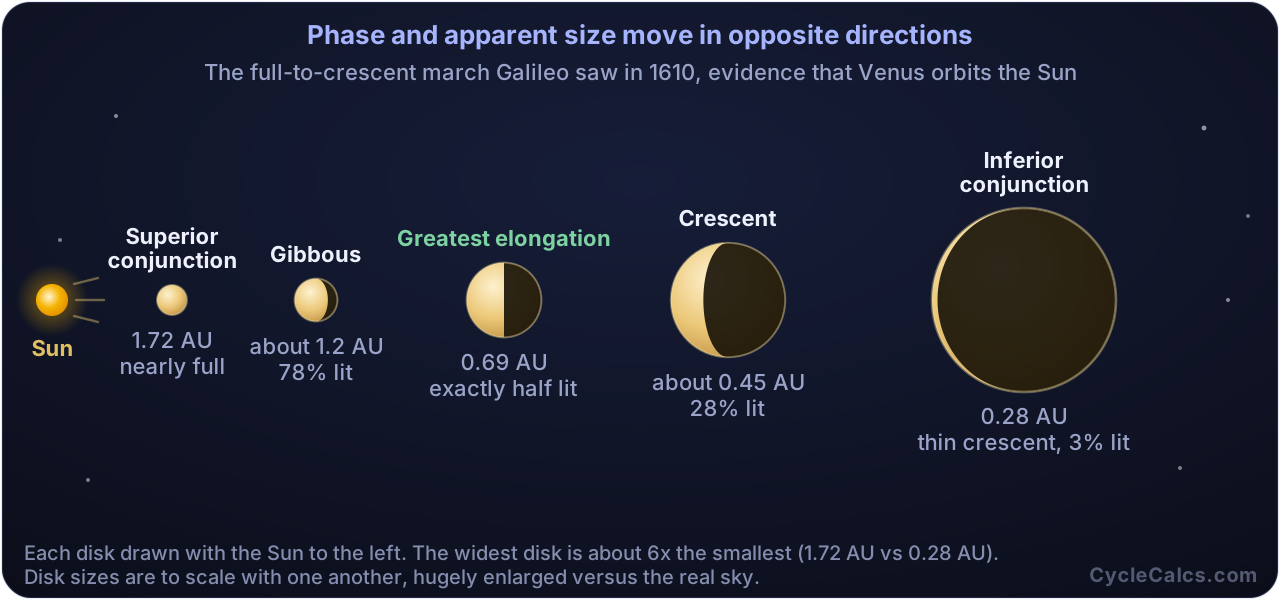
This changing shape carried real historical weight. When Galileo pointed his telescope at Venus in 1610 and watched it run through a full set of phases, including a plainly gibbous, nearly full Venus, he had direct evidence that Venus must travel around the Sun rather than around the Earth. That single observation helped overturn the old Earth-centered picture of the heavens, and it became one of the cornerstones of the Sun-centered model we hold today.
Frequently asked questions
Why is Venus called the morning star and the evening star?
Venus orbits closer to the Sun than Earth, so from our view it never moves far from the Sun. When it is west of the Sun it rises shortly before sunrise (the morning star); when it is east of the Sun it sets shortly after sunset (the evening star). The ancient Greeks first thought these were two different objects, Phosphorus and Hesperus.
How far from the Sun can Venus appear?
At greatest elongation Venus is only about 47 degrees from the Sun (the value ranges from roughly 45.4 to 47.1 degrees). That is set by the size of its orbit: the angle equals the arcsine of Venus's orbital radius, 0.72 AU, which is about 46 degrees.
What is the 8-year cycle of Venus?
Five Venus synodic periods of 583.92 days add up to 2,919.6 days, almost exactly 8 Earth years and 13 Venus years. So the Sun-Earth-Venus geometry nearly repeats every 8 years, and the five inferior conjunctions in that span fall about 72 degrees apart around the sky, tracing a five-pointed pentagram or rose that slowly rotates by about 2.4 degrees each cycle.
Sources & further reading
- NASA Science: Venus: NASA's overview of the planet and its orbit.
- NASA Science: Venus Facts: the roughly 225-day orbital period behind the eight-year pattern.
- NASA JPL: Approximate Positions of the Planets: the orbital elements and rates for Venus and Earth.
- Jean Meeus, Astronomical Algorithms (Willmann-Bell): the standard reference for synodic periods and planetary conjunctions.
See how these figures are computed on the methodology and sources page.
Keep exploring
Is Venus the morning star right now?
The live answer for your location, with the whole 584-day cycle on a dial and every transition date.
Venus
The facts, the phases and the physical data, with apparition tables to 2032.
InteractiveMoon Phases
Venus shows phases for the same reason the Moon does: the changing angle of its lit half.
InteractiveEclipses
Inferior conjunction is Venus’s “new” phase, and on rare occasions a transit across the Sun.
InteractiveApsidal Precession
Another slow turning: the planets’ orbits pivoting over the ages.
InteractiveResonance Lab
Draw the rose of Venus yourself and measure the 13:8 near-commensurability behind it, alongside other planet pairs.
ReferenceThe numbers and where we stand: the Venus pentagram
Five 583.92-day synodic periods per 8-year star: the exact figures, where the pattern stands, and the next inferior conjunctions.