The Hale cycle
Why does the Sun's full magnetic cycle take 22 years, not 11?
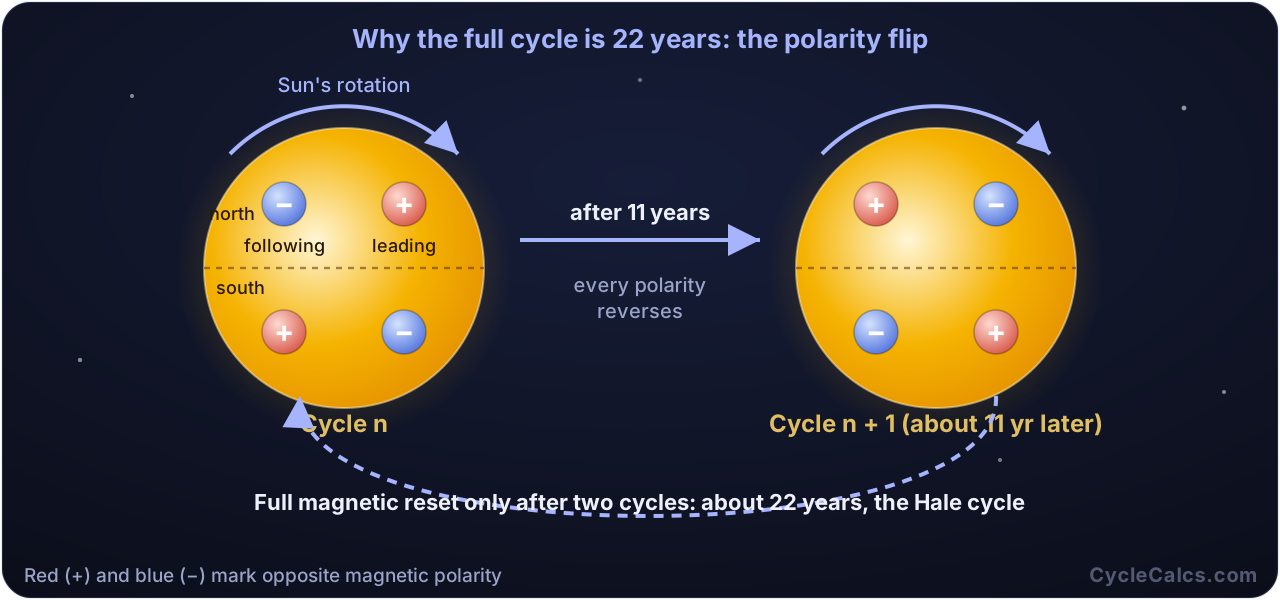
The Hale cycle is the full magnetic cycle of the Sun. Sunspots come and go on a roughly 11-year rhythm, but the Sun's magnetic field returns to the state it began in only after two of those cycles, about 22 years. The count of spots cycles in 11 years; the magnetism takes 22.
George Ellery Hale measured the magnetic fields inside sunspots in 1908, and over the cycles that followed he and his colleagues traced a rule that still carries his name. Within a single 11-year cycle, the leading spot of each pair holds one magnetic polarity in the Sun's northern hemisphere and the opposite polarity in the southern, and both reverse at the start of the next cycle. Two reversals bring the field back to its original configuration, so the true period is twice the sunspot count, not the count itself.
How it works, in plain language: The sunspot cycle. This page carries the numbers.
On this page
The Sun's spot count rises and falls every 11 years, but its magnetic polarity flips at each maximum, so the field returns to its starting polarity only after two cycles, about 22 years. That is the Hale cycle.
We are in Solar Cycle 25, past its maximum of October 2024 (13-month smoothed sunspot number). The polarity that leads sunspot pairs now will reverse at the next maximum and return at the one after.
Where we are in the Hale cycle right nowobserved data
The Hale magnetic cycle is about 22 years, two sunspot cycles. Solar Cycle 25 passed its maximum in October 2024 (NOAA SWPC; 13-month smoothed); its magnetic polarity reverses at the next maximum. This is an observed, data-driven rhythm, so the timing is an estimate.
The sunspot and Hale cycles are tracked from the NOAA sunspot-number record, not an ephemeris, so the figures here are observed data and estimates. See every cycle together on the cosmic clock.
The Hale cycle at a glance
| Period | about 22 years |
|---|---|
| Equals | 2 sunspot (Schwabe) cycles |
| What reverses | the Sun's magnetic polarity, at each sunspot maximum |
| Named for | George Ellery Hale; polarity law 1919 |
| Governing rule | Hale's polarity law |
| Sunspot cycle length | about 11 yr (ranges 9 to 14) |
| Current state | Solar Cycle 25, maximum October 2024 (13-month smoothed) |
| Data source | NOAA sunspot record (observed) |
Sources: NOAA Space Weather Prediction Center, observed solar cycle indices.
The Hale cycle in every unit
The Hale cycle is most naturally written as two sunspot cycles, so its decomposition is a small-integer relationship set against the observed 11-year mean.
| Headline period | about 22 years (two sunspot cycles) |
|---|---|
| In sunspot cycles | 2 x about 11 yr = about 22 yr |
| In years (range) | about 18 to 28 yr (from 9 to 14 yr cycles) |
| In days | about 22 x 365.25 = about 8,035 d |
| Polarity reversals | 2 per Hale cycle, one at each maximum |
| Magnetic repeat | after 2 Schwabe cycles |
| Mean sunspot cycle | about 11.0 yr (NOAA record, the 24 completed cycles since 1755) |
| Gleissberg envelope | about 80 to 100 yr (longer amplitude modulation) |
Periods are observed averages from the NOAA sunspot record, not ephemeris constants: individual sunspot cycles have run from about 9 to 14 years, so the doubled Hale period varies with them. Day counts use 365.25 days per year and are approximate.
What the Hale cycle is and how it arises
Sunspots are cool, dark patches where the Sun's magnetic field pushes through the visible surface. Their number waxes and wanes on the roughly 11-year sunspot cycle, first identified by Samuel Heinrich Schwabe in 1843. What Schwabe tracked was the count. What Hale later added was the magnetism: each spot is a knot of intense field, thousands of times stronger than Earth's, and the whole system carries an orientation that the eye cannot read from a simple spot count.
Hale's polarity law sets out that hidden orientation. In one cycle, sunspot pairs in the northern hemisphere lead with, say, a north magnetic polarity and follow with a south, while pairs in the southern hemisphere show the mirror arrangement. By the next sunspot minimum the sign of the field at the poles has already reversed, and when the new cycle's spots emerge they carry the opposite polarities in both hemispheres. The naked-eye count looks the same from cycle to cycle; the magnetic bookkeeping does not.
That is the reason the magnetic period is doubled. A single reversal takes the Sun to the opposite magnetic state; a second reversal is needed to bring it home. Solar dynamo models, in the Babcock-Leighton picture, describe this as the Sun rebuilding its large-scale poloidal field with the opposite sign each cycle, so two cycles are required to close the loop. The sunspot count peaks twice in that span, but the field completes just one full turn, about 22 years long.
The math
The relationship is a simple doubling. Write the sunspot period as T_Schwabe and the magnetic period as T_Hale; then T_Hale = 2 x T_Schwabe. Using the observed mean sunspot cycle of about 11.0 years from the NOAA record, T_Hale = 2 x 11.0 = about 22.0 years. This is an observed, data-driven average, not an ephemeris constant like a synodic month: the 24 completed sunspot cycles since 1755 have run from about 9 to nearly 14 years, so the doubled Hale period stretches and shrinks with them, from roughly 18 to 28 years.
The polarity accounting makes the factor of two concrete. Each Hale cycle contains two sunspot maxima and two polarity reversals; after one reversal the field is inverted, after two it is restored. In days, about 22 years is close to 22 x 365.25 = about 8,035 days, though the spread in real cycles makes any single figure approximate. To see the count behind the magnetism, follow the spot numbers on the sunspot cycle profile and the live solar state on the Sun.
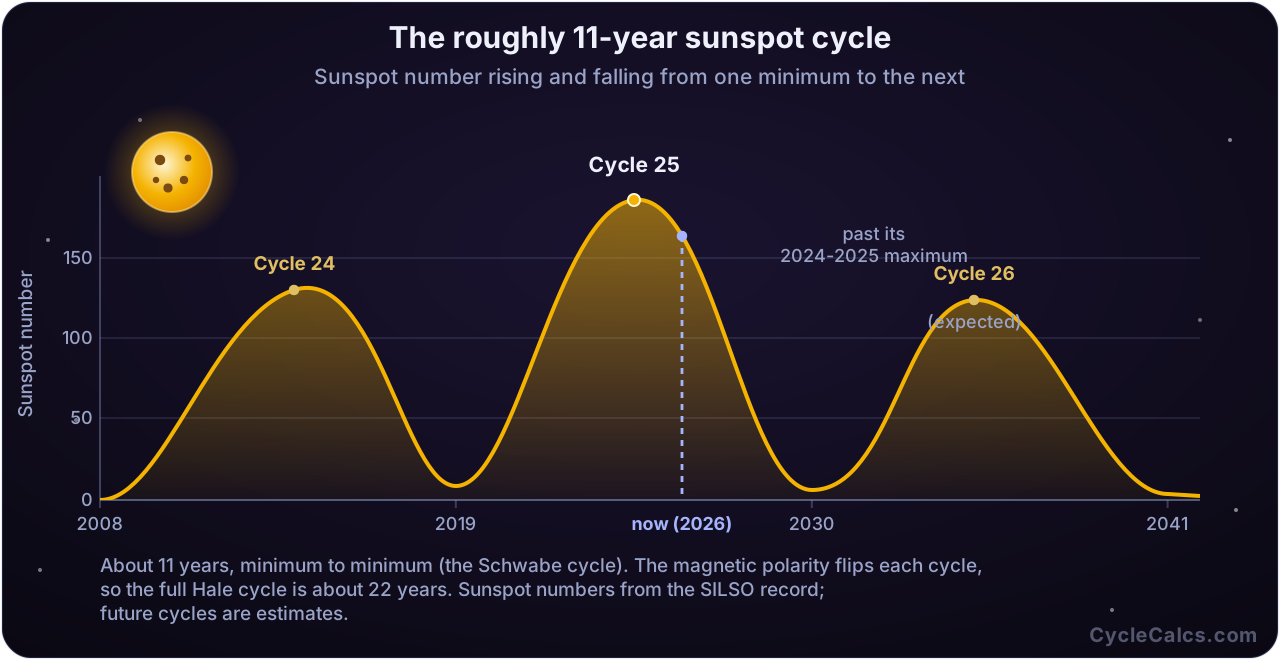
The magnetic cycle in outline
| When | Magnetic milestone |
|---|---|
| Each 11-year maximum | The Sun's magnetic polarity reverses (Hale's law) |
| 2019 to about 2030 | Solar Cycle 25, maximum in October 2024 |
| About 2030 to 2041 | Solar Cycle 26; polarity opposite to Cycle 25 |
| One Hale cycle | Two sunspot cycles, about 22 years, polarity returned |
How the Hale cycle relates to other cycles
The Hale cycle is the magnetic double of the sunspot cycle. That page follows the roughly 11-year count of spots and the activity that comes with it; this one follows the polarity underneath, which needs two of those counts to repeat. The Learn lesson on the sunspot cycle walks through how the numbers are recorded and why maxima and minima are defined the way they are, the same data that fixes the 22-year magnetic period.
It helps to keep the Hale cycle apart from the long positional cycles. Axial precession, the roughly 25,800-year wobble of Earth's axis, is geometry of the Earth and has nothing to do with solar magnetism, even though both are sometimes grouped together as long cycles. The great conjunction of Jupiter and Saturn recurs about every 19.86 years, in the same rough two-decade band, but the resemblance is a coincidence of period alone: there is no established physical link between the planets' spacing and the solar dynamo. The Hale cycle is measured from the Sun's own field, not from anything in the sky around it.
Frequently asked questions
Why is the Hale cycle 22 years and not 11?
The count of sunspots rises and falls every 11 years or so, but that is only half the story. At each sunspot maximum the Sun's magnetic field reverses polarity. It takes two of those 11-year cycles, and two reversals, for the field to return to the polarity it started with. That doubled magnetic period, about 22 years, is the Hale cycle.
What is Hale's polarity law?
Hale's polarity law describes the magnetic pattern of sunspot pairs. In any given 11-year cycle the leading spot of a pair has one magnetic polarity in the Sun's northern hemisphere and the opposite polarity in the southern hemisphere. At the start of the next cycle both hemispheres reverse. George Ellery Hale and his colleagues stated the law in 1919, from magnetic measurements begun in 1908, and it is the reason the full magnetic cycle runs about 22 years.
Who discovered the Sun's 22-year magnetic cycle?
George Ellery Hale, an American astronomer, made the key measurements. In 1908 he used the Zeeman splitting of spectral lines to show that sunspots hold strong magnetic fields, the first magnetic field measured beyond Earth. Tracking their polarity across the cycles that followed, into the 1920s, revealed that the pattern reverses at each 11-year maximum and repeats only after two cycles. That is why the Sun's magnetic cycle is about 22 years and carries Hale's name.
What is the difference between the Hale cycle and the sunspot cycle?
They measure two different things about the same Sun. The sunspot cycle, or Schwabe cycle, is the roughly 11-year rise and fall in the number of spots and the level of activity. The Hale cycle is the magnetic cycle: the Sun's field reverses at each sunspot maximum and returns to its starting polarity only after two sunspot cycles, about 22 years. The count cycles in 11 years; the magnetism takes 22.
When does the Sun's magnetic field reverse?
The Sun's global magnetic field reverses near the peak of each sunspot cycle, at solar maximum, roughly every 11 years. The reversal is not instant; the polar fields weaken, vanish, and rebuild with the opposite sign over a year or more around maximum. Because it takes two such reversals to return to the original polarity, the complete magnetic cycle, the Hale cycle, spans about 22 years. Solar Cycle 25 reached its maximum in October 2024, measured by the 13-month smoothed sunspot number.
How long is the Hale cycle?
The Hale cycle is about 22 years, twice the roughly 11-year sunspot cycle. The number of sunspots peaks every 11 years, but the Sun's magnetic field reverses polarity at each peak, so the full magnetic pattern repeats only after two sunspot cycles. It is named for George Ellery Hale, who discovered sunspot magnetism in 1908.
Keep exploring
- Sunspot cycle: the 11-year count this doubles
- Learn: the sunspot cycle: how the spot numbers are recorded
- The Sun: live solar state and facts
- Axial precession: a long positional cycle, unrelated
- Great conjunction: another roughly two-decade cycle