Uranus
Uranus is the first planet anyone ever discovered. Mercury, Venus, Mars, Jupiter, and Saturn are bright enough that people have known them since prehistory, but Uranus waited until 13 March 1781, when William Herschel picked it out with a telescope. It hid in plain sight: at its very best it reaches magnitude 5.38 on astronomers' brightness scale (lower numbers mean brighter, and the naked-eye limit under a dark sky is about 6), so it technically grazes naked-eye visibility while remaining, in practice, a binocular object. It is also the strangest spinner in the solar system, rolling around its 84-year orbit tipped almost completely onto its side.
The live panel below tracks it for you: its current constellation, when it rises and sets from your location, and how bright it looks tonight, all computed in your browser.
On this page
Uranus reaches opposition next on November 25, 2026, when Earth passes between it and the Sun. Around that date it rises near sunset, stays up all night, and shines at its brightest for the apparition (magnitude +5.6) in the constellation Taurus.
Tonight's position and rise and set times for your location are in the live panel below; the month-by-month table shows where Uranus sits through the coming year.
Uranus rotates once every 17.24 hours, tipped almost entirely on its side and technically backwards, so a day there runs just over seven tenths of an Earth day. The extreme tilt does something stranger to the seasons, though: over the 84-year orbit each pole gets about 42 years of continuous daylight, then about 42 of night.
Uranus tonight from your location
Enter coordinates
This panel computes tonight's position and rise and set times for Uranus in your browser, and it needs JavaScript to run. The rest of this page, including the month-by-month table below, is fully readable without it. For a live all-sky view, open the Sky Map or Today in the Sky.
Everything is computed on your device. Tapping "Use my location" names your city from a place index served with this page. Times appear in your device's time zone.
Uranus at a glance
| Mean distance from the Sun | 2,867.0 million km (19.2 AU) |
|---|---|
| Distance from Earth | 2,580.6 to 3,153.5 million km |
| Equatorial diameter | 51,118 km (4.0 × Earth's) |
| Mass | 8.68 × 10²⁵ kg (14.5 Earths) |
| Gravity (mean, at the cloud tops) | 9.01 m/s² (0.92 of Earth's) |
| Escape velocity | 21.3 km/s |
| Rotation period (sidereal) | 17.24 hours, retrograde |
| Orbital period | 84.02 years |
| Synodic period (opposition to opposition) | 369.7 days |
| Axial tilt | 97.77° (it rolls around its orbit on its side) |
| Temperature at the cloud tops | about −197 °C (at the 1-bar level) |
| Atmosphere | 83% hydrogen, 15% helium, 2% methane (the methane makes it blue-green) |
| Moons | 28 known |
| Rings | yes: faint and narrow |
| Brightest apparent magnitude | +5.4, right at the naked-eye limit |
| Discovered | William Herschel, 1781 |
Physical data: NASA NSSDCA Uranus Fact Sheet. Orbital period: the mean sidereal value from Meeus, Astronomical Algorithms, ch. 31, in Julian years of 365.25 days.
Where is Uranus month by month?
The table below tracks Uranus through the next twelve months: the constellation it sits in on the 15th of each month (dates in Universal Time), whether it is a morning object, an evening object or up all night, and how bright it looks.
| Month | Constellation | Where to look | Magnitude |
|---|---|---|---|
| Oct 2026 | Taurus | Up most of the night | +5.6 |
| Nov 2026 | Taurus | Up most of the night | +5.6 |
| Dec 2026 | Taurus | Up most of the night | +5.6 |
| Jan 2027 | Taurus | Evening sky, after dusk | +5.6 |
| Feb 2027 | Taurus | Evening sky, after dusk | +5.7 |
| Mar 2027 | Taurus | Evening sky, after dusk | +5.7 |
| Apr 2027 | Taurus | Evening sky, after dusk | +5.8 |
| May 2027 | Taurus | Lost in the Sun's glare | +5.8 |
| Jun 2027 | Taurus | Morning sky, before dawn | +5.8 |
| Jul 2027 | Taurus | Morning sky, before dawn | +5.8 |
| Aug 2027 | Taurus | Morning sky, before dawn | +5.7 |
| Sep 2027 | Taurus | Morning sky, before dawn | +5.7 |
How to see Uranus
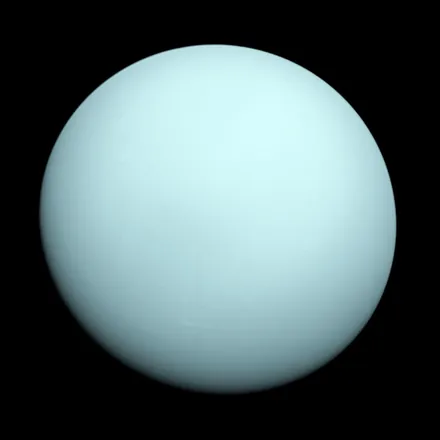
Binoculars are the honest tool for Uranus. Around opposition (the night Earth passes directly between Uranus and the Sun) it shines near magnitude 5.6, easy in any binoculars even from a suburb, and from a genuinely dark site a sharp-eyed observer can catch it unaided with a good chart. The trouble is telling it apart, since it looks like one more faint star among thousands. Open the Sky Map, which plots Uranus live against tonight's stars, and star-hop to it from a pattern you recognize. Because the planet creeps along an 84-year orbit, the star field you learn stays useful for months at a stretch.
A telescope turns a good guess into certainty. The disk of Uranus is tiny, 3.3 to 4.1 arcseconds across (an arcsecond is 1/3,600 of a degree; the full Moon spans about 1,900 of them), so at low power it still impersonates a star. Raise the magnification (the telescope calculator shows what your aperture can support) and the disguise fails: a true star stays a point at any power, while Uranus swells into a minute blue-green disk that refuses to sharpen the way a star does. That stubborn softness is the confirmation. That is about all it will do, though. A small telescope will not show cloud detail, the rings, or the moons, and the labeled photo on this page is a spacecraft or observatory image, not the eyepiece view.
The best weeks are the ones around opposition, when Uranus rises near sunset, stands highest in the middle of the night, and comes closest, in a typical year about 2.7 billion kilometers away. Even then it is about 18 times as far from us as the Sun, which is why finding it rewards patience more than aperture.
Uranus's cycles
Uranus moves at a genuinely glacial pace. One orbit takes 30,688 days, just over 84 years, so it drifts about 4 degrees a year against the stars, lingering for years in one constellation; the Sky Map plots the creep night by night. Earth laps it almost annually: the synodic period, one opposition to the next, is 369.66 days, so its best week falls four or five days later each year, and every overtaking swings it through a months-long retrograde loop. The synodic vs sidereal lesson explains why slower planets have synodic periods closer to one year, and Today's Sky tells you whether Uranus is up right now.
Then there is the tilt. Uranus's spin axis leans 97.77 degrees, so it rolls around its orbit on its side, spinning backwards relative to most planets once every 17.24 hours. Across the 84-year orbit each pole takes a turn aimed almost at the Sun: about 42 years of unbroken daylight, then about 42 years of night. Earth's far gentler lean drives our seasons; Uranus is the same machinery pushed nearly to the limit. The view from Earth rides the same slow clock, facing a pole in some decades and the equator in others.
The slowest planets meet each other least often. Uranus gains only about 2 degrees a year on Neptune, the one planet slower still, so Uranus-Neptune conjunctions arrive about once every 171 years, the rarest meeting of any pair you can realistically observe; the synodic period calculator computes that rhythm for any two planets. Put in human terms, a Uranian year is about the length of a long life, and Uranus has completed two full orbits of the Sun since Herschel found it in 1781.
To see where these periods fit among everything else that repeats overhead, read the full the Uranus synodic period profile, or find it sorted by length in the complete cycles list.
What's next for Uranus
Over the next few years, Uranus's calendar comes down to two kinds of event: the oppositions worth circling, and the solar conjunctions that hide it behind the Sun for a few weeks. Computed with the same engine that runs this site's live sky tools; dates are in Universal Time.
| Date | Event |
|---|---|
| Nov 25, 2026 | Opposition: closest and brightest for the year (magnitude +5.6) in Taurus |
| May 27, 2027 | Solar conjunction: passes behind the Sun and out of view for a few weeks |
| Nov 30, 2027 | Opposition: closest and brightest for the year (magnitude +5.6) in Taurus |
| May 30, 2028 | Solar conjunction: passes behind the Sun and out of view for a few weeks |
| Dec 3, 2028 | Opposition: closest and brightest for the year (magnitude +5.6) in Taurus |
| Jun 4, 2029 | Solar conjunction: passes behind the Sun and out of view for a few weeks |
| Dec 8, 2029 | Opposition: closest and brightest for the year (magnitude +5.5) in Taurus |
| Jun 9, 2030 | Solar conjunction: passes behind the Sun and out of view for a few weeks |
| Dec 12, 2030 | Opposition: closest and brightest for the year (magnitude +5.5) in Taurus |
| Jun 14, 2031 | Solar conjunction: passes behind the Sun and out of view for a few weeks |
Frequently asked questions
Can you see Uranus with the naked eye?
Just barely, and only under excellent conditions. Uranus peaks at magnitude 5.38, and the naked-eye limit under a truly dark sky is around magnitude 6 (lower numbers mean brighter), so a sharp-eyed observer far from city lights can pick it up with a detailed chart and patience. From a typical suburb it is invisible without help, while ordinary binoculars show it easily almost anywhere. The hard part is knowing which faint point is the planet.
Why does Uranus spin on its side?
Its spin axis is tipped 97.77 degrees from upright, so Uranus effectively rolls along its orbital path instead of spinning like a top. The leading explanation is that one or more giant collisions early in the solar system's history knocked the planet over, though the case is not closed. The tilt produces the most extreme seasons of any planet: each pole gets about 42 years of continuous daylight followed by about 42 years of darkness.
Why is Uranus blue-green?
Methane. The atmosphere is mostly hydrogen and helium, but about 2.3 percent of it is methane, and methane absorbs the red portion of incoming sunlight while letting the blue-green portion reflect back to space. Through an amateur telescope the color reads as a subtle pale aquamarine tint on a tiny disk, and that odd hue is often the first clue that you have found the planet rather than a star.
Who discovered Uranus?
William Herschel, on 13 March 1781, during a systematic telescope survey of the sky. He initially reported the object as a possible comet, but its steady motion and nearly circular orbit soon showed it was a planet orbiting far beyond Saturn. That made Uranus the first planet ever discovered; Mercury, Venus, Mars, Jupiter, and Saturn are bright enough to have been known since prehistory. Others had seen it without recognizing it: John Flamsteed recorded it in 1690 and catalogued it as the star 34 Tauri (Royal Museums Greenwich).
How long is a day and a year on Uranus?
Uranus spins once every 17.24 hours, and the spin is retrograde, the reverse direction of most planets. Its year is 30,688 days, a little over 84 Earth years, which means the planet has completed two full orbits since William Herschel found it in 1781. A human lifetime and a single Uranian year are roughly the same length.
When is the next Uranus opposition?
Uranus reaches opposition on November 25, 2026. At opposition Earth passes directly between Uranus and the Sun, so it rises around sunset, stays visible all night, and is at its closest and brightest for the year, about magnitude +5.6 in Taurus.
Keep exploring
- Sky Map: plots Uranus live against tonight's stars so you can star-hop to the right faint point
- Uranus-Neptune conjunctions: the rarest observable planet pairing, about once every 171 years
- Neptune: the next world out, found by mathematical prediction rather than by accident
- Telescope Calculator: find the magnification that turns Uranus from a point into a disk
- Synodic vs Sidereal lesson: why Uranus reaches opposition four or five days later each year