Pluto
Pluto is the best known of the dwarf planets, the category the International Astronomical Union created in 2006 when it tightened the definition of a planet; the reclassification changed a label, not the world itself. Discovered by Clyde Tombaugh in 1930, Pluto is a small, icy member of the Kuiper Belt, about 2,376 km across, and it takes roughly 248 years to complete one orbit, a path so stretched that part of every circuit brings it closer to the Sun than Neptune.
The live panel below computes tonight's numbers for your location: which constellation Pluto currently sits in, when it rises and sets, and how faint it is. That last figure matters. Pluto is far too dim for the naked eye or binoculars, and reaching it at all asks more of your equipment than most observers expect.
On this page
Pluto reaches opposition next on July 29, 2027, when Earth passes between it and the Sun. That is its best-placed point of the year, at its highest around local midnight in the constellation Capricornus, though at magnitude +14.5 it is far too faint for the naked eye; seeing it takes a large telescope or an astro-camera.
Tonight's position for your location is in the live panel below; the month-by-month table shows where Pluto sits through the coming year.
A day on Pluto lasts 6.39 Earth days, the time it takes to turn once, and it spins backwards, tipped far over on its side. The Sun is so distant that even Pluto's noon is only about as bright as twilight on Earth.
Pluto tonight from your location
Enter coordinates
This panel computes tonight's position and rise and set times for Pluto in your browser, and it needs JavaScript to run. The rest of this page, including the month-by-month table below, is fully readable without it. For a live all-sky view, open the Sky Map or Today in the Sky.
Everything is computed on your device. Tapping "Use my location" names your city from a place index served with this page. Times appear in your device's time zone.
Pluto at a glance
| Status | dwarf planet (reclassified by the IAU in 2006) |
|---|---|
| Mean distance from the Sun | about 5,906 million km (39.48 AU on average) |
| Distance from Earth | 4,284.7 to 7,528.0 million km |
| Equatorial diameter | 2,376 km (0.19 of Earth's, smaller than our Moon) |
| Mass | 1.30 × 10²² kg (0.002 of Earth's) |
| Surface gravity | 0.62 m/s² (about 1/16 of Earth's) |
| Escape velocity | 1.21 km/s |
| Rotation period (sidereal) | 6.39 days, retrograde |
| Orbital period | about 248 years |
| Synodic period (opposition to opposition) | 366.7 days |
| Axial tilt | 119.5° |
| Orbital eccentricity | 0.244 (part of each orbit lies closer to the Sun than Neptune) |
| Surface temperature | roughly −240 to −226 °C |
| Atmosphere | thin nitrogen with methane and carbon monoxide, about 13 microbars |
| Moons | 5 (Charon, Styx, Nix, Kerberos, Hydra) |
| Rings | none |
| Brightest apparent magnitude | +13.7 (a large amateur telescope target) |
| Discovered | Clyde Tombaugh, 1930 |
Physical data: NASA NSSDCA Pluto Fact Sheet (surface temperature from NASA Science).
Where is Pluto month by month?
The table below tracks Pluto through the next twelve months: the constellation it sits in on the 15th of each month (dates in Universal Time), whether it is a morning object, an evening object or up all night, and how bright it looks. Pluto creeps along its 248-year orbit so slowly that it stays in the same constellation for years at a time.
| Month | Constellation | Where to look | Magnitude |
|---|---|---|---|
| Oct 2026 | Capricornus | Evening sky, after dusk | +14.6 |
| Nov 2026 | Capricornus | Evening sky, after dusk | +14.6 |
| Dec 2026 | Capricornus | Evening sky, after dusk | +14.6 |
| Jan 2027 | Capricornus | Lost in the Sun's glare | +14.6 |
| Feb 2027 | Capricornus | Morning sky, before dawn | +14.6 |
| Mar 2027 | Capricornus | Morning sky, before dawn | +14.6 |
| Apr 2027 | Capricornus | Morning sky, before dawn | +14.6 |
| May 2027 | Capricornus | Morning sky, before dawn | +14.6 |
| Jun 2027 | Capricornus | Up most of the night | +14.5 |
| Jul 2027 | Capricornus | Up most of the night | +14.5 |
| Aug 2027 | Capricornus | Up most of the night | +14.5 |
| Sep 2027 | Capricornus | Evening sky, after dusk | +14.6 |
How to see Pluto
For almost everyone, the honest answer is no, at least not directly. Astronomers grade brightness in magnitude, a scale where lower numbers mean brighter. Pluto reaches magnitude 13.65 at its rare best, when its stretched orbit carries it nearest the Sun; at a typical opposition (its best placement of the year, opposite the Sun in our sky) it is closer to magnitude 15. That is far beyond binoculars and small telescopes. Catching it visually takes roughly a 200 mm (8-inch) telescope or larger, a genuinely dark rural sky, and a detailed chart of the exact star field.
Even then, Pluto never looks like anything but one more faint star. Its disk spans less than a tenth of an arcsecond, an angle no backyard telescope can resolve, so the proven technique is the one Clyde Tombaugh used to discover it in 1930: record the field, wait, and compare. Sketch or photograph the suspect stars one night, come back a night or two later, and the point that has shifted is Pluto. Our telescope calculator estimates whether your aperture and sky can reach 15th magnitude at all.
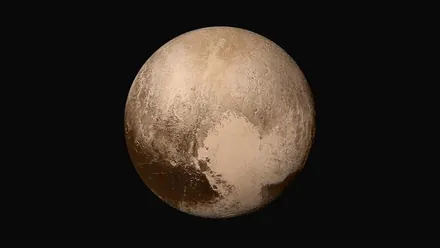
Most people meet Pluto a different way, and it is a good one: through NASA's New Horizons spacecraft, which flew past in 2015 and returned images of nitrogen-ice plains, water-ice mountains and a hazy, layered atmosphere. The photo on this page is one of those spacecraft views, not an eyepiece view; no telescope on Earth shows Pluto as anything more than a point of light.
Pluto's cycles
Pluto's defining cycle is its long, lopsided year. With an orbital eccentricity of 0.2444 (zero would be a perfect circle), its distance from the Sun swings between about 4.4 and 7.3 billion kilometers, and Kepler's second law sets the tempo: about 6.1 km/s at its closest, 3.7 km/s at its farthest. For part of each 248-year circuit, the inbound swing carries Pluto closer to the Sun than Neptune.
The two worlds can never collide, because they are held in a true 3:2 orbital resonance: Neptune completes exactly three orbits for every two of Pluto's, and that gravitational gearing repeats the same safe geometry indefinitely, so Neptune is always far away whenever Pluto crosses inside. Pluto's orbit is also tilted about 17 degrees to the plane of the planets, lifting the crossing well clear of Neptune's path.
Closer in is a second lock. Charon, Pluto's largest moon, is 606 km in radius against Pluto's 1,188 km, more partner than satellite, and the pair are mutually tidally locked: Charon circles every 6.4 days, Pluto spins (retrograde, with a roughly 153-hour day) in the same 6.4 days, and each hangs fixed in the other's sky. Earth's Moon is locked to Earth; Pluto and Charon are locked to each other.
From Earth, Pluto returns to opposition every 366.73 days, about a day and a half later each year, and its slow lap keeps it inside one constellation for years at a time. Point the Sky Map at tonight's field, fly out to it in Voyage, or check the live cycles dashboard to see how far around its orbit Pluto has come: not even one full circuit since its discovery in 1930.
To see where these periods fit among everything else that repeats overhead, read the full the Pluto orbital period profile, or find it sorted by length in the complete cycles list.
What's next for Pluto
Over the next few years, Pluto's calendar comes down to two kinds of event: the oppositions that place it best for imaging, and the solar conjunctions that hide it behind the Sun for a few weeks. Computed with the same engine that runs this site's live sky tools; dates are in Universal Time.
| Date | Event |
|---|---|
| Jan 25, 2027 | Solar conjunction: passes behind the Sun and out of view for a few weeks |
| Jul 29, 2027 | Opposition: closest and brightest for the year (magnitude +14.5) in Capricornus |
| Jan 27, 2028 | Solar conjunction: passes behind the Sun and out of view for a few weeks |
| Jul 30, 2028 | Opposition: closest and brightest for the year (magnitude +14.5) in Capricornus |
| Jan 28, 2029 | Solar conjunction: passes behind the Sun and out of view for a few weeks |
| Aug 1, 2029 | Opposition: closest and brightest for the year (magnitude +14.5) in Capricornus |
| Jan 29, 2030 | Solar conjunction: passes behind the Sun and out of view for a few weeks |
| Aug 3, 2030 | Opposition: closest and brightest for the year (magnitude +14.6) in Capricornus |
| Jan 31, 2031 | Solar conjunction: passes behind the Sun and out of view for a few weeks |
| Aug 5, 2031 | Opposition: closest and brightest for the year (magnitude +14.6) in Capricornus |
Frequently asked questions
Why is Pluto no longer called a planet?
In 2006 the International Astronomical Union defined a planet as a body that orbits the Sun, is massive enough for its own gravity to pull it round, and has cleared the neighborhood of its orbit. Pluto passes the first two tests but not the third, because it shares the Kuiper Belt with many other icy bodies. It was reclassified as a dwarf planet. Nothing about Pluto changed, only the category we file it under.
How long does Pluto take to orbit the Sun?
About 248 Earth years, or roughly 90,560 days. The orbit is strongly stretched, so Pluto's distance from the Sun swings between about 4.4 billion and 7.3 billion kilometers over each circuit. Pluto has not yet completed a single full orbit since its discovery in 1930.
Will Pluto ever collide with Neptune?
No. Pluto does spend part of each orbit closer to the Sun than Neptune, but the two are locked in a 3:2 orbital resonance: Neptune circles the Sun exactly three times for every two Pluto orbits, and that gearing keeps them far apart whenever Pluto crosses inside. Pluto's orbit is also tilted about 17 degrees, so the crossing happens well away from Neptune's path in any case.
How many moons does Pluto have?
Five: Charon, Styx, Nix, Kerberos and Hydra. Charon is by far the largest, with a radius of 606 km to Pluto's 1,188 km, so the pair behave more like a double world than a planet and a satellite. The two are mutually tidally locked, each keeping the same face toward the other as Charon circles every 6.4 days.
How cold is Pluto, and does it have an atmosphere?
Pluto's surface sits between about minus 240 and minus 226 degrees Celsius, cold enough for nitrogen to freeze. It does hold a thin atmosphere, about 99% nitrogen with traces of methane and carbon monoxide, at a surface pressure near 13 millionths of a bar. As Pluto travels toward the far end of its orbit, part of that atmosphere is expected to condense back onto the surface as frost.
How long is a day on Pluto?
A day on Pluto lasts 6.39 Earth days, the time it takes to rotate once, and Pluto spins backwards relative to most planets. Because it is tidally locked with its large moon Charon, the moon appears to hang almost fixed over one spot on Pluto, neither rising nor setting as the day goes by.
When is the next Pluto opposition?
Pluto reaches opposition on July 29, 2027. At opposition Earth passes directly between Pluto and the Sun, so it rises around sunset, stays visible all night, and is at its closest and brightest for the year, about magnitude +14.5 in Capricornus. At that brightness Pluto remains a target for large amateur telescopes and cameras, not the naked eye.
Keep exploring
- Neptune: the planet whose orbit Pluto crosses but can never meet
- Tidal Locking lesson: how Pluto and Charon ended up facing each other forever
- Sky Map: chart the exact star field Pluto is hiding in tonight
- Voyage: fly out to Pluto at its real position today
- Telescope Calculator: check whether your aperture can reach 15th magnitude