The draconic month
What times every eclipse to the Moon's node crossings?
The draconic month is 27.212221 days, or 27 days 5 hours 6 minutes. It is the time the Moon takes to return to the same node of its orbit, one of the two points where its path, tilted 5.14 degrees to the ecliptic, crosses the plane of Earth's orbit around the Sun.
It is the shortest of the Moon's several months, and the one that governs eclipses. The nodes were once drawn as a dragon: the ascending node was the caput draconis, the dragon's head, and the descending node the cauda draconis, its tail, from the old image of a dragon swallowing the Sun or Moon whenever the two met there. An eclipse can happen only when the Moon sits at a node, so this month is the beat that times every one.
How it works, in plain language: The lunar nodes. This page carries the numbers.
On this page
The Moon next crosses the ecliptic at its descending node on November 3, 2026, and returns to that same node one draconic month later, every 27.212221 days (27 d 5 h 6 min).
This node-crossing month is the shortest of the Moon's months, and its beat is what confines eclipses to the days around a node.
Where we are in the draconic month right nowcomputed live
The Moon next reaches a lunar node, a crossing of the ecliptic, on November 3, 2026 at its descending node. Node to the same node is one draconic month of 27.21 days. With JavaScript on, this panel shows how close the Moon is to a node now.
Computed live in your browser from the open-source Astronomy Engine. See every cycle together on the cosmic clock.
The draconic month at a glance
| Period | 27.212221 days |
|---|---|
| In hours and minutes | 27 d 5 h 6 min |
| Also called | the nodal month or eclipse month |
| What it measures | the Moon's return to the same orbital node |
| Shorter than sidereal month by | about 2 h 38 min (0.109440 d) |
| Draconic months in a Saros | 242 (6,585.36 d) |
| Node regression | one turn in 18.61 yr, about 19.34 deg per year |
| Orbit tilt to the ecliptic | 5.14 degrees |
Sources: U.S. Naval Observatory and Jean Meeus, Astronomical Algorithms.
The draconic month in every unit
The draconic month written in several forms and set against the sidereal month, the year, and the Saros.
| In days | 27.212221 d |
|---|---|
| In hours | 27.212221 d x 24 = 653.09 h |
| In hours and minutes | 27 d 5 h 6 min |
| Draconic months per year | 365.2422 d / 27.212221 d = about 13.42 |
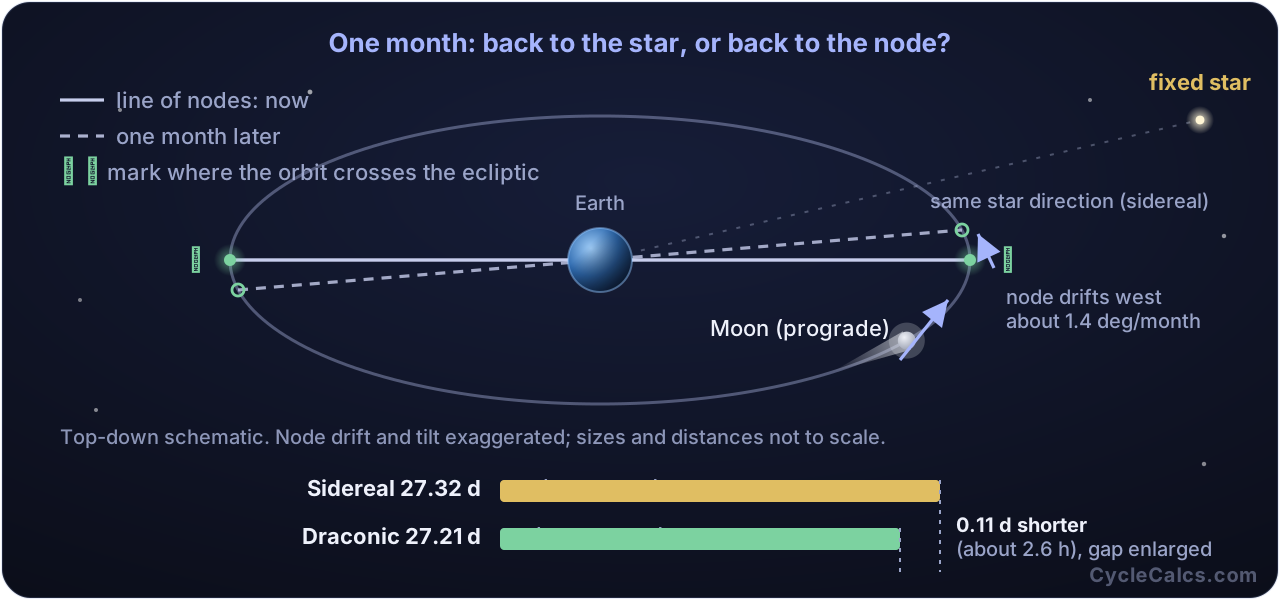
| Versus sidereal month | 27.212221 d vs 27.321661 d, about 0.109440 d (2 h 38 min) shorter |
| Draconic months in a Saros | 242 x 27.212221 d = 6,585.36 d |
| The matching synodic count | 223 x 29.530589 d = 6,585.32 d, one Saros |
| Node regression rate | one turn in 18.61 yr, about 19.34 deg per year |
Period constants from the U.S. Naval Observatory and Jean Meeus, Astronomical Algorithms. The 6,585.36 d and 6,585.32 d totals are the near-commensurability behind eclipse repetition, and the 19.34 degrees per year is a mean rate; the true node motion wobbles slightly through the month.
What the draconic month is and how it arises
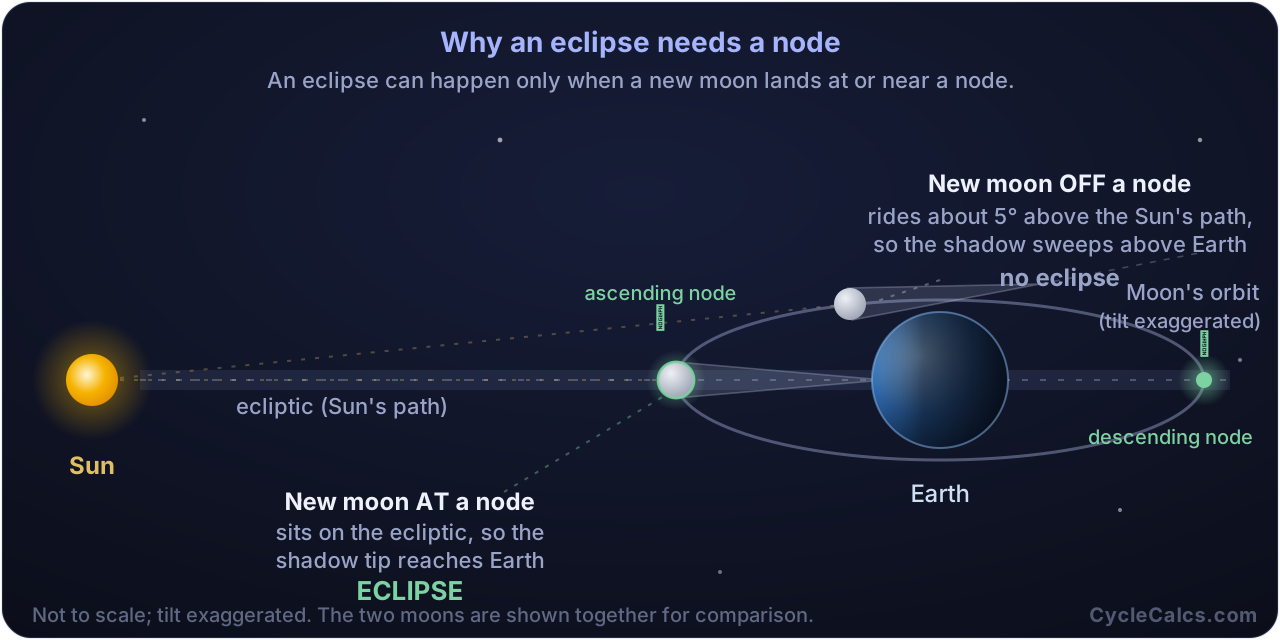
The Moon's orbit is tilted about 5.14 degrees to the ecliptic, the plane of Earth's orbit, so it crosses that plane at just two points: the ascending node, where the Moon climbs north, and the descending node, where it drops south. The draconic month is the interval between one passage through a given node and the next passage through the same node, 27.212221 days. It is the shortest of the Moon's months, and the reason lies in what the nodes themselves are doing.
The line of nodes does not hold still. It regresses, sliding slowly westward around the ecliptic and finishing one full turn in 18.61 years, about 19.34 degrees a year. Because the node drifts toward the oncoming Moon, the Moon meets it a little before completing a full circuit against the stars. That is why the draconic month falls 0.109440 days, roughly 2 hours 38 minutes, short of the sidereal month of 27.321661 days. It is the exact mirror of why the eclipse year runs shorter than the tropical year: there the Sun meets a westward-drifting node early, here the Moon does.
Eclipses are the reason the month is worth naming. A solar eclipse needs a new moon at a node; a lunar eclipse needs a full moon at a node. The draconic month is the clock of those node crossings, and it enters one of the great coincidences of the sky. Stack 242 of them and you reach 6,585.36 days, almost exactly the 6,585.32 days of the 223 synodic months that make one Saros. That near-match, one of three lunar-month near-commensurabilities behind eclipse repetition, is why a similar eclipse returns roughly every 18 years.
The math
The draconic and sidereal months are tied together by the drift of the nodes. Because the line of nodes moves backward toward the Moon, the node-referenced month is the shorter one, and the relation is 1/T_drac = 1/T_sid + 1/T_node, where T_node is the 18.61-year nodal regression period, about 6,798 days. Putting in the numbers, 1/27.321661 + 1/6798.4 gives a daily rate whose reciprocal is 27.2122 days, the draconic month.
The eclipse coincidence is pure arithmetic. Multiply the draconic month by 242 and you get 242 x 27.212221 = 6,585.36 days; multiply the synodic month by 223 and you get 223 x 29.530589 = 6,585.32 days. The two totals agree to within about an hour, so after that span both the phase and the node line up again and a similar eclipse repeats. The lunar nodes lesson traces the node crossings that define the month.
The next node crossings
| Date | Node | Interval |
|---|---|---|
| Nov 3, 2026 | Descending node | next crossing |
| Nov 17, 2026 | Ascending node | 14 days later |
| Nov 30, 2026 | Descending node | 13 days later |
| Dec 14, 2026 | Ascending node | 14 days later |
| Dec 27, 2026 | Descending node | 13 days later |
| Jan 10, 2027 | Ascending node | 14 days later |
| Jan 23, 2027 | Descending node | 13 days later |
| Feb 6, 2027 | Ascending node | 14 days later |
How the draconic month relates to other cycles
The draconic month belongs to a small family of cycles built on the same tilted geometry, and they are easy to confuse. This one is the Moon's return to a node, a 27-day month. The eclipse year of 346.62 days is the Sun's version of the same idea, the time between the Sun's passages through a node. The lunar nodal cycle of 18.61 years is neither body's return but the node itself dragging once around the ecliptic. Three different clocks, one line of nodes.
Measured against the sidereal month, the draconic month is the shorter twin, trailing it by about 2 hours 38 minutes because the node moves to meet the Moon. Stacked 242 deep it builds the Saros, the eclipse-repeat cycle, alongside 223 synodic and 239 anomalistic months. The lunar nodes lesson shows the crossings themselves, the moments this month counts.
Frequently asked questions
How long is a draconic month?
A draconic month is 27.212221 days, or 27 days 5 hours 6 minutes. It is the time the Moon takes to return to the same node of its orbit, one of the two points where its 5.14-degree tilted path crosses the ecliptic. It is the shortest of the Moon's several months, running about 2 hours 38 minutes shorter than the 27.321661-day sidereal month.
Why is it called a draconic month?
The name comes from draco, Latin for dragon. The two nodes where the Moon's orbit crosses the ecliptic were called the caput draconis and cauda draconis, the dragon's head and tail, from the ancient image of a dragon swallowing the Sun or Moon during an eclipse. Because eclipses happen only when the Moon is at a node, the 27.212221-day node-return interval took the dragon's name.
What is the difference between a draconic month and a sidereal month?
A sidereal month, 27.321661 days, is the Moon's return to the same fixed star, one full orbit in space. A draconic month, 27.212221 days, is its return to the same node. The draconic month is about 0.109440 days, roughly 2 hours 38 minutes, shorter because the line of nodes regresses westward toward the oncoming Moon, so the Moon reaches the node before finishing a full circuit against the stars.
Why does the draconic month matter for eclipses?
An eclipse can happen only when the Moon is at a node: a new moon there gives a solar eclipse, a full moon a lunar eclipse. The draconic month, 27.212221 days, is the clock of those node crossings. It also feeds the Saros: 242 draconic months equal 6,585.36 days, nearly matching the 6,585.32 days of 223 synodic months, which is why similar eclipses return about every 18 years.
How many draconic months are in a Saros?
There are 242 draconic months in one Saros. At 27.212221 days each, that comes to 6,585.36 days, almost exactly the 6,585.32 days of the 223 synodic months that also define the Saros. The close agreement of these counts, together with 239 anomalistic months, is the near-commensurability that makes an eclipse repeat with similar geometry roughly every 18 years 11 days.
When does the Moon next cross a node?
The Moon next crosses the ecliptic at its descending node on November 3, 2026. Node crossings come about every 13.6 days, alternating ascending and descending, and the Moon returns to the same node one draconic month of 27.21 days later. An eclipse can happen only when a new or full moon falls close to one of these crossings.
Keep exploring
- Sidereal month: the star-return month, 2 h 38 min longer
- Saros: 242 draconic months in one
- Eclipse year: the Sun's return to a node
- Lunar nodal cycle: the node's full 18.61-year regression
- Lunar nodes: the node crossings explained
Cite this page
CycleCalcs, "The Draconic Month: Node to Node, the Eclipse Clock", CycleCalcs LLC, https://www.cyclecalcs.com/cycles/draconic-month.html (add your access date). The underlying event datasets are archived with a permanent DOI: 10.5281/zenodo.21905241, which always resolves to the newest version. Since v1.1.0 that archived record also carries the engine's accuracy study against JPL Horizons, with every raw residual and the code that reproduces it; the same files are browsable in the data repository.
Every computed value on this page is public domain: CycleCalcs asserts no copyright in calculated astronomical facts and dedicates any such right to CC0, stated here. Quote the numbers freely, with or without credit. Conventions and sources: the engine and sources.
The data behind this page. Lunar node crossings 1700-2200: ascending and descending instants, free and in the public domain under CC0: CSV. The archive files are regenerated by a documented build and published with a SHA-256 manifest.