GalaxiesPeer-reviewed: The Astrophysical Journal
Nearby dwarf galaxies kept only about 11% of the oxygen their stars made
A Hubble-based census of 37 small galaxies finds most of their oxygen gone, apparently carried off by winds from exploding stars more effectively than computer models predict.
The short version
- A census of 37 nearby dwarf galaxies found they kept only 4% to 25% of the oxygen their stars made, about 11% on average.
- Most of the oxygen that remains is in the galaxies' gas, with less in their stars and very little in dust.
- Computer simulations predicted these galaxies keep more; winds driven by supernovae appear to remove oxygen more effectively than the models allow.
- Where the missing oxygen went, into the gas around each galaxy or out of it entirely, is still an open question.
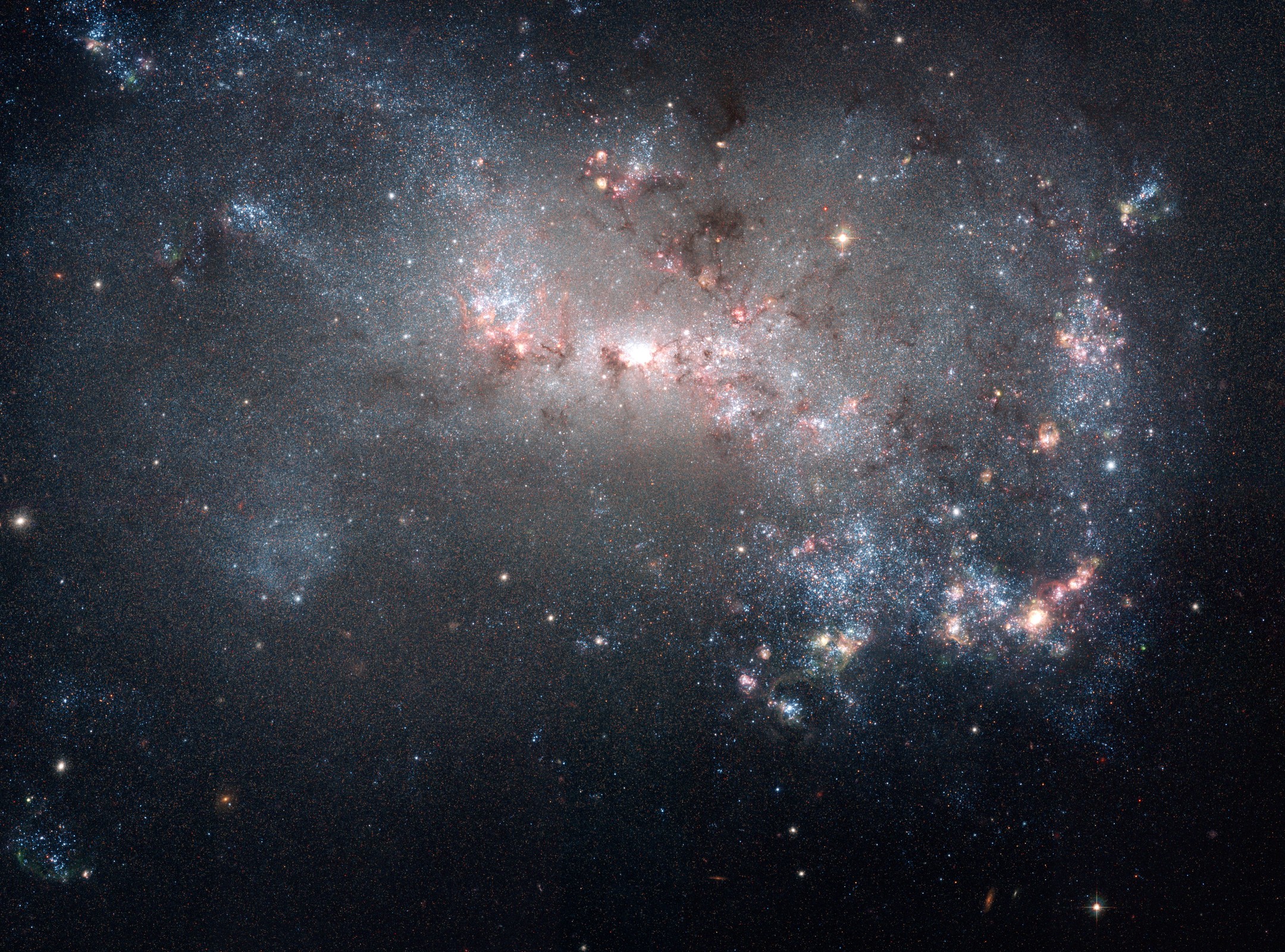
Oxygen, the element in every breath you take, is forged inside stars. Small galaxies lose most of it. A census of 37 nearby dwarf galaxies found that they kept only 4% to 25% of the oxygen their stars made, about 11% on average.
The study, led by Kristen McQuinn of the Space Telescope Science Institute and Rutgers University, used Hubble observations and is published in The Astrophysical Journal; NASA announced it on November 2, 2026. The project behind it is called GLOW, short for Galaxies Losing Oxygen via Winds.
An oxygen budget, galaxy by galaxy
All 37 galaxies lie within about 6 megaparsecs of Earth, roughly 19.5 million light-years; a megaparsec is a unit astronomers use for the distances between galaxies. That is nearly eight times as far as the Andromeda galaxy, which is about 2.5 million light-years away. It is still close enough for Hubble to pick out the galaxies' individual stars, which let the team reconstruct each galaxy's star-formation history, a record of how many stars it made and when, and so how much oxygen is now locked in its stars.
The team then compared the oxygen the galaxies' stars made, worked out from each galaxy's total mass in stars, with the oxygen still in the galaxies, in their stars, their gas and their dust. Across the sample, most of the oxygen that remains is in the gas, with less in the stars and very little in dust, though in a few galaxies the stars hold more than the gas.
Less than the models predicted
Three sets of computer simulations predicted that galaxies like these keep more of their oxygen than the census found; one of them predicted 2 to 4 times as much. The authors and NASA's release point to winds driven by supernovae, the explosions of massive stars, which appear to remove oxygen from small galaxies more effectively than current models predict.
To astronomers, a metal is any element heavier than hydrogen and helium, so oxygen counts as one. Small galaxies are thought to lose a larger share of their metals in outflows because their gravity is weaker, and in the study the share of oxygen kept falls modestly as galaxies get smaller.
For comparison, the paper cites earlier tallies made in a similar way. The tiny dwarf galaxy Leo P has kept 5% of its oxygen, and the Andromeda galaxy, M31, a big spiral, has kept about 38% of its metals. Bigger galaxies hold on to more, and the authors find that the share kept rises quickly, by a factor of 3 to 4, for galaxies much more massive than these dwarfs.
Where did the oxygen go?
Some oxygen has been detected in the gas around dwarf galaxies, but it is still an open question whether most of the missing oxygen sits there or has escaped entirely.
The tally has uncertainties of its own. The oxygen the stars made is worked out from each galaxy's stellar mass and an assumed oxygen yield, the amount a given mass of stars produces. The authors note that in the few galaxies whose gas reaches far out, the share kept could be higher than they calculate, and that the largest shares measured also carry the largest uncertainties.
Why the oxygen budget matters
Oxygen is forged by stars and spread through galaxies by outflows, so how much a galaxy keeps is a test of how its winds behave. The census gives the people who build galaxy simulations a measured share to match; the three sets compared here all predicted more.
The paper, GLOW II: A Census of Oxygen in Low-Mass Galaxies, is free to read on arXiv.
By the numbers
- Dwarf galaxies in the census
- 37 [1]
- Share of oxygen kept, galaxy by galaxy
- 4% to 25% [1]
- Average share of oxygen kept
- about 11% [1]
- Distance of the farthest galaxies
- about 6 megaparsecs roughly 19.5 million light-years [1]
- Oxygen kept in one set of simulations
- 2 to 4 times as much [1]
- Leo P, earlier tally
- 5% of its oxygen [1]
- Andromeda, earlier tally
- about 38% of its metals [1]
Explore it on CycleCalcs
Sources
- Primary source McQuinn et al. 2026, "GLOW II: A Census of Oxygen in Low-Mass Galaxies," The Astrophysical Journal 1011, 158, doi:10.3847/1538-4357/ae93a6
- Primary source The same study on arXiv (full text), arXiv:2608.07665
- Primary source NASA Science, "NASA's Hubble Uncovers Case of Missing Oxygen in Nearby Dwarf Galaxies," news release, November 2, 2026
- Independent report Sci.News, "Nearby Dwarf Galaxies are Missing Most of Their Oxygen, Hubble Data Show," November 2, 2026
- Background Rutgers University news release, "Stars Make Oxygen for Small Galaxies. They Lose Most of It.," November 2, 2026
- Data ESA/Hubble, heic0711a, NGC 4449 (image source and credit)
- Data NASA Science, Messier 31 (distance)
- Background ESA/Hubble, heic0711, "Stellar fireworks are ablaze in galaxy NGC 4449," July 3, 2007
Images: NASA, ESA, A. Aloisi (STScI/ESA), and The Hubble Heritage (STScI/AURA)-ESA/Hubble Collaboration (CC BY 4.0).